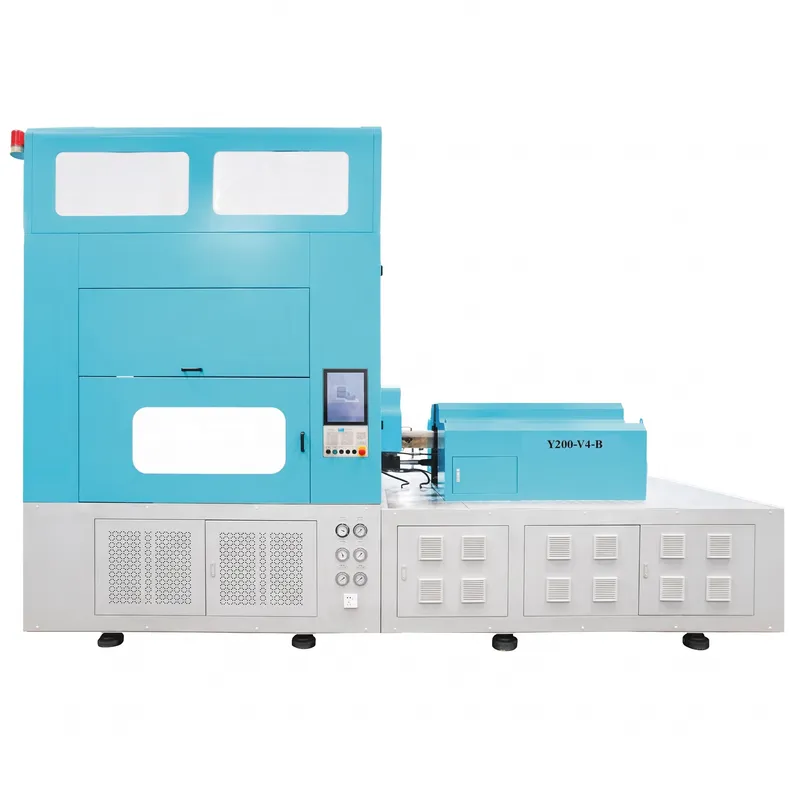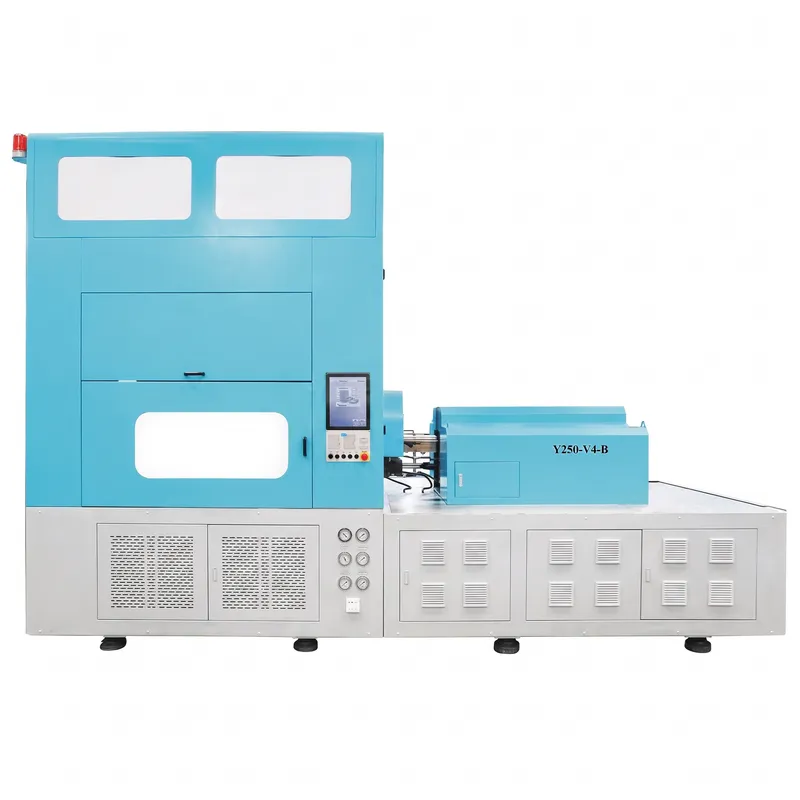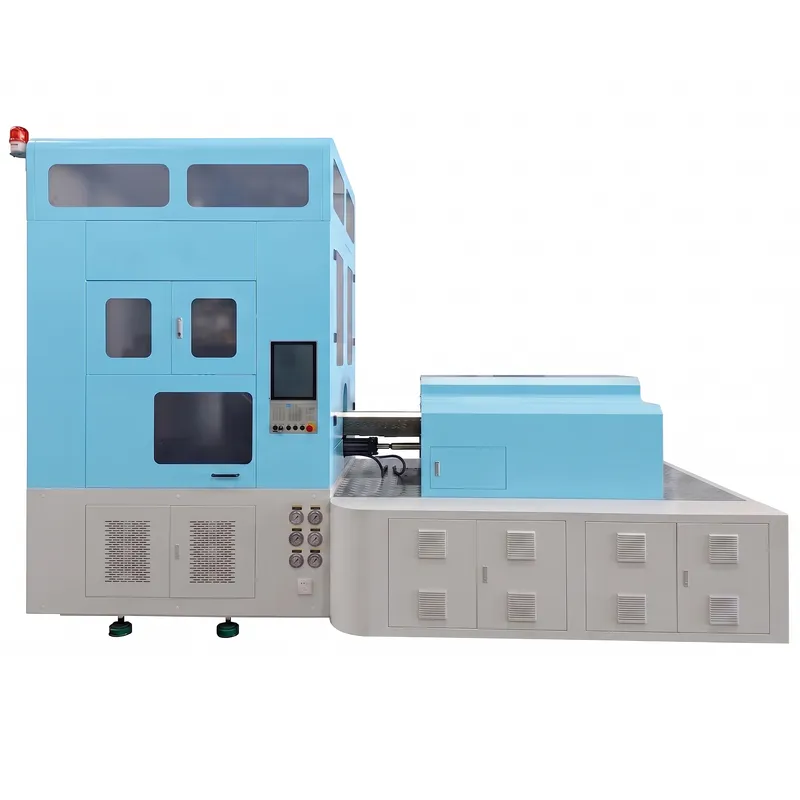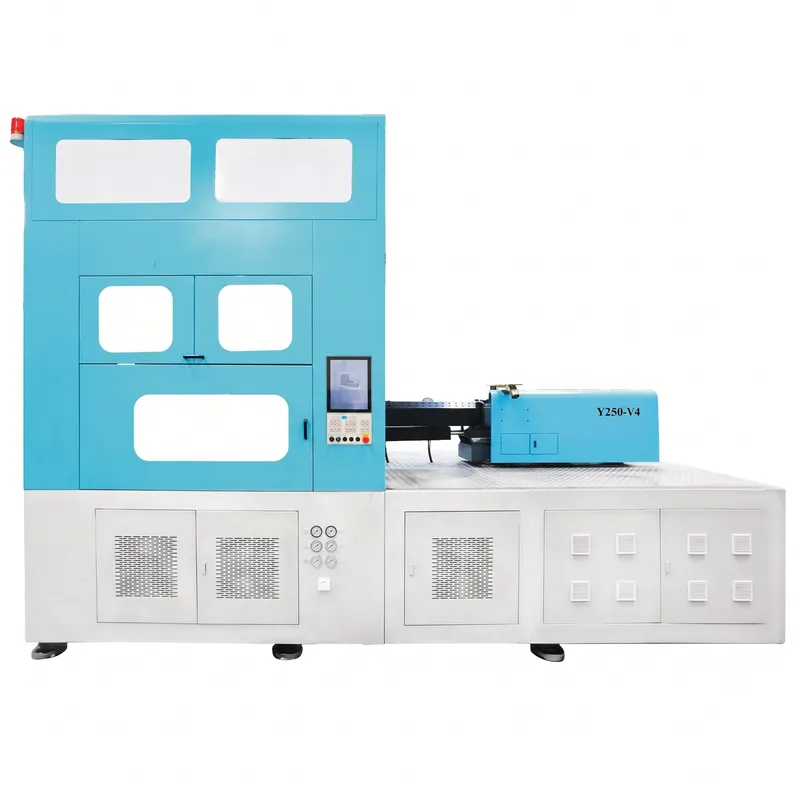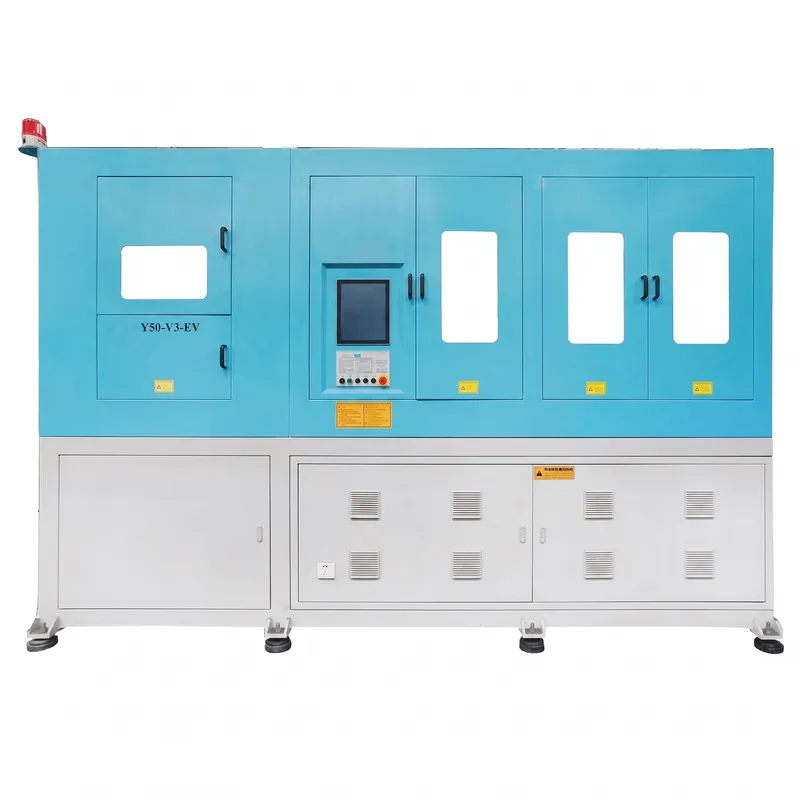
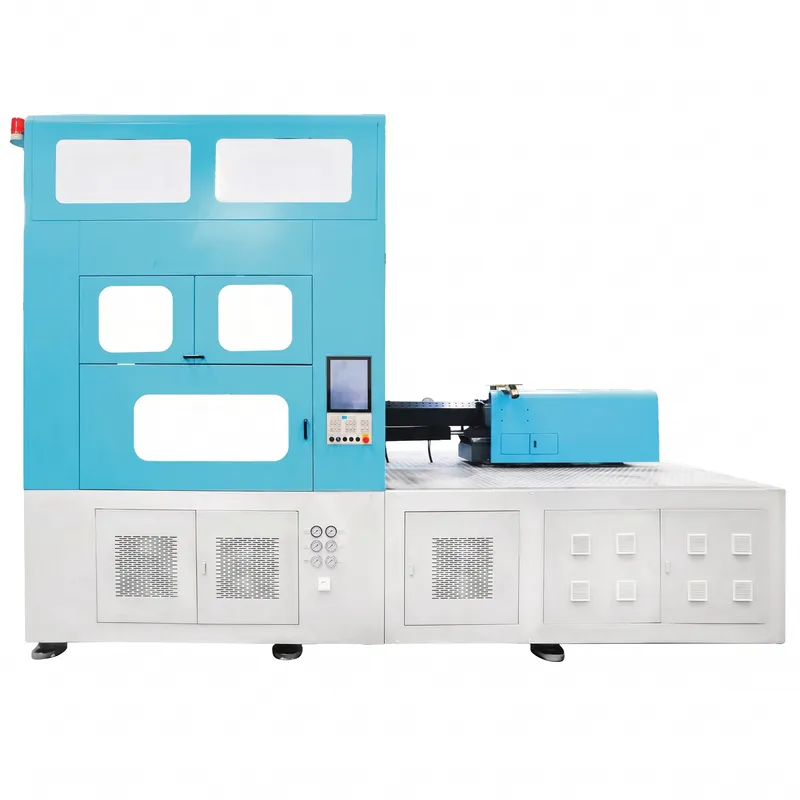
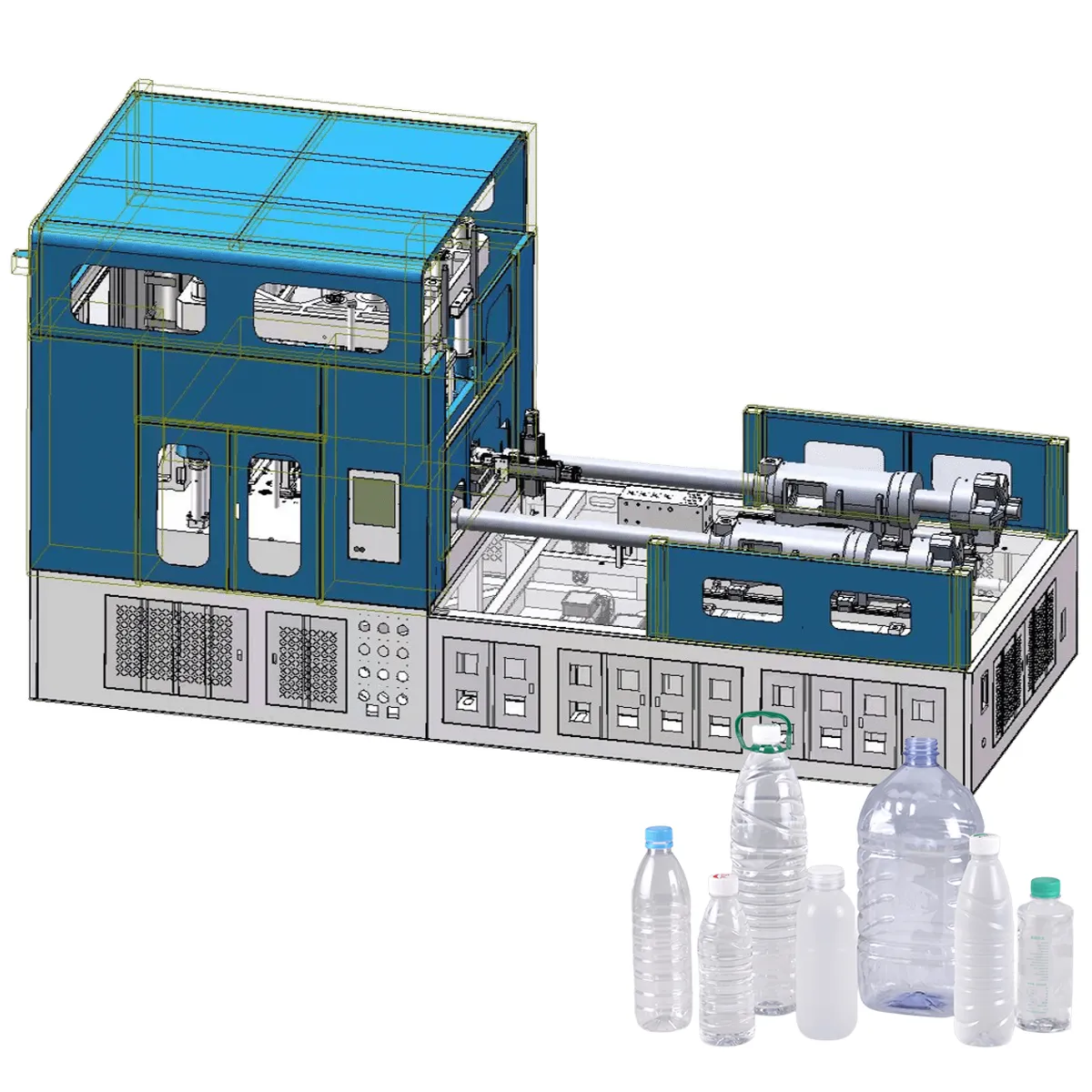
Máy ép phun kéo giãn thổi khuôn một bước Y280-V6 (6 trạm)
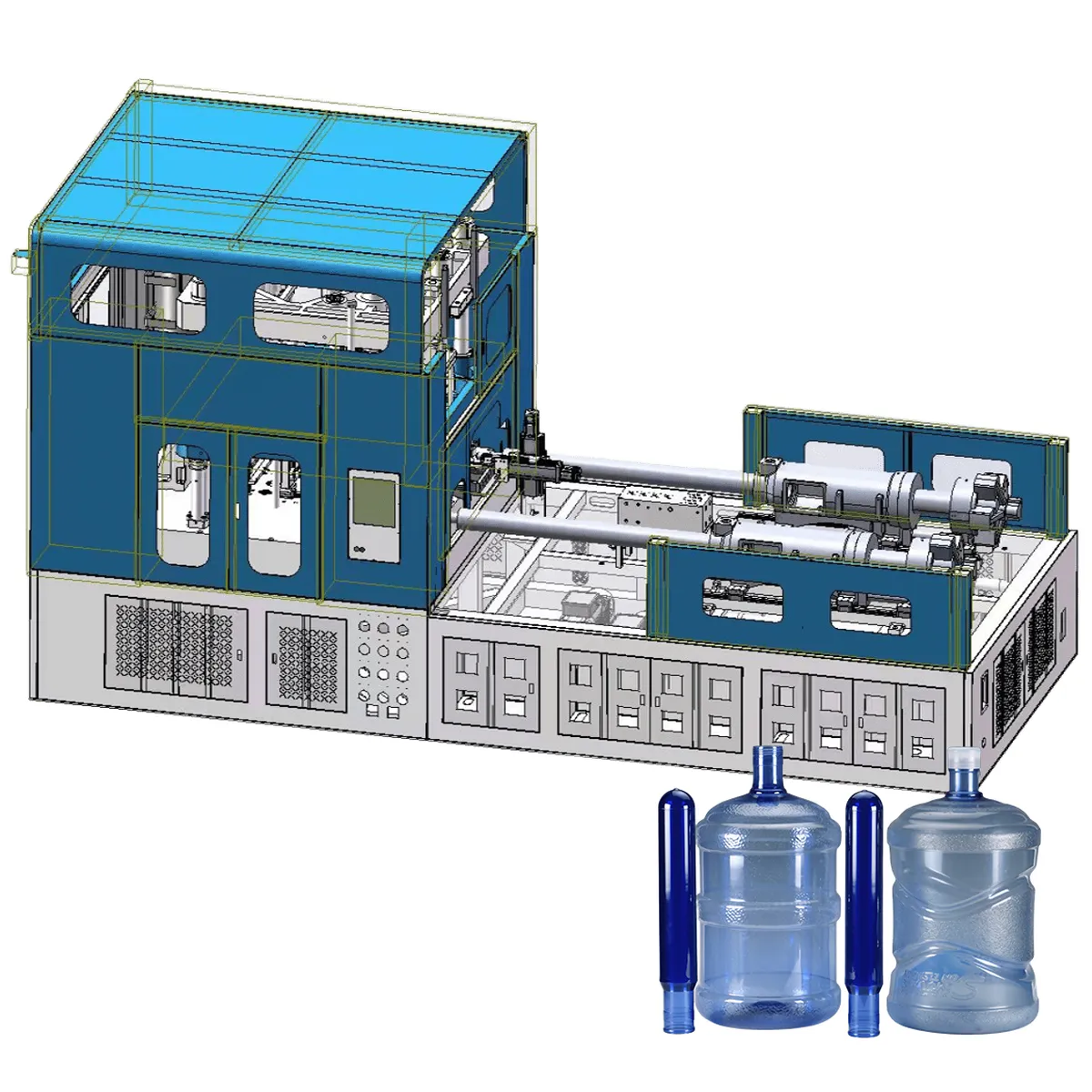
The Y280-V6 One Step Injection Stretch Blow Molding Machine is a highly efficient plastic container molding process widely used in the production of high-precision, high-demand hollow plastic products, including baby bottles, water bottles, medicine bottles, craft and special-shaped bottles, and cosmetic bottles made of PET, PETG, PP, PC, Tritan, PS, ABS, or PLA. The Y280-V6 is a direct-replacement option for leading Japanese injection stretch blow molding machines and is available in Standard, Servo, and Fully Electric configurations to suit diverse production environments.
The Y280-V6 One Step Injection Stretch Blow Molding Machine is a highly efficient plastic container molding process widely used in the production of high-precision, high-demand hollow plastic products, including baby bottles, water bottles, medicine bottles, craft and special-shaped bottles, and cosmetic bottles made of PET, PETG, PP, PC, Tritan, PS, ABS, or PLA. As a leading one step ISBM machine with six stations, its defining feature is that injection, stretching, and blow moulding are all completed continuously within the same equipment without any intermediate steps. This single-stage design eliminates reheating energy, reduces floor space, and significantly improves both production efficiency and batch-to-batch product consistency. The Y280-V6 is a direct-replacement option for leading Japanese injection stretch blow molding machines and is available in Standard, Servo, and Fully Electric configurations to suit diverse production environments.
The six-station rotary turntable architecture of the Y280-V6 sets it apart from conventional four-station ISBM machines. By adding two additional stations to the processing cycle, the machine can produce up to six plastic bottles simultaneously per cycle, delivering throughput levels that match high-volume cosmetic, pharmaceutical, beverage, and personal care packaging lines. All critical components are sourced from trusted global suppliers: Japan Yaskawa or WEICHI servo motors drive the turntable, American Parker high-pressure valves manage blowing air, Airtak air cylinders handle actuation, and YUKEN hydraulic control valves from Taiwan govern pressure regulation. The twin-screw system is heated by nano far-infrared energy-saving rings, reducing heating power consumption while maintaining melt quality. Whether you operate in the pharmaceutical sector requiring GMP-grade oil-free production, or a cosmetic packaging line demanding flawless surface finish with no visible parting lines, the Y280-V6 delivers. It is an ideal solution for businesses seeking a reliable PET injection stretch blow molding machine with proven industrial-grade durability and broad mold compatibility.
Thương hiệu và mẫu mã có thể thay thế
CMN Transmission cung cấp đầy đủ các loại máy ép phun thổi định hình, mỗi loại được thiết kế để thay thế trực tiếp cho các thương hiệu hàng đầu của Nhật Bản. Tất cả các mẫu đều có sẵn ở cấu hình Tiêu chuẩn, Servo và Hoàn toàn bằng điện để phù hợp với yêu cầu sản xuất của bạn.
| Mô hình tiêu chuẩn | Y150-V4 | Y200-V4 | Y250-V4 |
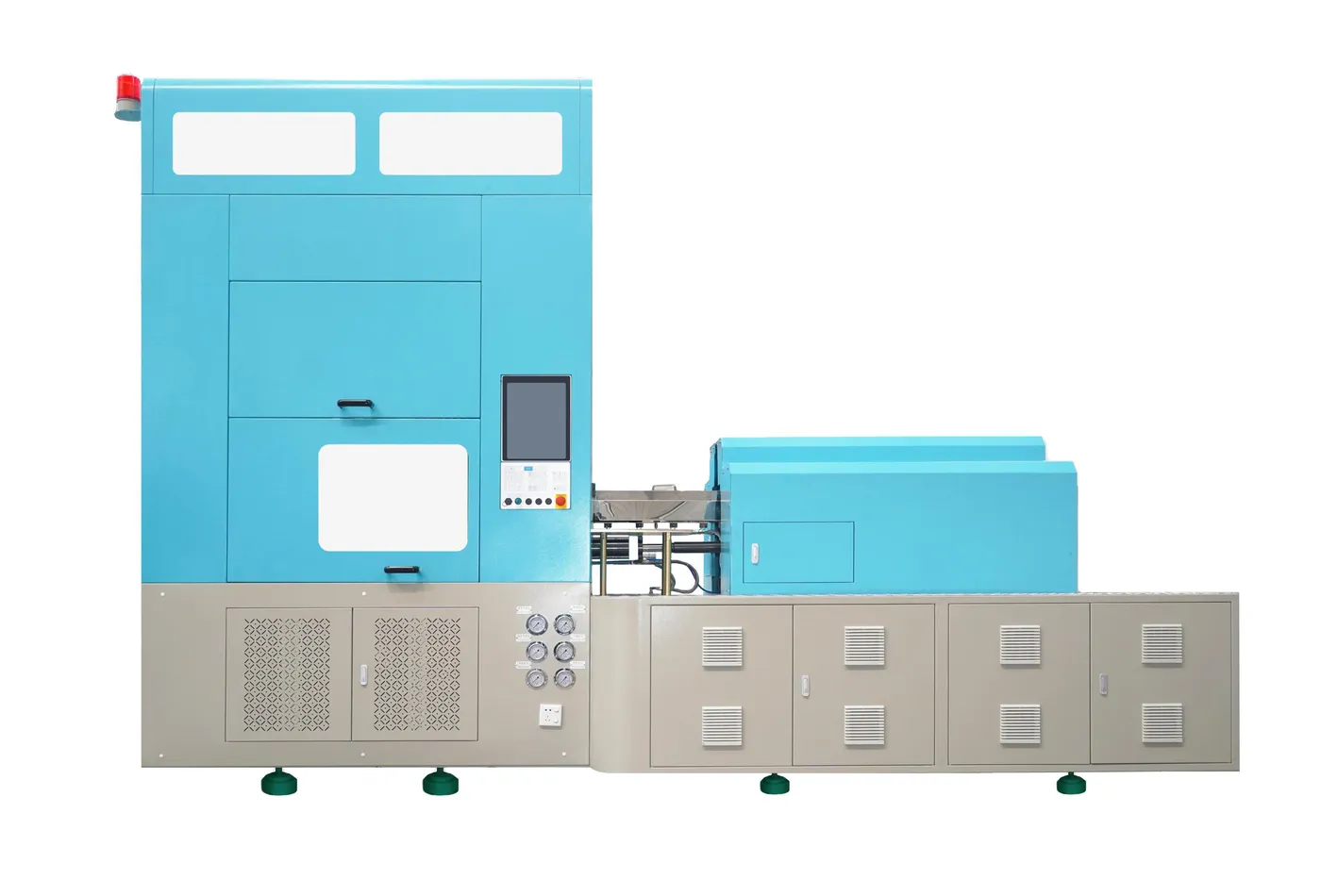 | Tương thích với ASB-12M của Nhật Bản | Tương thích với Aoki 250 của Nhật Bản. | Tương thích với ASB-70DPH của Nhật Bản |
| Y150-V4-B | Y500-V3 | - | |
| Tương thích với Aoki 100 của Nhật Bản. | Tương thích với Aoki 500 của Nhật Bản. | - | |
| Kẹp thủy lực, bơm vít thủy lực. | |||
| Mô hình Servo | YS150-V4 | YS200-V4 | YS250-V4 |
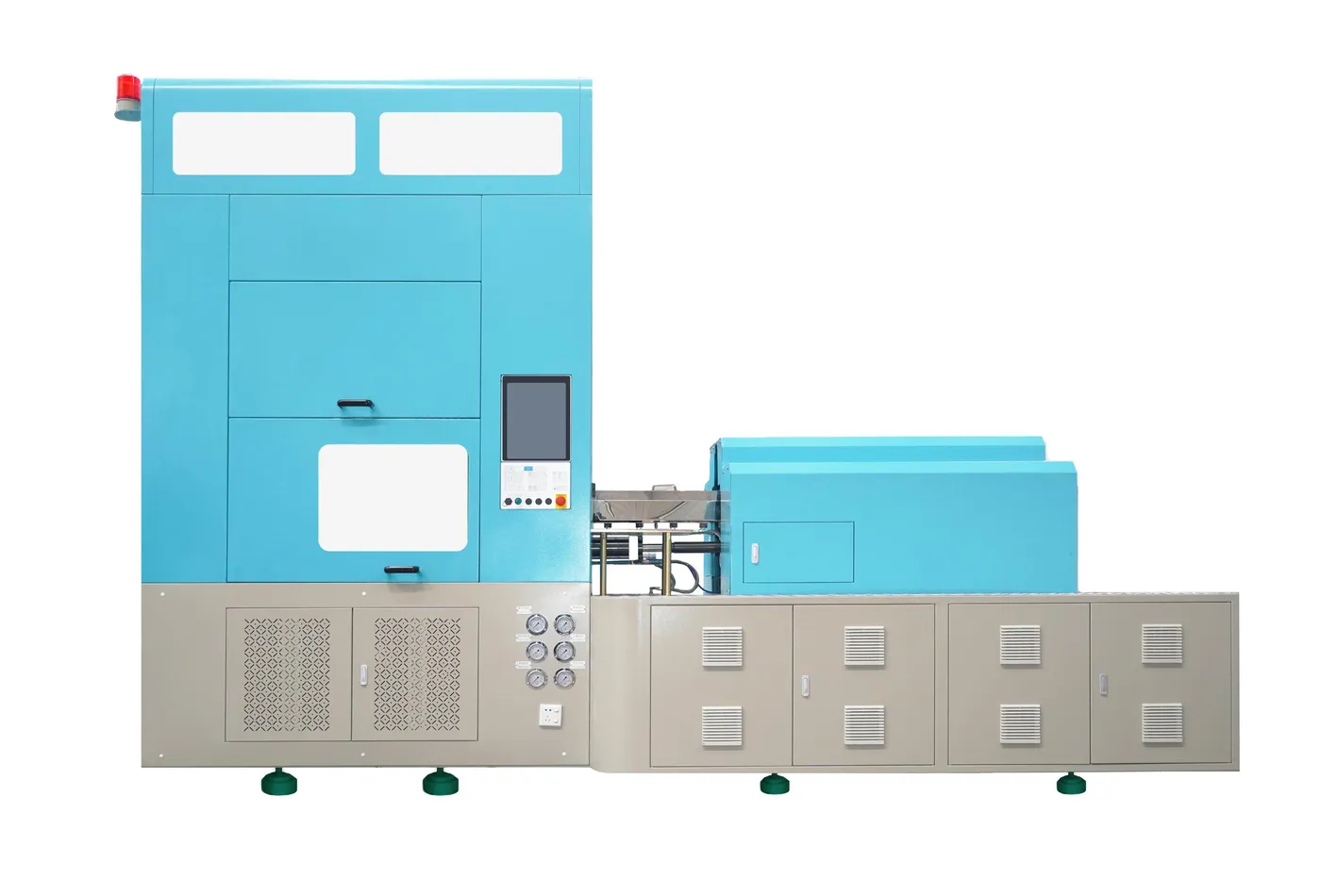 | Kẹp servo, phun vít servo, độ chính xác cao, năng lượng thấp, ổn định lâu dài. | ||
| Mô hình hoàn toàn bằng điện | Y150-V4-EV | Y200-V4-EV | Y250-V4-EV |
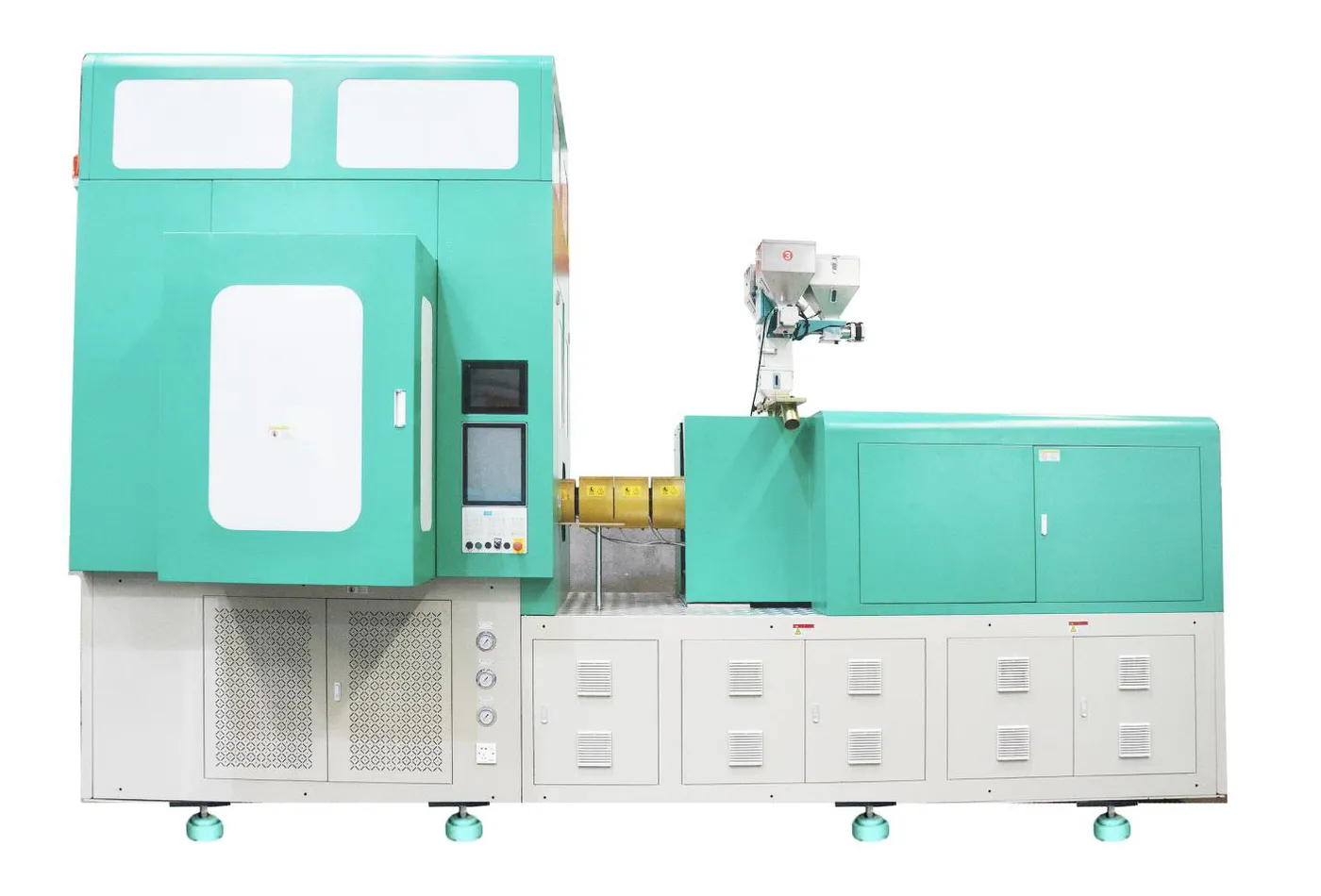 | Hệ thống vận hành hoàn toàn bằng điện, tránh sử dụng các sản phẩm bị nhiễm dầu. | ||
Lợi ích của máy ISBM của chúng tôi
1. Chất lượng tốt hơn. Các chai nhựa được sản xuất bằng máy thổi khuôn từ Nhật Bản đều có đường phân khuôn. Có một phần nhựa nhô ra ở giữa hai khuôn ở hai bên, tạo thành một vết. Tuy nhiên, khuôn của chúng tôi có độ chính xác cực cao, và vết này hoàn toàn không nhìn thấy được.
2. Quy trình sản xuất của chúng tôi nhanh chóng, với nhiều giải pháp vít xoắn và tốc độ cao. Trong khi Nhật Bản chỉ có thể sản xuất bốn chai nhựa cùng một lúc, chúng tôi có thể sản xuất sáu chai.
3. Tiết kiệm năng lượng. Máy móc của chúng tôi tiêu thụ ít năng lượng hơn từ 15% đến 25% so với các máy ở Nhật Bản, Châu Âu và Hoa Kỳ.
4. Nhiều công nghệ điều khiển điện đã được áp dụng để thay thế các bộ phận thủy lực và khí nén. Ví dụ, các bộ phận khí nén được sử dụng trong cơ cấu cắt đáy ở Nhật Bản được thay thế bằng động cơ servo ở đây, và tốc độ của động cơ servo được tăng gấp đôi. Trong ngành dược phẩm và các lĩnh vực khác, động cơ servo hoàn toàn có thể được sử dụng mà không cần bất kỳ hệ thống thủy lực nào, đảm bảo tuân thủ các tiêu chuẩn GMP và hoạt động trong môi trường không dầu và không ô nhiễm.
Thông số kỹ thuật sản phẩm
| Mục | Đơn vị | Thông số kỹ thuật | |||||||
| Tên | One-step injection stretch blow molding machine (6-station) | ||||||||
| Người mẫu | Y280-V6 | ||||||||
| Nhà sản xuất | Truyền tải CMN | ||||||||
| Meterial | PET/PETG | ||||||||
| Đường kính vít | MM | 40 | 50 | 55 | 60 | ||||
| Thể tích tiêm lý thuyết | CM³ | 188 | 310 | 442 | 480 | ||||
| Tốc độ quay của vít (RPM) | r/phút | 270 | 180 | 150 | 150~220 | ||||
| Lực kẹp phun | KN | 150 | |||||||
| Lực kẹp thổi | KN | 200 | |||||||
| Công suất động cơ | KW | 43.2 | |||||||
| Công suất sưởi ấm | KW | 10 | |||||||
| Thổi áp suất không khí | Mpa | 2.0-3.5 | |||||||
| Áp suất nước làm mát | Mpa | 0.4-0.6 | |||||||
| Áp suất nước làm mát dầu máy | Mpa | 0.3-0.4 | |||||||
| Nhiệt độ nước làm mát dầu máy | ℃ | 20-25 | |||||||
| Điện áp | V | 370-400 | |||||||
| (Dài*Rộng*Cao) Kích thước(Dài*Rộng*Cao) | MM | 5900x2600x3200 | |||||||
| Cân nặng | T | 14 | |||||||
| Kích thước sản phẩm | |||||||||
| Số lượng sản phẩm | PCS | 1 | 2 | 4 | 5 | 6 | 7 | 9 | 10 |
| Đường kính chai (BD) | MM | 120 | 110 | 68 | 55 | 50 | 45 | 35 | 20 |
| Chiều cao chai (H) | MM | 210 | 150 | 100 | |||||
| Đường kính cổ (E) | MM | 85 | 70 | 50 | 38 | 32 | 25 | 17 | 12 |
| Thể tích tối đa của chai (ml) | ML | 2500 | 1500 | 900 | 400 | 250 | 100 | 30 | 20 |
| Trọng lượng tối đa của chai (W) | G | 130 | 65 | 43 | 32 | 26 | 22 | 18 | 16 |
Thông số máy
| Đường kính vít: | 50mm (tùy chọn) |
| Dung tích tiêm lý thuyết: | 310g |
| Lực kẹp khi phun: | 150KN |
| Hành trình khuôn trên: | 250mm |
| Hành trình khuôn dưới: | 205mm |
| Nhiệt độ. Điều chỉnh nhịp tim cốt lõi: | 250mm |
| Điều chỉnh nhiệt độ hành trình thùng: | 230mm |
| Động tác kết thúc: | 170mm |
| Lực kẹp thổi: | 200KN (một phía) |
| Đòn đánh cốt lõi: | 250mm |
| Hành trình thổi khuôn: | 75+75mm |
| Thể tích bình chứa dầu: | 300 lít |
| Kích thước (Dài × Rộng × Cao): | 5.9*2.6*3.2m |
| Cân nặng: | 14T |
Tiêu chuẩn kỹ thuật
| Hệ thống điều khiển servo: | Using 2 sets of servo pump systems. |
| Công suất động cơ servo: | Công suất động cơ servo Inovance/ WEICHI: 43,2KW. |
| Hệ thống điều khiển bằng máy tính: | Sử dụng PLC Inovance/MiRLE. |
| Hệ thống truyền động bàn xoay: | Mâm xoay được trang bị động cơ servo Yaskawa của Nhật Bản hoặc động cơ servo WEICHI kết hợp với bộ giảm tốc TSUNTIEN của Đài Loan. |
| Van áp suất cao: | Sử dụng van cao áp Parker của Mỹ. |
| Bình khí nén: | Sử dụng bình khí nén Aitak. |
| Kiểm soát nhiệt độ: | Using an integrated control box to control temperature, which is highly accurate, stable, and easy to operate. |
| Van điều khiển áp suất thủy lực: | Sử dụng van điều khiển áp suất thủy lực của hãng YUKEN đến từ Đài Loan, Trung Quốc. |
| Ốc vít nung nóng: | The twin-screw is heated by a nano-far-infrared energy-saving heating ring(10KW). |
| Cấu trúc ép thổi: | Cấu trúc ép thổi sử dụng hệ thống kẹp khuôn bằng xi lanh thủy lực hoặc động cơ servo kép với chức năng bù áp suất cao. |
| Bộ phận tiêm: | The double-injection unit is controled by a single cylinder. The melt motor may be controlled either hydraulically or by a servo motor. |
| Ống dầu: | Ống dẫn dầu được làm từ vật liệu nhập khẩu từ Ý. |
| Tổng công suất của máy: | Tổng công suất của máy: 53,2KW. |
Key Features of the Y280-V6 ISBM Machine
1. Superior Product Quality
The single-stage injection stretch blow molding machine process produces bottles directly from preforms without reheating, which preserves molecular alignment and surface integrity. Containers achieve high optical clarity, smooth surface finishes, and uniform wall thickness in every cycle. Because the preform and finished bottle are made on the same machine without intermediate handling, there is virtually no risk of contamination or surface damage. The Y280-V6 mold tooling is manufactured to extremely tight tolerances, making parting line marks invisible to the naked eye. This is a clear advantage over Japanese-brand alternatives where a visible parting line protrusion is common.
2. Flexible Design Capabilities
The Y280-V6 customized injection stretch blow molding machine platform supports intricate bottle shapes, custom neck finishes, and container volumes from 20 ml up to 2,500 ml. With 8 available cavity configurations per cycle, the machine adapts to both small-batch specialty orders and large-volume commodity runs. This adaptability makes it ideal for cosmetic brands requiring distinctive bottle profiles, pharmaceutical manufacturers demanding precise closure fitment, and premium beverage producers needing transparent PET bottles with high visual appeal. The machine's mold compatibility also extends to tooling originally designed for Japanese ASB and Aoki equipment.
3. Sustainability and Lower Energy Use
The one-step process eliminates the secondary preform reheating stage that two-step systems require, reducing overall energy consumption by 15% to 25% compared to equivalent Japanese, European, or American machines. Nano far-infrared energy-saving heating rings on the twin-screw system further reduce heat loss during the melting phase. The process also generates less material waste than extrusion blow molding because preform weight is precisely controlled before blowing. For manufacturers working with bio-based resins such as PLA or recycled PET content, the stable melt temperature management of the Y280-V6 helps maintain consistent processing conditions without degradation.
4. High Production Efficiency
The six-station rotary architecture of the Y280-V6 produces more bottles per cycle than the four-station designs found in competing Japanese ISBM machine models. While a standard four-station Japanese machine typically produces four bottles simultaneously, the Y280-V6 outputs six bottles per cycle. Combined with a servo-driven turntable and dual servo pump systems that reduce pressure stabilization delays, overall throughput increases significantly. The integrated single-stage processing cycle also reduces machine downtime between production runs, eliminating the need to synchronize separate injection and blow molding equipment. Full-process PLC automation reduces operator intervention and supports cost-effective mass production across extended shifts.
5. Versatile Application Range
As a true-purpose injection blow molding machine for packaging, the Y280-V6 produces containers ranging from 20 ml eye-drop bottles to 2,500 ml wide-mouth packaging. Supported materials include PET, PETG, PP, PC, Tritan, PS, ABS, and PLA, giving manufacturers broad flexibility to serve pharmaceutical, cosmetic, food, beverage, chemical, and personal care markets from a single machine platform. Multiple screw diameter configurations (40, 50, 55, or 60 mm) allow operators to match injection shot size to the specific product and material being run. This versatility makes the Y280-V6 one of the most commercially adaptable one step injection stretch blow molding machines currently available from Chinese manufacturers.
6. Compatible with Japanese ASB or Aoki Machine
One of the most significant commercial benefits of the Y280-V6 is its direct compatibility with mold tooling originally designed for Japanese ASB injection stretch blow molding machines. For manufacturers currently running ASB or Aoki machines, this means existing mold investments can be transferred to the CMN machine without costly retooling. The Y280-V6 is engineered as a direct replacement for ASB ISBM machine models and also offers compatibility paths for Aoki model formats. This mold compatibility dramatically reduces the total cost of switching from Japanese to CMN equipment.
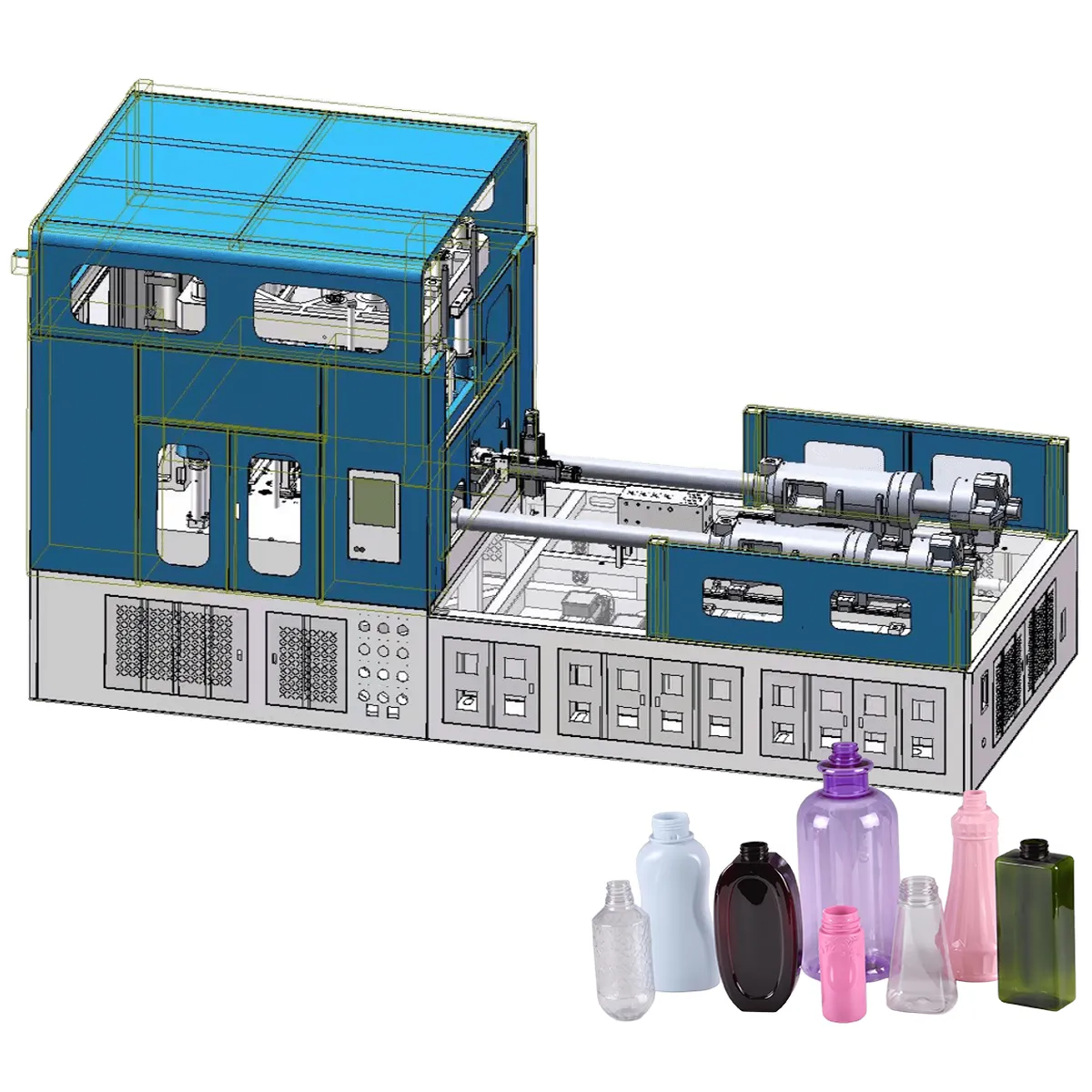
Working Principle
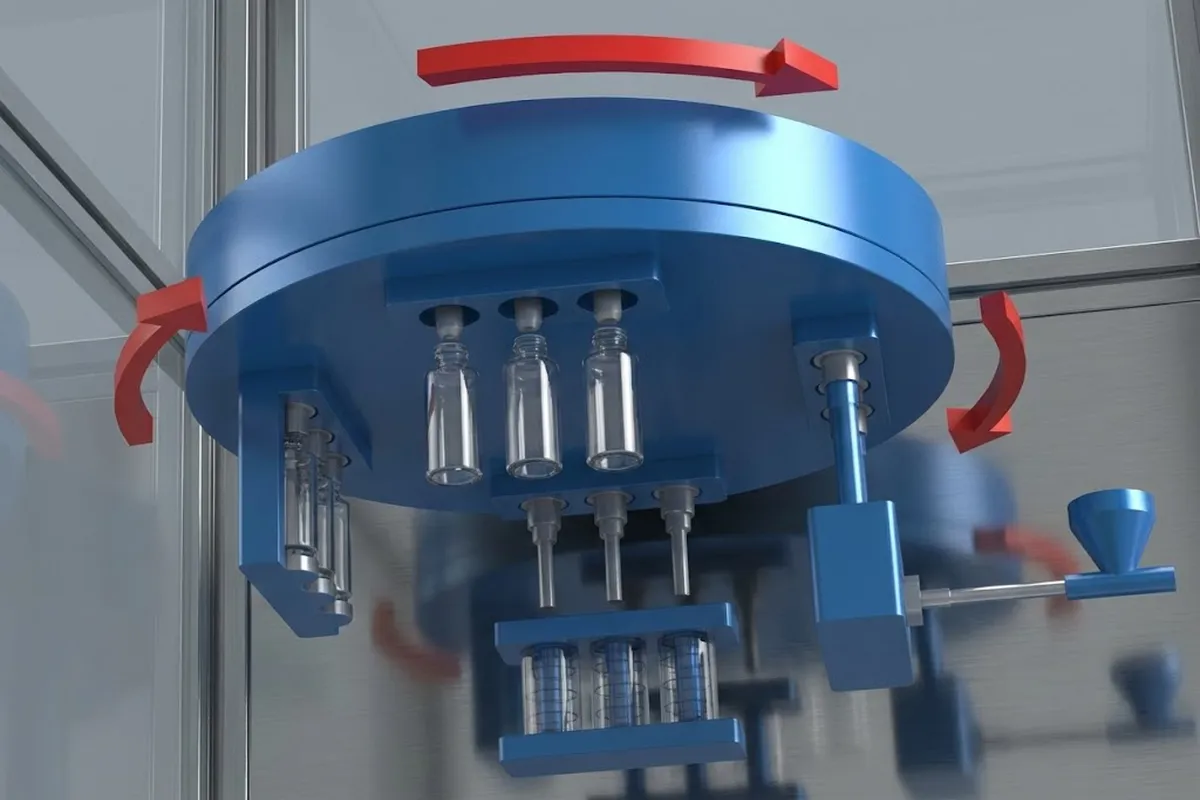
Bước 1: Ép phun
The process begins by heating PET or PETG resin to a precise molten state using the nano far-infrared screw heating system. The molten material is injected under 150 KN clamping force into a mold cavity to form a preform. The preform is partially cooled to stabilize its shape while retaining sufficient heat to allow effective stretching in the next stage. During this phase, the neck finish, thread geometry, and sealing area are formed to their final dimensions. This ensures reliable cap fitment, dimensional accuracy, and consistent bottle weight from cycle to cycle. The injection unit operates under single-cylinder control, with the melt motor configurable as either hydraulic or servo-driven depending on the production environment and accuracy requirements.
Bước 2: Thực hiện quá trình chuẩn bị và chuyển giao
The Japan Yaskawa or WEICHI servo motor drives the six-station rotary turntable, transferring the freshly molded preform from the injection station to the temperature conditioning zone with precise indexing accuracy. As the preform travels between stations, it passes through controlled thermal management zones managed by the integrated temperature control box. The TEMP. Regulating Core Stroke of 250 mm and TEMP. Regulating Barrel Stroke of 230 mm allow fine adjustment of heat distribution along the preform body. This consistent thermal conditioning step is critical for achieving uniform material behavior during the subsequent stretching and blowing stage. Uneven preform temperature is one of the primary causes of thin shoulders, thick bases, or cracking during blow molding, all of which the Y280-V6 conditioning system is engineered to prevent.
Bước 3: Ép thổi kéo giãn
This is the transformation stage where the preform becomes its final container shape. The blow core stroke of 250 mm and blow mold stroke of 75 + 75 mm on the Y280-V6 provide generous travel range to accommodate a wide range of bottle heights and body profiles. Biaxial stretching begins as a stretch rod extends the preform lengthwise, followed by compressed air at 2.0 to 3.5 MPa expanding it outward to match the blow mold cavity. The hydraulic cylinder or dual servo motor mold clamping system with high-pressure compensation function maintains 200 KN blowing clamping force (single side), ensuring the mold seals fully against the internal air pressure. This dual-axis orientation of the polymer molecules significantly improves the finished container's resistance to gas penetration, impact force, and internal pressure, making the output ideal for carbonated beverages, pharmaceutical liquids, and pressurized cosmetic packaging.
Bước 4: Làm nguội và đẩy ra
Once the container has been fully blown into its final shape, the cooling water system (maintained at 0.4 to 0.6 MPa and 20 to 25 degrees Celsius through the machine oil cooler) rapidly removes heat from the mold cavity to solidify the bottle form. Controlled cooling is essential for dimensional stability, consistent bottle weight, and preventing internal stress that could lead to deformation during storage or transport. After sufficient cooling is achieved, the mold opens and the take-out mechanism (with a stroke of 170 mm) automatically ejects the finished bottle from the station. The complete molding cycle concludes with a ready-to-fill plastic container delivered directly to the take-out position, requiring no manual trimming, reheating, or secondary processing before use.
Các lĩnh vực ứng dụng
1. Chai đựng mỹ phẩm
High-end cosmetic packaging demands flawless surface aesthetics, transparency, and dimensional consistency. The Y280-V6 produces skincare, toner, serum, and lotion containers in Tritan, PETG, and PET with no visible parting lines and excellent optical clarity. The mold precision achievable with CMN tooling makes it the preferred máy ép phun kéo giãn thổi for cosmetic brands supplying premium retail markets in Europe, North America, and Southeast Asia.
2. Chai đựng thuốc
The Y280-V6 is widely used in pharmaceutical packaging facilities requiring GMP-compliant production. The machine supports fully electric, oil-free servo configurations that eliminate hydraulic oil contamination risk. Pharmaceutical bottles for oral liquids, tablets, capsules, syrups, and eye drops can be produced in PET, PETG, and PP from 20 ml to 500 ml with highly accurate neck thread geometry to ensure reliable closure sealing and dosing accuracy.
3. Chai đựng hóa chất
Chemical packaging requires containers that resist solvent permeation, maintain structural integrity under varied storage conditions, and offer tamper-evident closure compatibility. The Y280-V6 produces PP and PET chemical bottles with uniform wall thickness and stable shoulder geometry. Applications include agricultural chemical packaging, cleaning agent bottles, industrial lubricant containers, and specialty chemical packaging requiring chemical resistance and controlled vapor permeability.
4. Hand Wash Bottles
Hand wash, liquid soap, and antibacterial gel packaging often requires ergonomic shapes, pump neck compatibility, and high visual appeal on retail shelves. The Y280-V6 ISBM process handles the complex shapes common in personal care packaging, including oval, square-shoulder, and waisted body profiles. The biaxial orientation of the PET or PP material improves bottle squeeze resistance and drop impact performance, which are important factors for consumer personal care products during distribution.
5. Beverage Bottles
PET beverage bottles produced on the Y280-V6 benefit from the biaxial molecular orientation created by the stretch blow process, resulting in improved top-load strength, burst pressure resistance, and excellent optical clarity. The machine can produce still water, juice, tea, and edible oil containers from 100 ml to 2,500 ml per cycle. The servo-controlled turntable indexing ensures consistent preform positioning between stations, which directly affects fill volume accuracy and bottle weight stability across large production runs.
6. Feeding Bottles (Baby Bottles)
Baby bottle production is one of the most demanding applications for any ISBM machine because the materials must be BPA-free, completely transparent, and free of surface defects. The Y280-V6 processes Tritan, PPSU, PC, and PET resins for baby bottles that meet international food contact and chemical migration standards. The one-step ISBM process prevents contamination between stations that could occur with two-step systems, making it the preferred technology for premium infant feeding product manufacturers globally.
7. Body Wash Bottles
Body wash packaging must deliver both functional performance and strong shelf presence. The Y280-V6 supports production of wide-body, tinted, and frosted PET and PETG body wash containers with pump or flip-top closure neck finishes. The machine's temperature conditioning accuracy allows processing of opaque and semi-transparent resin blends without inconsistent color distribution or localized thin spots, which are common defects when bottle shape complexity increases. Output ranges from 200 ml travel sizes to 1,000 ml family-size formats within the same cavity configuration.
8. Drinking Water Buckets
Large-format PET drinking water containers require outstanding structural rigidity, high clarity, and stackable base geometry. The Y280-V6 accommodates wide-mouth neck configurations and large-body bottle designs up to 2,500 ml. The 200 KN blowing clamping force and 250 mm blow core stroke provide the dimensional control needed for consistent, thick-walled large containers. For water dispenser bottle manufacturers, the Y280-V6 offers a reliable, energy-efficient production platform that meets the volume demands of bulk water packaging markets in Asia, the Middle East, and Africa.
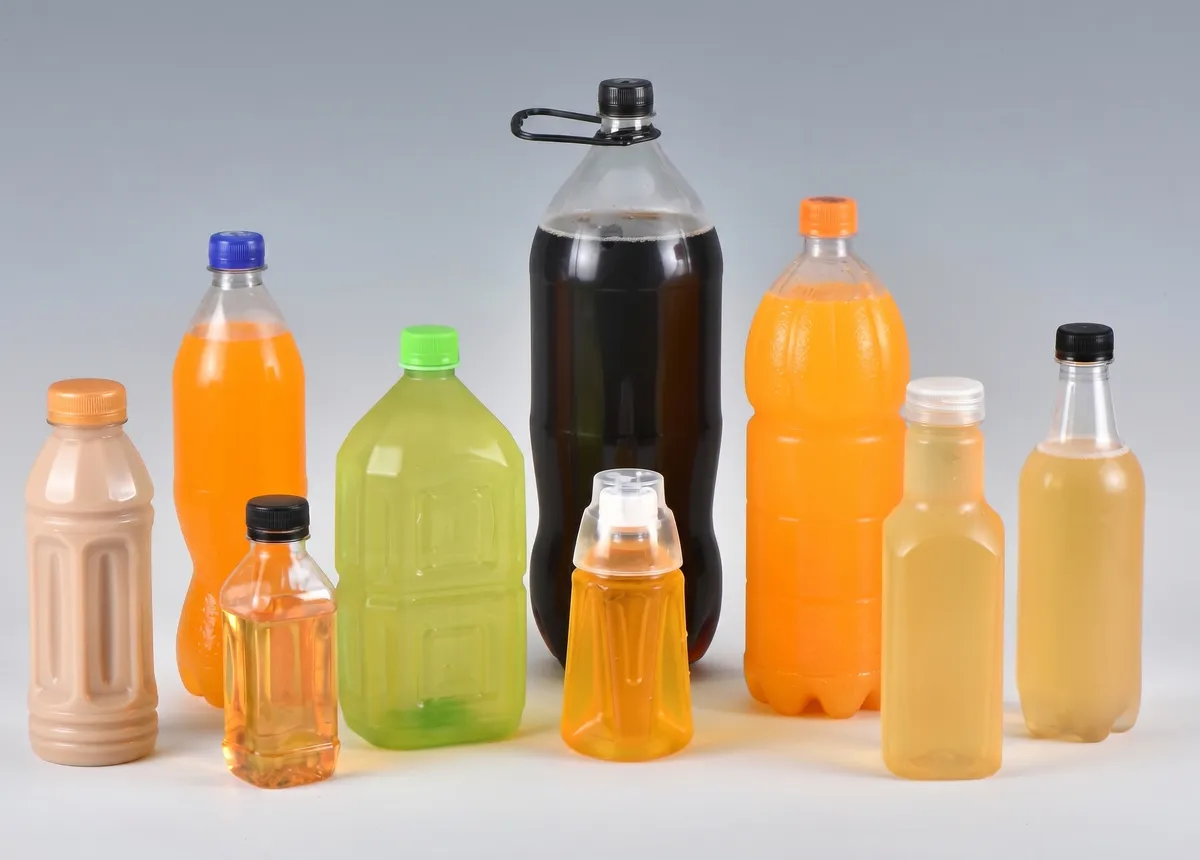
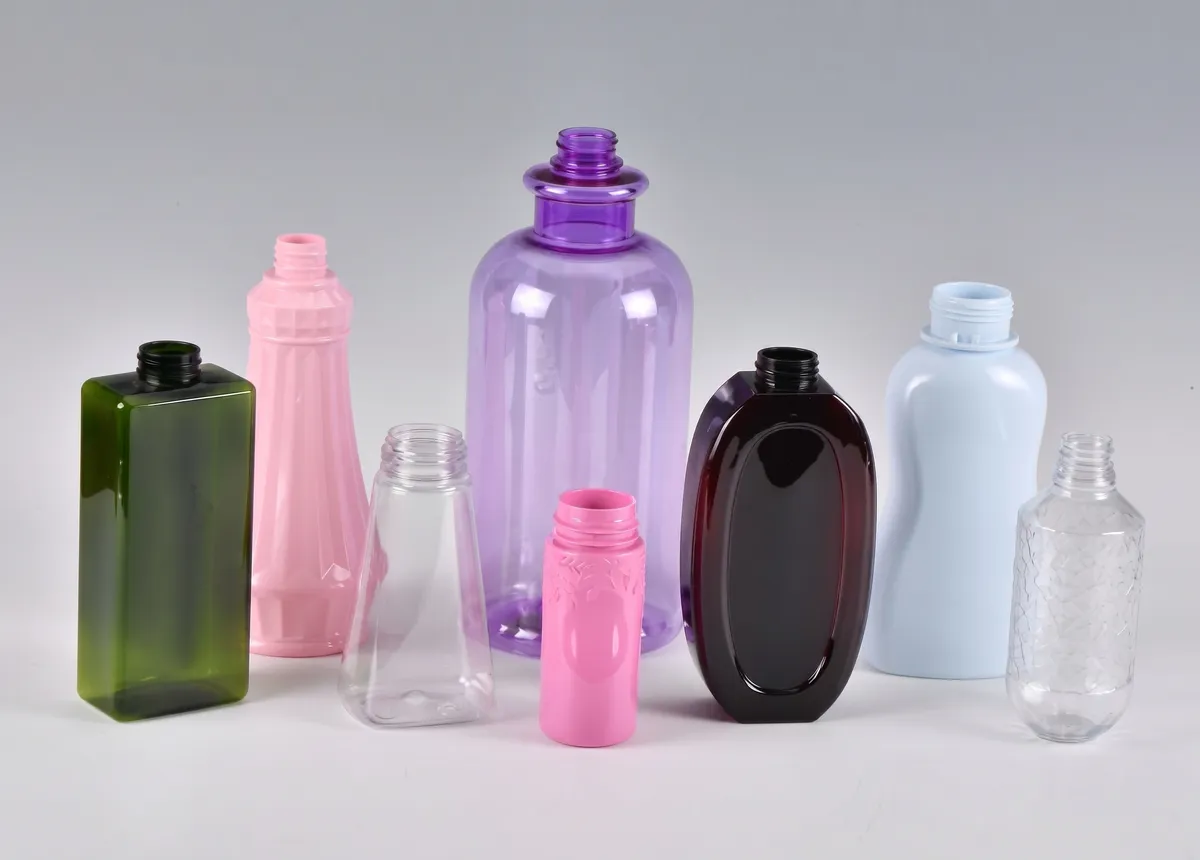 | 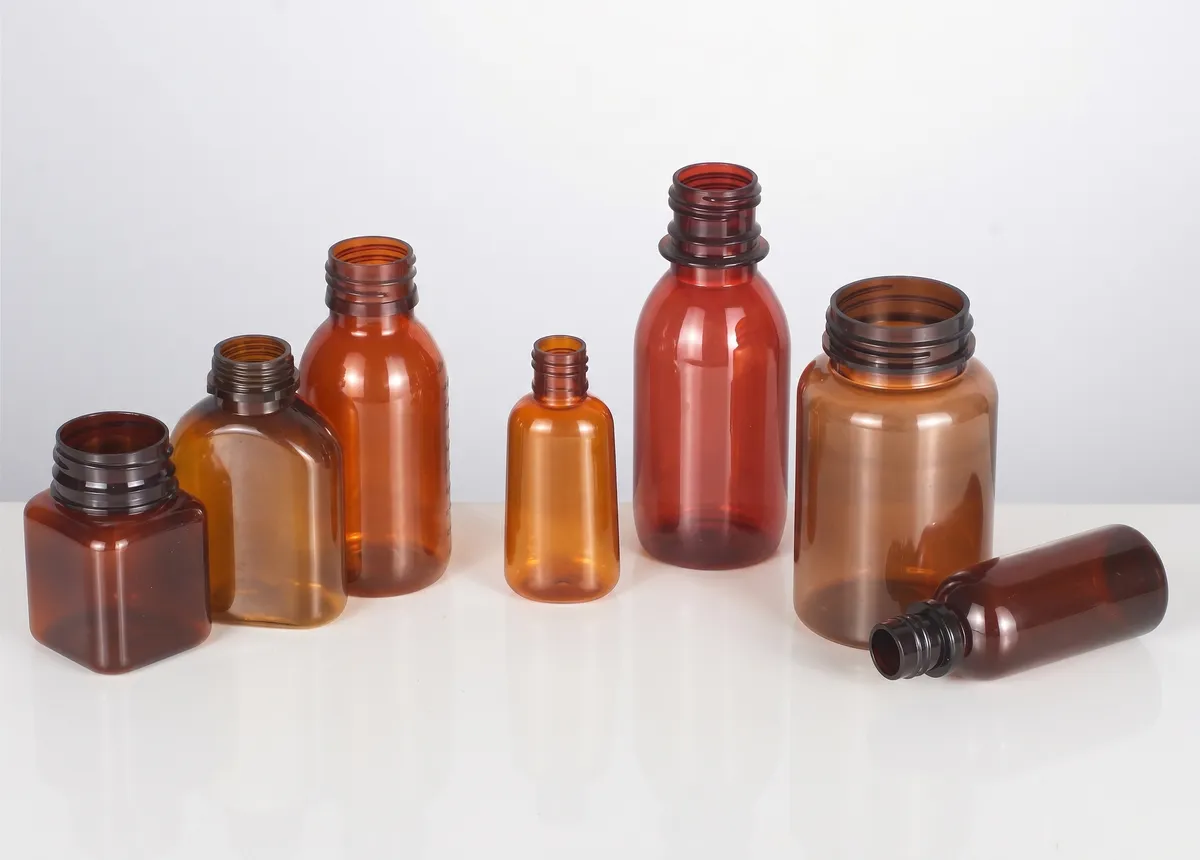 |
| Chai đựng mỹ phẩm | Chai thuốc |
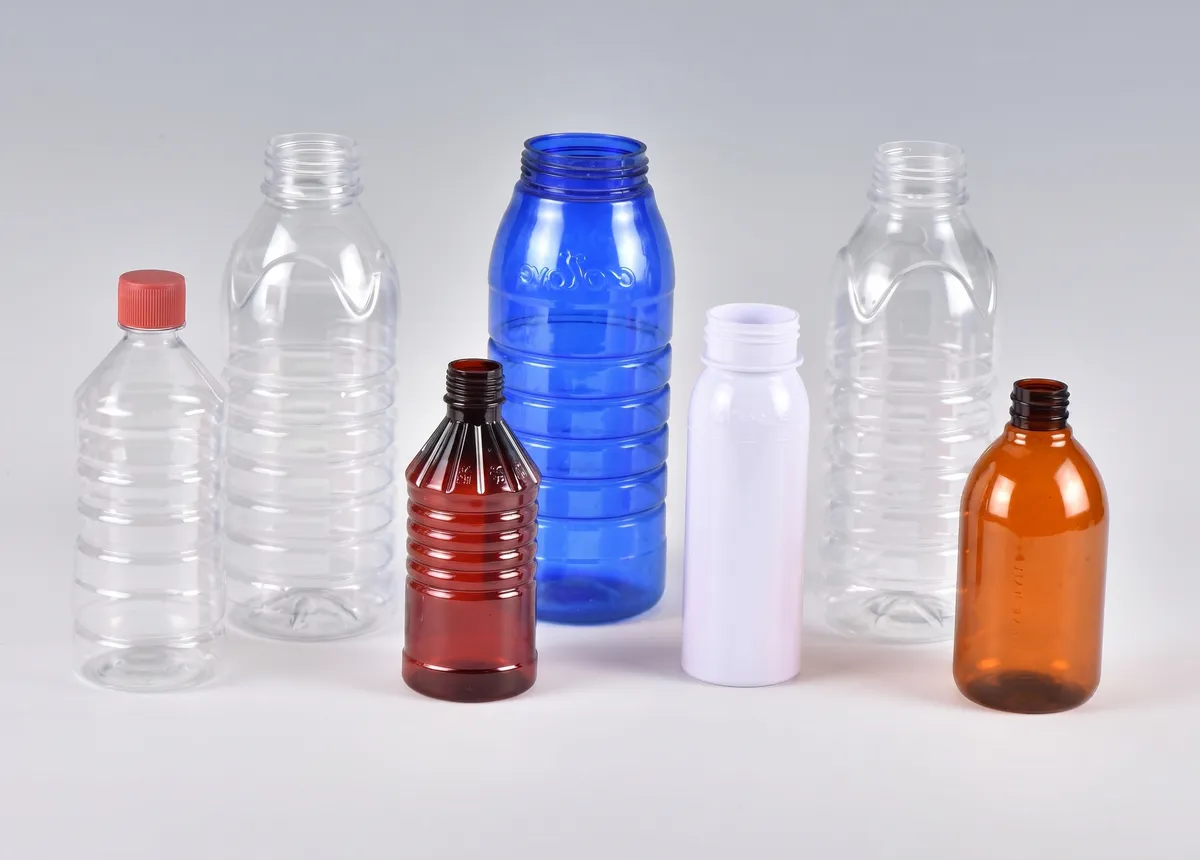 | 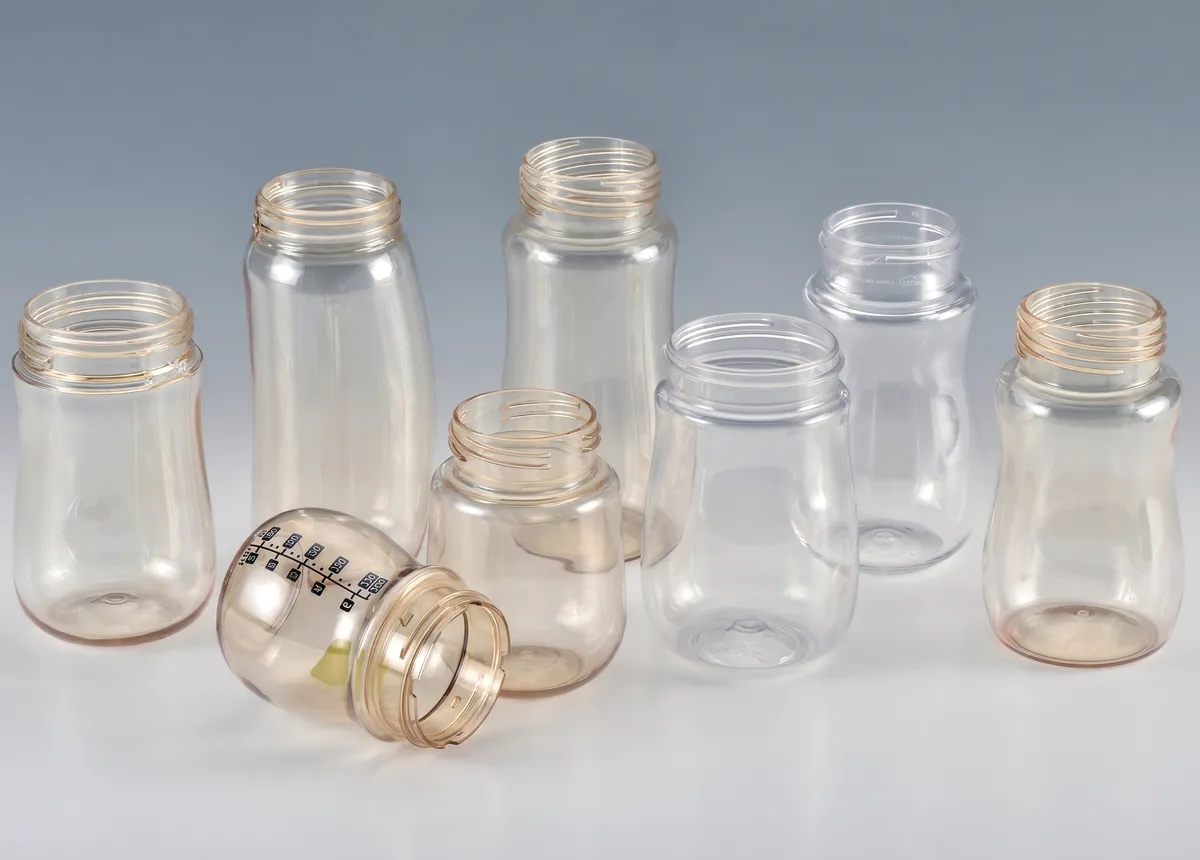 |
| Chai đựng hóa chất | Bình sữa |
Key Components of ISBM Y280-V6 Machine
Bộ kẹp
The Y280-V6 uses a dual-mode clamping system that supports either a hydraulic cylinder or dual servo motor configuration with high-pressure compensation. The injection clamping force of 150 KN and blow clamping force of 200 KN (single side) are precisely maintained throughout each production cycle. The upper mold stroke of 250 mm and lower mold stroke of 205 mm provide clearance for a wide range of bottle heights up to 210 mm. High-pressure compensation during mold closure eliminates parting line flash and ensures airtight sealing during the blow phase, directly improving finished bottle quality and reducing scrap rates.
Đơn vị tiêm
The double injection unit is controlled by a single cylinder, with the melt motor available in hydraulic or servo motor versions depending on the buyer's process requirements. The twin-screw design is heated by nano far-infrared energy-saving rings (10 KW total heating power) that distribute heat along the screw barrel with minimal energy loss. Available screw diameters of 40, 50, 55, and 60 mm allow the injection shot size to be matched precisely to the product cavity volume, with theoretical injection capacities ranging from 188 cm³ up to 480 cm³. This flexibility makes it practical to run both small cosmetic containers and large water containers on the same machine platform with screw changeovers.
Hệ thống khuôn
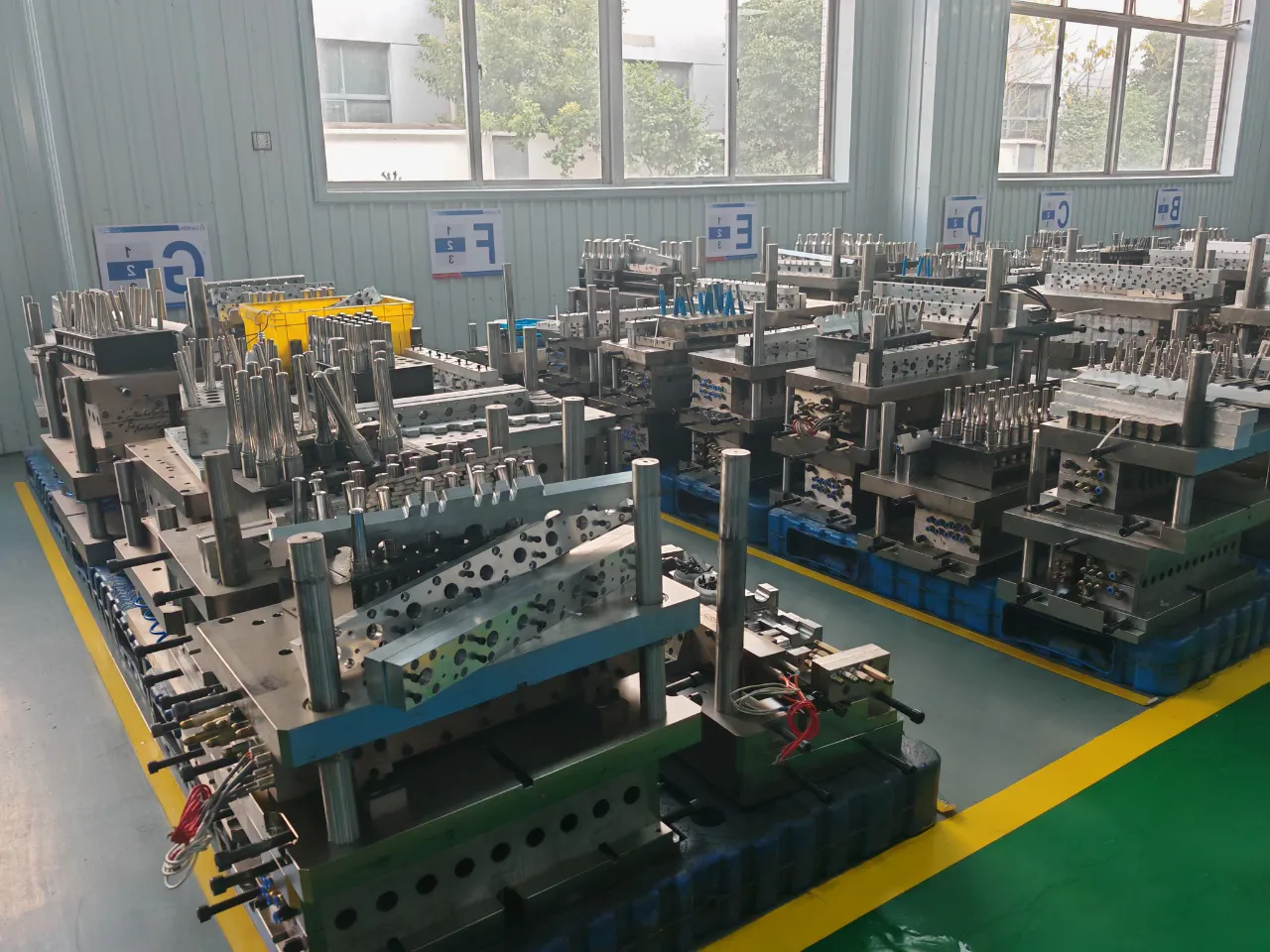
CMN Transmission manufactures injection stretch blow molds to extremely tight tolerances, producing finished containers with parting lines that are virtually invisible to the naked eye. This is a direct performance improvement over equivalent Japanese-brand machines where parting line protrusion is a common quality issue. The mold tooling is compatible with existing ASB injection stretch blow molding machine mold formats, which allows manufacturers transitioning from Japanese equipment to reuse their existing tooling investment. Cavity configurations range from 1 to 10 cavities per cycle, with bottle diameter ranges from 20 mm to 120 mm and volumes from 20 ml to 2,500 ml.
Blow Pin and Air Delivery System
The blow pin assembly on the Y280-V6 operates with a 250 mm blow core stroke, providing sufficient travel for tall bottle body profiles. High-pressure air is delivered through American Parker valves at blowing pressures of 2.0 to 3.5 MPa, which ensures complete mold filling during the blow phase even for complex or thick-walled bottle designs. The consistent air pressure management prevents thin spots, uneven wall distribution, and blow-out defects that can occur when air delivery timing or pressure fluctuates between cycles. The Parker valve specification also ensures long service life under continuous high-pressure cycling conditions typical of commercial production schedules.
Hệ thống làm mát
The Y280-V6 cooling system maintains machine oil cooler water at 20 to 25 degrees Celsius at 0.3 to 0.4 MPa, while the primary mold cooling water circuit operates at 0.4 to 0.6 MPa. This dual-circuit approach separates hydraulic system heat management from mold cooling, allowing each to be optimized independently. Effective mold cooling directly determines cycle time and dimensional stability of the finished bottle. The 300-liter oil tank provides adequate thermal mass to buffer heat load fluctuations during high-speed production, maintaining consistent hydraulic oil temperature and preventing viscosity-related performance changes that could affect clamping force or injection pressure accuracy.
Hệ thống phóng
The take-out mechanism operates with a 170 mm stroke and is driven by Airtak air cylinders for fast, consistent bottle removal at the ejection station. Servo-timed ejection is synchronized with the turntable indexing cycle through the Inovance or MiRLE PLC to prevent mechanical interference and allow maximum production speed without compromising bottle integrity during removal. The ejection stroke and speed are adjustable through the HMI interface, allowing operators to tune take-out timing when switching between different bottle heights or weights. Gentle ejection control is particularly important for thin-walled or elongated containers where rough handling at the take-out station can cause deformation before the bottle has fully solidified.
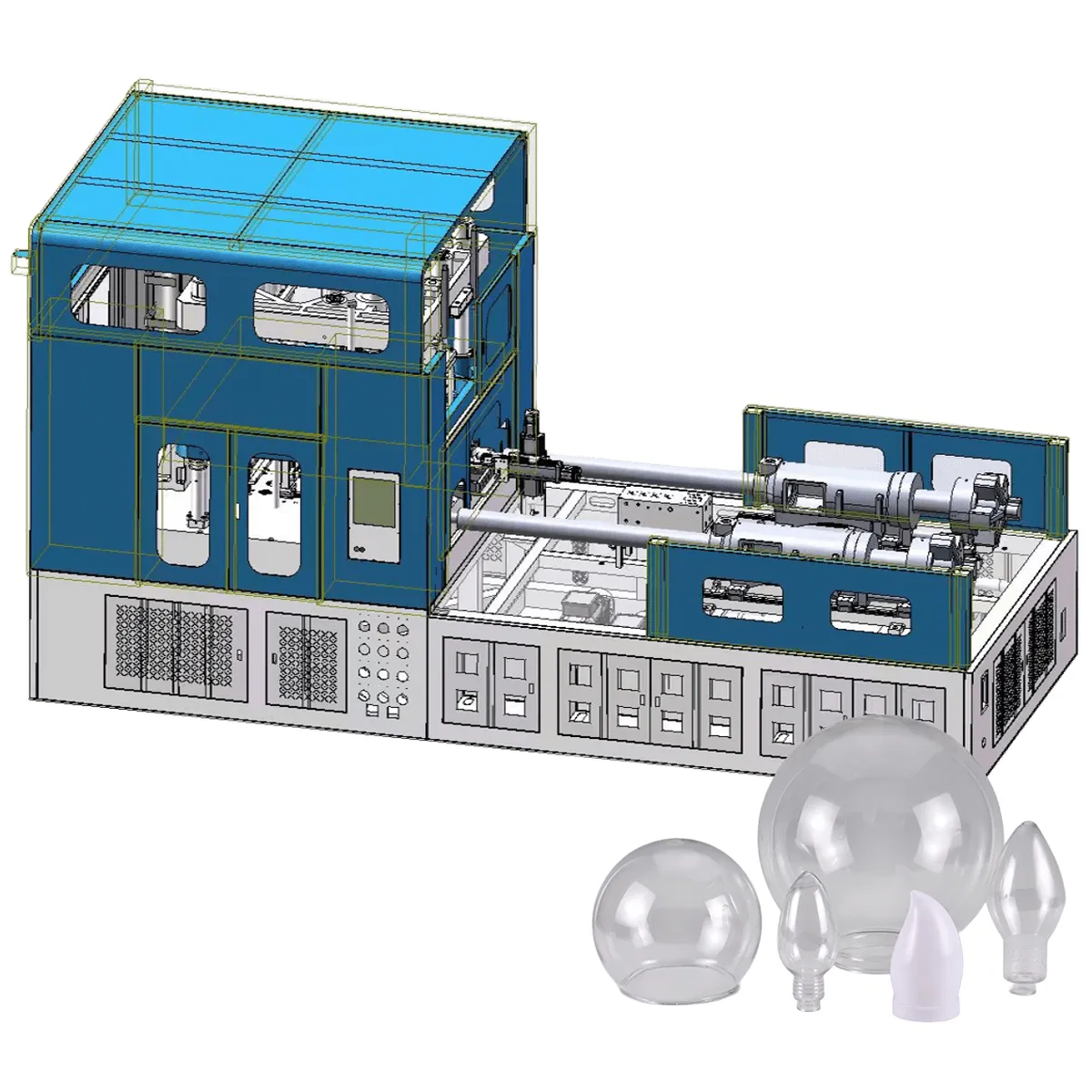
Injection Blow Molding vs Injection Stretch Blow Molding vs Extrusion Blow Molding
Choosing the right blow molding process is a fundamental decision that affects bottle quality, production cost, mold investment, and material compatibility. Here is how the three main processes compare.
EBM | Extrusion Blow Molding
EBM starts with a hot hollow parison formed by an extruder. The mold closes around the parison, and compressed air expands the plastic into the mold cavity. This method is highly flexible for producing large containers, handled bottles, drums, and HDPE packaging where exact neck precision is less critical. Common materials include HDPE, LDPE, PP, and PVC.
The primary advantage of EBM is shape freedom. Parison extrusion can form handles, wide bodies, and offset shapes more easily than injection-based processes. However, parison sag under gravity can create uneven wall thickness, and the mold closing process often produces flash that requires trimming. For buyers, the main quality risks are inconsistent wall distribution around handles or shoulders and less precise neck thread definition.
IBM | Injection Blow Molding
IBM starts with an injection-molded preform where the neck, thread, and sealing area are formed with high dimensional precision before the bottle body is blown. The preform is transferred into a blow mold and inflated into its final shape. Because the neck geometry is established during injection before blowing, IBM produces exceptionally accurate thread definitions and closure sealing surfaces.
This precision matters most for small pharmaceutical bottles, eye-drop containers, cosmetic jars, and medical packaging where cap and pump fitment must be leak-free. IBM also produces consistent bottle weight and repeatable dimensions. However, IBM does not include a stretch rod, so the biaxial orientation benefits of the ISBM process are not achieved, making IBM less suitable for large or lightweight PET containers where strength and clarity at low wall thickness are priorities.
ISBM | Injection Stretch Blow Molding
ISBM is the process used in the Y280-V6. Like IBM, it starts with an injection-molded preform that establishes the neck geometry. But ISBM adds a stretch rod that extends the preform vertically before compressed air expands it outward. This biaxial orientation aligns the polymer molecules in two directions simultaneously, producing bottles with significantly improved clarity, top-load strength, gas barrier performance, and lightweight potential.
These properties are critical for PET water bottles, carbonated beverage packaging, edible oil containers, and clear cosmetic bottles where both performance and visual clarity matter. The single-stage injection stretch blow molding machine design of the Y280-V6 combines injection and blow molding in one continuous cycle without secondary preform reheating, achieving 15 to 25% energy savings compared to two-step systems while maintaining superior bottle quality and production speed.
Bảng so sánh
| Kiểu | Biểu mẫu ban đầu | Vật liệu thông thường | Sản phẩm tốt nhất | Điểm mạnh chính | Hạn chế chính |
|---|---|---|---|---|---|
| EBM | Giáo xứ | HDPE, LDPE, PP, PVC | Thùng chứa lớn, chai có tay cầm, thùng phuy | Flexible sizes and lower tooling cost | Độ chính xác ở phần cổ kém hơn, có thể bị lỗi hiển thị. |
| IBM | Mầm | HDPE, PP, PET, PS | Các loại chai và lọ nhỏ, chính xác. | Hoàn thiện cổ cổ và đường ren chính xác. | Chi phí dụng cụ cao hơn, phạm vi kích thước nhỏ hơn. |
| ISBM | Múi kéo giãn | PET, PETG, PP, Tritan | Clear bottles, beverage and cosmetic packaging | Strength, clarity, lightweighting, energy savings | Higher machine and mold initial cost |
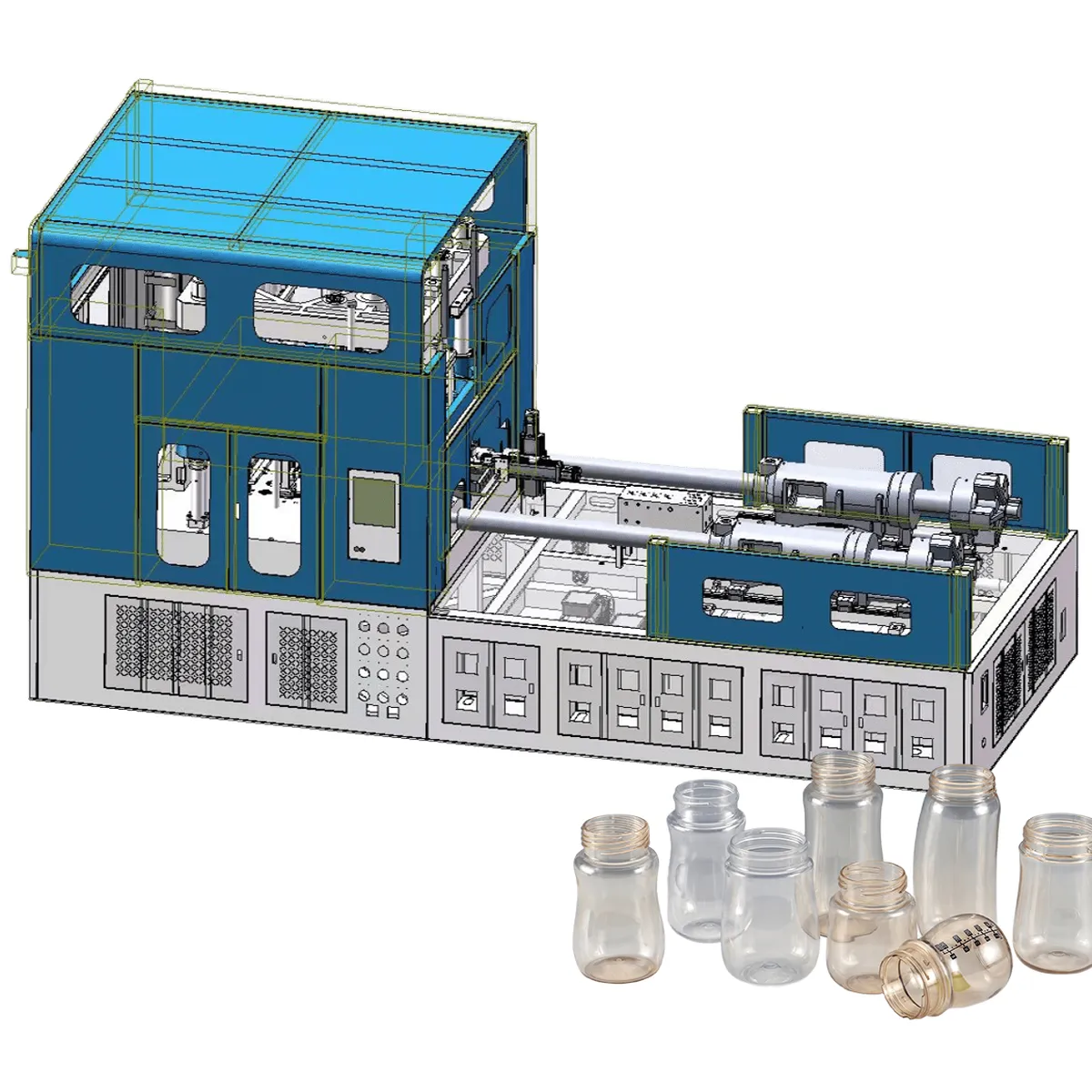
Nguyên liệu thô tương thích cho máy ISBM
PET (Polyethylene Terephthalate)
PET is the most widely processed resin on the Y280-V6 and the material most closely associated with the ISBM process. Its excellent optical clarity, gas barrier properties, and lightweight strength make it the standard choice for water bottles, beverage containers, food packaging, and transparent cosmetic bottles. PET processed through biaxial ISBM stretching achieves significantly better mechanical properties than unstretched PET, including improved top-load strength and drop impact resistance.
PETG (PET biến tính bằng Glycol)
PETG is a modified form of PET with superior impact resistance, easier processing, and the ability to be formed into complex shapes without cracking. It offers the same high clarity as standard PET but with greater flexibility and toughness. PETG is commonly chosen for cosmetic packaging, medical containers, and display packaging where the bottle must withstand rough handling or temperature variation without becoming brittle. The Y280-V6 handles PETG with consistent melt quality through its precise barrel temperature control.
PP (Polypropylene)
PP is valued for its excellent chemical resistance, high-temperature tolerance, and food-contact safety compliance. It is widely used in pharmaceutical packaging, food containers, and personal care applications where the bottle must survive sterilization cycles or hot-fill processes. PP on the Y280-V6 requires careful temperature management due to its narrower processing window compared to PET, but the machine's integrated control box temperature system handles this reliably. PP bottles produced on the Y280-V6 offer a cost-effective alternative to glass for pharmaceutical and food applications.
PPSU (Polyphenylsulfone)
PPSU is a high-performance engineering resin offering exceptional heat resistance, hydrolytic stability, and transparency that withstands repeated steam sterilization cycles at 134 degrees Celsius. It is the premium choice for baby bottles and medical containers that must endure autoclave sterilization without degradation or discoloration. PPSU is BPA-free and meets the most stringent global food contact regulations. The Y280-V6's precision temperature control capability ensures stable melt flow of this high-viscosity resin without causing surface defects or molecular degradation.
PC (Polycarbonate)
PC offers the highest impact resistance among common transparent engineering plastics and is traditionally used in reusable water bottles, large water dispensing containers, and baby bottles. While BPA concerns have reduced PC use in certain markets, it remains an important material for industrial containers and optical-quality applications requiring exceptional clarity combined with toughness. The Y280-V6 processes PC with precise barrel temperature profiles to prevent degradation and color change during the injection phase. PC containers produced on the ISBM machine achieve superior drop resistance compared to those produced by other molding methods.
Tritan (Eastman Tritan Copolyester)
Tritan is a BPA-free copolyester developed by Eastman Chemical that combines the clarity and toughness of PC with enhanced chemical resistance and dishwasher durability. It has become the leading material for premium reusable water bottles, baby bottles, and kitchen containers marketed to health-conscious consumers. The Y280-V6 processes Tritan effectively through its stable screw temperature management, producing bottles with outstanding clarity, scratch resistance, and long-term durability that justify the premium positioning of Tritan-branded packaging in retail markets.
PCTG (Glycol-Modified PCT)
PCTG is a transparent copolyester with properties positioned between standard PETG and Tritan, offering excellent impact resistance, low-temperature clarity, and good chemical resistance. It is commonly used in cosmetic packaging, medical device housings, and consumer product containers where high clarity and toughness are both required at a cost point below Tritan. PCTG processes at moderate temperatures on the Y280-V6 and produces bottles with a crystal-clear appearance suitable for premium cosmetic and personal care packaging lines targeting demanding retail markets.
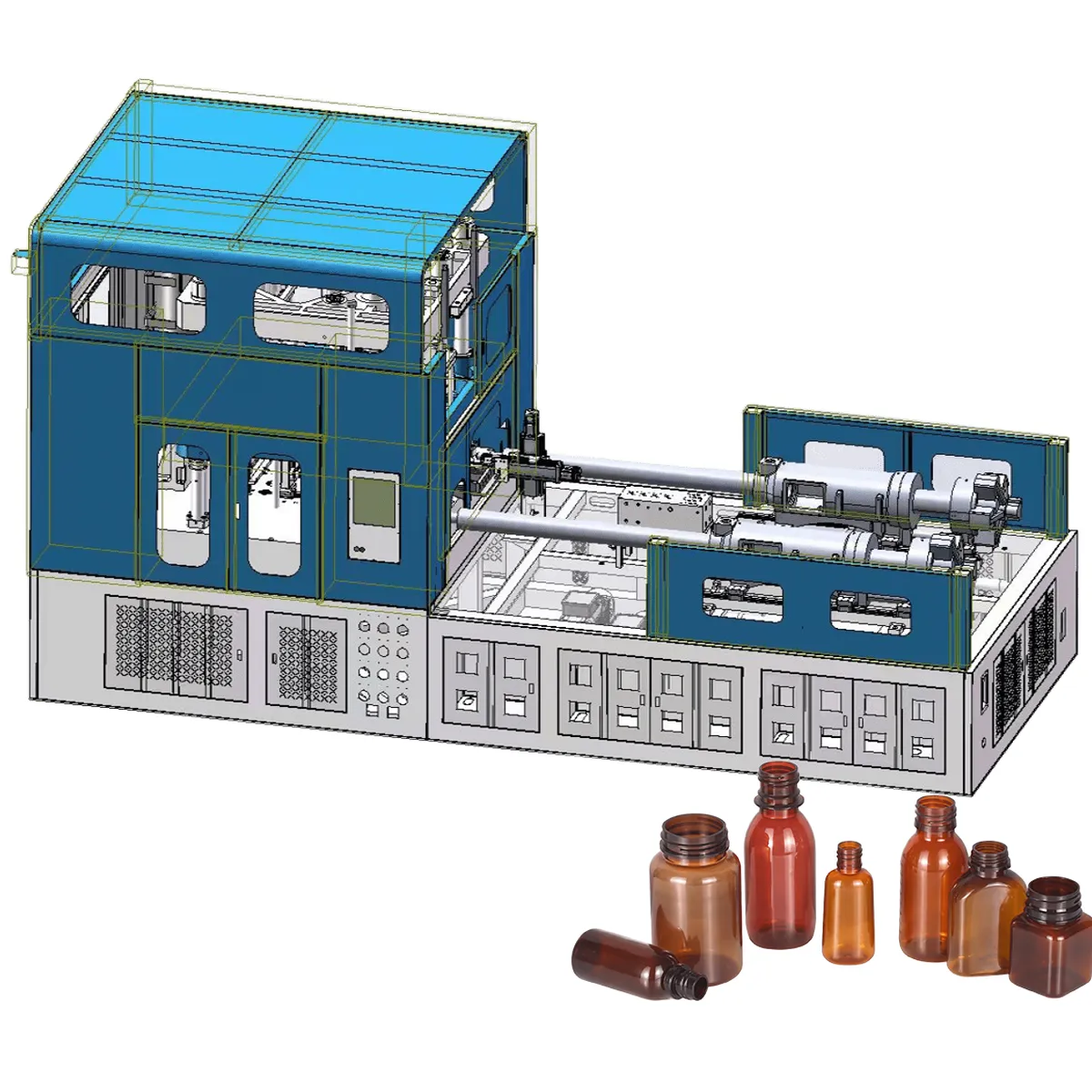
Injection Stretch Blow Molding Machine for Beverage Bottle Production
Step 1: PET Resin Drying and Hopper Loading
PET resin for beverage bottle production must be dried to a moisture content below 50 ppm before processing to prevent hydrolytic degradation during melt injection. A dehumidifying dryer operating at 160 to 170 degrees Celsius for 4 to 6 hours is typically required. Dried PET pellets are loaded into the machine hopper, which feeds the injection screw. Undried PET produces bottles with reduced intrinsic viscosity, visible surface haziness, and reduced mechanical strength that can cause bottles to fail burst pressure or drop tests during quality control inspection.
Step 2: Preform Injection Molding
The dried PET resin is fed to the screw barrel, melted at temperatures typically between 270 and 285 degrees Celsius, and injected under precise pressure into the injection mold to form the beverage bottle preform. The preform shape, including the neck thread, sealing surface, and body wall thickness distribution, is determined at this stage. For carbonated beverage bottles, neck finish accuracy is especially critical because the crown or screw cap must seal reliably against the internal CO2 pressure of 2.0 to 4.5 bar. The preform is partially cooled to a stable but pliable temperature before transfer.
Step 3: Temperature Conditioning and Turntable Transfer
The servo-driven rotary turntable transfers the freshly injected preform from the injection station to the temperature conditioning zone. The integrated control box temperature system manages thermal equilibration across the preform body length to achieve a consistent temperature profile before stretching begins. For beverage bottles, the optimal preform temperature for biaxial ISBM stretching is typically 85 to 100 degrees Celsius, varying by bottle design and wall thickness target. Uneven preform temperature at this stage is the most common cause of shoulder thinning, base thickening, and pearl white opacity in the finished bottle.
Step 4: Biaxial Stretch Blow Molding
The conditioned preform enters the blow station where the mold closes around it and a stretch rod extends the preform vertically to the base of the blow mold. High-pressure air at 2.0 to 3.5 MPa is then introduced through the blow pin to expand the preform outward against the mold cavity walls simultaneously. This biaxial stretching step is what produces the superior strength and clarity characteristic of ISBM PET bottles. For carbonated beverage bottles, the resulting molecular orientation improves CO2 barrier performance, burst pressure resistance, and thermal stability during hot filling or pasteurization processes.
Step 5: Mold Cooling and Bottle Solidification
Following the blow molding stage, the bottle is held inside the closed mold while cooling water circulated through the mold channels removes heat from the container surface. Cooling time is a direct determinant of cycle time and dimensional stability. For beverage bottles where high clarity and low haze are commercial requirements, rapid and uniform cooling prevents crystallization that would make the PET appear white or translucent. The Y280-V6 cooling water circuit maintains temperature at 20 to 25 degrees Celsius through the machine oil cooler, providing stable cooling conditions across extended production runs.
Step 6: Ejection and Quality Inspection
After sufficient cooling, the mold opens and the take-out mechanism with 170 mm stroke removes the finished beverage bottle from the blow station. The ejected bottle is transferred to the inspection and downstream packaging area. Quality checks for beverage bottles typically include visual inspection for surface defects and clarity, neck dimension gauging for cap fitment, weight measurement for fill volume consistency, and periodic burst pressure and drop impact testing according to the customer's quality plan. Bottles that pass inspection proceed directly to the filling line, conveyor system, or packing station without any secondary trimming or surface treatment.
Step 7: Downstream Packing and Storage
Finished beverage bottles from the Y280-V6 production line are typically collected on conveyors, counted into specified lot quantities, and packed into corrugated cartons or plastic bags for shipment to the filling plant. For high-volume operations, automatic bottle counting and bagging systems can be integrated downstream of the ISBM machine ejection station. Bottles should be stored in clean, dry conditions away from direct sunlight and chemical vapors that could affect PET surface quality before filling. Proper downstream handling protects the investment in bottle quality that the ISBM process provides throughout the entire production chain.
Maintenance and Care
1. Daily Lubrication and Mechanical Checks
At the start of each production shift, inspect all lubrication points on the clamping unit, turntable bearing, and ejection mechanism. Apply grease to specified points according to the maintenance schedule provided in the machine manual. Check that the turntable rotation is smooth and that no unusual vibration or noise is present during indexing. Verify that all air cylinder rod seals are intact and that there is no air leakage at cylinder connections. Addressing minor lubrication deficiencies early prevents accelerated wear on precision components and avoids unplanned downtime during production runs.
2. Hydraulic System Oil Management
The 300-liter hydraulic oil tank should be checked weekly for oil level, color, and contamination. Fresh hydraulic oil is typically light amber; darkening or cloudiness indicates oxidation, water contamination, or particle contamination from worn seals. Replace hydraulic oil completely according to the manufacturer's scheduled interval, typically every 2,000 to 3,000 hours of operation. Clean or replace hydraulic oil filters at each oil change. Maintaining clean hydraulic oil is critical because the YUKEN hydraulic control valves and high-pressure components have tight internal clearances that are sensitive to particulate contamination, which causes valve sticking, erratic pressure behavior, and accelerated component wear.
3. Cooling Water Circuit Maintenance
The cooling water circuit should be inspected monthly for scale buildup, biological growth, and flow rate consistency. The machine oil cooler must maintain water temperature between 20 and 25 degrees Celsius and pressure between 0.3 and 0.4 MPa to keep hydraulic oil viscosity within the operating range. The mold cooling circuit operates at 0.4 to 0.6 MPa and must be monitored for blockages that could cause uneven mold cooling and dimensional variation in bottles. Use treated water or a closed-loop cooling system with corrosion inhibitor to prevent scale and corrosion that would reduce heat transfer efficiency and restrict flow through mold cooling channels over time.
4. Screw and Barrel Cleaning
The injection screw and barrel should be purged and cleaned whenever changing between resin types or colors, and at scheduled intervals during extended production runs of the same material. For PET and PETG, purge with a commercial purging compound or a compatible transition resin to remove degraded material from the screw flights and barrel walls. Degraded PET deposits can cause black specks, yellow streaking, or molecular weight reduction in the finished container if not removed. The nano far-infrared heating ring system heats the barrel uniformly, but stagnant material in low-flow zones can still degrade if the screw is left stationary at temperature for extended periods without purging.
5. Mold Inspection and Cavity Care
Mold tooling should be inspected at regular intervals for wear on the cavity surface, parting line, venting channels, and neck ring components. Clean cavity surfaces with approved mold release agents and plastic-safe solvents to remove resin deposits and oxidation. Inspect water channel connections on the mold for leaks or blockages and verify that the cooling circuit is balanced across all cavities. Misaligned or worn parting surfaces can create flash on bottles, which affects container appearance and may indicate clamping force imbalance. Store molds in climate-controlled storage with protective coating on metal surfaces when not in production to prevent corrosion and humidity damage.
6. Servo Motor and Electrical System Checks
The Inovance or WEICHI servo motors driving the Y280-V6 clamping and injection systems should be inspected quarterly for bearing temperature, encoder signal quality, and cable condition. Check servo drive units in the electrical cabinet for adequate ventilation and absence of dust buildup that could cause overheating or signal interference. The Inovance or MiRLE PLC should have its battery backup status checked annually to ensure parameter memory is retained during power outages. Review the PLC fault log monthly to identify recurring alarms that may indicate developing mechanical or electrical issues before they cause a production stoppage. All electrical connections should be retorqued at commissioning and at annual service intervals to prevent high-resistance contacts from developing.
Tại sao nên chọn máy ép phun kéo giãn thổi khuôn của CMN?
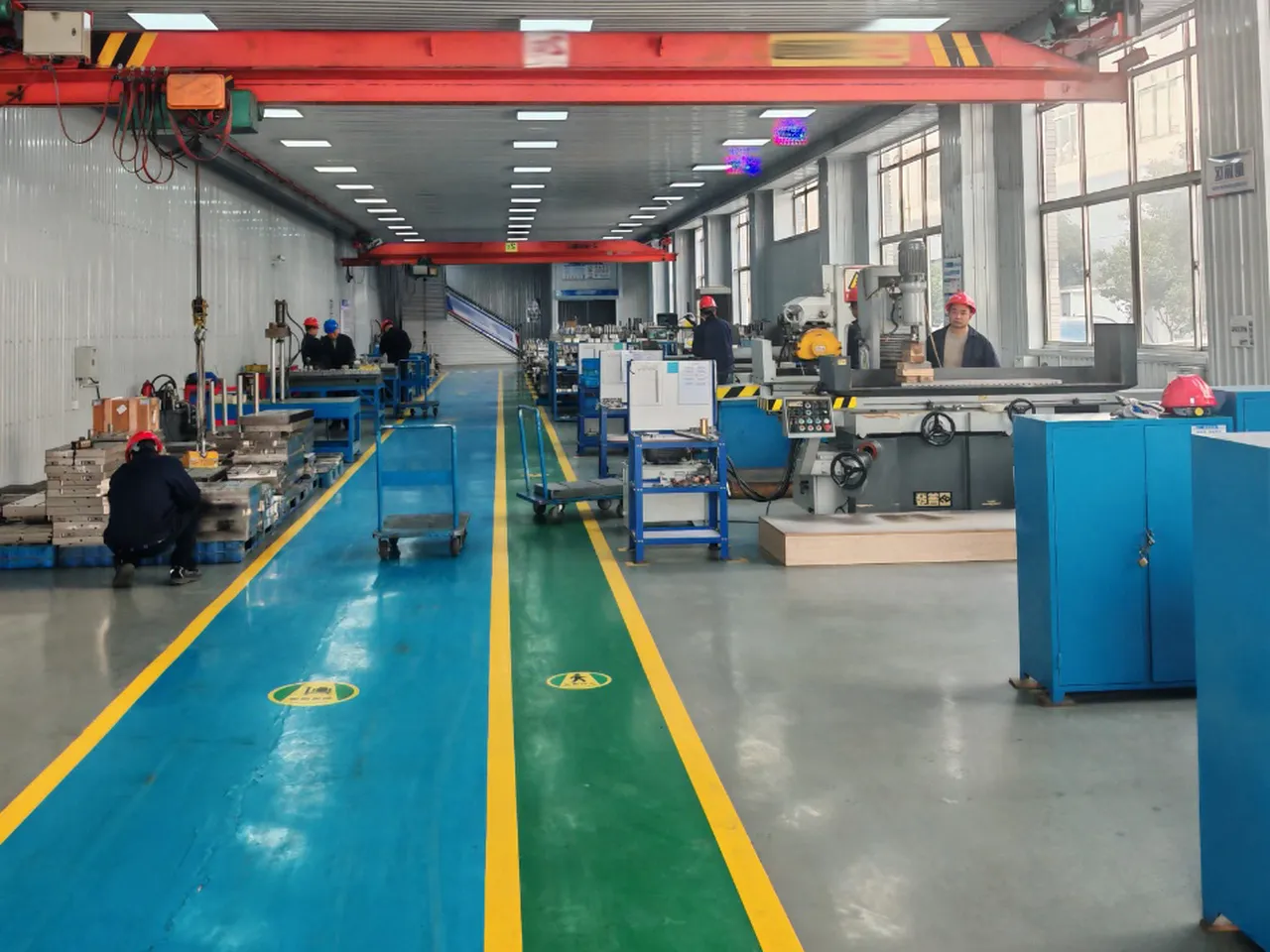
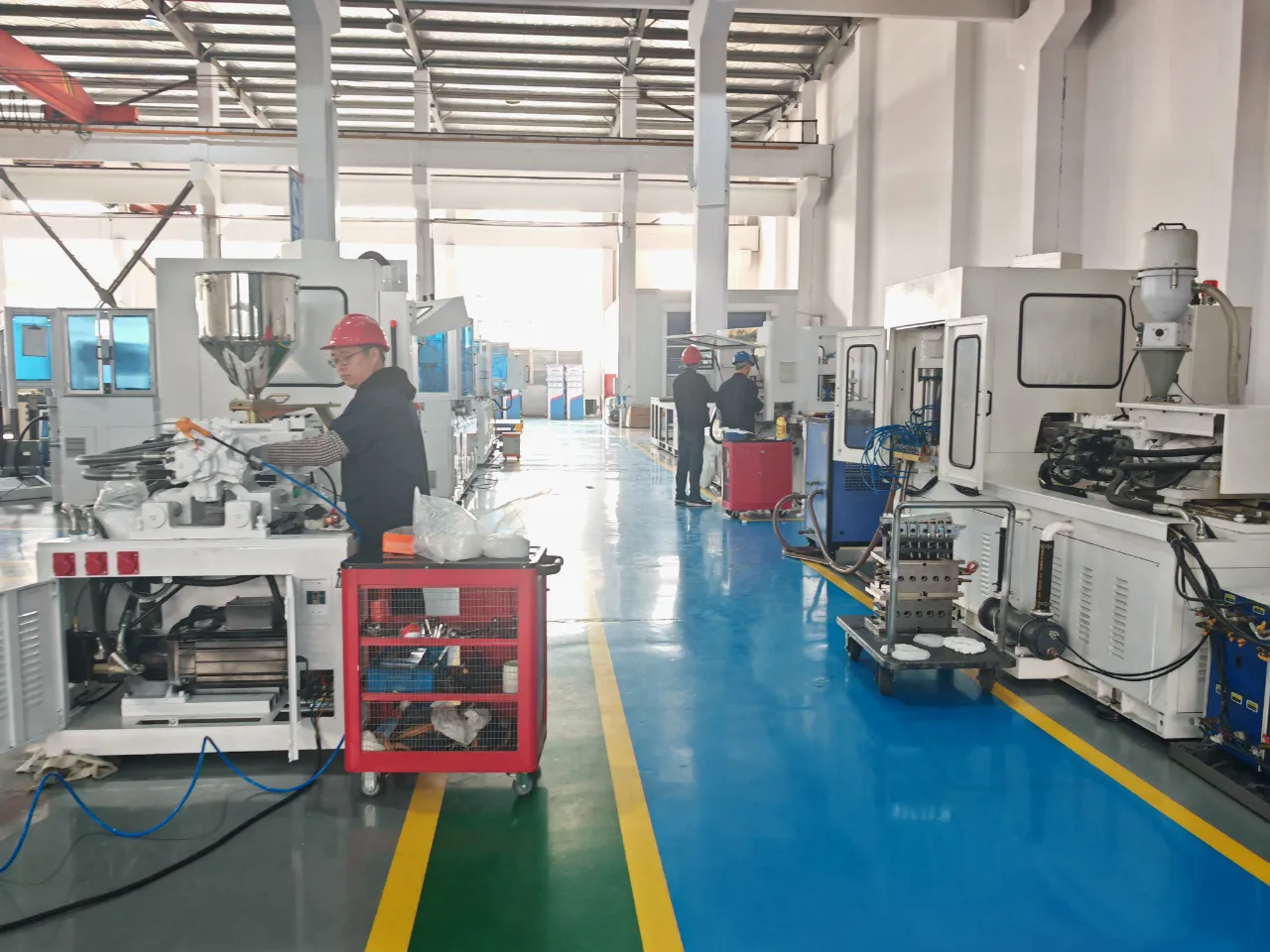
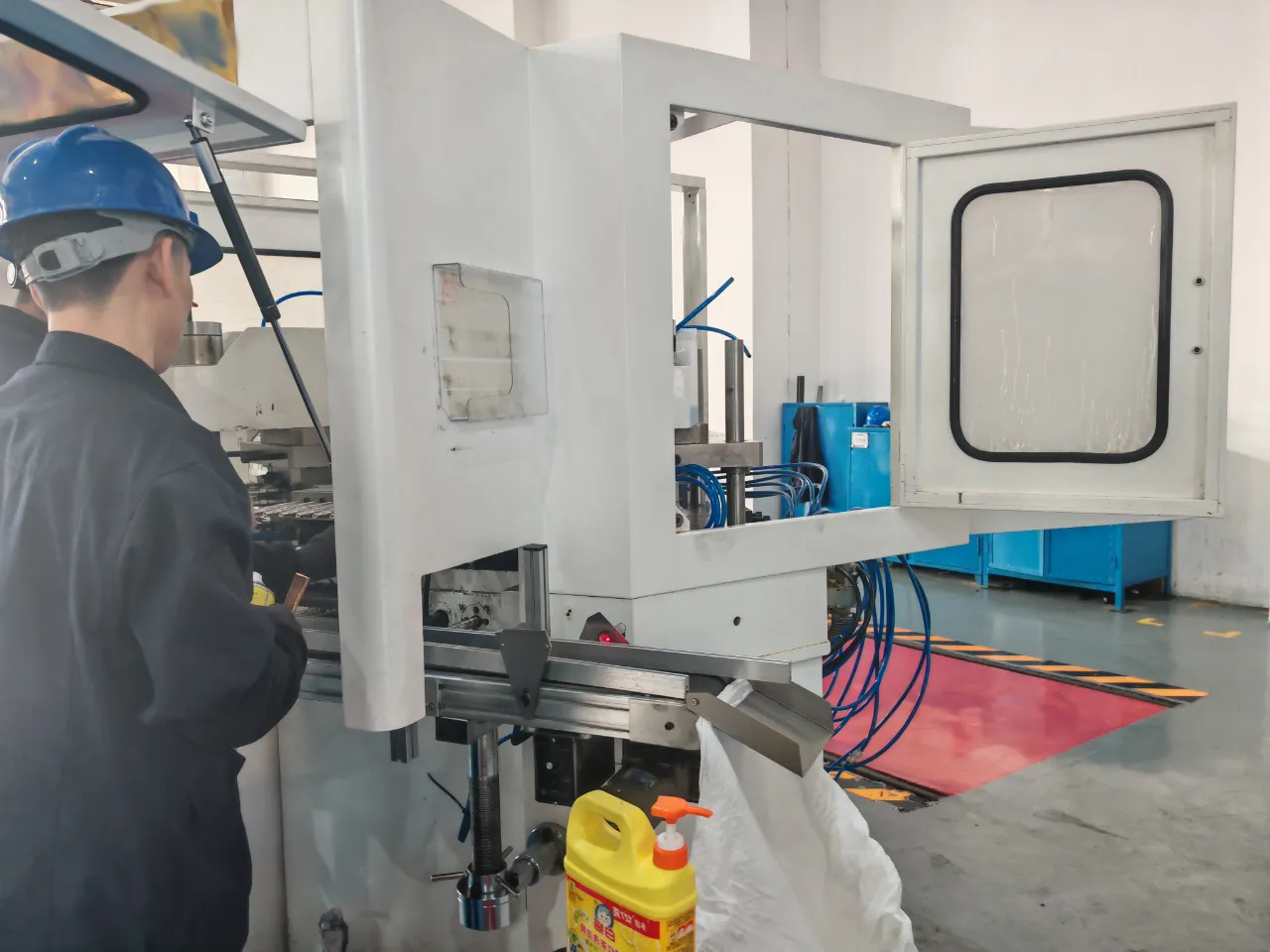
CMN Transmission is a dedicated manufacturer of automatic one-step injection blow molding machines and injection stretch blow molding machine equipment, with a product range covering injection blow molding machines, extrusion blow molding machines, injection stretch blow molding machines, molds, and auxiliary equipment. CMN operates from a well-located production base with efficient logistics access that supports reliable international delivery timelines for customers across Asia, the Middle East, Africa, South America, and Europe.
CMN maintains an experienced R&D team that brings together engineering and technical personnel with deep backgrounds in both injection-blowing machinery design and injection-blowing mold manufacturing. This dual expertise, covering both the machine and the tooling, gives CMN a significant advantage in helping customers solve complex bottle design challenges that combine difficult shapes, demanding materials, or tight dimensional tolerances. Combining strong theoretical knowledge with practical production experience, CMN's technical team provides detailed, personalized pre-sale consultation, responsive in-sale technical support, and committed after-sale service including on-site installation, operator training, process optimization, and spare parts supply.
CMN's product applications span pharmaceutical packaging, food and beverage packaging, healthcare and personal care packaging, cosmetic packaging, and a wide range of specialty plastic packaging products from 1 ml to 1,000 ml in materials including HDPE, LDPE, PET, PETG, PP, PS, PPSU, PC, Tritan, ABS, PLA, PCTG, EVA, and environmentally certified corn-based resins. CMN adheres to the development philosophy of self-reliance, integrity, practicality, innovation, and responsibility, building a comprehensive one-stop turnkey project capability that covers machine selection, mold design, process validation, and ongoing production support. This full-chain approach ensures that CMN customers receive high-end injection-blowing products that consistently meet quality requirements from the first production cycle through the life of the equipment.
 |  |
 |  |
Câu hỏi thường gặp
Q: What is the difference between the Y280-V6 and a standard four-station injection stretch blow molding machine?
A: The Y280-V6 uses a six-station rotary turntable instead of the four-station design common in Japanese ISBM machines. This means the Y280-V6 can process six preforms simultaneously in a single rotation cycle, producing more bottles per cycle than a four-station machine running the same tooling configuration. In addition to higher output, the extra stations allow for longer temperature conditioning and cooling dwell times, which can improve bottle quality when running demanding materials or complex shapes.
Q: Can the Y280-V6 use existing ASB or Aoki injection stretch blow molding machine molds?
A: Yes. The Y280-V6 is designed to be compatible with mold tooling originally manufactured for Japanese ASB injection stretch blow molding machines, specifically ASB-12M and ASB-70DPH format molds. CMN's broader product range also includes models compatible with Aoki 100, Aoki 250, and Aoki 500 mold formats. This mold compatibility is a major commercial advantage for manufacturers who have existing tooling investment and want to switch to CMN equipment without the cost of replacing all their molds. Contact our sales team with your existing mold specifications to verify compatibility before purchase.
Q: Is a fully electric version of this one step injection stretch blow molding machine available?
A: Yes. CMN Transmission offers the Y280-V6 in a Fully Electric configuration that replaces all hydraulic drive systems with servo motors. The fully electric version produces no hydraulic oil, making it suitable for pharmaceutical manufacturing facilities that must comply with GMP standards and operate in clean-room-adjacent environments. The fully electric version also offers advantages in energy consumption, positioning repeatability, and quieter operation. It is available at a higher initial cost than the Standard or Servo hydraulic-assisted versions.
Q: What materials can the Y280-V6 PET injection stretch blow molding machine process?
A: The Y280-V6 is designed primarily for PET and PETG processing, which are the most common materials for ISBM production. However, the machine is also capable of processing PP, PC, Tritan, PPSU, PCTG, ABS, PS, and PLA with appropriate screw diameter selection, barrel temperature adjustment, and drying pre-treatment. Different materials require different processing parameters, and CMN's technical team can advise on the correct configuration for your specific material and bottle design before delivery.
Q: How much energy does the Y280-V6 single-stage injection stretch blow molding machine save compared to Japanese equivalents?
A: The Y280-V6 consumes 15% to 25% less energy than comparable Japanese, European, or American injection stretch blow molding machines running similar bottle designs and output volumes. This saving comes from three sources: the servo pump systems which only generate pressure on demand rather than running continuously at full flow, the nano far-infrared screw heating rings which reduce heat loss compared to conventional resistance heating, and the single-stage ISBM process which eliminates the secondary preform reheating step required by two-stage blow molding systems. Actual savings vary by bottle design, cycle time, and local utility rates.
Q: What bottle sizes and volumes can the Y280-V6 ISBM machine produce?
A: The Y280-V6 accommodates bottles from 20 ml to 2,500 ml in volume, with bottle diameters from 20 mm to 120 mm and bottle heights up to 210 mm. The machine can run from 1 to 10 cavities per cycle depending on bottle size, with neck diameters from 12 mm up to 85 mm. The product dimensions table provides the maximum bottle specifications at each cavity count. Custom bottle dimensions outside the standard table can be discussed with the CMN engineering team, who will assess mold feasibility and machine stroke compatibility before confirming the order.
Q: What is the difference between a one step ISBM machine and a two-step PET blow molding machine?
A: In a one step ISBM machine like the Y280-V6, the plastic resin is injected into a preform and immediately transferred to the stretch blow molding station within the same machine, retaining the heat from the injection phase. No separate preform reheating equipment is needed. In a two-step system, preforms are injection molded separately, stored and cooled completely, then reheated in a second machine before blow molding. The one-step process uses less energy because it avoids the preform reheating cycle, has a smaller footprint because only one machine is required, and produces bottles directly from resin pellets. The two-step system offers greater flexibility for high-volume commodity PET bottle production where preforms can be produced and stored separately for flexible output scheduling.
Hỏi: Việc lắp đặt và vận hành thử Y280-V6 mất bao lâu?
A: Việc lắp đặt và vận hành thử tiêu chuẩn máy Y280-V6 thường mất từ 3 đến 5 ngày với sự có mặt của đội ngũ kỹ thuật CMN tại chỗ. Quy trình bao gồm định vị và cân bằng máy, kết nối điện và khí nén, vận hành thử mạch nước làm mát, mồi và điều chỉnh áp suất hệ thống thủy lực, lắp đặt và căn chỉnh khuôn, và các thử nghiệm sản xuất ban đầu với vật liệu và dụng cụ của người mua. Việc đào tạo người vận hành bao gồm thiết lập máy, điều chỉnh thông số, quy trình an toàn và bảo trì cơ bản được tiến hành song song trong quá trình vận hành thử. Lịch trình chuyến thăm của kỹ sư lắp đặt CMN được phối hợp vào thời điểm giao máy và phụ thuộc vào sự sẵn sàng của người mua và sự có sẵn của tất cả các tiện ích và dụng cụ tại chỗ.
Hỏi: Máy ép phun thổi khuôn Y280-V6 cần nguồn khí nén loại nào?
A: Máy Y280-V6 yêu cầu nguồn khí nén có khả năng cung cấp khí thổi ở áp suất từ 2,0 đến 3,5 MPa (20 đến 35 bar). Cần có máy nén khí cao áp để đạt được mức áp suất cao nhất trong phạm vi này đối với một số thiết kế chai hoặc vật liệu nhất định. Lượng khí tiêu thụ mỗi chu kỳ phụ thuộc vào thể tích khoang chai và số lượng khoang, với các chai lớn hơn hoặc nhiều chai hơn sẽ cần nhiều khí hơn mỗi chu kỳ. Người mua nên tính toán công suất máy nén khí cần thiết dựa trên tốc độ sản xuất dự kiến và số lượng chai trước khi lắp đặt. Nguồn khí nén không đủ công suất là một trong những nguyên nhân phổ biến nhất gây chậm trễ khi khởi động các máy ISBM mới.
Hỏi: Máy Y280-V6 có thể sản xuất chai không chứa BPA dùng cho dược phẩm và thực phẩm không?
A: Có. Máy Y280-V6 xử lý các vật liệu không chứa BPA, bao gồm PET, PETG, PP, Tritan, PPSU và PCTG, tất cả đều tuân thủ các quy định quốc tế quan trọng về bao bì thực phẩm và dược phẩm, bao gồm FDA, EU 10/2011 và các tiêu chuẩn tương đương. Đối với các ứng dụng dược phẩm mà GMP yêu cầu loại bỏ hoàn toàn nguy cơ ô nhiễm dầu thủy lực, cấu hình servo hoàn toàn bằng điện của Y280-V6 được khuyến nghị. Người mua yêu cầu tài liệu tuân thủ vật liệu cụ thể hoặc tuyên bố an toàn tiếp xúc thực phẩm cho thị trường cuối cùng của họ nên yêu cầu các chứng chỉ liên quan từ CMN và từ nhà cung cấp nhựa của họ tại thời điểm mua hàng.
Đánh giá của khách hàng
Kim Jae-won, Bao bì Dược phẩm, Hàn Quốc
"Chúng tôi đã lắp đặt máy Y280-V6 tại nhà máy đóng gói dược phẩm ở Seoul khoảng mười bốn tháng trước và thành thật mà nói, đó là một trong những quyết định về thiết bị tốt nhất mà chúng tôi đã đưa ra. Chúng tôi sản xuất chai nhựa PET 50 ml dùng cho dung dịch uống bằng khuôn 6 khoang và độ đồng nhất về kích thước cổ chai thực sự rất tốt. Tỷ lệ sản phẩm lỗi trên bề mặt niêm phong đã giảm từ khoảng 1,21 TP3T xuống dưới 0,251 TP3T sau khi chuyển từ máy ISBM của Nhật Bản. Chi phí điện năng cũng giảm nhiều hơn chúng tôi mong đợi - kỹ sư nhà máy của chúng tôi đã tính toán mức giảm khoảng 221 TP3T chi phí điện năng cho mỗi nghìn chai được sản xuất. Đội ngũ lắp đặt của CMN đã dành trọn bốn ngày để hỗ trợ chúng tôi trong quá trình vận hành thử. Họ làm việc rất kỹ lưỡng."
Rajesh Mehta, Bao bì mỹ phẩm, Ấn Độ
"Tôi điều hành một dây chuyền đóng gói mỹ phẩm ở Mumbai và chúng tôi đã chuyển sang sử dụng máy Y280-V6 thay cho một máy một bước cũ của Nhật Bản vào năm ngoái. Chất lượng bề mặt được cải thiện ngay lập tức. Khách hàng của chúng tôi thường phàn nàn về các vết mờ ở đường phân khuôn trên các chai mỹ phẩm 150 ml, và sau khi chuyển sang sử dụng khuôn CMN, vấn đề đó đã hoàn toàn biến mất. Quá trình gia công Tritan và PETG trên máy này rất ổn định. Thời gian chu kỳ ngắn hơn và hệ thống servo phản hồi nhanh hơn đáng kể. Tôi lo lắng về dịch vụ hỗ trợ từ một nhà sản xuất Trung Quốc nhưng họ đã phản hồi khá nhanh chóng. Tôi thường nhận được phản hồi cho tin nhắn WhatsApp của mình trong vòng vài giờ."
Ahmed Hassan, Bao bì đồ uống, Ai Cập
"Chúng tôi đã đặt mua hai máy Y280-V6 cho dây chuyền sản xuất chai nước PET tại Cairo. Thời gian giao hàng khoảng 10 tuần kể từ khi xác nhận đơn hàng, mức này là chấp nhận được. Máy móc được giao đến trong tình trạng tốt với bao bì xuất khẩu đúng quy cách. Bộ khuôn ASB hiện có của Nhật Bản được chuyển đổi mà không cần sửa đổi gì, giúp chúng tôi tiết kiệm được một khoản đáng kể chi phí khuôn mới. Sản lượng mỗi ca cao hơn so với các máy bốn trạm của Nhật Bản mà chúng tôi sử dụng trước đây. Việc hỗ trợ ngôn ngữ tiếng Ả Rập trên giao diện HMI sẽ là một bổ sung đáng hoan nghênh, nhưng giao diện tiếng Anh cũng khá dễ sử dụng đối với người vận hành của chúng tôi. Nhìn chung, chi phí sản xuất đã giảm và chất lượng được duy trì ổn định."
Fernanda Costa, Bao bì sản phẩm cho trẻ em, Brazil
"Công ty chúng tôi ở São Paulo sản xuất bình sữa trẻ em bằng nhựa Tritan cho thị trường bán lẻ Brazil. Chúng tôi chọn máy Y280-V6 vì tùy chọn cấu hình hoàn toàn bằng điện, đáp ứng yêu cầu GMP của chúng tôi. Chúng tôi đã vận hành máy được khoảng 8 tháng, sản xuất bình sữa 120 ml với 6 khoang. Độ đồng nhất về kích thước giữa các khoang rất tốt - sai số trong vòng 0,15 mm đường kính cổ bình, nằm trong giới hạn cho phép của chúng tôi. Điều tôi muốn góp ý là tài liệu hướng dẫn phụ tùng thay thế bằng tiếng Bồ Đào Nha cần chi tiết hơn, nhưng CMN đã cung cấp các video hướng dẫn cho các công việc bảo trì chính, giúp ích rất nhiều cho các kỹ thuật viên của chúng tôi. Sản lượng sản xuất rất ổn định."
Budi Santoso, Thiết bị đóng gói, Indonesia
"Tôi đã làm trong ngành thiết bị ép thổi ở Jakarta hơn mười lăm năm và máy Y280-V6 thực sự cạnh tranh được với các máy của Nhật Bản với mức giá thấp hơn đáng kể. Chúng tôi đã mua một chiếc cho một khách hàng đang sản xuất chai nước rửa tay bằng PP và PETG và kết quả rất tốt. Độ đồng nhất về trọng lượng chai rất tuyệt vời - trong phạm vi cộng hoặc trừ 0,3 gram, điều này khiến khách hàng rất hài lòng. Dữ liệu tiêu thụ năng lượng mà chúng tôi đo được trong thực tế xác nhận mức tiêu thụ điện năng thấp hơn khoảng 20% so với máy Nhật Bản trước đây khi sử dụng cùng một thiết kế chai. CMN đã xử lý việc vận chuyển và thủ tục hải quan mà không gặp vấn đề gì. Tôi chắc chắn sẽ giới thiệu họ cho các khách hàng khác."
Muhammad Khalid, Ngành Bao bì Thực phẩm và Đồ uống, Pakistan
"Chúng tôi sản xuất chai nhựa PET đựng nước ép và dầu ăn tại Lahore và đã đánh giá ba nhà sản xuất máy ép thổi định hình khác nhau trước khi chọn CMN. Giá cả cạnh tranh nhưng điều thực sự quyết định lựa chọn chúng tôi là khả năng tương thích của khuôn với hệ thống khuôn ASB hiện có. Chúng tôi đã có sáu bộ khuôn và không muốn đầu tư vào toàn bộ khuôn mới. Quá trình chuyển giao diễn ra suôn sẻ và chất lượng chai luôn ổn định kể từ ngày đầu sản xuất. Điều phối viên hậu cần của chúng tôi cho biết chứng từ vận chuyển từ CMN được sắp xếp rất tốt, giúp việc thông quan nhanh hơn dự kiến. Việc cung cấp phụ tùng thay thế cũng rất tốt - chúng tôi đã thay thế hai van thủy lực nhỏ và cả hai bộ phận đều được giao trong vòng ba tuần."
Nguyễn Thị Lan, Bao bì Mỹ phẩm, Việt Nam
"Nhà máy của chúng tôi tại Thành phố Hồ Chí Minh sản xuất chai mỹ phẩm xuất khẩu và chúng tôi đã sử dụng máy Y280-V6 được khoảng mười một tháng. Chúng tôi chủ yếu dùng máy này để sản xuất chai sữa dưỡng thể và serum PETG dung tích 200 ml và 300 ml, thông thường từ 4 đến 6 khuôn mỗi lần sản xuất. Chất lượng bề mặt của chai rất tốt - các khách hàng châu Âu kiểm tra mẫu sản phẩm và chưa từng phàn nàn về chất lượng bề mặt kể từ khi chúng tôi chuyển sang sử dụng máy này. Phản hồi của động cơ servo trong quá trình ép phun nhanh hơn đáng kể so với máy thủy lực cũ của chúng tôi. Thời gian thiết lập khi thay đổi thiết kế chai khoảng 40 phút, phù hợp với lịch trình sản xuất của chúng tôi. Kỹ thuật viên của CMN đã đến thăm chúng tôi hai lần trong ba tháng đầu tiên để tinh chỉnh các thông số quy trình. Mức độ hỗ trợ đó tốt hơn nhiều so với mong đợi của tôi."
Thabo Ndlovu, Bao bì đồ uống, Nam Phi
"Chúng tôi điều hành một nhà máy sản xuất chai PET tại Johannesburg, cung cấp cho các thương hiệu đồ uống trên khắp miền Nam châu Phi. Máy Y280-V6 là sản phẩm đầu tiên chúng tôi mua từ một nhà sản xuất máy ISBM của Trung Quốc sau nhiều năm mua máy của Nhật Bản. Đội ngũ bảo trì của chúng tôi mất khoảng hai tháng để làm quen hoàn toàn, chủ yếu là vì họ đã quen với bố cục máy của Nhật Bản. Về hiệu suất, máy móc hoạt động rất đáng tin cậy. Trong mười hai tháng, chúng tôi không gặp sự cố lớn nào - chỉ có bảo trì định kỳ theo kế hoạch. Kết quả kiểm tra độ trong suốt và độ bền nổ của chai đều nằm trong tiêu chuẩn của chúng tôi. Điều quan trọng nhất tôi muốn lưu ý cho những người mua khác là cần lên kế hoạch dự trù đủ lượng khí nén vì máy Y280-V6 sử dụng nhiều khí hơn so với các máy áp suất thấp hơn đời cũ."
Carlos Ramirez, Công ty đóng gói theo hợp đồng, Mexico
"Chúng tôi là nhà sản xuất bao bì theo hợp đồng tại Thành phố Mexico và đã bổ sung máy Y280-V6 vào dây chuyền sản xuất của mình cách đây mười tám tháng. Chúng tôi sản xuất chai sữa tắm, dầu gội và nước rửa tay cho nhiều khách hàng bằng nhựa PET và PP với dung tích từ 250 ml đến 1.000 ml. Thiết kế sáu trạm là lý do chính khiến chúng tôi chọn máy này thay vì các máy bốn trạm của đối thủ cạnh tranh vì khách hàng của chúng tôi mong muốn chu kỳ giao hàng nhanh. Tốc độ sản xuất thực tế trong điều kiện của chúng tôi rất tốt. Chức năng lưu trữ công thức PLC là một tính năng hữu ích để quản lý nhiều thiết kế chai khác nhau cho các khách hàng khác nhau. Một lời khuyên thiết thực cho những người mua khác - hãy đảm bảo nguồn cung cấp khí nén tại chỗ của bạn có công suất phù hợp với áp suất thổi 3,5 MPa trước khi lắp đặt. Điều này đã gây khó khăn cho chúng tôi ban đầu và làm chậm quá trình khởi động khoảng một tuần."
Thông tin bổ sung
| Được chỉnh sửa bởi | Yjx |
|---|