
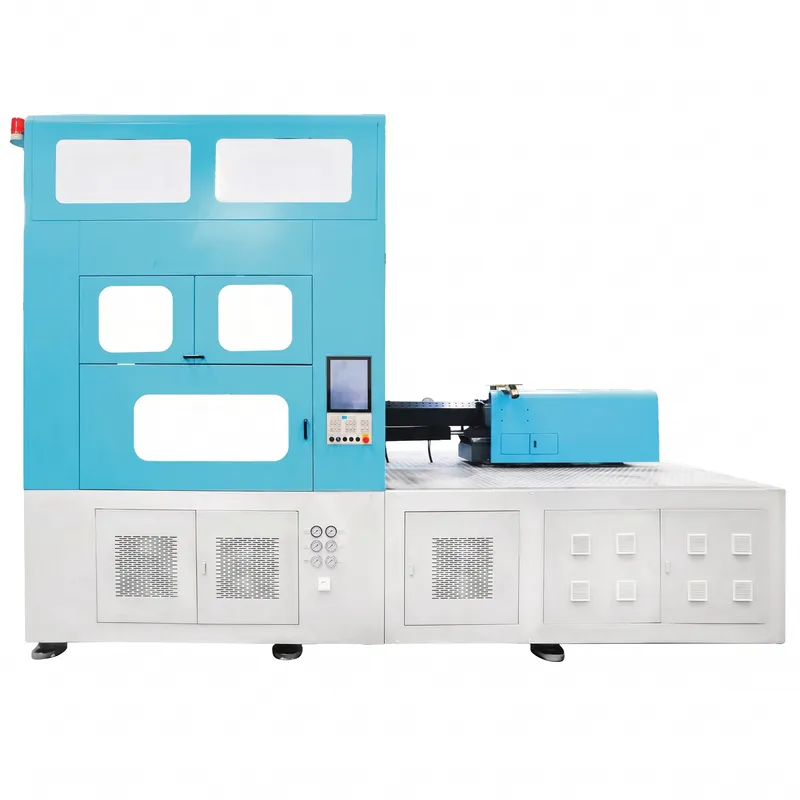
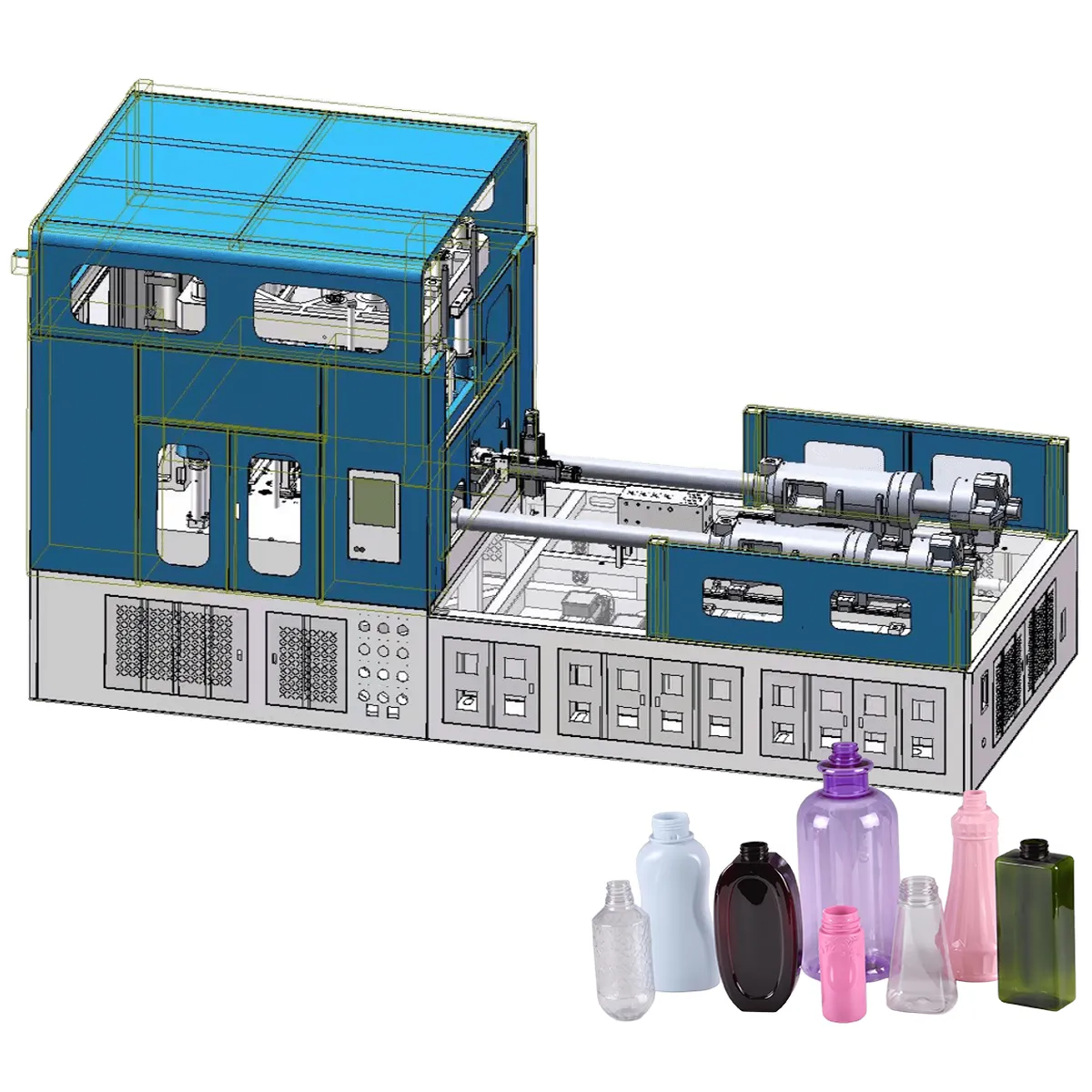
Macchina per stampaggio a iniezione-soffiaggio monostadio Y280-V6 (6 stazioni)
The Y280-V6 One Step Injection Stretch Blow Molding Machine is a highly efficient plastic container molding process widely used in the production of high-precision, high-demand hollow plastic products, including baby bottles, water bottles, medicine bottles, craft and special-shaped bottles, and cosmetic bottles made of PET, PETG, PP, PC, Tritan, PS, ABS, or PLA. The Y280-V6 is a direct-replacement option for leading Japanese injection stretch blow molding machines and is available in Standard, Servo, and Fully Electric configurations to suit diverse production environments.
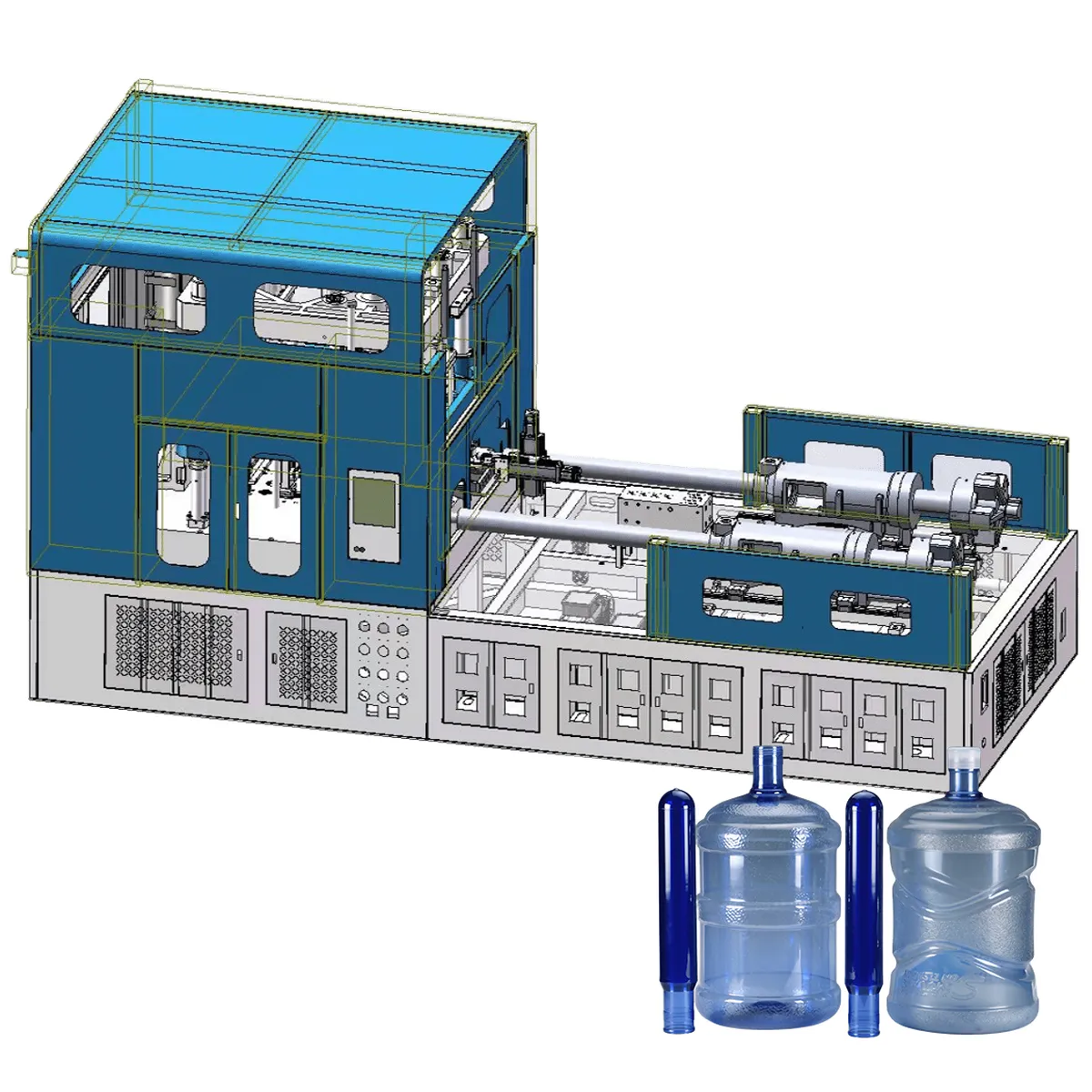
The Y280-V6 One Step Injection Stretch Blow Molding Machine is a highly efficient plastic container molding process widely used in the production of high-precision, high-demand hollow plastic products, including baby bottles, water bottles, medicine bottles, craft and special-shaped bottles, and cosmetic bottles made of PET, PETG, PP, PC, Tritan, PS, ABS, or PLA. As a leading one step ISBM machine with six stations, its defining feature is that injection, stretching, and blow moulding are all completed continuously within the same equipment without any intermediate steps. This single-stage design eliminates reheating energy, reduces floor space, and significantly improves both production efficiency and batch-to-batch product consistency. The Y280-V6 is a direct-replacement option for leading Japanese injection stretch blow molding machines and is available in Standard, Servo, and Fully Electric configurations to suit diverse production environments.
The six-station rotary turntable architecture of the Y280-V6 sets it apart from conventional four-station ISBM machines. By adding two additional stations to the processing cycle, the machine can produce up to six plastic bottles simultaneously per cycle, delivering throughput levels that match high-volume cosmetic, pharmaceutical, beverage, and personal care packaging lines. All critical components are sourced from trusted global suppliers: Japan Yaskawa or WEICHI servo motors drive the turntable, American Parker high-pressure valves manage blowing air, Airtak air cylinders handle actuation, and YUKEN hydraulic control valves from Taiwan govern pressure regulation. The twin-screw system is heated by nano far-infrared energy-saving rings, reducing heating power consumption while maintaining melt quality. Whether you operate in the pharmaceutical sector requiring GMP-grade oil-free production, or a cosmetic packaging line demanding flawless surface finish with no visible parting lines, the Y280-V6 delivers. It is an ideal solution for businesses seeking a reliable PET injection stretch blow molding machine with proven industrial-grade durability and broad mold compatibility.
Marca e modello sostituibili
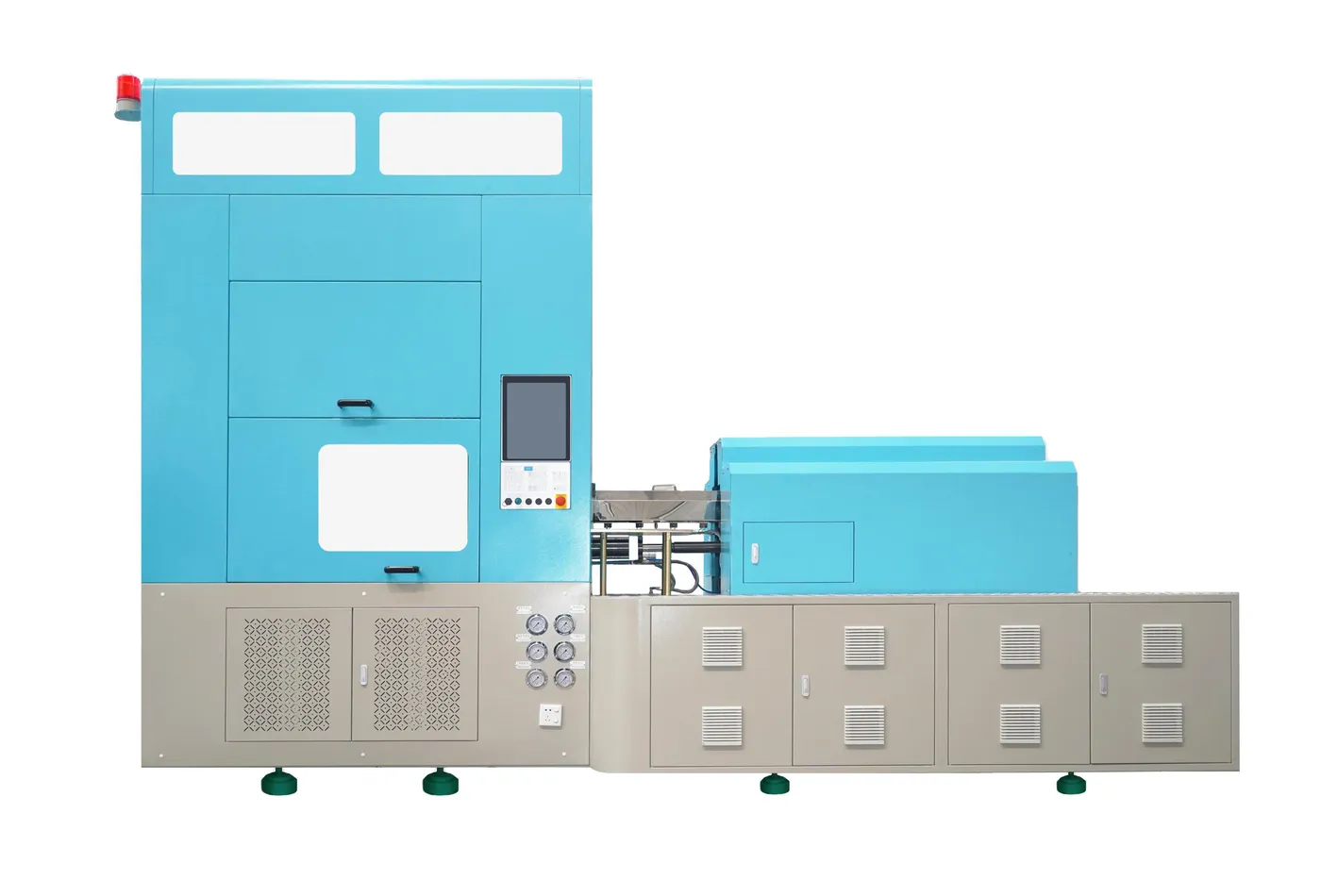
CMN Transmission offre una gamma completa di macchine per lo stampaggio a iniezione-soffiaggio, ciascuna progettata come sostituto diretto dei principali marchi giapponesi. Tutti i modelli sono disponibili nelle configurazioni Standard, Servo e Completamente Elettrica per soddisfare le vostre esigenze di produzione.
| Modello standard | Y150-V4 | Y200-V4 | Y250-V4 |
 | Compatibile con l'ASB-12M giapponese | Compatibile con l'Aoki 250 giapponese | Compatibile con l'ASB-70DPH giapponese |
| Y150-V4-B | Y500-V3 | - | |
| Compatibile con l'Aoki 100 giapponese | Compatibile con l'Aoki 500 giapponese | - | |
| Serraggio idraulico, iniezione idraulica a vite. | |||
| Modello servo | YS150-V4 | YS200-V4 | YS250-V4 |
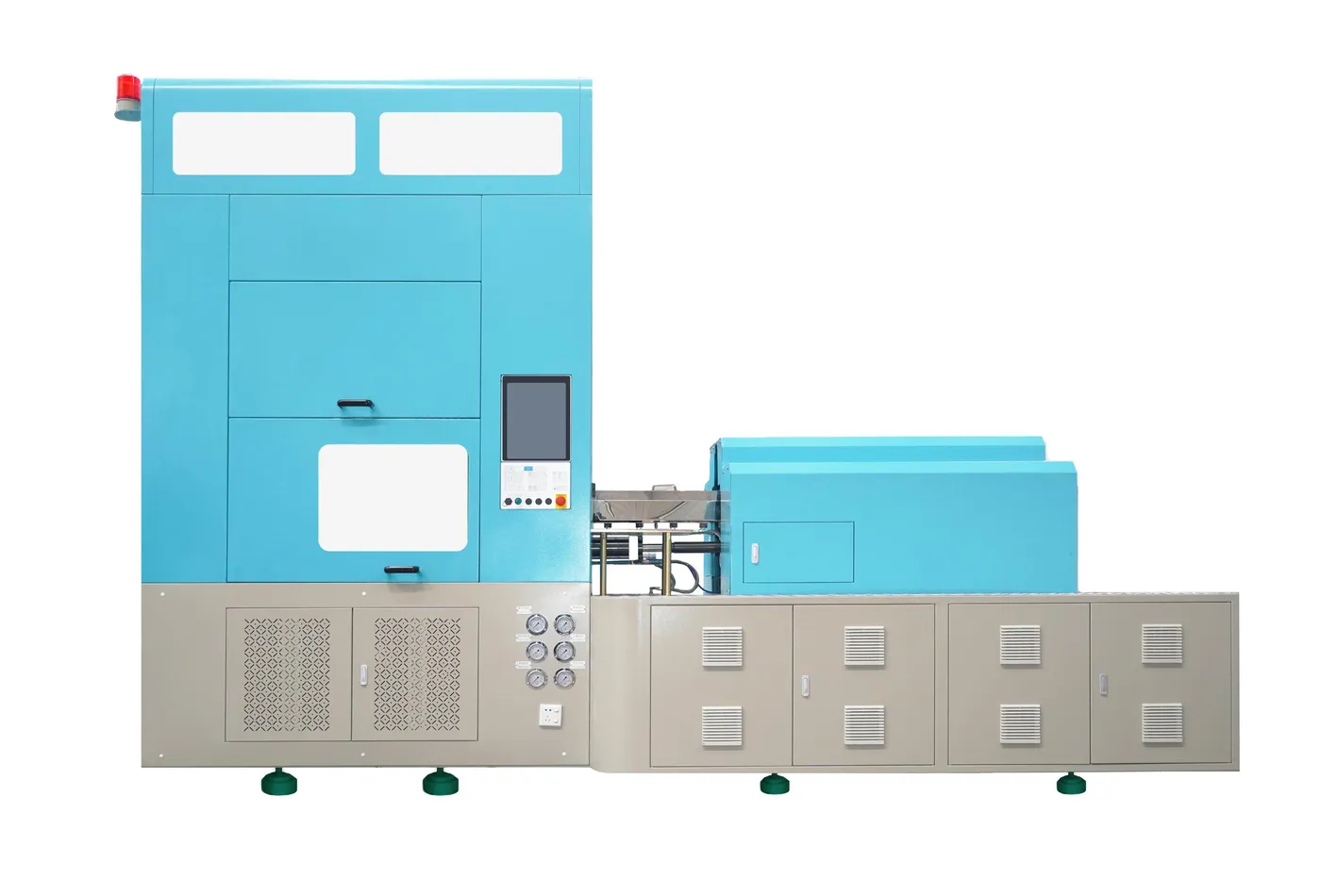 | Serraggio servoassistito, iniezione di vite servoassistita, alta precisione, basso consumo energetico, stabilità a lungo termine | ||
| Modello completamente elettrico | Y150-V4-EV | Y200-V4-EV | Y250-V4-EV |
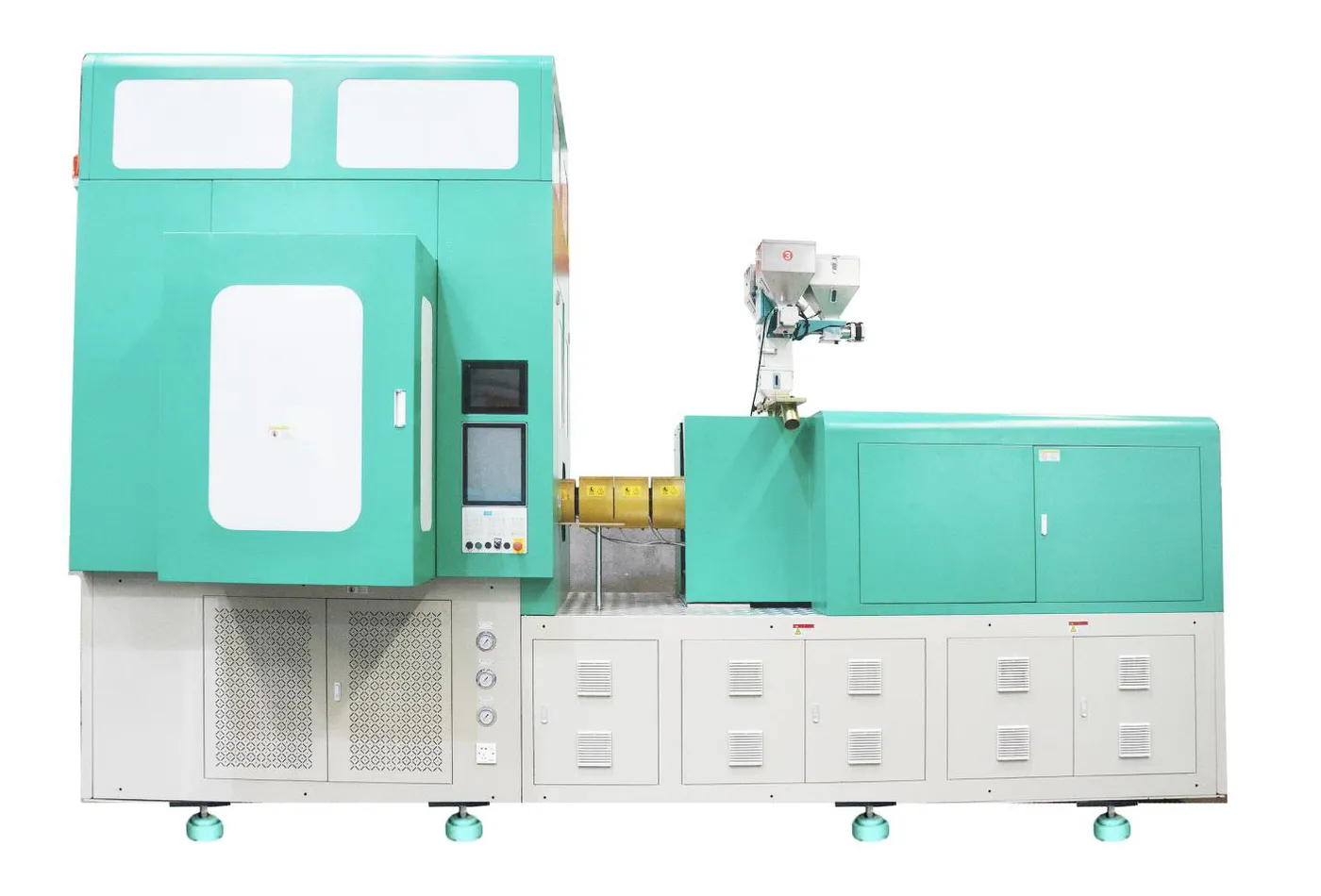 | Azionamento completamente elettrico, senza l'utilizzo di prodotti contaminati da petrolio. | ||
I vantaggi della nostra macchina ISBM
1. La qualità è superiore. Le bottiglie di plastica prodotte con le macchine per soffiaggio giapponesi presentano tutte una linea di separazione. Si tratta di una sporgenza di plastica tra i due stampi, su entrambi i lati, che lascia un segno. I nostri stampi, invece, sono estremamente precisi e il segno è completamente invisibile.
2. La nostra produzione è rapida, con un'ampia gamma di soluzioni di viti e un'elevata velocità. Mentre il Giappone può produrre quattro bottiglie di plastica alla volta, noi ne possiamo produrre sei.
3. Risparmio energetico. Le nostre macchine consumano da 15% a 25% in meno di energia rispetto a quelle in Giappone, Europa e Stati Uniti.
4. È stata adottata un'ampia gamma di tecnologie di controllo elettrico per sostituire i componenti idraulici e pneumatici. Ad esempio, i componenti pneumatici utilizzati nel meccanismo di taglio inferiore in Giappone sono stati sostituiti qui da servomotori, raddoppiandone la velocità. Nell'industria farmaceutica e in altri settori, è possibile utilizzare esclusivamente servomotori senza alcun sistema idraulico, garantendo la conformità agli standard GMP e il funzionamento in un ambiente privo di olio e inquinamento.
Specifiche del prodotto
| Articolo | Unità | Specifiche | |||||||
| Nome | One-step injection stretch blow molding machine (6-station) | ||||||||
| Modello | Y280-V6 | ||||||||
| Produttore | Trasmissione CMN | ||||||||
| Meterial | PET/PETG | ||||||||
| Diametro della vite | MM | 40 | 50 | 55 | 60 | ||||
| Volume di iniezione teorico | CM³ | 188 | 310 | 442 | 480 | ||||
| Velocità di rotazione della vite (RPM) | r/min | 270 | 180 | 150 | 150~220 | ||||
| Forza di serraggio dell'iniezione | KN | 150 | |||||||
| Forza di serraggio del soffiaggio | KN | 200 | |||||||
| Potenza del motore | KW | 43.2 | |||||||
| Potenza di riscaldamento | KW | 10 | |||||||
| pressione dell'aria soffiata | Mpa | 2.0-3.5 | |||||||
| Pressione dell'acqua di raffreddamento | Mpa | 0.4-0.6 | |||||||
| Pressione dell'acqua del radiatore dell'olio motore | Mpa | 0.3-0.4 | |||||||
| Temperatura dell'acqua del radiatore dell'olio motore | °C | 20-25 | |||||||
| Voltaggio | V | 370-400 | |||||||
| Dimensioni (L*P*A) | MM | 5900x2600x3200 | |||||||
| Peso | T | 14 | |||||||
| Dimensioni del prodotto | |||||||||
| Quantità del prodotto | PCS | 1 | 2 | 4 | 5 | 6 | 7 | 9 | 10 |
| Diametro della bottiglia (BD) | MM | 120 | 110 | 68 | 55 | 50 | 45 | 35 | 20 |
| Altezza della bottiglia (H) | MM | 210 | 150 | 100 | |||||
| Diametro del collo (E) | MM | 85 | 70 | 50 | 38 | 32 | 25 | 17 | 12 |
| Volume massimo della bottiglia (ml) | ML | 2500 | 1500 | 900 | 400 | 250 | 100 | 30 | 20 |
| Peso massimo della bottiglia (W) | G | 130 | 65 | 43 | 32 | 26 | 22 | 18 | 16 |
Parametri della macchina
| Diametro della vite: | 50 mm (opzionale) |
| Capacità teorica di iniezione: | 310 g |
| Forza di serraggio dell'iniezione: | 150 kN |
| tratto superiore dello stampo: | 250 mm |
| Corsa inferiore dello stampo: | 205 mm |
| TEMP. Regolazione della frequenza cardiaca: | 250 mm |
| TEMP. regolazione della corsa della canna: | 230 mm |
| Fase di uscita: | 170 mm |
| Forza di serraggio del soffiaggio: | 200 kN (lato singolo) |
| Colpo centrale di soffiaggio: | 250 mm |
| Fase di soffiaggio: | 75+75mm |
| Serbatoio dell'olio VOL: | 300 litri |
| Dimensioni (L×P×A): | 5.9*2.6*3.2m |
| Peso: | 14T |
Norma tecnica
| Sistema di servocontrollo: | Using 2 sets of servo pump systems. |
| Potenza del servomotore: | Inovance/ WEICHI servo motor power: 43.2KW. |
| Sistema di controllo computerizzato: | Utilizzo del PLC Innovance/MiRLE. |
| Azionamento del piatto girevole: | Il piatto girevole è dotato di un servomotore giapponese Yaskawa o di un servomotore WEICHI con riduttore taiwanese TSUNTIEN. |
| Valvola ad alta pressione: | Utilizzo della valvola ad alta pressione American Parker. |
| Cilindro pneumatico: | Utilizzo del cilindro pneumatico Aitak. |
| Controllo della temperatura: | Using an integrated control box to control temperature, which is highly accurate, stable, and easy to operate. |
| Valvola di controllo della pressione idraulica: | Utilizzo di una valvola di controllo della pressione idraulica YUKEN proveniente da Taiwan, Cina. |
| Viti riscaldate: | The twin-screw is heated by a nano-far-infrared energy-saving heating ring(10KW). |
| Struttura stampata a soffiaggio: | La struttura di stampaggio a soffiaggio adotta un sistema di bloccaggio dello stampo con cilindro idraulico o doppio servomotore con funzione di compensazione dell'alta pressione. |
| Unità di iniezione: | The double-injection unit is controled by a single cylinder. The melt motor may be controlled either hydraulically or by a servo motor. |
| Tubo dell'olio: | Il tubo dell'olio è realizzato con materiale importato dall'Italia. |
| Potenza totale della macchina: | Total power of the machine:53.2KW. |
Key Features of the Y280-V6 ISBM Machine
1. Superior Product Quality
The single-stage injection stretch blow molding machine process produces bottles directly from preforms without reheating, which preserves molecular alignment and surface integrity. Containers achieve high optical clarity, smooth surface finishes, and uniform wall thickness in every cycle. Because the preform and finished bottle are made on the same machine without intermediate handling, there is virtually no risk of contamination or surface damage. The Y280-V6 mold tooling is manufactured to extremely tight tolerances, making parting line marks invisible to the naked eye. This is a clear advantage over Japanese-brand alternatives where a visible parting line protrusion is common.
2. Flexible Design Capabilities
The Y280-V6 customized injection stretch blow molding machine platform supports intricate bottle shapes, custom neck finishes, and container volumes from 20 ml up to 2,500 ml. With 8 available cavity configurations per cycle, the machine adapts to both small-batch specialty orders and large-volume commodity runs. This adaptability makes it ideal for cosmetic brands requiring distinctive bottle profiles, pharmaceutical manufacturers demanding precise closure fitment, and premium beverage producers needing transparent PET bottles with high visual appeal. The machine's mold compatibility also extends to tooling originally designed for Japanese ASB and Aoki equipment.
3. Sustainability and Lower Energy Use
The one-step process eliminates the secondary preform reheating stage that two-step systems require, reducing overall energy consumption by 15% to 25% compared to equivalent Japanese, European, or American machines. Nano far-infrared energy-saving heating rings on the twin-screw system further reduce heat loss during the melting phase. The process also generates less material waste than extrusion blow molding because preform weight is precisely controlled before blowing. For manufacturers working with bio-based resins such as PLA or recycled PET content, the stable melt temperature management of the Y280-V6 helps maintain consistent processing conditions without degradation.
4. High Production Efficiency
The six-station rotary architecture of the Y280-V6 produces more bottles per cycle than the four-station designs found in competing Japanese ISBM machine models. While a standard four-station Japanese machine typically produces four bottles simultaneously, the Y280-V6 outputs six bottles per cycle. Combined with a servo-driven turntable and dual servo pump systems that reduce pressure stabilization delays, overall throughput increases significantly. The integrated single-stage processing cycle also reduces machine downtime between production runs, eliminating the need to synchronize separate injection and blow molding equipment. Full-process PLC automation reduces operator intervention and supports cost-effective mass production across extended shifts.
5. Versatile Application Range
As a true-purpose injection blow molding machine for packaging, the Y280-V6 produces containers ranging from 20 ml eye-drop bottles to 2,500 ml wide-mouth packaging. Supported materials include PET, PETG, PP, PC, Tritan, PS, ABS, and PLA, giving manufacturers broad flexibility to serve pharmaceutical, cosmetic, food, beverage, chemical, and personal care markets from a single machine platform. Multiple screw diameter configurations (40, 50, 55, or 60 mm) allow operators to match injection shot size to the specific product and material being run. This versatility makes the Y280-V6 one of the most commercially adaptable one step injection stretch blow molding machines currently available from Chinese manufacturers.
6. Compatible with Japanese ASB or Aoki Machine
One of the most significant commercial benefits of the Y280-V6 is its direct compatibility with mold tooling originally designed for Japanese ASB injection stretch blow molding machines. For manufacturers currently running ASB or Aoki machines, this means existing mold investments can be transferred to the CMN machine without costly retooling. The Y280-V6 is engineered as a direct replacement for ASB ISBM machine models and also offers compatibility paths for Aoki model formats. This mold compatibility dramatically reduces the total cost of switching from Japanese to CMN equipment.
Working Principle
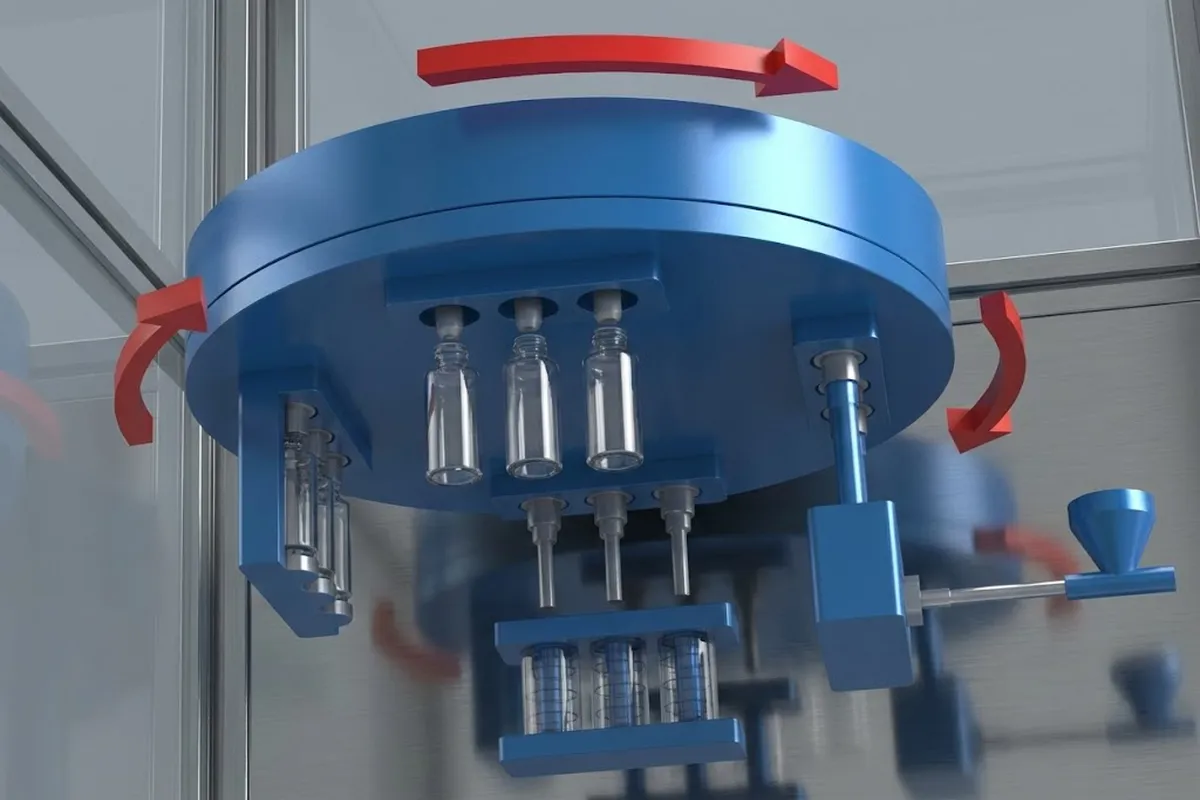
Fase 1: Stampaggio a iniezione
The process begins by heating PET or PETG resin to a precise molten state using the nano far-infrared screw heating system. The molten material is injected under 150 KN clamping force into a mold cavity to form a preform. The preform is partially cooled to stabilize its shape while retaining sufficient heat to allow effective stretching in the next stage. During this phase, the neck finish, thread geometry, and sealing area are formed to their final dimensions. This ensures reliable cap fitment, dimensional accuracy, and consistent bottle weight from cycle to cycle. The injection unit operates under single-cylinder control, with the melt motor configurable as either hydraulic or servo-driven depending on the production environment and accuracy requirements.
Fase 2: Eseguire il condizionamento e il trasferimento
The Japan Yaskawa or WEICHI servo motor drives the six-station rotary turntable, transferring the freshly molded preform from the injection station to the temperature conditioning zone with precise indexing accuracy. As the preform travels between stations, it passes through controlled thermal management zones managed by the integrated temperature control box. The TEMP. Regulating Core Stroke of 250 mm and TEMP. Regulating Barrel Stroke of 230 mm allow fine adjustment of heat distribution along the preform body. This consistent thermal conditioning step is critical for achieving uniform material behavior during the subsequent stretching and blowing stage. Uneven preform temperature is one of the primary causes of thin shoulders, thick bases, or cracking during blow molding, all of which the Y280-V6 conditioning system is engineered to prevent.
Step 3: Stretch Blow Molding
This is the transformation stage where the preform becomes its final container shape. The blow core stroke of 250 mm and blow mold stroke of 75 + 75 mm on the Y280-V6 provide generous travel range to accommodate a wide range of bottle heights and body profiles. Biaxial stretching begins as a stretch rod extends the preform lengthwise, followed by compressed air at 2.0 to 3.5 MPa expanding it outward to match the blow mold cavity. The hydraulic cylinder or dual servo motor mold clamping system with high-pressure compensation function maintains 200 KN blowing clamping force (single side), ensuring the mold seals fully against the internal air pressure. This dual-axis orientation of the polymer molecules significantly improves the finished container's resistance to gas penetration, impact force, and internal pressure, making the output ideal for carbonated beverages, pharmaceutical liquids, and pressurized cosmetic packaging.
Fase 4: Raffreddamento ed espulsione
Once the container has been fully blown into its final shape, the cooling water system (maintained at 0.4 to 0.6 MPa and 20 to 25 degrees Celsius through the machine oil cooler) rapidly removes heat from the mold cavity to solidify the bottle form. Controlled cooling is essential for dimensional stability, consistent bottle weight, and preventing internal stress that could lead to deformation during storage or transport. After sufficient cooling is achieved, the mold opens and the take-out mechanism (with a stroke of 170 mm) automatically ejects the finished bottle from the station. The complete molding cycle concludes with a ready-to-fill plastic container delivered directly to the take-out position, requiring no manual trimming, reheating, or secondary processing before use.
Ambiti di applicazione
1. Cosmetic Bottles
High-end cosmetic packaging demands flawless surface aesthetics, transparency, and dimensional consistency. The Y280-V6 produces skincare, toner, serum, and lotion containers in Tritan, PETG, and PET with no visible parting lines and excellent optical clarity. The mold precision achievable with CMN tooling makes it the preferred macchina per stampaggio a iniezione-stiro-soffiaggio for cosmetic brands supplying premium retail markets in Europe, North America, and Southeast Asia.
2. Flaconi farmaceutici
The Y280-V6 is widely used in pharmaceutical packaging facilities requiring GMP-compliant production. The machine supports fully electric, oil-free servo configurations that eliminate hydraulic oil contamination risk. Pharmaceutical bottles for oral liquids, tablets, capsules, syrups, and eye drops can be produced in PET, PETG, and PP from 20 ml to 500 ml with highly accurate neck thread geometry to ensure reliable closure sealing and dosing accuracy.
3. Bottiglie di prodotti chimici
Chemical packaging requires containers that resist solvent permeation, maintain structural integrity under varied storage conditions, and offer tamper-evident closure compatibility. The Y280-V6 produces PP and PET chemical bottles with uniform wall thickness and stable shoulder geometry. Applications include agricultural chemical packaging, cleaning agent bottles, industrial lubricant containers, and specialty chemical packaging requiring chemical resistance and controlled vapor permeability.
4. Hand Wash Bottles
Hand wash, liquid soap, and antibacterial gel packaging often requires ergonomic shapes, pump neck compatibility, and high visual appeal on retail shelves. The Y280-V6 ISBM process handles the complex shapes common in personal care packaging, including oval, square-shoulder, and waisted body profiles. The biaxial orientation of the PET or PP material improves bottle squeeze resistance and drop impact performance, which are important factors for consumer personal care products during distribution.
5. Beverage Bottles
PET beverage bottles produced on the Y280-V6 benefit from the biaxial molecular orientation created by the stretch blow process, resulting in improved top-load strength, burst pressure resistance, and excellent optical clarity. The machine can produce still water, juice, tea, and edible oil containers from 100 ml to 2,500 ml per cycle. The servo-controlled turntable indexing ensures consistent preform positioning between stations, which directly affects fill volume accuracy and bottle weight stability across large production runs.
6. Feeding Bottles (Baby Bottles)
Baby bottle production is one of the most demanding applications for any ISBM machine because the materials must be BPA-free, completely transparent, and free of surface defects. The Y280-V6 processes Tritan, PPSU, PC, and PET resins for baby bottles that meet international food contact and chemical migration standards. The one-step ISBM process prevents contamination between stations that could occur with two-step systems, making it the preferred technology for premium infant feeding product manufacturers globally.
7. Body Wash Bottles
Body wash packaging must deliver both functional performance and strong shelf presence. The Y280-V6 supports production of wide-body, tinted, and frosted PET and PETG body wash containers with pump or flip-top closure neck finishes. The machine's temperature conditioning accuracy allows processing of opaque and semi-transparent resin blends without inconsistent color distribution or localized thin spots, which are common defects when bottle shape complexity increases. Output ranges from 200 ml travel sizes to 1,000 ml family-size formats within the same cavity configuration.
8. Drinking Water Buckets
Large-format PET drinking water containers require outstanding structural rigidity, high clarity, and stackable base geometry. The Y280-V6 accommodates wide-mouth neck configurations and large-body bottle designs up to 2,500 ml. The 200 KN blowing clamping force and 250 mm blow core stroke provide the dimensional control needed for consistent, thick-walled large containers. For water dispenser bottle manufacturers, the Y280-V6 offers a reliable, energy-efficient production platform that meets the volume demands of bulk water packaging markets in Asia, the Middle East, and Africa.
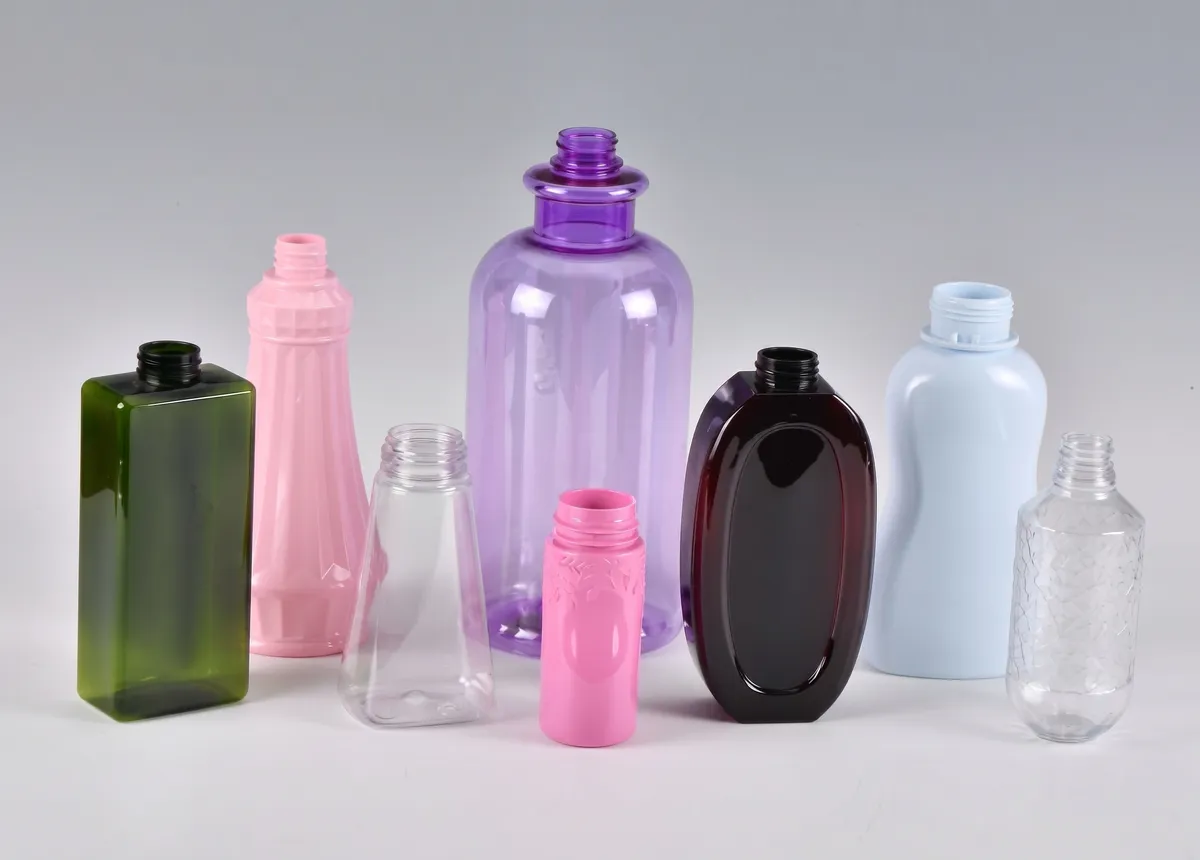 | 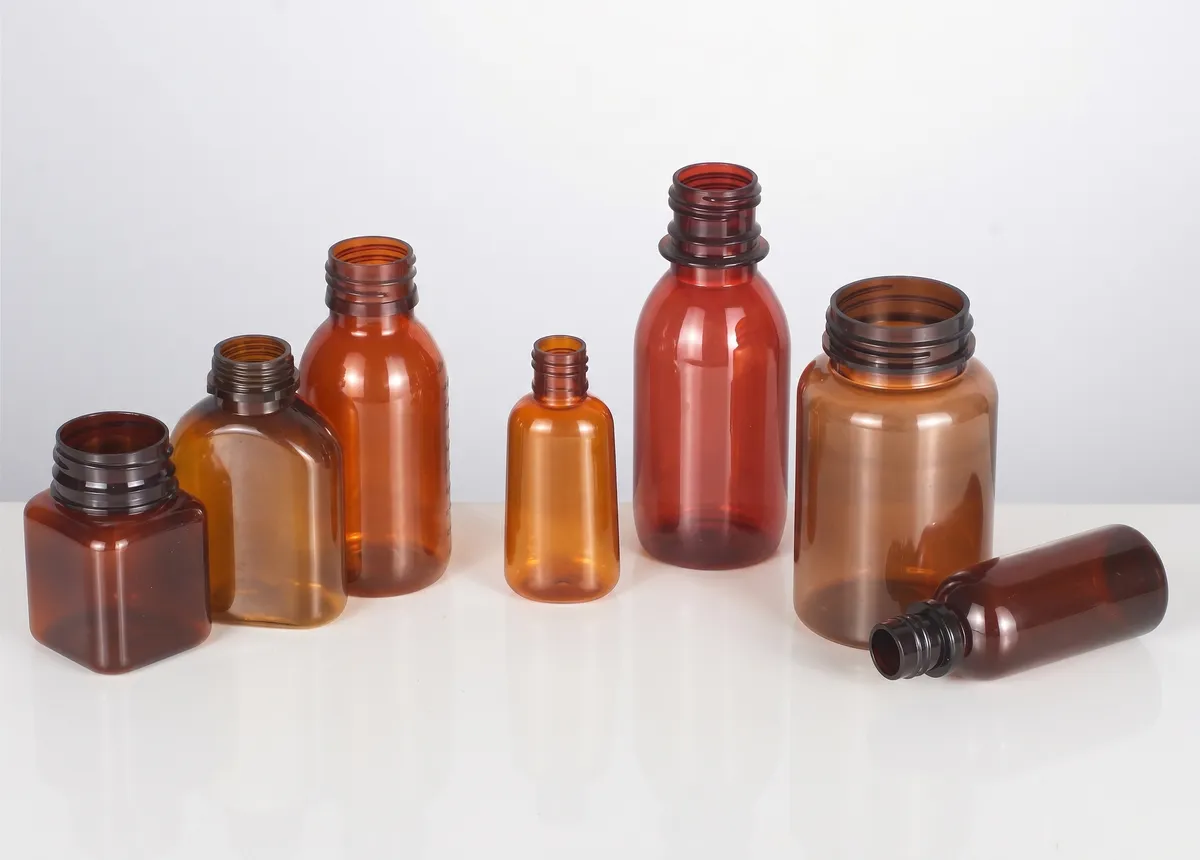 |
| Flacone cosmetico | Flacone farmaceutico |
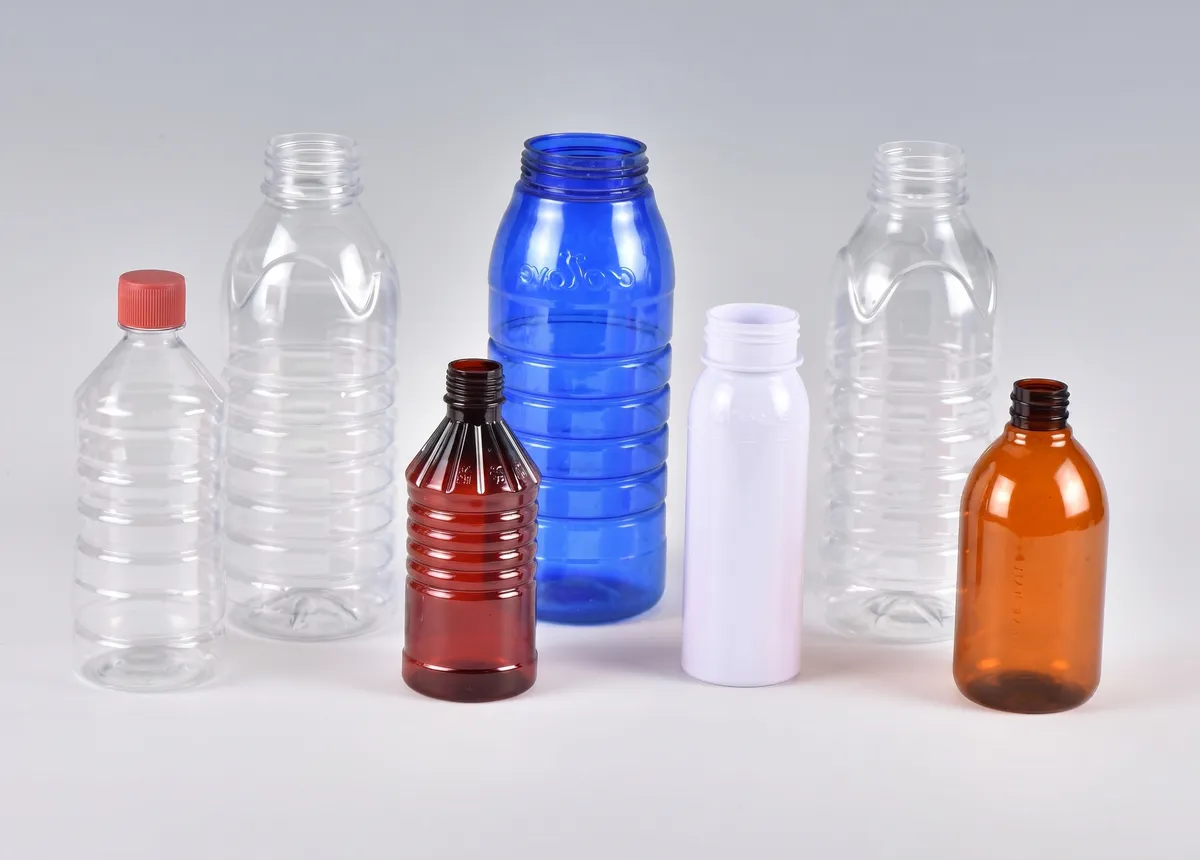 | 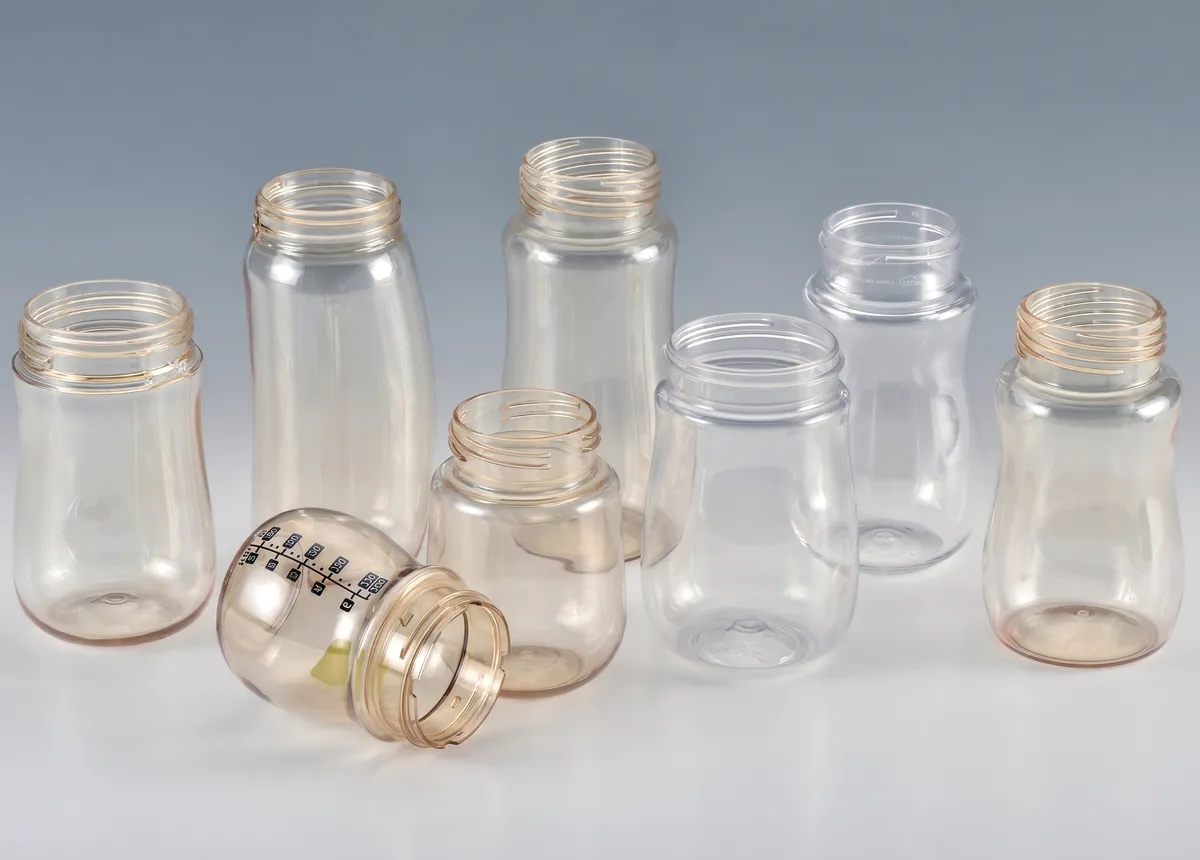 |
| Bottiglia chimica | Biberon |
Key Components of ISBM Y280-V6 Machine
Unità di serraggio
The Y280-V6 uses a dual-mode clamping system that supports either a hydraulic cylinder or dual servo motor configuration with high-pressure compensation. The injection clamping force of 150 KN and blow clamping force of 200 KN (single side) are precisely maintained throughout each production cycle. The upper mold stroke of 250 mm and lower mold stroke of 205 mm provide clearance for a wide range of bottle heights up to 210 mm. High-pressure compensation during mold closure eliminates parting line flash and ensures airtight sealing during the blow phase, directly improving finished bottle quality and reducing scrap rates.
Unità di iniezione
The double injection unit is controlled by a single cylinder, with the melt motor available in hydraulic or servo motor versions depending on the buyer's process requirements. The twin-screw design is heated by nano far-infrared energy-saving rings (10 KW total heating power) that distribute heat along the screw barrel with minimal energy loss. Available screw diameters of 40, 50, 55, and 60 mm allow the injection shot size to be matched precisely to the product cavity volume, with theoretical injection capacities ranging from 188 cm³ up to 480 cm³. This flexibility makes it practical to run both small cosmetic containers and large water containers on the same machine platform with screw changeovers.
Sistema di stampaggio
CMN Transmission manufactures injection stretch blow molds to extremely tight tolerances, producing finished containers with parting lines that are virtually invisible to the naked eye. This is a direct performance improvement over equivalent Japanese-brand machines where parting line protrusion is a common quality issue. The mold tooling is compatible with existing ASB injection stretch blow molding machine mold formats, which allows manufacturers transitioning from Japanese equipment to reuse their existing tooling investment. Cavity configurations range from 1 to 10 cavities per cycle, with bottle diameter ranges from 20 mm to 120 mm and volumes from 20 ml to 2,500 ml.
Blow Pin and Air Delivery System
The blow pin assembly on the Y280-V6 operates with a 250 mm blow core stroke, providing sufficient travel for tall bottle body profiles. High-pressure air is delivered through American Parker valves at blowing pressures of 2.0 to 3.5 MPa, which ensures complete mold filling during the blow phase even for complex or thick-walled bottle designs. The consistent air pressure management prevents thin spots, uneven wall distribution, and blow-out defects that can occur when air delivery timing or pressure fluctuates between cycles. The Parker valve specification also ensures long service life under continuous high-pressure cycling conditions typical of commercial production schedules.
Sistema di raffreddamento
The Y280-V6 cooling system maintains machine oil cooler water at 20 to 25 degrees Celsius at 0.3 to 0.4 MPa, while the primary mold cooling water circuit operates at 0.4 to 0.6 MPa. This dual-circuit approach separates hydraulic system heat management from mold cooling, allowing each to be optimized independently. Effective mold cooling directly determines cycle time and dimensional stability of the finished bottle. The 300-liter oil tank provides adequate thermal mass to buffer heat load fluctuations during high-speed production, maintaining consistent hydraulic oil temperature and preventing viscosity-related performance changes that could affect clamping force or injection pressure accuracy.
Sistema di espulsione
The take-out mechanism operates with a 170 mm stroke and is driven by Airtak air cylinders for fast, consistent bottle removal at the ejection station. Servo-timed ejection is synchronized with the turntable indexing cycle through the Inovance or MiRLE PLC to prevent mechanical interference and allow maximum production speed without compromising bottle integrity during removal. The ejection stroke and speed are adjustable through the HMI interface, allowing operators to tune take-out timing when switching between different bottle heights or weights. Gentle ejection control is particularly important for thin-walled or elongated containers where rough handling at the take-out station can cause deformation before the bottle has fully solidified.
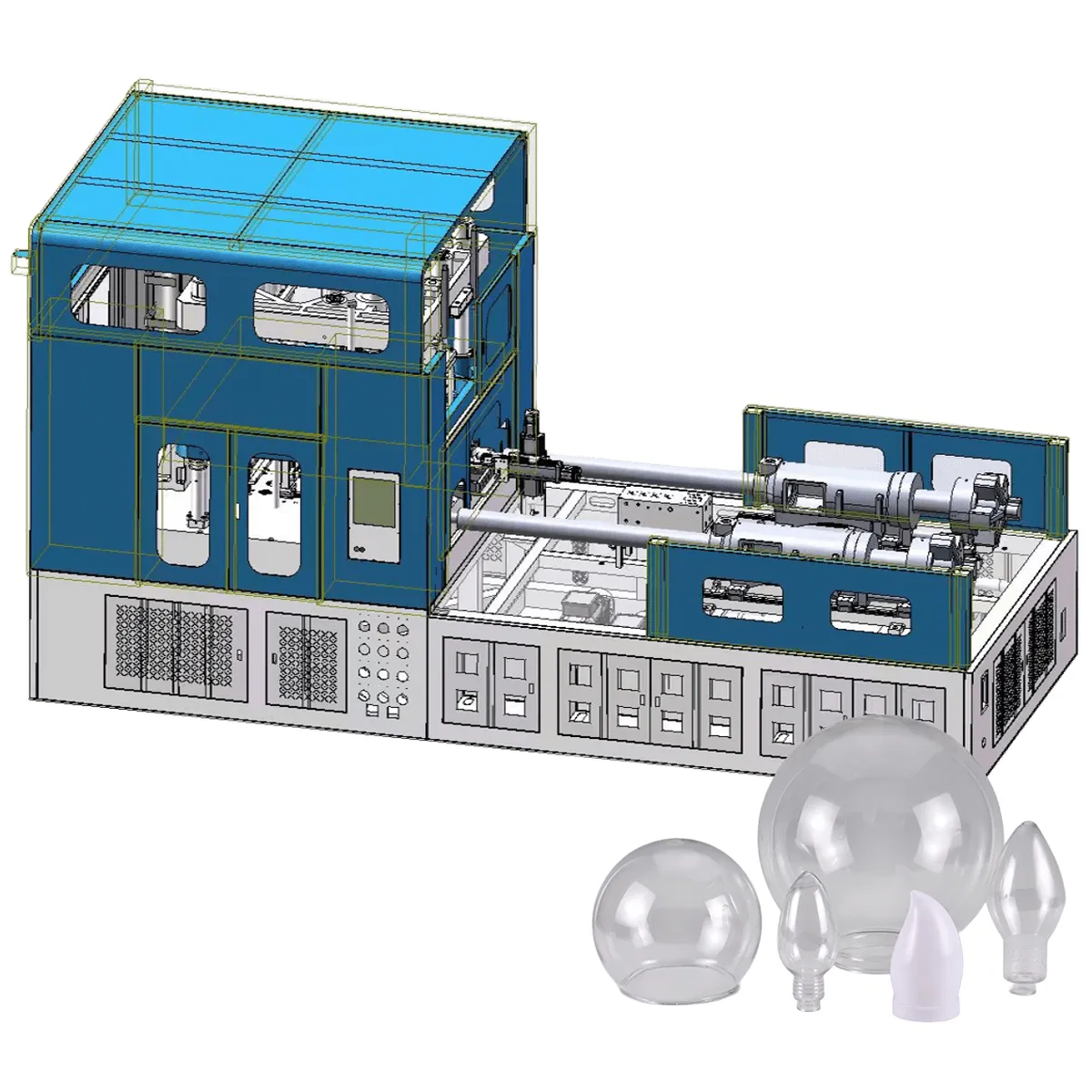
Injection Blow Molding vs Injection Stretch Blow Molding vs Extrusion Blow Molding
Choosing the right blow molding process is a fundamental decision that affects bottle quality, production cost, mold investment, and material compatibility. Here is how the three main processes compare.
EBM | Extrusion Blow Molding
EBM starts with a hot hollow parison formed by an extruder. The mold closes around the parison, and compressed air expands the plastic into the mold cavity. This method is highly flexible for producing large containers, handled bottles, drums, and HDPE packaging where exact neck precision is less critical. Common materials include HDPE, LDPE, PP, and PVC.
The primary advantage of EBM is shape freedom. Parison extrusion can form handles, wide bodies, and offset shapes more easily than injection-based processes. However, parison sag under gravity can create uneven wall thickness, and the mold closing process often produces flash that requires trimming. For buyers, the main quality risks are inconsistent wall distribution around handles or shoulders and less precise neck thread definition.
IBM | Injection Blow Molding
IBM starts with an injection-molded preform where the neck, thread, and sealing area are formed with high dimensional precision before the bottle body is blown. The preform is transferred into a blow mold and inflated into its final shape. Because the neck geometry is established during injection before blowing, IBM produces exceptionally accurate thread definitions and closure sealing surfaces.
This precision matters most for small pharmaceutical bottles, eye-drop containers, cosmetic jars, and medical packaging where cap and pump fitment must be leak-free. IBM also produces consistent bottle weight and repeatable dimensions. However, IBM does not include a stretch rod, so the biaxial orientation benefits of the ISBM process are not achieved, making IBM less suitable for large or lightweight PET containers where strength and clarity at low wall thickness are priorities.
ISBM | Injection Stretch Blow Molding
ISBM is the process used in the Y280-V6. Like IBM, it starts with an injection-molded preform that establishes the neck geometry. But ISBM adds a stretch rod that extends the preform vertically before compressed air expands it outward. This biaxial orientation aligns the polymer molecules in two directions simultaneously, producing bottles with significantly improved clarity, top-load strength, gas barrier performance, and lightweight potential.
These properties are critical for PET water bottles, carbonated beverage packaging, edible oil containers, and clear cosmetic bottles where both performance and visual clarity matter. The single-stage injection stretch blow molding machine design of the Y280-V6 combines injection and blow molding in one continuous cycle without secondary preform reheating, achieving 15 to 25% energy savings compared to two-step systems while maintaining superior bottle quality and production speed.
Comparison Table
| Tipo | Presentazione iniziale | Materiali comuni | I migliori prodotti | Punto di forza principale | Principale limitazione |
|---|---|---|---|---|---|
| EBM | Parrocchia | HDPE, LDPE, PP, PVC | Grandi contenitori, bottiglie con manico, fusti | Flexible sizes and lower tooling cost | Minore precisione del collo, possibile flash |
| IBM | Preforma | HDPE, PP, PET, PS | Piccole bottiglie e vasetti di precisione | Finitura del collo e definizione della filettatura precise | Costi di attrezzaggio più elevati, gamma di taglie più ristretta |
| ISBM | Preforma stirata | PET, PETG, PP, Tritan | Clear bottles, beverage and cosmetic packaging | Strength, clarity, lightweighting, energy savings | Higher machine and mold initial cost |
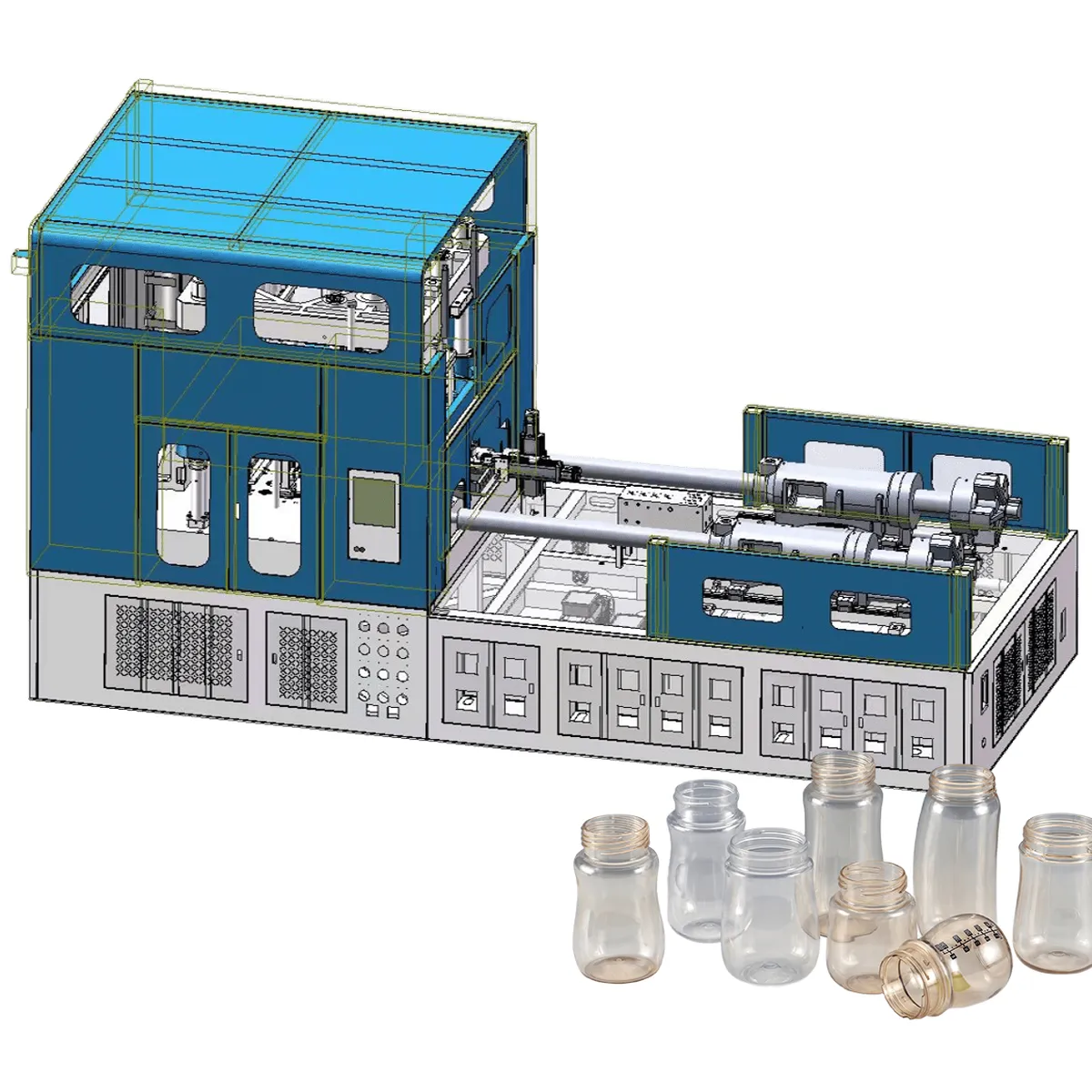
Materie prime compatibili con la macchina ISBM
PET (polietilene tereftalato)
PET is the most widely processed resin on the Y280-V6 and the material most closely associated with the ISBM process. Its excellent optical clarity, gas barrier properties, and lightweight strength make it the standard choice for water bottles, beverage containers, food packaging, and transparent cosmetic bottles. PET processed through biaxial ISBM stretching achieves significantly better mechanical properties than unstretched PET, including improved top-load strength and drop impact resistance.
PETG (Glycol-Modified PET)
PETG is a modified form of PET with superior impact resistance, easier processing, and the ability to be formed into complex shapes without cracking. It offers the same high clarity as standard PET but with greater flexibility and toughness. PETG is commonly chosen for cosmetic packaging, medical containers, and display packaging where the bottle must withstand rough handling or temperature variation without becoming brittle. The Y280-V6 handles PETG with consistent melt quality through its precise barrel temperature control.
PP (polipropilene)
PP is valued for its excellent chemical resistance, high-temperature tolerance, and food-contact safety compliance. It is widely used in pharmaceutical packaging, food containers, and personal care applications where the bottle must survive sterilization cycles or hot-fill processes. PP on the Y280-V6 requires careful temperature management due to its narrower processing window compared to PET, but the machine's integrated control box temperature system handles this reliably. PP bottles produced on the Y280-V6 offer a cost-effective alternative to glass for pharmaceutical and food applications.
PPSU (Polyphenylsulfone)
PPSU is a high-performance engineering resin offering exceptional heat resistance, hydrolytic stability, and transparency that withstands repeated steam sterilization cycles at 134 degrees Celsius. It is the premium choice for baby bottles and medical containers that must endure autoclave sterilization without degradation or discoloration. PPSU is BPA-free and meets the most stringent global food contact regulations. The Y280-V6's precision temperature control capability ensures stable melt flow of this high-viscosity resin without causing surface defects or molecular degradation.
PC (policarbonato)
PC offers the highest impact resistance among common transparent engineering plastics and is traditionally used in reusable water bottles, large water dispensing containers, and baby bottles. While BPA concerns have reduced PC use in certain markets, it remains an important material for industrial containers and optical-quality applications requiring exceptional clarity combined with toughness. The Y280-V6 processes PC with precise barrel temperature profiles to prevent degradation and color change during the injection phase. PC containers produced on the ISBM machine achieve superior drop resistance compared to those produced by other molding methods.
Tritan (Eastman Tritan Copolyester)
Tritan is a BPA-free copolyester developed by Eastman Chemical that combines the clarity and toughness of PC with enhanced chemical resistance and dishwasher durability. It has become the leading material for premium reusable water bottles, baby bottles, and kitchen containers marketed to health-conscious consumers. The Y280-V6 processes Tritan effectively through its stable screw temperature management, producing bottles with outstanding clarity, scratch resistance, and long-term durability that justify the premium positioning of Tritan-branded packaging in retail markets.
PCTG (Glycol-Modified PCT)
PCTG is a transparent copolyester with properties positioned between standard PETG and Tritan, offering excellent impact resistance, low-temperature clarity, and good chemical resistance. It is commonly used in cosmetic packaging, medical device housings, and consumer product containers where high clarity and toughness are both required at a cost point below Tritan. PCTG processes at moderate temperatures on the Y280-V6 and produces bottles with a crystal-clear appearance suitable for premium cosmetic and personal care packaging lines targeting demanding retail markets.
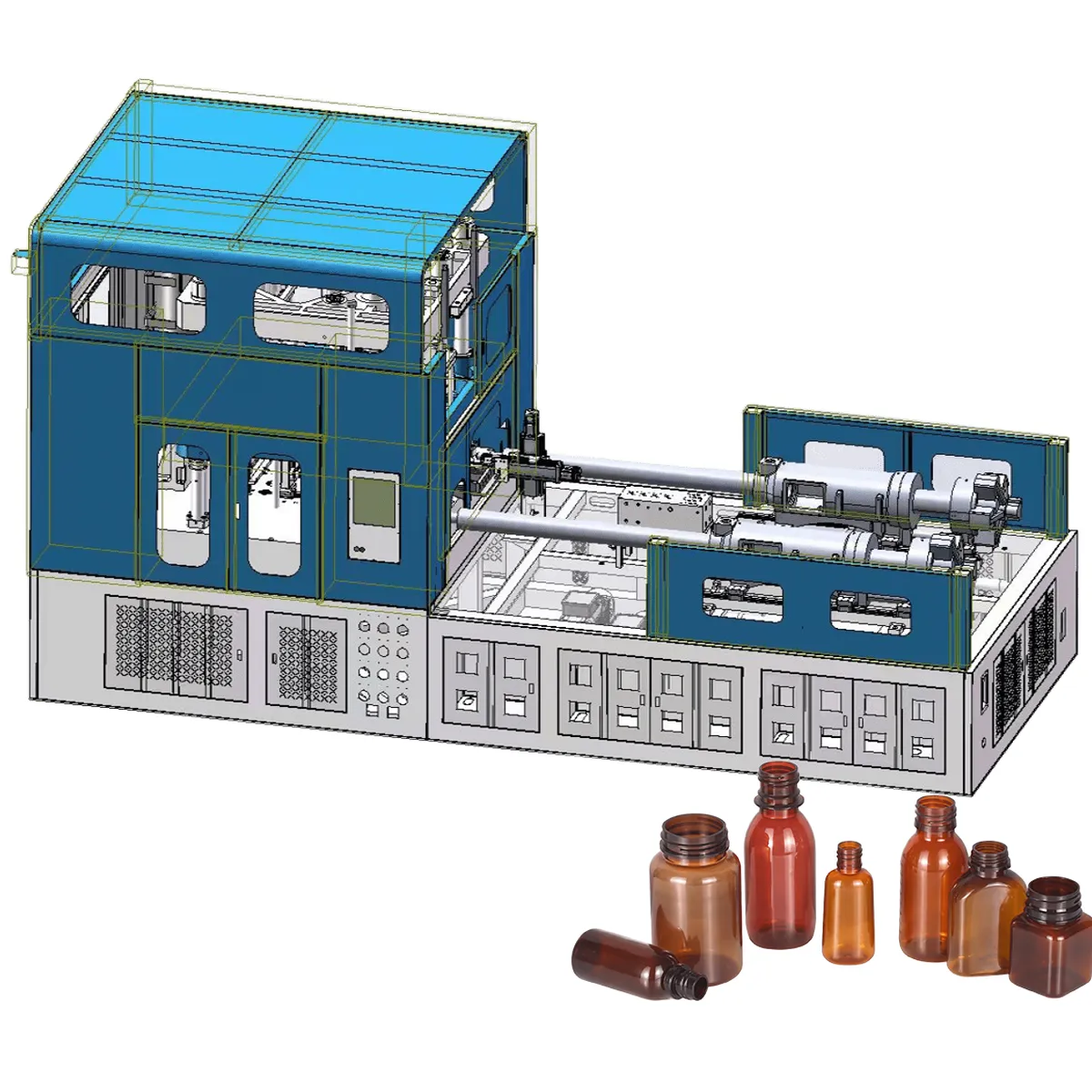
Injection Stretch Blow Molding Machine for Beverage Bottle Production
Step 1: PET Resin Drying and Hopper Loading
PET resin for beverage bottle production must be dried to a moisture content below 50 ppm before processing to prevent hydrolytic degradation during melt injection. A dehumidifying dryer operating at 160 to 170 degrees Celsius for 4 to 6 hours is typically required. Dried PET pellets are loaded into the machine hopper, which feeds the injection screw. Undried PET produces bottles with reduced intrinsic viscosity, visible surface haziness, and reduced mechanical strength that can cause bottles to fail burst pressure or drop tests during quality control inspection.
Step 2: Preform Injection Molding
The dried PET resin is fed to the screw barrel, melted at temperatures typically between 270 and 285 degrees Celsius, and injected under precise pressure into the injection mold to form the beverage bottle preform. The preform shape, including the neck thread, sealing surface, and body wall thickness distribution, is determined at this stage. For carbonated beverage bottles, neck finish accuracy is especially critical because the crown or screw cap must seal reliably against the internal CO2 pressure of 2.0 to 4.5 bar. The preform is partially cooled to a stable but pliable temperature before transfer.
Step 3: Temperature Conditioning and Turntable Transfer
The servo-driven rotary turntable transfers the freshly injected preform from the injection station to the temperature conditioning zone. The integrated control box temperature system manages thermal equilibration across the preform body length to achieve a consistent temperature profile before stretching begins. For beverage bottles, the optimal preform temperature for biaxial ISBM stretching is typically 85 to 100 degrees Celsius, varying by bottle design and wall thickness target. Uneven preform temperature at this stage is the most common cause of shoulder thinning, base thickening, and pearl white opacity in the finished bottle.
Step 4: Biaxial Stretch Blow Molding
The conditioned preform enters the blow station where the mold closes around it and a stretch rod extends the preform vertically to the base of the blow mold. High-pressure air at 2.0 to 3.5 MPa is then introduced through the blow pin to expand the preform outward against the mold cavity walls simultaneously. This biaxial stretching step is what produces the superior strength and clarity characteristic of ISBM PET bottles. For carbonated beverage bottles, the resulting molecular orientation improves CO2 barrier performance, burst pressure resistance, and thermal stability during hot filling or pasteurization processes.
Step 5: Mold Cooling and Bottle Solidification
Following the blow molding stage, the bottle is held inside the closed mold while cooling water circulated through the mold channels removes heat from the container surface. Cooling time is a direct determinant of cycle time and dimensional stability. For beverage bottles where high clarity and low haze are commercial requirements, rapid and uniform cooling prevents crystallization that would make the PET appear white or translucent. The Y280-V6 cooling water circuit maintains temperature at 20 to 25 degrees Celsius through the machine oil cooler, providing stable cooling conditions across extended production runs.
Step 6: Ejection and Quality Inspection
After sufficient cooling, the mold opens and the take-out mechanism with 170 mm stroke removes the finished beverage bottle from the blow station. The ejected bottle is transferred to the inspection and downstream packaging area. Quality checks for beverage bottles typically include visual inspection for surface defects and clarity, neck dimension gauging for cap fitment, weight measurement for fill volume consistency, and periodic burst pressure and drop impact testing according to the customer's quality plan. Bottles that pass inspection proceed directly to the filling line, conveyor system, or packing station without any secondary trimming or surface treatment.
Step 7: Downstream Packing and Storage
Finished beverage bottles from the Y280-V6 production line are typically collected on conveyors, counted into specified lot quantities, and packed into corrugated cartons or plastic bags for shipment to the filling plant. For high-volume operations, automatic bottle counting and bagging systems can be integrated downstream of the ISBM machine ejection station. Bottles should be stored in clean, dry conditions away from direct sunlight and chemical vapors that could affect PET surface quality before filling. Proper downstream handling protects the investment in bottle quality that the ISBM process provides throughout the entire production chain.
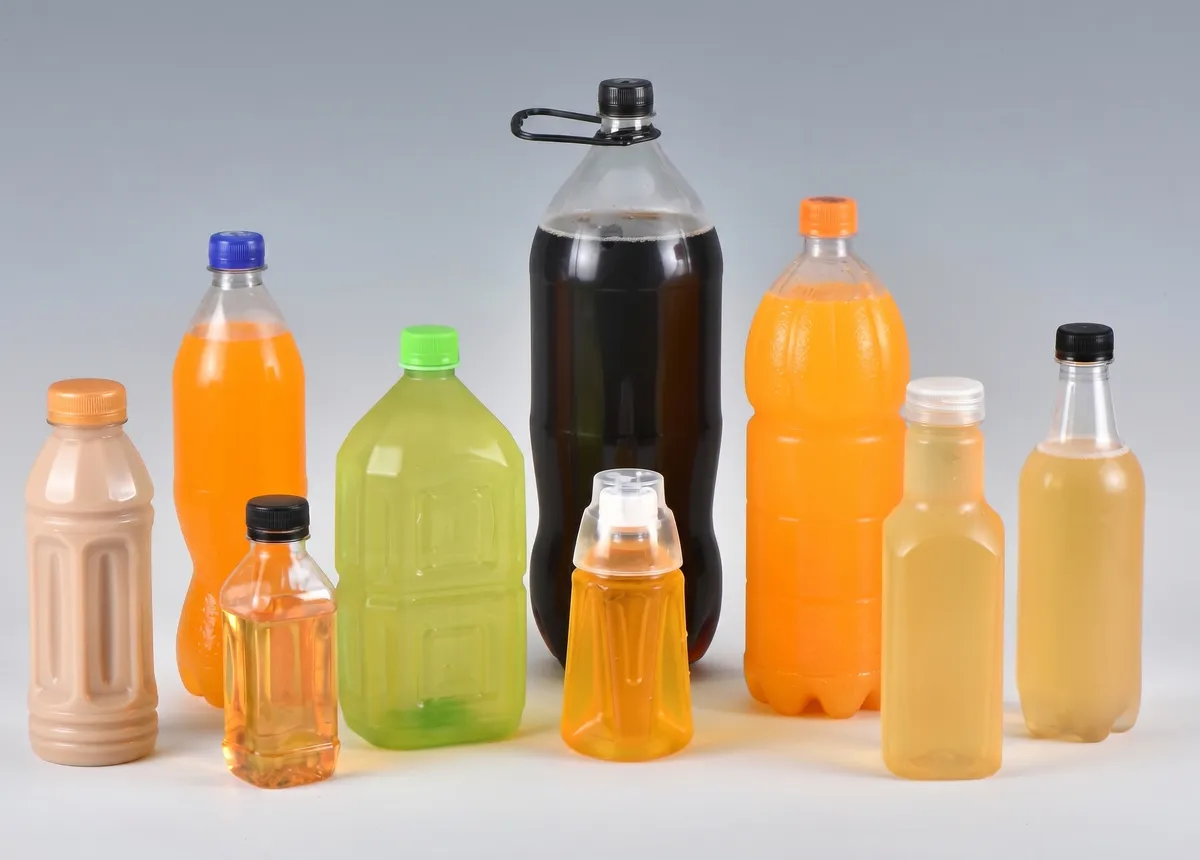
Maintenance and Care
1. Daily Lubrication and Mechanical Checks
At the start of each production shift, inspect all lubrication points on the clamping unit, turntable bearing, and ejection mechanism. Apply grease to specified points according to the maintenance schedule provided in the machine manual. Check that the turntable rotation is smooth and that no unusual vibration or noise is present during indexing. Verify that all air cylinder rod seals are intact and that there is no air leakage at cylinder connections. Addressing minor lubrication deficiencies early prevents accelerated wear on precision components and avoids unplanned downtime during production runs.
2. Hydraulic System Oil Management
The 300-liter hydraulic oil tank should be checked weekly for oil level, color, and contamination. Fresh hydraulic oil is typically light amber; darkening or cloudiness indicates oxidation, water contamination, or particle contamination from worn seals. Replace hydraulic oil completely according to the manufacturer's scheduled interval, typically every 2,000 to 3,000 hours of operation. Clean or replace hydraulic oil filters at each oil change. Maintaining clean hydraulic oil is critical because the YUKEN hydraulic control valves and high-pressure components have tight internal clearances that are sensitive to particulate contamination, which causes valve sticking, erratic pressure behavior, and accelerated component wear.
3. Cooling Water Circuit Maintenance
The cooling water circuit should be inspected monthly for scale buildup, biological growth, and flow rate consistency. The machine oil cooler must maintain water temperature between 20 and 25 degrees Celsius and pressure between 0.3 and 0.4 MPa to keep hydraulic oil viscosity within the operating range. The mold cooling circuit operates at 0.4 to 0.6 MPa and must be monitored for blockages that could cause uneven mold cooling and dimensional variation in bottles. Use treated water or a closed-loop cooling system with corrosion inhibitor to prevent scale and corrosion that would reduce heat transfer efficiency and restrict flow through mold cooling channels over time.
4. Screw and Barrel Cleaning
The injection screw and barrel should be purged and cleaned whenever changing between resin types or colors, and at scheduled intervals during extended production runs of the same material. For PET and PETG, purge with a commercial purging compound or a compatible transition resin to remove degraded material from the screw flights and barrel walls. Degraded PET deposits can cause black specks, yellow streaking, or molecular weight reduction in the finished container if not removed. The nano far-infrared heating ring system heats the barrel uniformly, but stagnant material in low-flow zones can still degrade if the screw is left stationary at temperature for extended periods without purging.
5. Mold Inspection and Cavity Care
Mold tooling should be inspected at regular intervals for wear on the cavity surface, parting line, venting channels, and neck ring components. Clean cavity surfaces with approved mold release agents and plastic-safe solvents to remove resin deposits and oxidation. Inspect water channel connections on the mold for leaks or blockages and verify that the cooling circuit is balanced across all cavities. Misaligned or worn parting surfaces can create flash on bottles, which affects container appearance and may indicate clamping force imbalance. Store molds in climate-controlled storage with protective coating on metal surfaces when not in production to prevent corrosion and humidity damage.
6. Servo Motor and Electrical System Checks
The Inovance or WEICHI servo motors driving the Y280-V6 clamping and injection systems should be inspected quarterly for bearing temperature, encoder signal quality, and cable condition. Check servo drive units in the electrical cabinet for adequate ventilation and absence of dust buildup that could cause overheating or signal interference. The Inovance or MiRLE PLC should have its battery backup status checked annually to ensure parameter memory is retained during power outages. Review the PLC fault log monthly to identify recurring alarms that may indicate developing mechanical or electrical issues before they cause a production stoppage. All electrical connections should be retorqued at commissioning and at annual service intervals to prevent high-resistance contacts from developing.
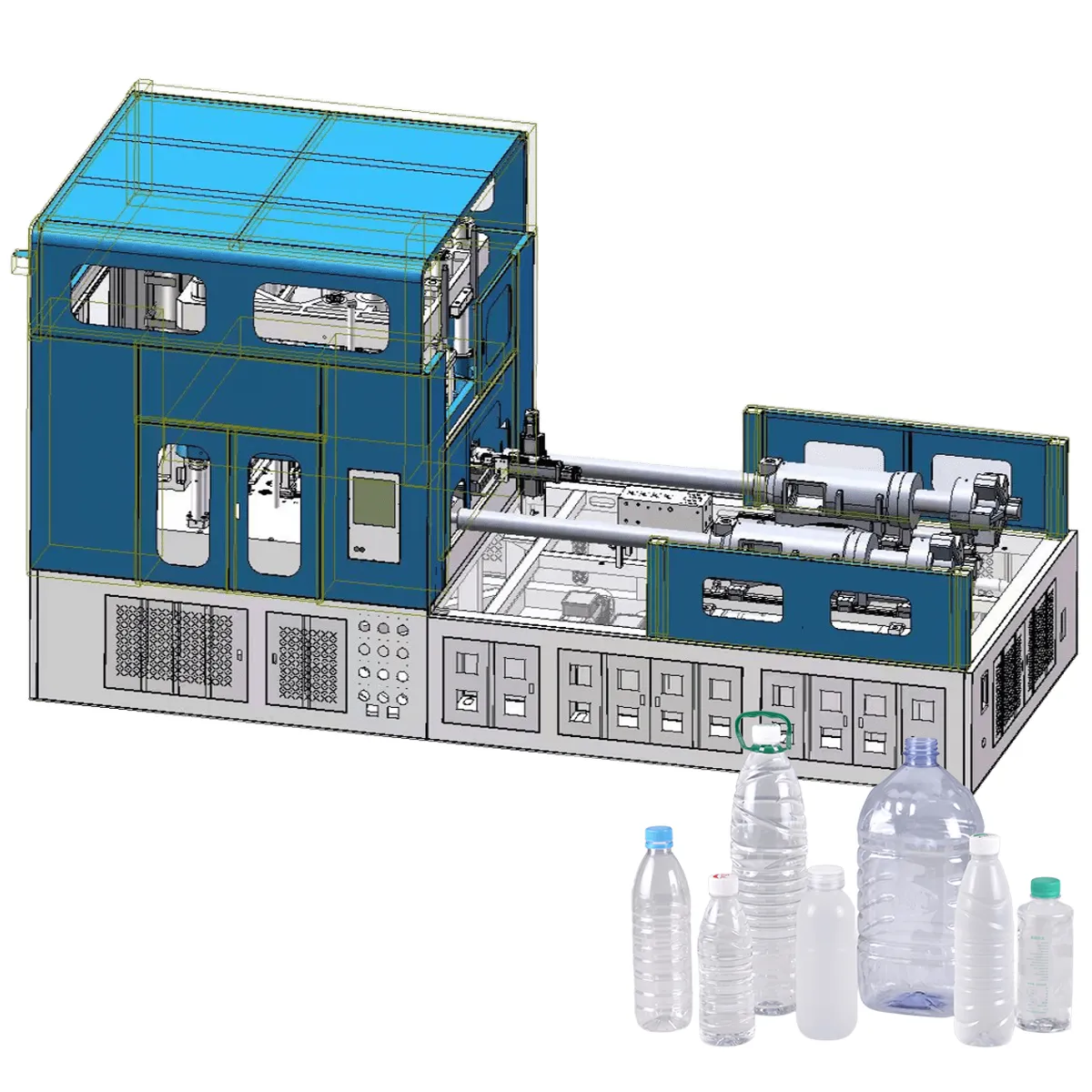
Perché scegliere la macchina per stampaggio a iniezione-soffiaggio di CMN?
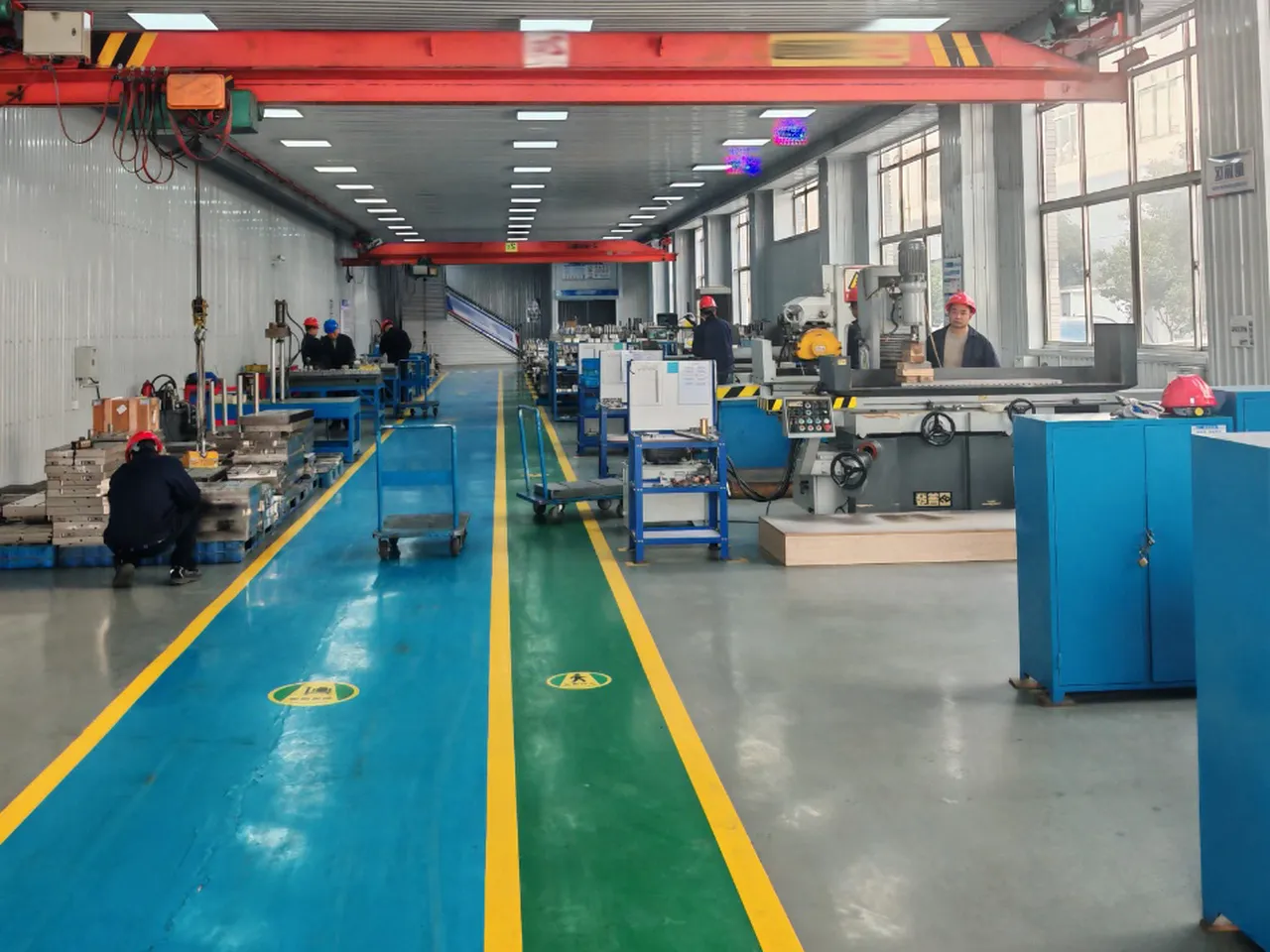
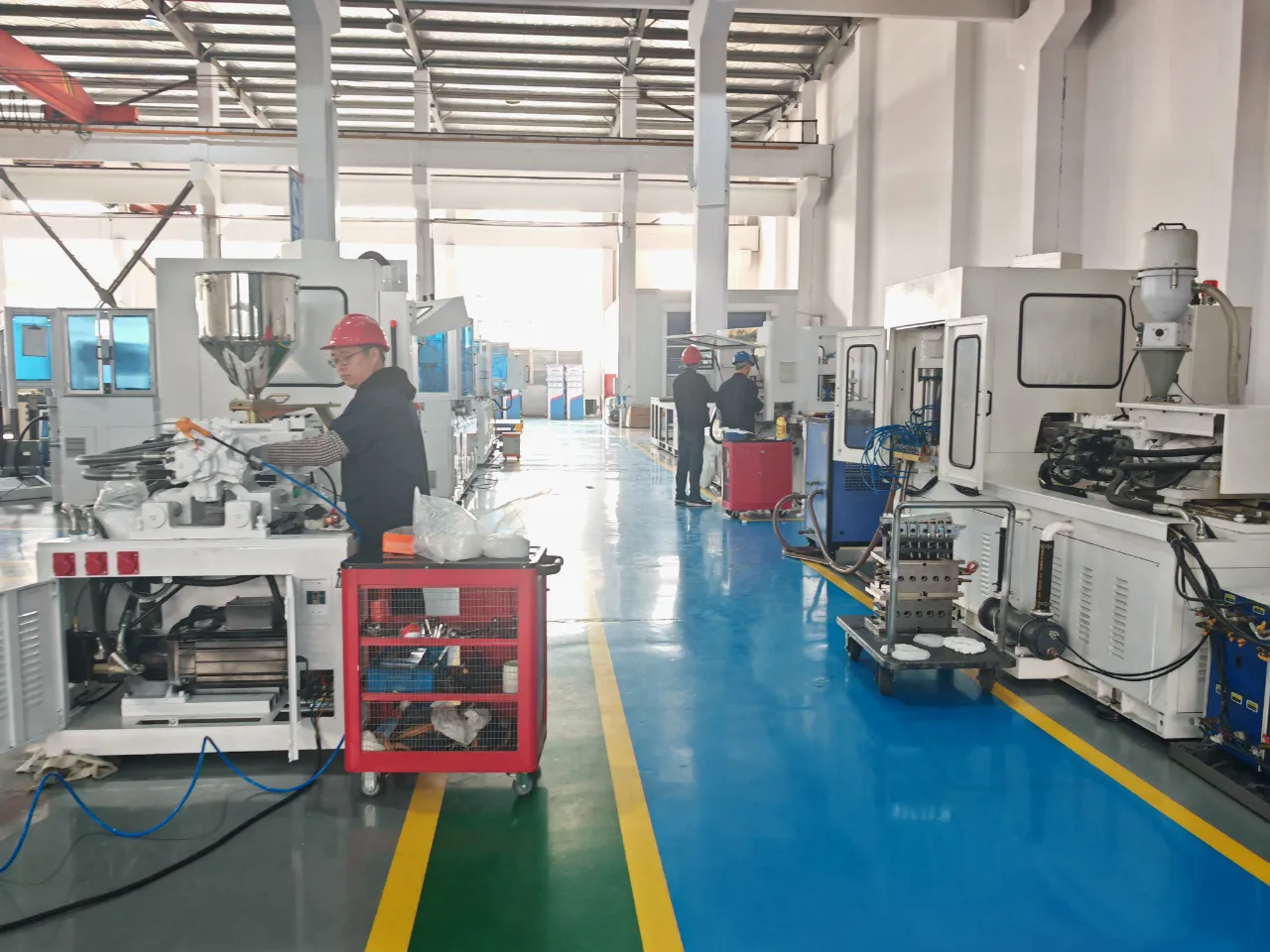
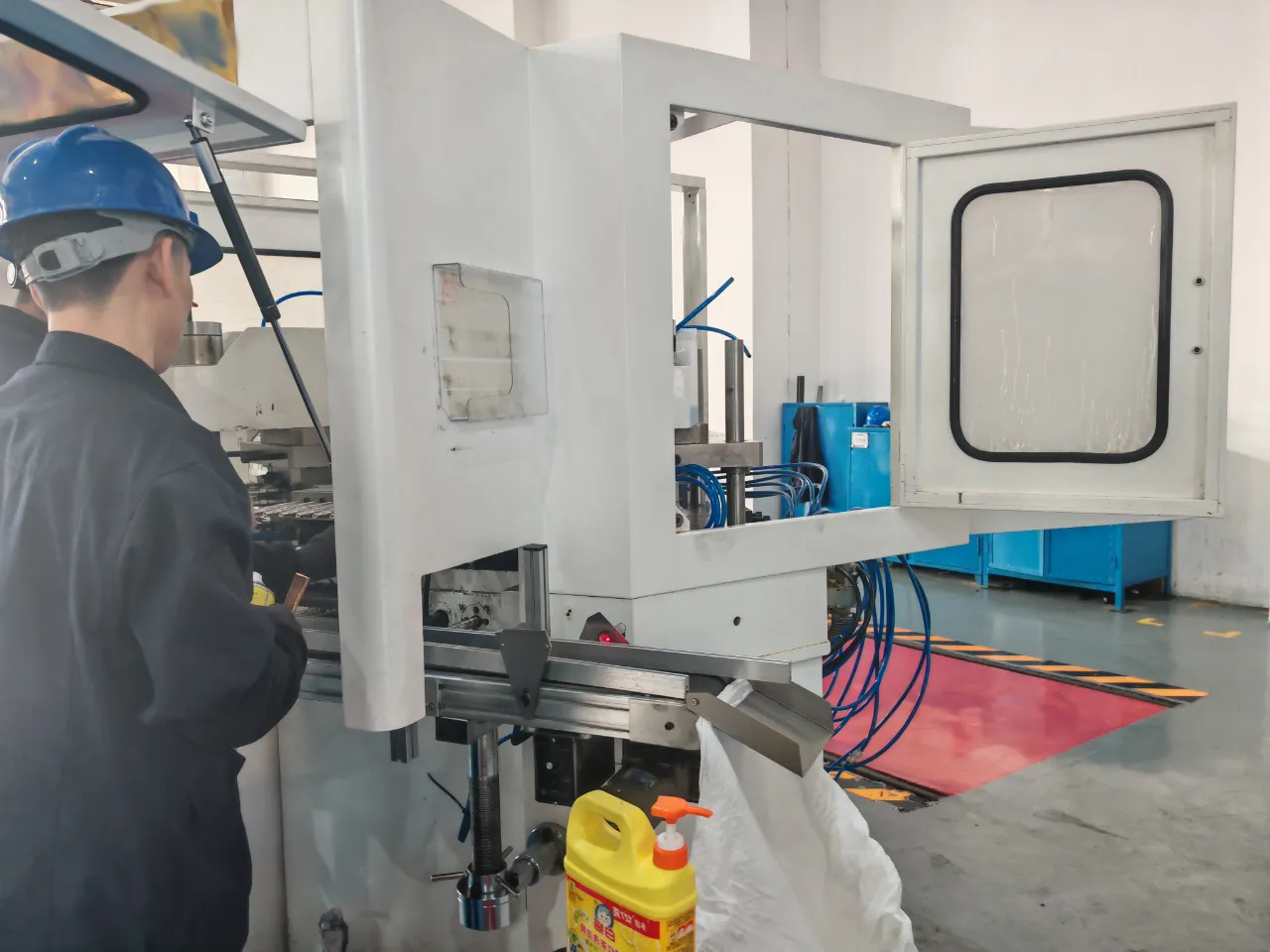
CMN Transmission is a dedicated manufacturer of automatic one-step injection blow molding machines and injection stretch blow molding machine equipment, with a product range covering injection blow molding machines, extrusion blow molding machines, injection stretch blow molding machines, molds, and auxiliary equipment. CMN operates from a well-located production base with efficient logistics access that supports reliable international delivery timelines for customers across Asia, the Middle East, Africa, South America, and Europe.
CMN maintains an experienced R&D team that brings together engineering and technical personnel with deep backgrounds in both injection-blowing machinery design and injection-blowing mold manufacturing. This dual expertise, covering both the machine and the tooling, gives CMN a significant advantage in helping customers solve complex bottle design challenges that combine difficult shapes, demanding materials, or tight dimensional tolerances. Combining strong theoretical knowledge with practical production experience, CMN's technical team provides detailed, personalized pre-sale consultation, responsive in-sale technical support, and committed after-sale service including on-site installation, operator training, process optimization, and spare parts supply.
CMN's product applications span pharmaceutical packaging, food and beverage packaging, healthcare and personal care packaging, cosmetic packaging, and a wide range of specialty plastic packaging products from 1 ml to 1,000 ml in materials including HDPE, LDPE, PET, PETG, PP, PS, PPSU, PC, Tritan, ABS, PLA, PCTG, EVA, and environmentally certified corn-based resins. CMN adheres to the development philosophy of self-reliance, integrity, practicality, innovation, and responsibility, building a comprehensive one-stop turnkey project capability that covers machine selection, mold design, process validation, and ongoing production support. This full-chain approach ensures that CMN customers receive high-end injection-blowing products that consistently meet quality requirements from the first production cycle through the life of the equipment.
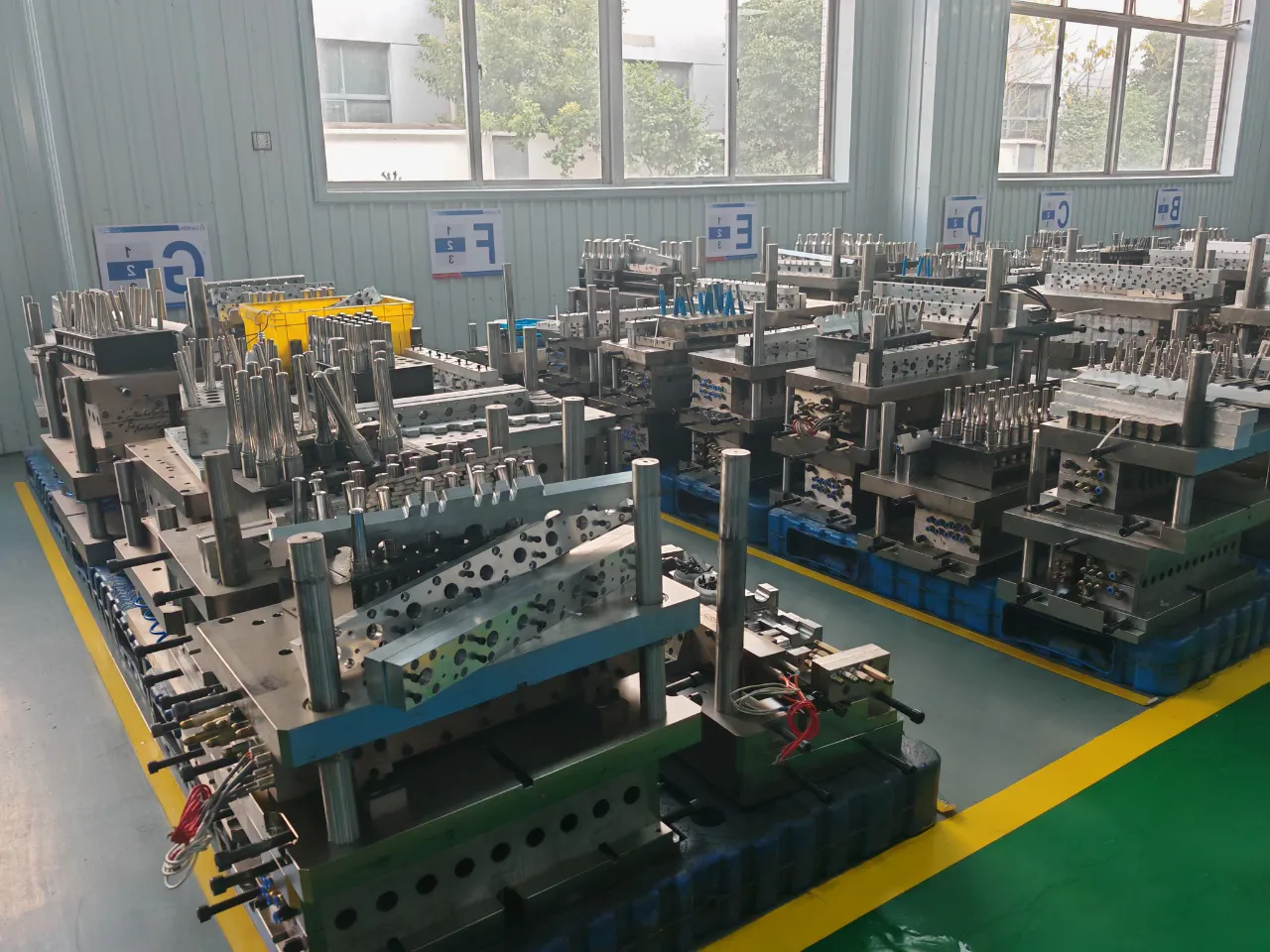 |  |
 |  |
Domande frequenti
Q: What is the difference between the Y280-V6 and a standard four-station injection stretch blow molding machine?
A: The Y280-V6 uses a six-station rotary turntable instead of the four-station design common in Japanese ISBM machines. This means the Y280-V6 can process six preforms simultaneously in a single rotation cycle, producing more bottles per cycle than a four-station machine running the same tooling configuration. In addition to higher output, the extra stations allow for longer temperature conditioning and cooling dwell times, which can improve bottle quality when running demanding materials or complex shapes.
Q: Can the Y280-V6 use existing ASB or Aoki injection stretch blow molding machine molds?
A: Yes. The Y280-V6 is designed to be compatible with mold tooling originally manufactured for Japanese ASB injection stretch blow molding machines, specifically ASB-12M and ASB-70DPH format molds. CMN's broader product range also includes models compatible with Aoki 100, Aoki 250, and Aoki 500 mold formats. This mold compatibility is a major commercial advantage for manufacturers who have existing tooling investment and want to switch to CMN equipment without the cost of replacing all their molds. Contact our sales team with your existing mold specifications to verify compatibility before purchase.
Q: Is a fully electric version of this one step injection stretch blow molding machine available?
A: Yes. CMN Transmission offers the Y280-V6 in a Fully Electric configuration that replaces all hydraulic drive systems with servo motors. The fully electric version produces no hydraulic oil, making it suitable for pharmaceutical manufacturing facilities that must comply with GMP standards and operate in clean-room-adjacent environments. The fully electric version also offers advantages in energy consumption, positioning repeatability, and quieter operation. It is available at a higher initial cost than the Standard or Servo hydraulic-assisted versions.
Q: What materials can the Y280-V6 PET injection stretch blow molding machine process?
A: The Y280-V6 is designed primarily for PET and PETG processing, which are the most common materials for ISBM production. However, the machine is also capable of processing PP, PC, Tritan, PPSU, PCTG, ABS, PS, and PLA with appropriate screw diameter selection, barrel temperature adjustment, and drying pre-treatment. Different materials require different processing parameters, and CMN's technical team can advise on the correct configuration for your specific material and bottle design before delivery.
D: Quanta energia consente di risparmiare la pressa a iniezione-soffiaggio monostadio Y280-V6 rispetto ai modelli giapponesi equivalenti?
A: La Y280-V6 consuma da 15% a 25% di energia in meno rispetto a macchine per stampaggio a iniezione-soffiaggio comparabili giapponesi, europee o americane che utilizzano design di bottiglie e volumi di produzione simili. Questo risparmio deriva da tre fattori: i sistemi di pompe servoassistite che generano pressione solo su richiesta anziché funzionare continuamente a pieno flusso, gli anelli riscaldanti a vite a infrarossi lontani nano che riducono la dispersione di calore rispetto al riscaldamento a resistenza convenzionale e il processo ISBM monostadio che elimina la fase di riscaldamento secondario della preforma richiesta dai sistemi di stampaggio a soffiaggio a due stadi. Il risparmio effettivo varia in base al design della bottiglia, al tempo di ciclo e alle tariffe energetiche locali.
D: Quali formati e volumi di bottiglie può produrre la macchina Y280-V6 ISBM?
A: La Y280-V6 è adatta a bottiglie con volume da 20 ml a 2.500 ml, diametro da 20 mm a 120 mm e altezza fino a 210 mm. La macchina può eseguire da 1 a 10 cavità per ciclo, a seconda delle dimensioni della bottiglia, con diametri del collo da 12 mm a 85 mm. La tabella delle dimensioni del prodotto fornisce le specifiche massime delle bottiglie per ogni numero di cavità. Dimensioni personalizzate delle bottiglie non presenti nella tabella standard possono essere discusse con il team di ingegneri CMN, che valuterà la fattibilità dello stampo e la compatibilità della corsa della macchina prima di confermare l'ordine.
D: Qual è la differenza tra una macchina ISBM a un solo stadio e una macchina per lo stampaggio a soffiaggio del PET a due stadi?
A: In una macchina ISBM a un solo stadio come la Y280-V6, la resina plastica viene iniettata in una preforma e immediatamente trasferita alla stazione di soffiaggio per stiramento all'interno della stessa macchina, mantenendo il calore della fase di iniezione. Non è necessaria alcuna apparecchiatura separata per il riscaldamento delle preforme. In un sistema a due stadi, le preforme vengono stampate a iniezione separatamente, immagazzinate e raffreddate completamente, quindi riscaldate in una seconda macchina prima del soffiaggio. Il processo a un solo stadio consuma meno energia perché evita il ciclo di riscaldamento delle preforme, ha un ingombro minore perché è necessaria una sola macchina e produce bottiglie direttamente da granuli di resina. Il sistema a due stadi offre maggiore flessibilità per la produzione di grandi volumi di bottiglie in PET standard, dove le preforme possono essere prodotte e immagazzinate separatamente per una programmazione flessibile della produzione.
D: Quanto tempo richiede l'installazione e la messa in servizio del modello Y280-V6?
A: L'installazione e la messa in servizio standard della Y280-V6 richiedono in genere dai 3 ai 5 giorni con un team tecnico CMN in loco. Il processo include il posizionamento e il livellamento della macchina, il collegamento elettrico e pneumatico, la messa in servizio del circuito dell'acqua di raffreddamento, l'adescamento e la regolazione della pressione del sistema idraulico, l'installazione e l'allineamento dello stampo e le prove di produzione iniziali con il materiale e gli utensili dell'acquirente. La formazione dell'operatore, che comprende la configurazione della macchina, la regolazione dei parametri, le procedure di sicurezza e la manutenzione di base, viene condotta in parallelo durante la messa in servizio. La programmazione della visita del tecnico installatore CMN viene coordinata al momento della consegna della macchina e dipende dalla disponibilità dell'acquirente e dalla disponibilità di tutte le utenze e gli utensili in loco.
D: Quale alimentazione di aria compressa richiede la pressa a iniezione-soffiaggio Y280-V6?
A: La Y280-V6 richiede un'alimentazione di aria compressa in grado di fornire aria soffiante a una pressione compresa tra 2,0 e 3,5 MPa (da 20 a 35 bar). Per raggiungere il limite superiore di questo intervallo, in presenza di determinati modelli o materiali di bottiglie, è necessario un compressore ad alta pressione. Il volume d'aria consumato per ciclo dipende dal volume e dal numero di cavità della bottiglia: bottiglie più grandi o più numerose richiedono una maggiore quantità d'aria per ciclo. Prima dell'installazione, gli acquirenti devono calcolare la capacità del compressore necessaria in base alla velocità di produzione prevista e al volume di bottiglie. Un'alimentazione di aria compressa sottodimensionata è una delle cause più comuni di ritardi all'avvio delle nuove installazioni di macchine ISBM.
D: La Y280-V6 è in grado di produrre flaconi privi di BPA per applicazioni farmaceutiche e a contatto con gli alimenti?
R: Sì. La Y280-V6 lavora materiali privi di BPA, tra cui PET, PETG, PP, Tritan, PPSU e PCTG, tutti conformi alle principali normative internazionali per gli imballaggi a contatto con gli alimenti e per il settore farmaceutico, tra cui FDA, UE 10/2011 e standard equivalenti. Per le applicazioni farmaceutiche in cui le GMP richiedono la completa eliminazione del rischio di contaminazione da olio idraulico, si consiglia la configurazione servoassistita completamente elettrica della Y280-V6. Gli acquirenti che necessitano di documentazione specifica sulla conformità dei materiali o di dichiarazioni di sicurezza per il contatto con gli alimenti per il loro mercato di riferimento, devono richiedere i relativi certificati a CMN e al proprio fornitore di resine al momento dell'acquisto.
Recensioni dei clienti
Kim Jae-won, Imballaggi farmaceutici, Corea del Sud
"Abbiamo installato la Y280-V6 nel nostro stabilimento di confezionamento farmaceutico a Seoul circa quattordici mesi fa e, onestamente, è stata una delle migliori decisioni che abbiamo preso in termini di attrezzature. Produciamo flaconi in PET da 50 ml per liquidi orali utilizzando uno stampo a 6 cavità e la precisione delle dimensioni del collo è davvero eccezionale. Il nostro tasso di scarto del controllo qualità sulle superfici di sigillatura è sceso da circa 1,2% a meno di 0,25% dopo il passaggio da una macchina ISBM giapponese. Anche i costi energetici si sono ridotti più del previsto: il nostro ingegnere di stabilimento ha calcolato una riduzione di circa 22% di costi elettrici per mille flaconi prodotti. Il team di installazione di CMN ha trascorso quattro giorni interi con noi durante la messa in servizio. Un lavoro davvero accurato."
Rajesh Mehta, Imballaggi cosmetici, India
"Gestisco una linea di confezionamento cosmetico a Mumbai e l'anno scorso siamo passati dalla vecchia macchina giapponese a un solo passaggio alla Y280-V6. Il miglioramento della qualità della superficie è immediatamente visibile. I nostri clienti si lamentavano spesso di lievi segni di giunzione sui nostri flaconi da 150 ml per la cura della pelle e, dopo il passaggio agli utensili CMN, questo problema è completamente scomparso. La lavorazione del Tritan e del PETG si è dimostrata molto stabile su questa macchina. I tempi di ciclo sono più brevi e il sistema servoassistito è notevolmente più reattivo. Ero preoccupato per l'assistenza post-vendita di un produttore cinese, ma si sono dimostrati molto efficienti. Le risposte ai miei messaggi WhatsApp arrivano solitamente entro poche ore."
Ahmed Hassan, Imballaggi per bevande, Egitto
"Abbiamo ordinato due unità Y280-V6 per la nostra linea di produzione di bottiglie d'acqua in PET al Cairo. I tempi di consegna sono stati di circa 10 settimane dalla conferma dell'ordine, un tempo accettabile. Le macchine sono arrivate in buone condizioni con un imballaggio adeguato per l'esportazione. I nostri stampi ASB giapponesi preesistenti sono stati trasferiti senza alcuna modifica, il che ci ha permesso di risparmiare una somma considerevole sull'acquisto di nuovi stampi. La produttività per turno è superiore rispetto alle macchine giapponesi a quattro stazioni che utilizzavamo in precedenza. Il supporto per la lingua araba nell'interfaccia HMI sarebbe un'aggiunta gradita, ma l'interfaccia in inglese è comunque utilizzabile dai nostri operatori. I costi di produzione complessivi sono diminuiti e la qualità è rimasta costante."
Fernanda Costa, Confezioni per neonati, Brasile
"La nostra azienda di San Paolo produce biberon in Tritan per il mercato al dettaglio brasiliano. Abbiamo scelto la Y280-V6 in particolare per la sua configurazione completamente elettrica, necessaria per rispettare i nostri requisiti GMP. La stiamo utilizzando da circa 8 mesi per produrre biberon da 120 ml con 6 cavità. La precisione dimensionale tra le cavità è ottima, con una tolleranza di 0,15 mm sul diametro del collo, un valore ampiamente entro i nostri limiti. Un piccolo appunto: la documentazione sui pezzi di ricambio potrebbe essere più dettagliata in portoghese, ma CMN è stata in grado di fornire video tutorial per le principali operazioni di manutenzione, che hanno aiutato i nostri tecnici. La produzione si è dimostrata affidabile."
Budi Santoso, Attrezzature per l'imballaggio, Indonesia
"Lavoro nel settore delle macchine per lo stampaggio a soffiaggio a Giacarta da oltre quindici anni e la Y280-V6 è davvero competitiva rispetto alle macchine giapponesi, a un prezzo significativamente inferiore. Ne abbiamo acquistata una per un cliente che produce flaconi di sapone liquido in PP e PETG e i risultati sono stati ottimi. La costanza del peso dei flaconi è eccellente, entro ± 0,3 grammi, cosa che soddisfa pienamente il cliente. I dati sul consumo energetico che abbiamo misurato sul campo confermano un consumo inferiore di circa 201 TP3T rispetto alla precedente macchina giapponese, per lo stesso tipo di flacone. CMN ha gestito la spedizione e le pratiche doganali senza problemi. Li raccomanderò sicuramente ad altri clienti."
Muhammad Khalid, Imballaggi per bevande e alimenti, Pakistan
"Produciamo bottiglie in PET per succhi di frutta e oli alimentari a Lahore e abbiamo valutato tre diversi produttori di macchine per lo stampaggio a iniezione-soffiaggio prima di scegliere CMN. Il prezzo era competitivo, ma ciò che ha davvero fatto la differenza è stata la compatibilità degli stampi con i nostri utensili ASB esistenti. Avevamo già sei set di stampi e non eravamo disposti a investire in nuovi utensili. Il trasferimento è andato liscio e le bottiglie sono state uniformi fin dal primo giorno di produzione. Il nostro coordinatore della logistica ha affermato che la documentazione di spedizione di CMN era molto ben organizzata, il che ha reso lo sdoganamento più veloce del previsto. La disponibilità dei pezzi di ricambio è stata buona: abbiamo dovuto sostituire due piccole valvole idrauliche ed entrambi i pezzi sono arrivati entro tre settimane."
Nguyen Thi Lan, Imballaggi cosmetici, Vietnam
"Il nostro stabilimento di Ho Chi Minh City produce flaconi per cosmetici destinati all'esportazione e utilizziamo la Y280-V6 da circa undici mesi. La impieghiamo principalmente per flaconi in PETG da 200 ml e 300 ml per lozioni e sieri, in genere da 4 a 6 cavità per ciclo. La qualità superficiale dei flaconi è eccellente: i nostri acquirenti europei che ispezionano i campioni non hanno sollevato alcuna lamentela da quando abbiamo adottato questa macchina. La risposta del servomotore durante l'iniezione è notevolmente più rapida rispetto alla nostra vecchia macchina idraulica. Il tempo di setup per il cambio di design dei flaconi è di circa 40 minuti, il che è accettabile per i nostri tempi di produzione. Il tecnico di CMN ci ha fatto visita due volte nei primi tre mesi per mettere a punto i parametri di processo. Questo livello di supporto è stato di gran lunga superiore alle mie aspettative."
Thabo Ndlovu, Imballaggi per bevande, Sudafrica
"Gestiamo un impianto di produzione di bottiglie in PET a Johannesburg, che rifornisce marchi di bevande in tutto il Sudafrica. La Y280-V6 è stata il nostro primo acquisto da un produttore cinese di macchine ISBM, dopo molti anni di acquisti da produttori giapponesi. Il nostro team di manutenzione ha impiegato circa due mesi per familiarizzare completamente con il sistema, principalmente perché erano abituati alla configurazione delle macchine giapponesi. In termini di prestazioni, le macchine si sono dimostrate affidabili. In dodici mesi non abbiamo avuto guasti importanti, solo la normale manutenzione programmata. I risultati dei test di trasparenza e resistenza allo scoppio delle bottiglie rientrano nelle nostre specifiche. L'aspetto principale che consiglierei ad altri acquirenti è di prevedere una capacità di aria compressa sufficiente, poiché la Y280-V6 utilizza un volume d'aria maggiore rispetto alle macchine più vecchie a pressione inferiore."
Carlos Ramirez, Confezionamento conto terzi, Messico
"Siamo un'azienda di confezionamento conto terzi con sede a Città del Messico e abbiamo integrato la Y280-V6 nella nostra linea di produzione diciotto mesi fa. Produciamo flaconi per bagnoschiuma, shampoo e gel igienizzante per le mani per diversi clienti, in PET e PP, con capacità da 250 ml a 1.000 ml. La configurazione a sei stazioni è stata la ragione principale per cui l'abbiamo scelta rispetto alle macchine a quattro stazioni della concorrenza, poiché i nostri clienti si aspettano cicli di consegna rapidi. La velocità di produzione effettiva, nelle nostre condizioni, si è rivelata molto buona. La memorizzazione delle ricette tramite PLC è una funzione utile per gestire diversi modelli di flaconi per clienti differenti. Un consiglio pratico per gli altri acquirenti: assicuratevi che la vostra fornitura locale di aria compressa sia dimensionata correttamente per una pressione di soffiaggio di 3,5 MPa prima dell'installazione. Questo ci ha creato qualche problema inizialmente e ha ritardato l'avvio di circa una settimana."
Informazioni aggiuntive
| A cura di | Yjx |
|---|
Prodotti correlati
-
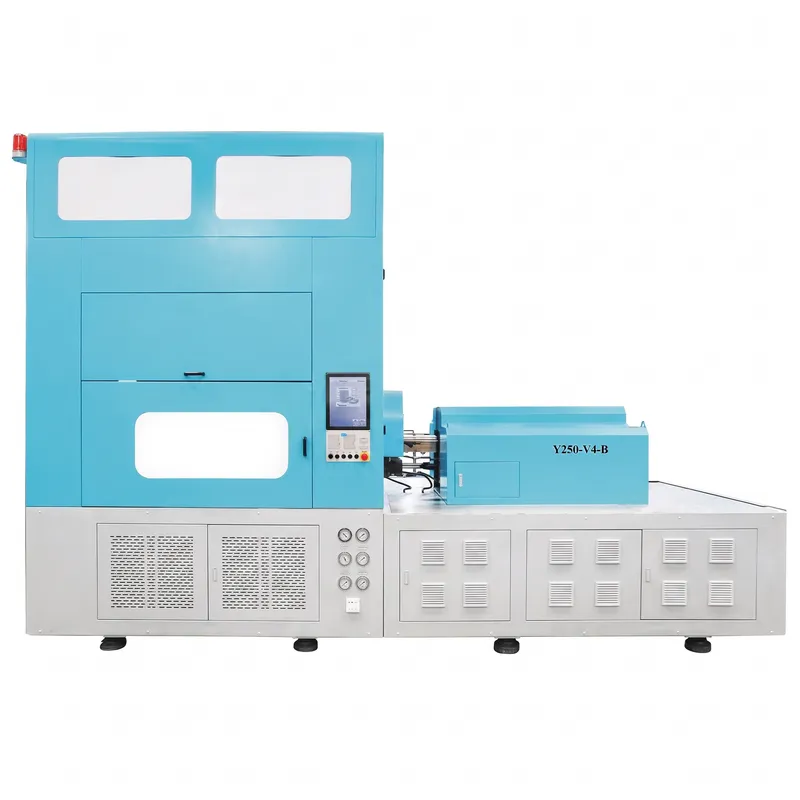
Y250-V4-B Macchina per stampaggio a iniezione-soffiaggio a un solo passaggio (4 stazioni)
-
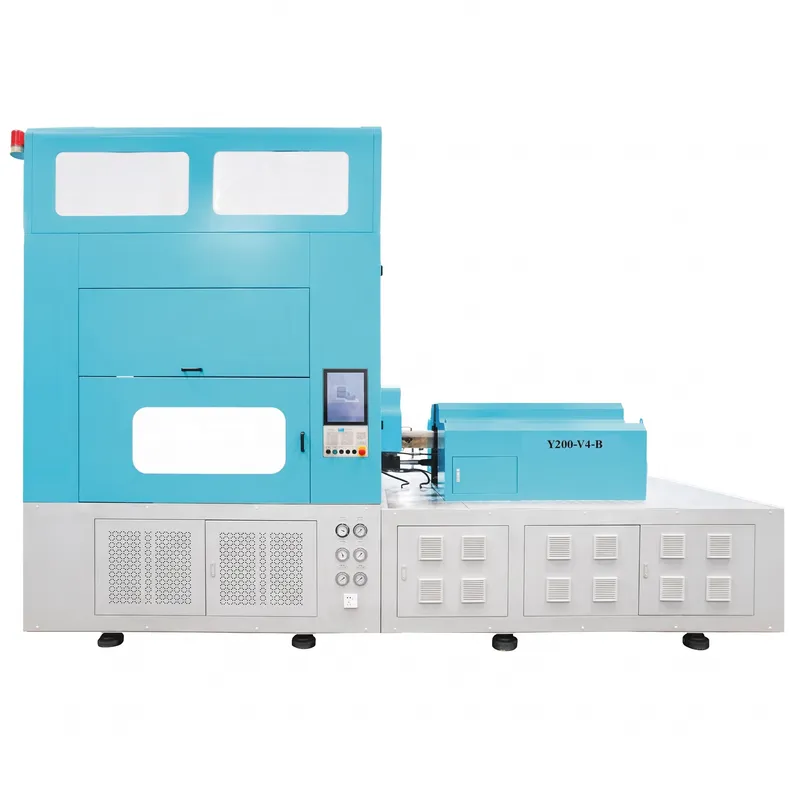
Y200-V4-B Macchina per stampaggio a iniezione-soffiaggio a un solo passaggio (4 stazioni)
-
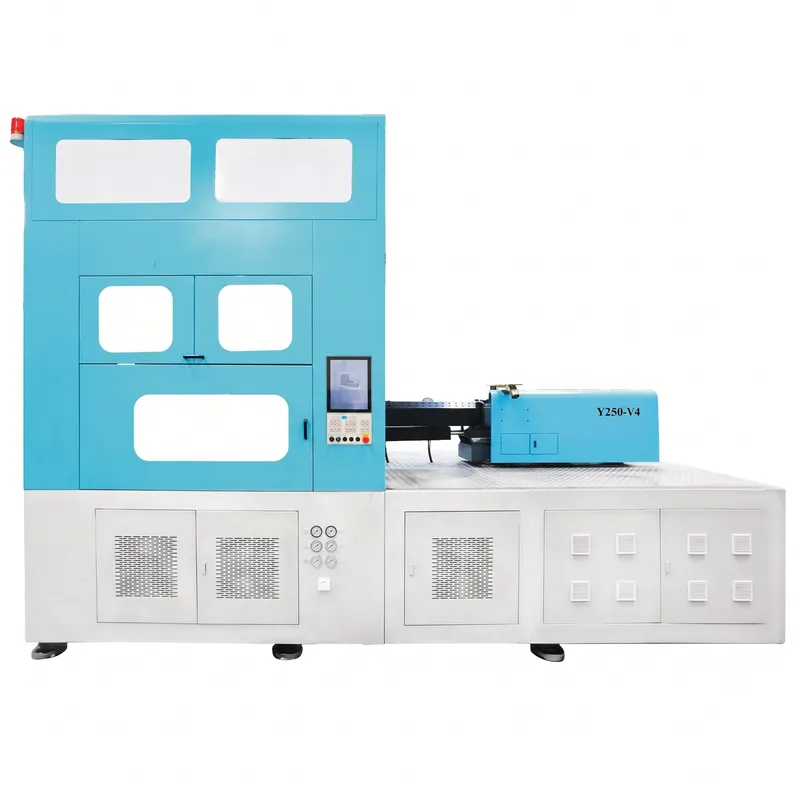
Macchina per stampaggio a iniezione-soffiaggio monostadio Y250-V4 (4 stazioni)
-
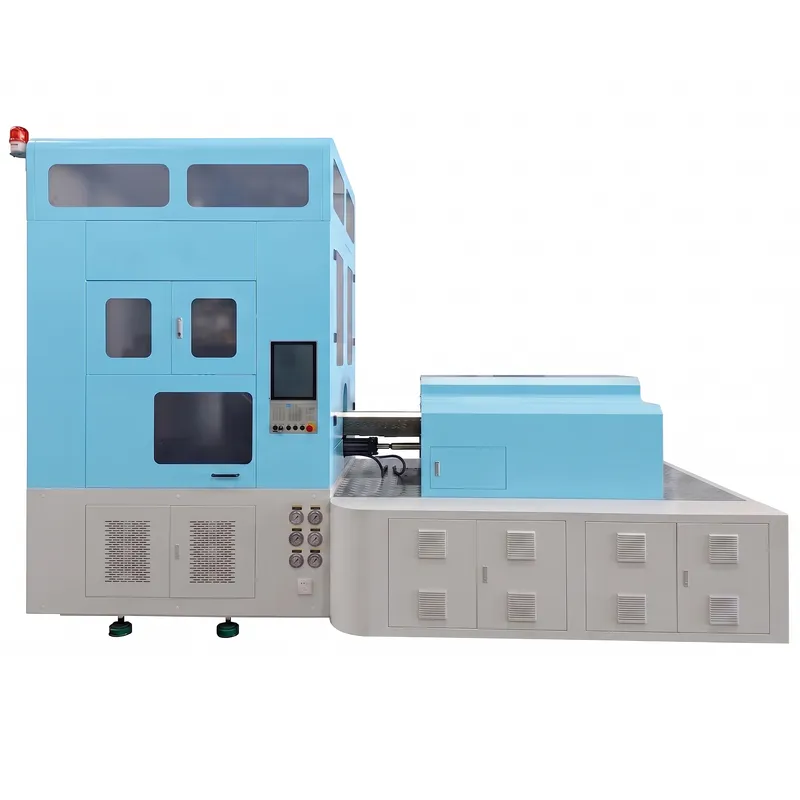
Macchina per stampaggio a iniezione-soffiaggio monostadio Y650-V4 (4 stazioni)
-
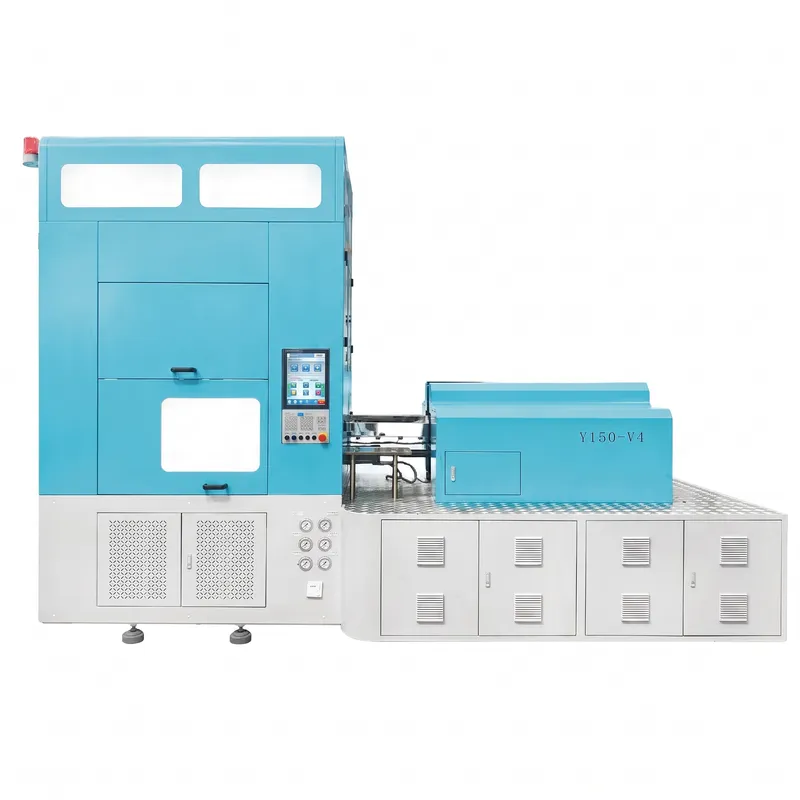
Macchina per stampaggio a iniezione-soffiaggio monostadio Y150-V4 (4 stazioni)