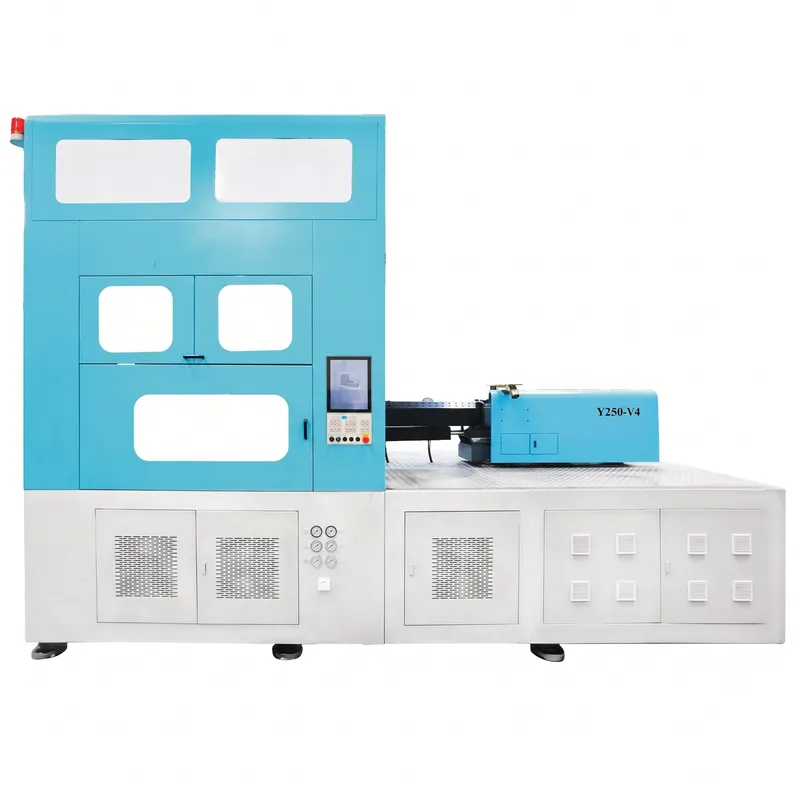
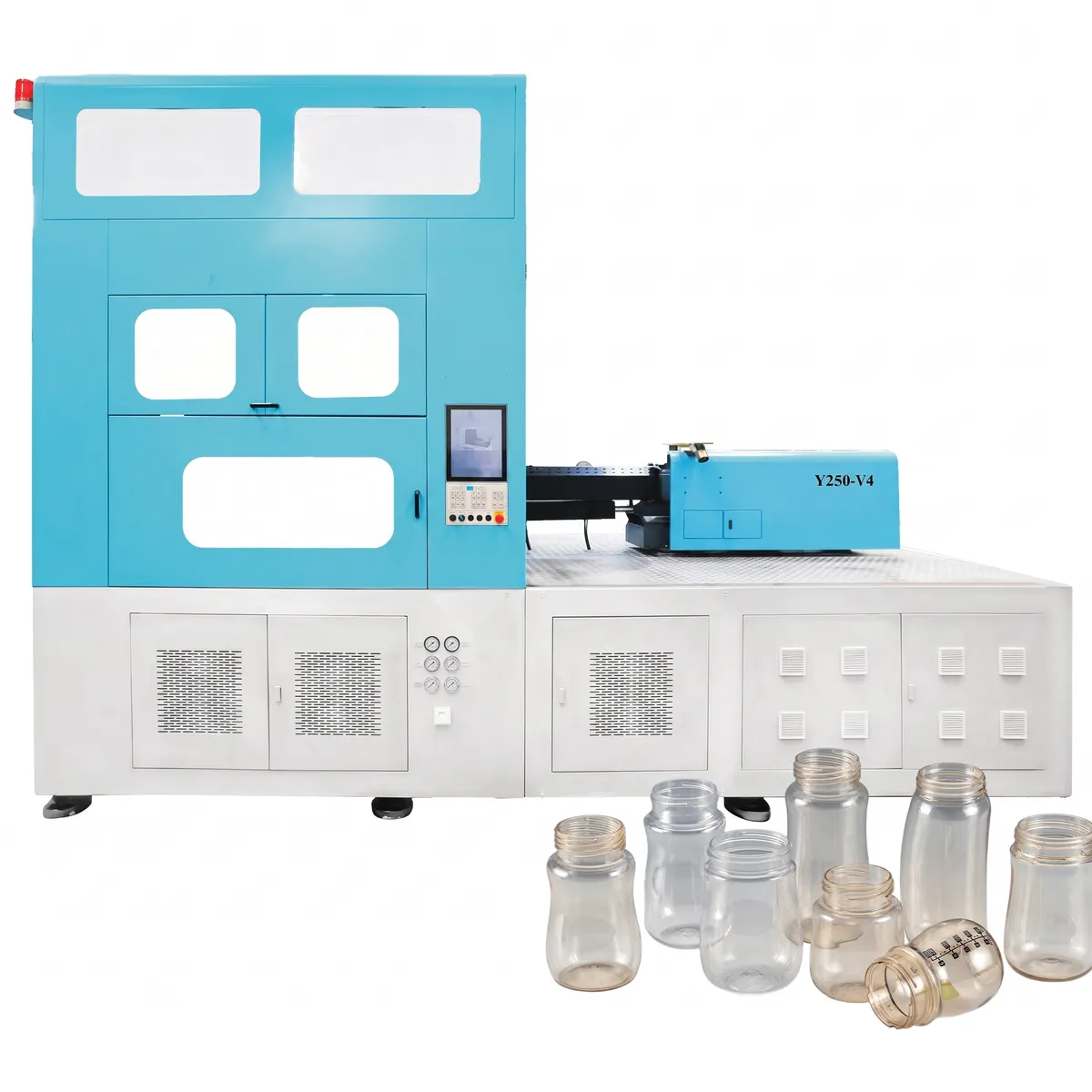
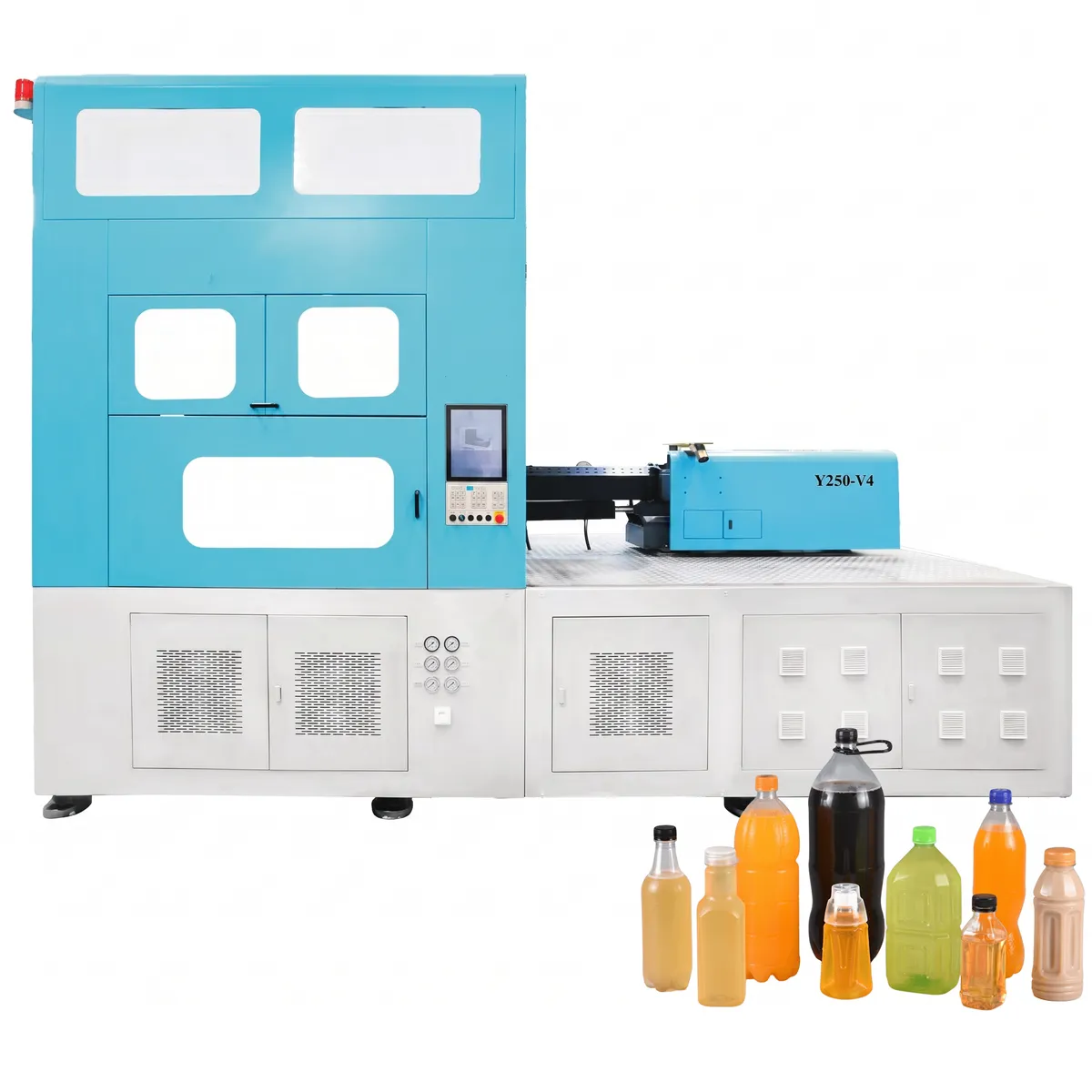
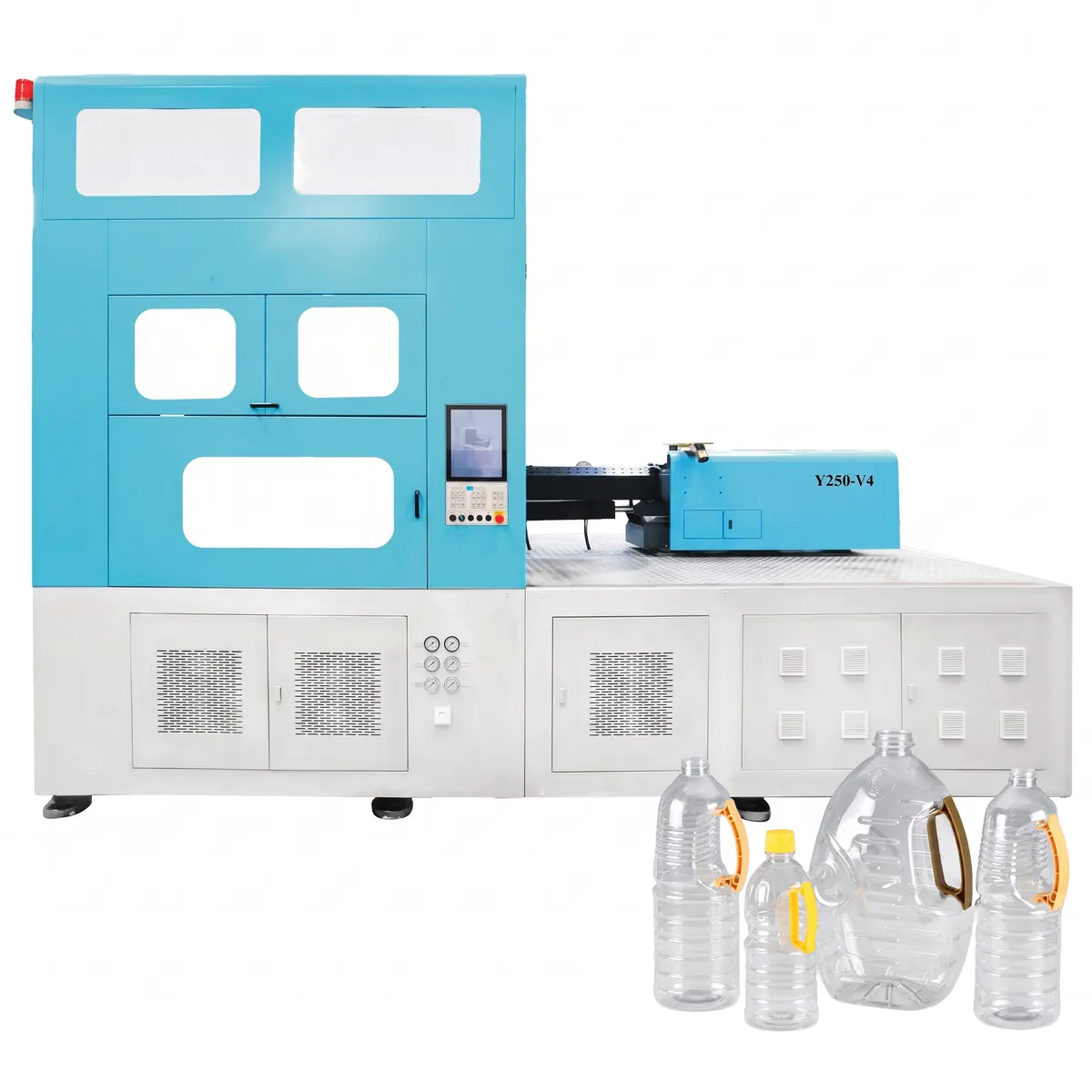
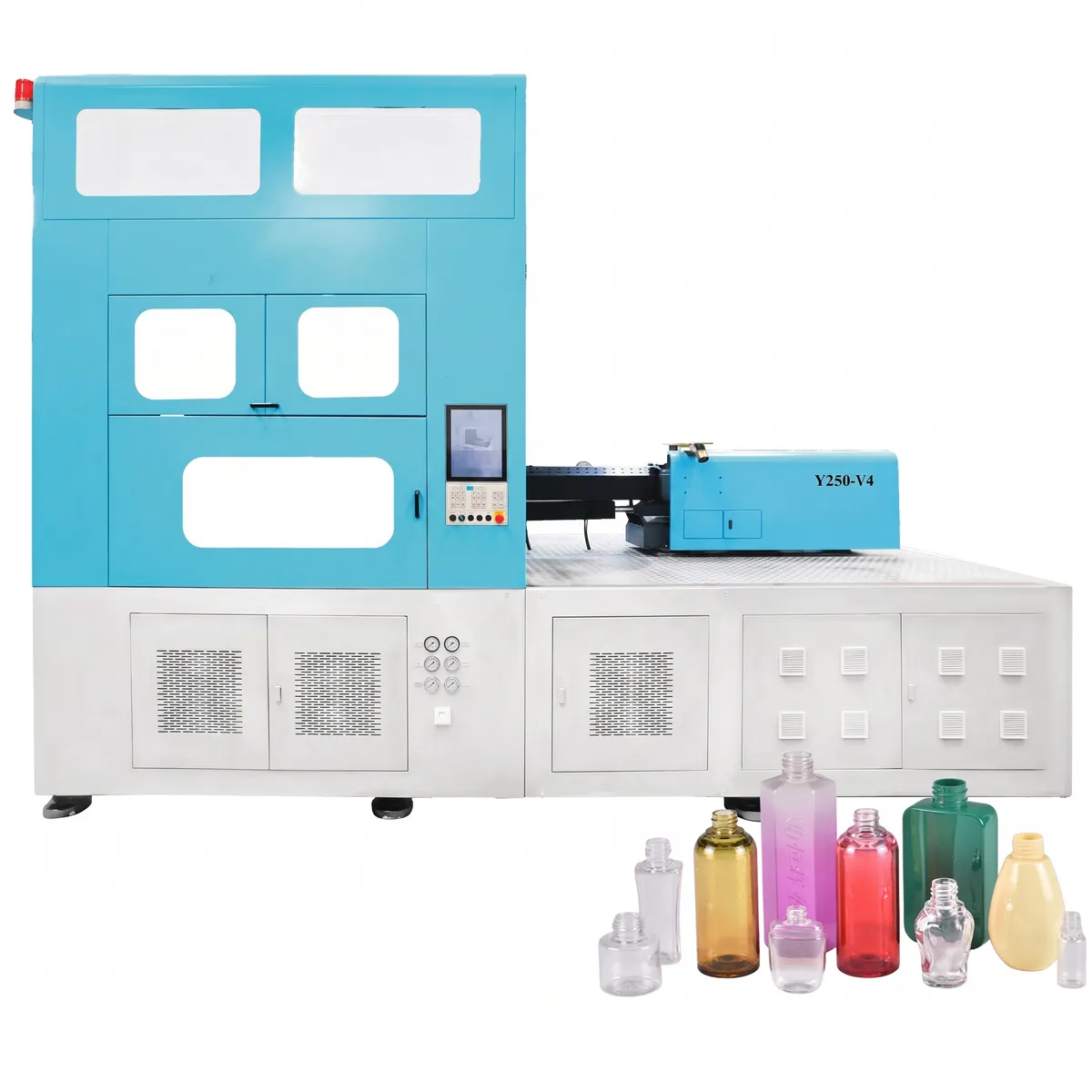
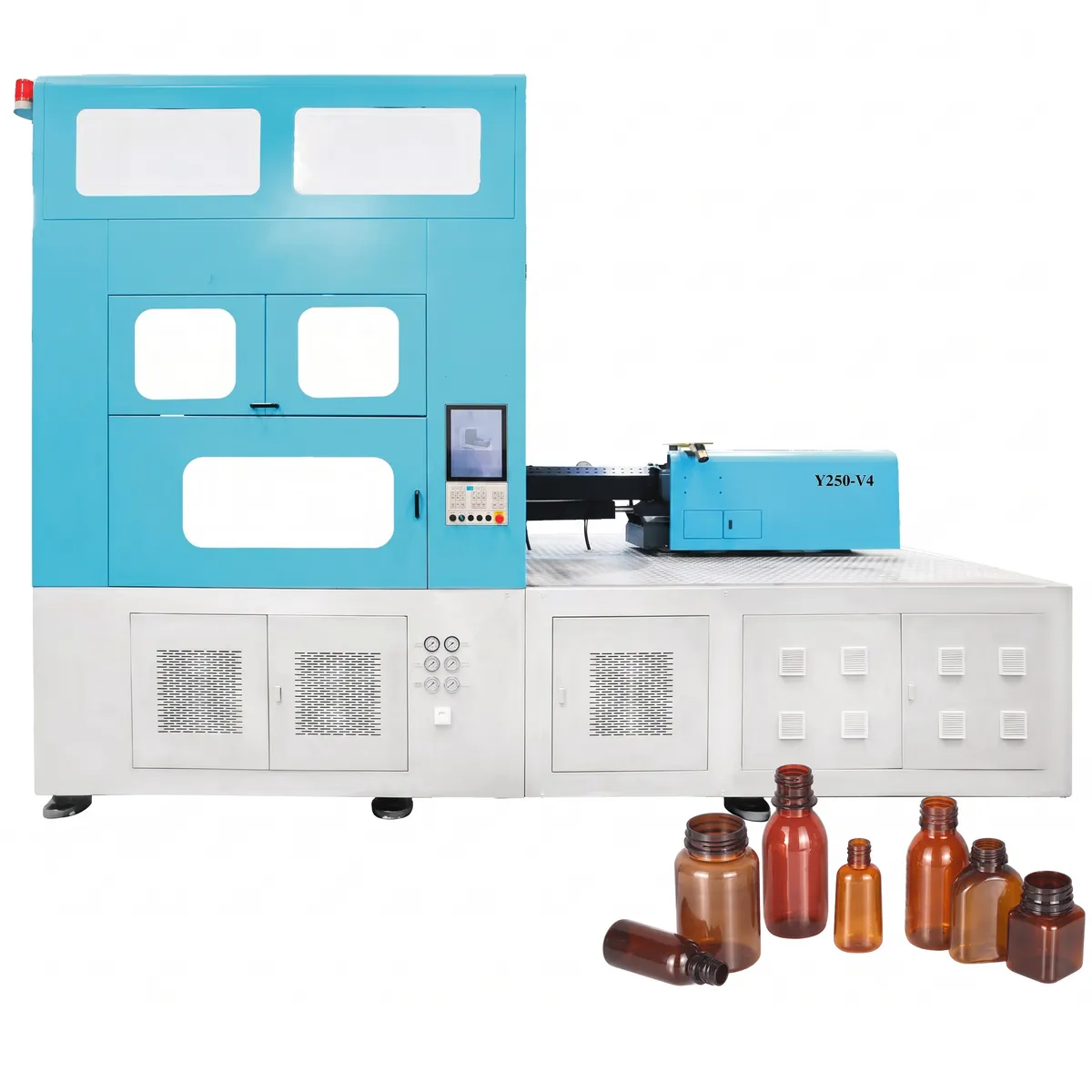
Machine de moulage par injection-soufflage en une étape Y250-V4 (4 stations)
La machine de moulage par injection-soufflage en une étape Y250-V4 est une solution de moulage de contenants plastiques haute performance, largement utilisée pour la production de produits creux en plastique de haute précision et à forte demande, tels que biberons, bouteilles d'eau, flacons de médicaments, flacons pour loisirs créatifs et de formes spéciales, et flacons cosmétiques en PET, PETG, PP, PC, Tritan, PS, ABS ou PLA. Compatible avec le modèle japonais ASB-70DPH, la machine Y250-V4 a fait ses preuves. Dotée d'un mode de fonctionnement à 4 stations, d'une force de fermeture d'injection maximale de 300 kN, d'une force de fermeture de soufflage de 200 kN et d'une puissance moteur totale de 67,7 kW, cette machine offre un rendement supérieur pour les industries de l'emballage des boissons, pharmaceutiques, cosmétiques et alimentaires.
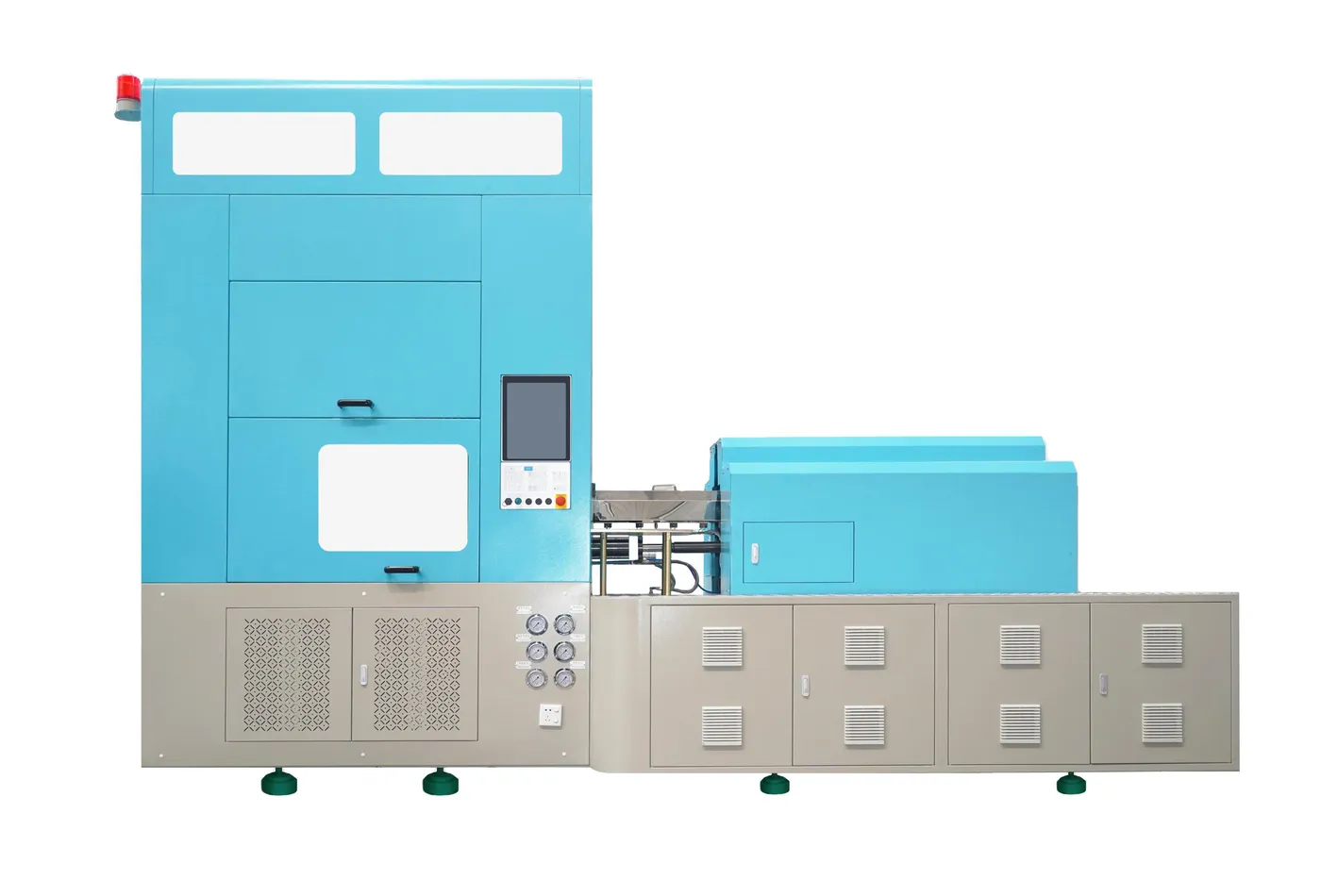
Machine de moulage par injection-soufflage en une étape Y250-V4
La machine de moulage par injection-soufflage en une étape Y250-V4 est une solution de moulage de contenants plastiques haute performance, largement utilisée pour la production de produits creux en plastique de haute précision et à forte demande, tels que biberons, bouteilles d'eau, flacons de médicaments, flacons pour loisirs créatifs et de formes spéciales, et flacons cosmétiques en PET, PETG, PP, PC, Tritan, PS, ABS ou PLA. En tant que fabricant professionnel de machines ISBM, CMN a conçu cette machine monobloc pour intégrer les trois étapes (injection, étirage et soufflage) en un seul processus continu. L'absence d'étapes de transfert intermédiaires améliore considérablement la productivité, réduit les risques de contamination et garantit une excellente homogénéité des produits à chaque production.
La machine de moulage par injection-soufflage Y250-V4 est compatible avec le modèle japonais ASB-70DPH et a fait ses preuves. Dotée d'un mode de fonctionnement à 4 stations, d'une force de fermeture maximale de 300 kN pour l'injection, de 200 kN pour le soufflage et d'une puissance moteur totale de 67,7 kW, cette machine offre un rendement supérieur pour les industries de l'emballage des boissons, pharmaceutiques, cosmétiques et alimentaires. Sa capacité à produire jusqu'à 6 bouteilles par cycle, contre 4 pour de nombreux concurrents japonais, associée à des économies d'énergie de 151 à 251 TJ/s par rapport aux alternatives européennes, américaines et japonaises, fait de la Y250-V4 l'une des machines de moulage par injection-soufflage PET les plus compétitives du marché. Que vous ayez besoin d'une machine sur mesure ou d'un remplacement compatible pour votre ligne existante, la Y250-V4 est conçue pour dépasser vos attentes.
Marque et modèle remplaçables
CMN Transmission propose une gamme complète de machines de moulage par injection-soufflage, conçues pour remplacer directement les grandes marques japonaises. Tous les modèles sont disponibles en versions Standard, Servo et 100 % électrique afin de répondre à vos besoins de production.
| Modèle standard | Y150-V4 | Y200-V4 | Y250-V4 |
 | Compatible avec le modèle japonais ASB-12M | Compatible avec le modèle japonais Aoki 250 | Compatible avec le modèle japonais ASB-70DPH |
| Y150-V4-B | Y500-V3 | - | |
| Compatible avec le modèle japonais Aoki 100 | Compatible avec le modèle japonais Aoki 500 | - | |
| Serrage hydraulique, injection par vis hydraulique. | |||
| Modèle de servo | YS150-V4 | YS200-V4 | YS250-V4 |
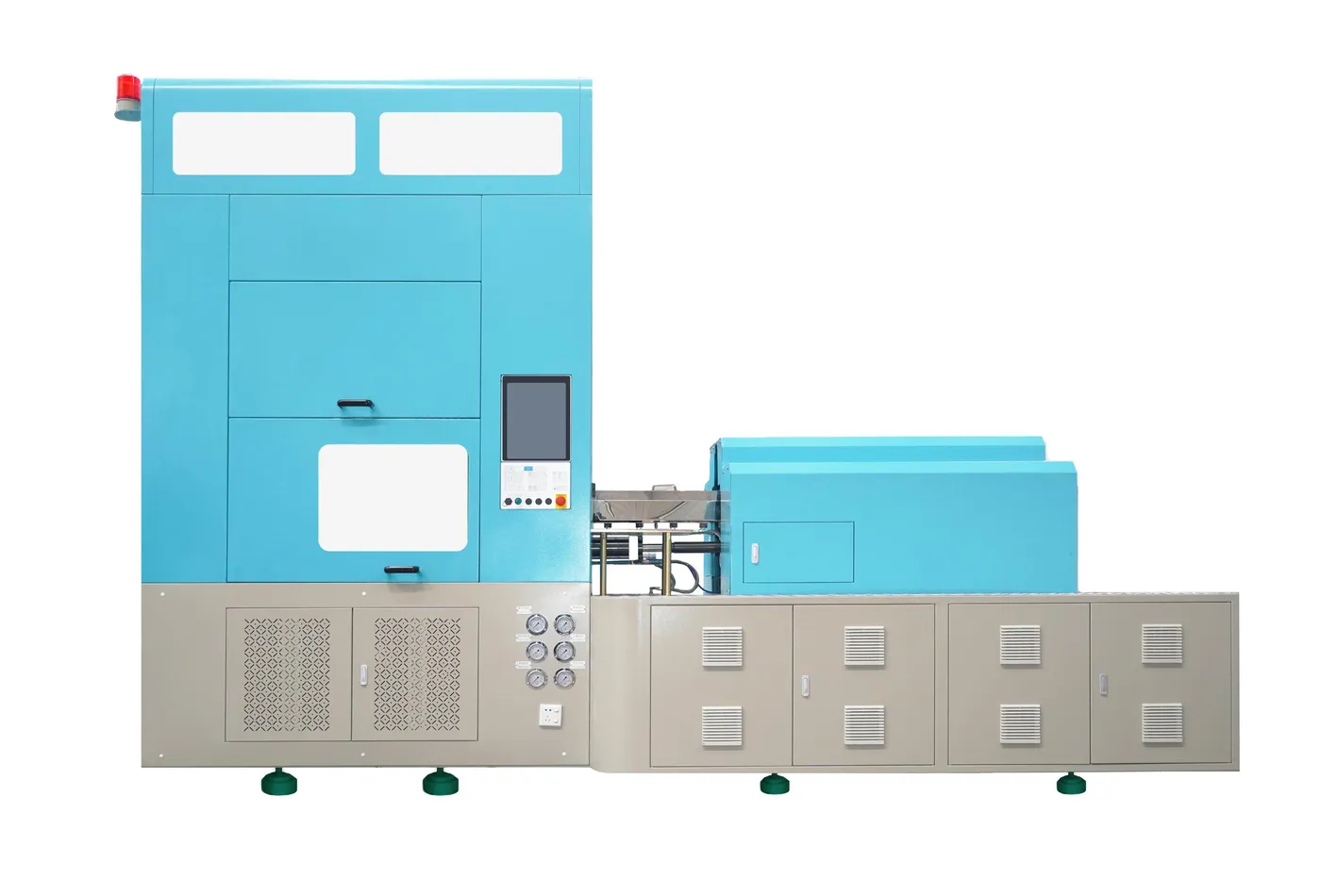 | Serrage servo, injection de vis servo, haute précision, faible consommation d'énergie, stabilité à long terme | ||
| Modèle entièrement électrique | Y150-V4-EV | Y200-V4-EV | Y250-V4-EV |
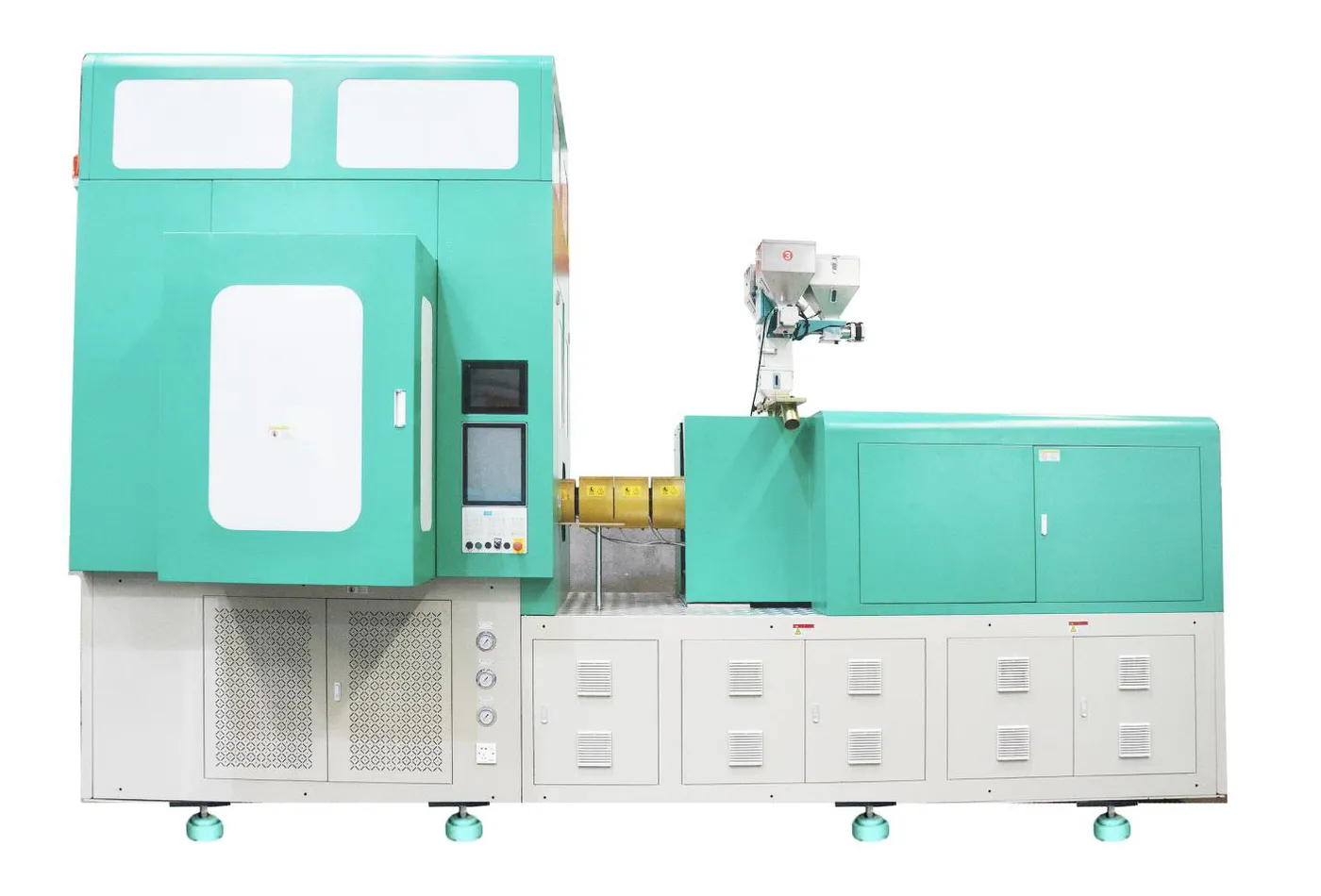 | Entraînement entièrement électrique, évitant les produits contaminés par l'huile. | ||
Avantages de notre machine ISBM
1. La qualité est supérieure. Les bouteilles en plastique produites par les machines de soufflage japonaises présentent toutes une ligne de joint. Une protubérance de plastique se forme au milieu des deux moules de chaque côté, laissant une marque. En revanche, nos moules sont d'une précision extrême et cette marque est totalement invisible.
2. Notre production est rapide, grâce à un grand nombre de vis et une cadence élevée. Alors que le Japon peut produire quatre bouteilles en plastique à la fois, nous pouvons en produire six.
3. Économisez de l'énergie. Nos machines consomment de 15% à 25% d'énergie en moins que celles du Japon, d'Europe et des États-Unis.
4. Un large éventail de technologies de commande électrique a été adopté pour remplacer les composants hydrauliques et pneumatiques. Par exemple, au Japon, les composants pneumatiques utilisés dans le mécanisme de coupe du fond sont ici remplacés par des servomoteurs, dont la vitesse est doublée. Dans l'industrie pharmaceutique et d'autres secteurs, l'utilisation exclusive de servomoteurs, sans aucun système hydraulique, garantit la conformité aux normes BPF et un fonctionnement dans un environnement exempt d'huile et de pollution.
Spécifications du produit
| Article | Unité | Caractéristiques | ||||||||||
| Nom | Moulage par injection-soufflage en une étape Machine (4 postes) | |||||||||||
| Modèle | Y250-V4 (Compatible avec le modèle japonais ASB-70DPH) | |||||||||||
| Fabricant | Transmission CMN | |||||||||||
| Matériel | PET/PETG | |||||||||||
| Diamètre de la vis | MM | 50 | 55 | 60 | / | |||||||
| Volume d'injection théorique | CM³ | 340 | 420 | 480 | / | |||||||
| Vitesse de rotation de la vis (tr/min) | r/min | 180 | 150 | 150~220 | / | |||||||
| Force de serrage par injection | KN | 300 | ||||||||||
| Force de serrage par soufflage | KN | 200 | ||||||||||
| Puissance du moteur | KW | 67.7 | ||||||||||
| Puissance de chauffage | KW | 15 | ||||||||||
| Pression d'air soufflé | MPA | 2.0-3.5 | ||||||||||
| Pression de l'eau de refroidissement | MPA | 0.4-0.6 | ||||||||||
| Pression d'eau du refroidisseur d'huile de machine | MPA | 0.3-0.4 | ||||||||||
| Température de l'eau du refroidisseur d'huile de la machine | ℃ | 20-25 | ||||||||||
| Tension | V | 370-400 | ||||||||||
| (L*l*H) Taille (L*l*H) | MM | 6300x2400x3700 | ||||||||||
| Poids | T | 16 | ||||||||||
| Dimensions du produit | ||||||||||||
| Quantité de produit | PCS | 2 | 3 | 4 | 5 | 6 | 8 | 9 | 10 | 14 | ||
| Diamètre de la bouteille (BD) | MM | 200 | 160 | 120 | 80 | 60 | 45 | 40 | 40 | 30 | ||
| Hauteur de la bouteille (H) | MM | 220 | 180 | 100 | ||||||||
| Diamètre du col (E) | MM | 130 | 130 | 100 | 65 | 55 | 40 | 32 | 28 | 16 | ||
| Volume maximal de la bouteille (ml) | ML | 2500 | 1500 | 900 | 750 | 350 | 200 | 100 | 50 | 30 | ||
| Poids maximal de la bouteille (W) (g) | G | 200 | 180 | 150 | 120 | 80 | 60 | 50 | 35 | 25 | ||
Paramètre machine
| Modèle compatible : | Compatible avec le modèle japonais ASB-70DPH |
| Diamètre de la vis : | 55 mm (en option) |
| Capacité d'injection théorique : | 420 g |
| Force de serrage par injection : | 300 kN |
| Course du moule supérieur : | 640 mm |
| Course inférieure du moule : | 350 mm |
| TEMP. Régulation du mouvement de base : | 300 mm |
| Course du barillet de régulation de température : | 300 mm |
| Coup de sortie : | 190 mm |
| Force de serrage par soufflage : | 200 kN (simple côté) |
| Coup de noyau de soufflage : | 300 mm |
| course de moulage par soufflage : | 75+75 mm |
| Réservoir d'huile VOL : | 600L |
| Dimensions (L×l×H) : | 6,3*2,4*3,7m; |
| Poids: | 16T |
Norme technique
| Système de servocommande : | Utilisation de 3 ensembles de systèmes de servopompes. |
| Puissance du servomoteur : | Puissance du servomoteur Inovance/ WEICHI : 67,7 KW. |
| Système de contrôle informatique : | Utilisation de l'automate programmable Inovance/MiRLE. |
| Entraînement de la platine : | La platine est équipée d'un servomoteur Yaskawa japonais ou d'un servomoteur WEICHI avec un réducteur TSUNTIEN taïwanais. |
| Structure de moulage par soufflage : | La structure de moulage par soufflage adopte un système de serrage de moule à vérin hydraulique ou à double servomoteur avec fonction de compensation haute pression. |
| Soupape haute pression : | Utilisation de la vanne haute pression américaine Parker. |
| Cylindre pneumatique : | Utilisation du cylindre pneumatique Aitak. |
| Contrôle de la température : | Utilisation d'un boîtier de commande intégré pour contrôler la température, offrant une grande précision, une stabilité optimale et une facilité d'utilisation ; vous pouvez également opter pour le système de contrôle de température intégré. |
| Vanne de régulation de pression hydraulique : | Utilisation d'une vanne de régulation de pression hydraulique de marque YUKEN (Taïwan, Chine). |
| Vis: | La vis est chauffée par un anneau chauffant nano-infrarouge lointain à économie d'énergie (10 kW). |
| Unité d'injection : | L'unité d'injection est commandée par un seul vérin. Le moteur de fusion peut être commandé hydrauliquement ou par un servomoteur. |
| Tube d'huile : | Le tube d'huile est fabriqué à partir de matériaux importés d'Italie. |
| Puissance totale de la machine : | Puissance totale de la machine : 82,7 kW. |
Principaux avantages de la machine ISBM en une étape Y250-V4
1. Économe en énergie
Cette machine de moulage par injection-soufflage en une seule étape conserve la chaleur résiduelle de la préforme de l'injection jusqu'au soufflage, éliminant ainsi le besoin d'un réchauffage secondaire. Cette conception fondamentalement différente réduit la consommation énergétique totale d'environ 400 TPL par rapport aux procédés de moulage par soufflage en deux étapes. Sur une année de production complète, les économies d'électricité sont substantielles, faisant de la Y250-V4 l'une des machines ISBM les plus rentables pour les fabricants à grand volume.
2. Excellentes performances
L'étape d'étirage biaxial permet d'aligner les molécules de plastique de manière orientée, améliorant considérablement la résistance à la compression, les propriétés de barrière et la transparence du contenant fini. Ceci est particulièrement précieux pour les emballages pharmaceutiques, les boissons gazeuses et les flacons cosmétiques où la clarté et l'intégrité structurelle sont essentielles. La Y250-V4 surpasse systématiquement les machines de moulage par injection-soufflage classiques en termes de qualité des bouteilles finies.
3. Haute précision et stabilité dimensionnelle
Le contrôle automatisé complet du processus par le système PLC Inovance/MiRLE minimise les erreurs humaines à chaque étape, de l'injection au refroidissement et à l'éjection. La Y250-V4 est ainsi idéale pour la production en continu à grande échelle, où une uniformité sur des milliers de cycles par poste est requise. Les tolérances dimensionnelles sont rigoureusement respectées, garantissant des volumes de remplissage constants, une étanchéité fiable des bouchons et des taux de rebut en aval réduits pour toutes les tailles de bouteilles prises en charge.
4. Utilisation élevée des matériaux
Le procédé en une seule étape de cette machine de moulage par injection-soufflage permet un moulage par injection précis de la préforme, suivie d'un soufflage pour obtenir la forme finale, avec un minimum de matière excédentaire. Contrairement aux procédés d'extrusion, il n'y a ni bavures, ni déchets de découpe, ni rebuts significatifs. Il en résulte une réduction des coûts de matières premières par unité produite et un impact environnemental moindre, contribuant ainsi à vos objectifs de développement durable tout en maintenant des coûts d'exploitation compétitifs.
5. Réduction des coûts totaux d'exploitation
Avec un encombrement réduit de 6,3 m x 2,4 m x 3,7 m et un poids de 16 tonnes, la Y250-V4 occupe moins d'espace au sol que les installations multi-machines comparables. L'automatisation complète réduit les besoins en main-d'œuvre. Sa consommation énergétique est de 151 à 251 TPE/3 TPE inférieure à celle des machines japonaises, européennes et américaines équivalentes. Grâce à des cycles de maintenance réduits et une grande stabilité de production, le coût total de possession sur cinq ans est nettement inférieur à celui des autres machines IBM de cette catégorie de performance.
6. Compatible avec les moules ASB japonais
La Y250-V4 est entièrement compatible avec les moules du modèle japonais ASB-70DPH. Elle constitue ainsi un remplacement idéal pour les machines ASB ISBM sur les lignes de production existantes. Les entreprises peuvent passer à la Y250-V4 sans mettre au rebut leur stock de moules actuel, préservant ainsi leurs investissements et bénéficiant d'une mise à niveau rapide et économique vers une plateforme plus performante.
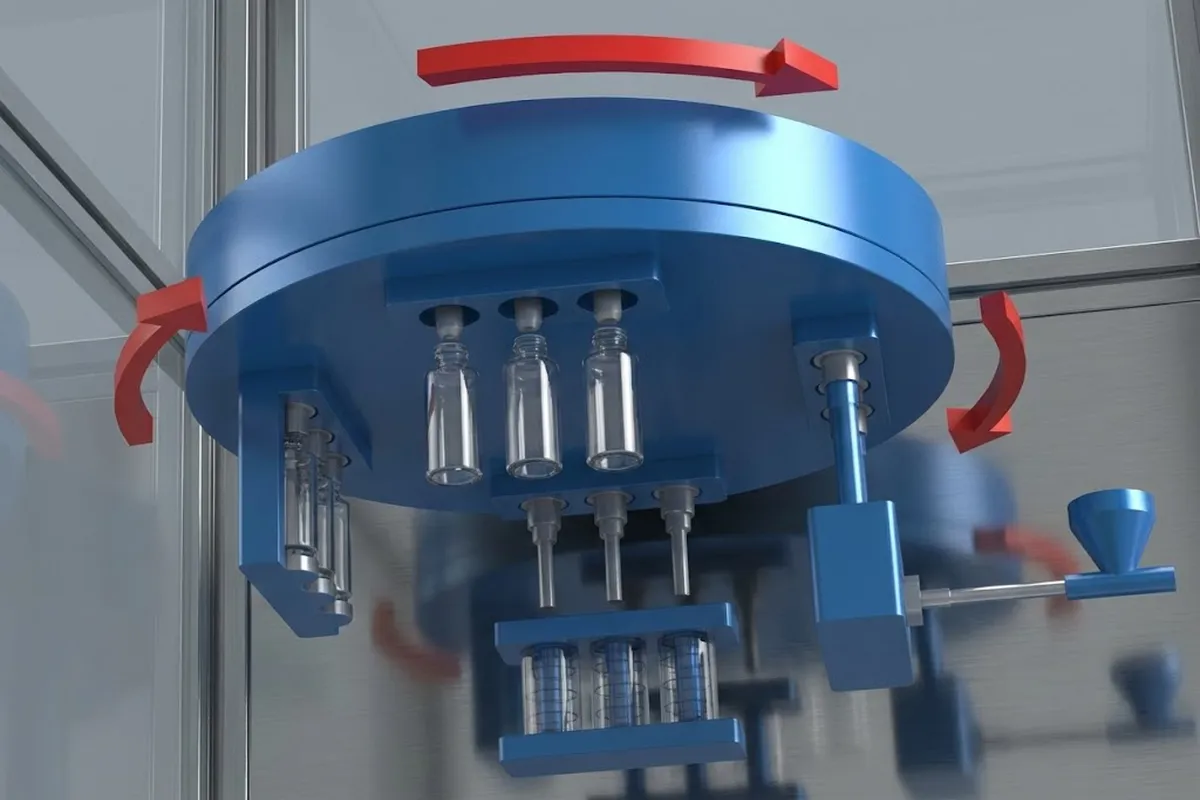
Processus de fabrication d'une machine de moulage par injection-soufflage
Étape 1 : Moulage par injection
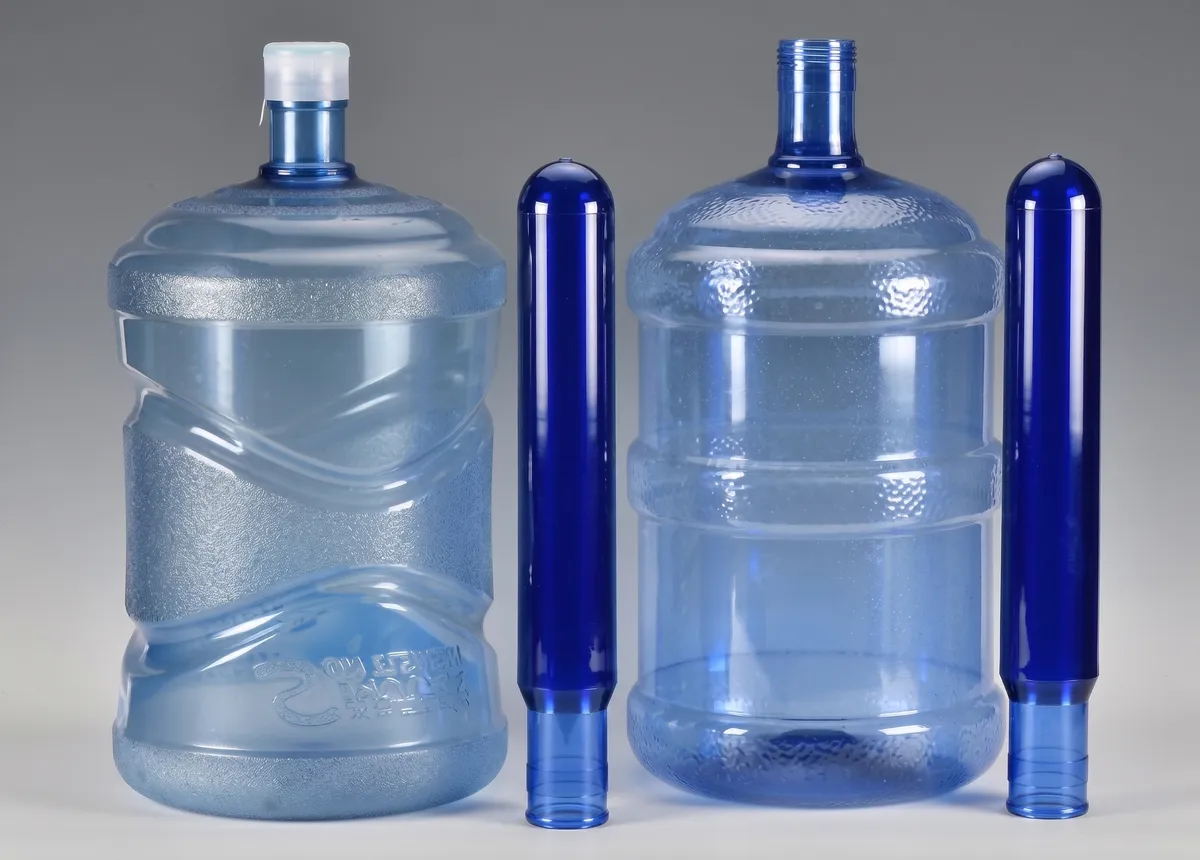
Le procédé débute par le chauffage d'une résine plastique (généralement du PET ou du PC) jusqu'à fusion. La résine fondue est injectée dans une cavité de moule pour former une préforme, qui est partiellement refroidie afin de stabiliser sa forme tout en conservant suffisamment de chaleur pour permettre l'étirage lors de l'étape suivante. Durant cette phase, la finition du col de la préforme est préservée. Cette conception garantit une étanchéité fiable, une précision dimensionnelle et un conditionnement thermique optimal pour les étapes suivantes.
Étape 2 : Conditionnement et transfert de la préforme
Un système de transfert rotatif spécialisé achemine la préforme fraîchement moulée de la station d'injection vers la zone de conditionnement. Elle traverse des zones de chauffage contrôlées qui stabilisent son profil de température interne. Ce conditionnement thermique homogène garantit un comportement uniforme du matériau lors des étapes d'étirage et de soufflage, améliorant ainsi la qualité des contenants et réduisant les risques de défauts tels qu'une épaisseur de paroi irrégulière ou un voile.
Étape 3 : Moulage par étirage-soufflage
C’est à cette étape que la préforme prend la forme finale de son contenant. L’étirage biaxial débute par l’allongement de la préforme à l’aide d’une tige, suivi d’un gonflage à l’air comprimé (2,0 à 3,5 MPa) pour épouser le moule. L’alignement des molécules de plastique dans deux directions confère au matériau une meilleure résistance à la pénétration des gaz et aux chocs, un atout particulièrement important pour les boissons gazeuses, les liquides pharmaceutiques et les contenants sous pression. L’épaisseur de paroi et les dimensions restent constantes à chaque cycle.
Étape 4 : Refroidissement et éjection
Une fois la bouteille entièrement soufflée à sa forme finale, elle est rapidement refroidie dans le moule pour se solidifier. Le système de refroidissement intégré fonctionne à une pression de 0,4 à 0,6 MPa et maintient la température du moule dans la plage optimale. Après refroidissement suffisant, le moule s'ouvre et éjecte automatiquement la bouteille finie. La course d'éjection de 190 mm garantit un démoulage fluide et sans dommage. Cette étape achève le cycle de moulage et permet de produire un contenant en plastique prêt à l'emploi à pleine vitesse.
Applications de moulage par injection-soufflage-étirage
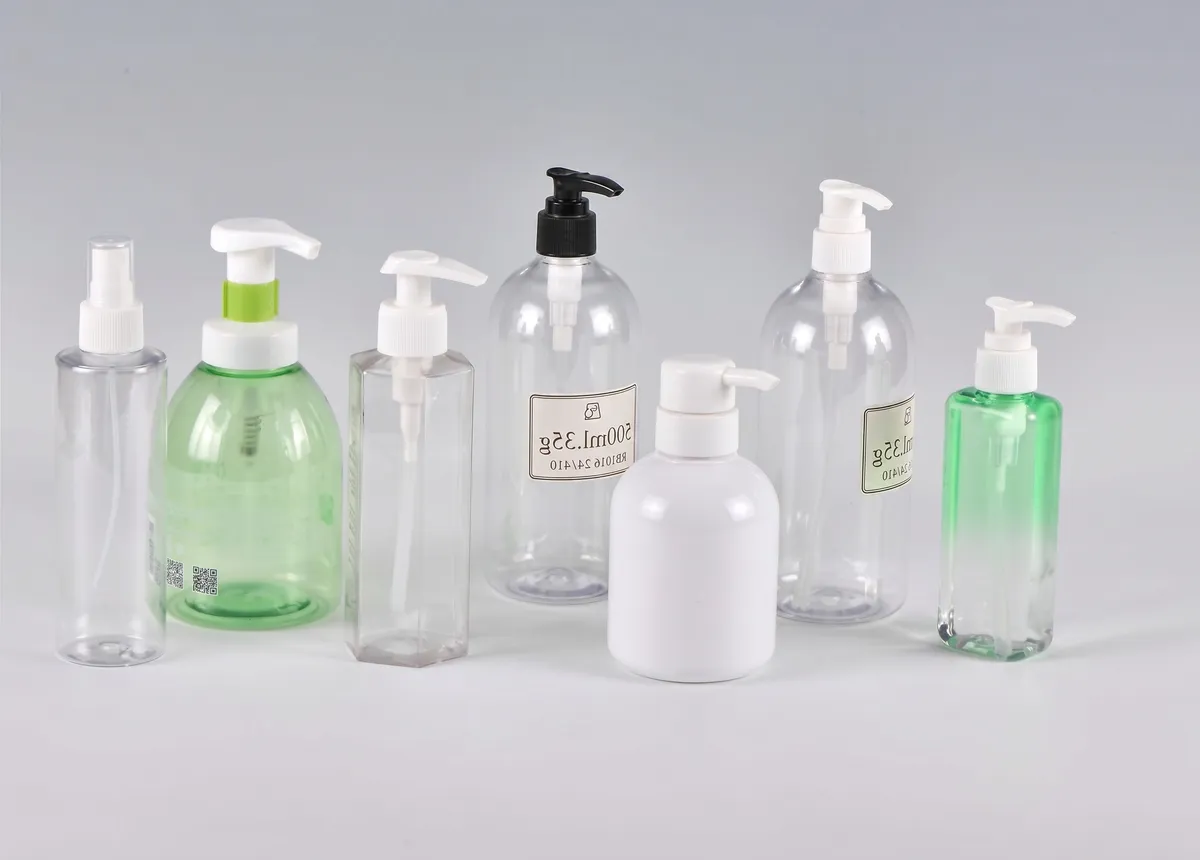
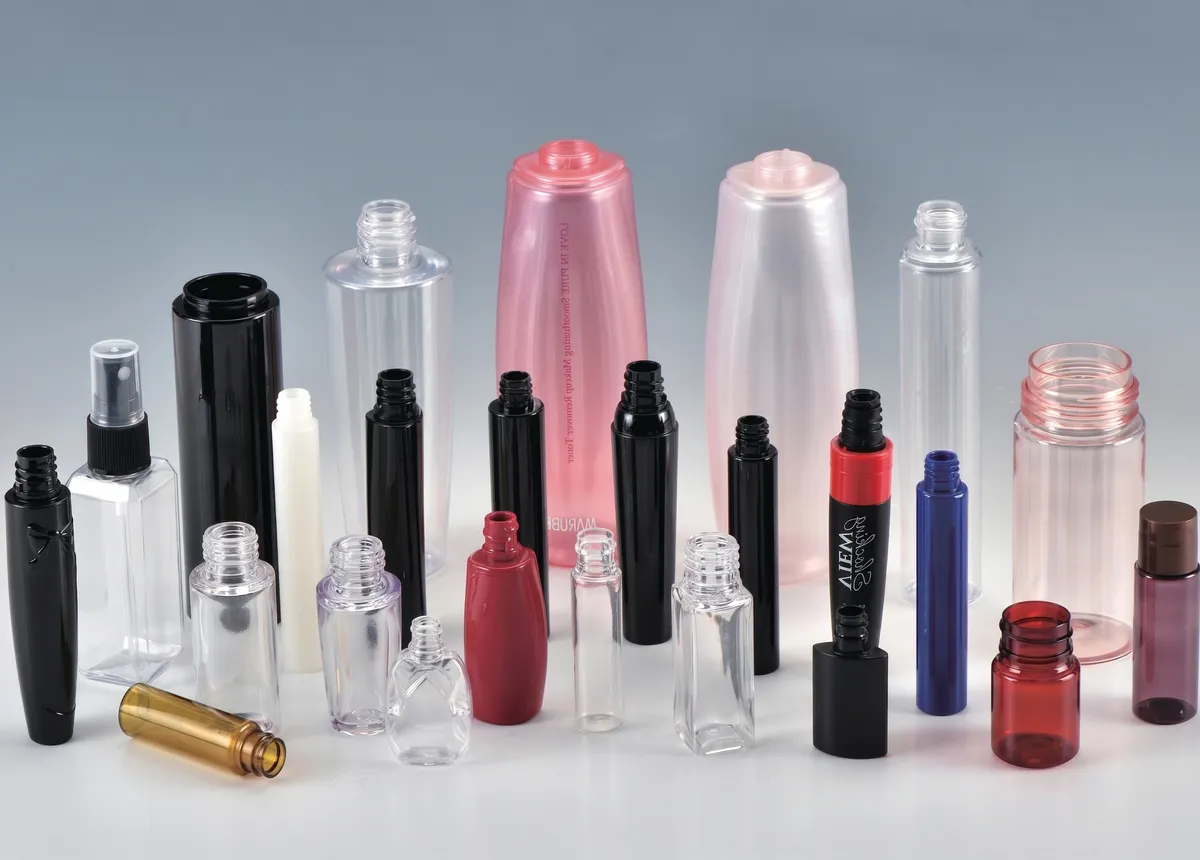
Flacon cosmétique
La Y250-V4 produit des flacons cosmétiques d'une clarté, d'une brillance et d'une précision dimensionnelle exceptionnelles. Les matériaux PET et PETG permettent d'obtenir des finitions d'une transparence cristalline qui mettent en valeur la couleur et la texture du produit, ce qui les rend idéaux pour les sérums, les lotions toniques, les lotions et les parfums. La conception sans joint du moule élimine les lignes de joint visibles, un avantage qualitatif significatif par rapport aux machines concurrentes japonaises.
Flacon pharmaceutique
Dans le secteur pharmaceutique, l'hygiène des contenants et la précision dimensionnelle sont essentielles pour la sécurité des patients et la conformité réglementaire. Le Y250-V4 machine de moulage par injection-étirage-soufflage Ce système peut être actionné exclusivement par servomoteurs, éliminant ainsi tout composant hydraulique et permettant un environnement de production entièrement sans huile et conforme aux BPF. La précision de la finition du col garantit des fermetures à l'épreuve des enfants et des scellés d'inviolabilité fiables sur chaque bouteille.
Bouteille de produit chimique
Le conditionnement de produits chimiques exige des propriétés de barrière supérieures afin d'empêcher la perméation et l'interaction entre le contenant et son contenu. Le procédé d'étirage biaxial de cette machine ISBM en une seule étape produit des flacons présentant une excellente résistance chimique, ce qui rend la Y250-V4 parfaitement adaptée au conditionnement de produits d'entretien ménager, de solvants industriels et de produits chimiques agricoles dans une gamme de contenances allant de 30 ml à 2 500 ml.
Bouteille de boisson
Les fabricants de boissons bénéficient de la cadence de production élevée de la Y250-V4, capable de produire jusqu'à 6 bouteilles par cycle. Les bouteilles PET produites par cette machine présentent une excellente barrière au CO2 pour les boissons gazeuses, ainsi qu'une transparence supérieure pour l'eau plate et les jus de fruits. La machine prend en charge les formats allant de 50 ml (portion individuelle) à 2 500 ml (grand format familial).
biberon
Les biberons exigent des matériaux de qualité supérieure, garantissant sécurité, transparence et régularité dimensionnelle. Le modèle Y250-V4 est compatible avec les matériaux PET, PETG, PC, Tritan et PP de qualité alimentaire, tous transformables pour répondre aux normes strictes de sécurité alimentaire. La configuration servo sans huile et sans pollution est particulièrement recommandée pour cette application, afin de satisfaire aux exigences des BPF et de la production alimentaire.
Bouteille de shampoing
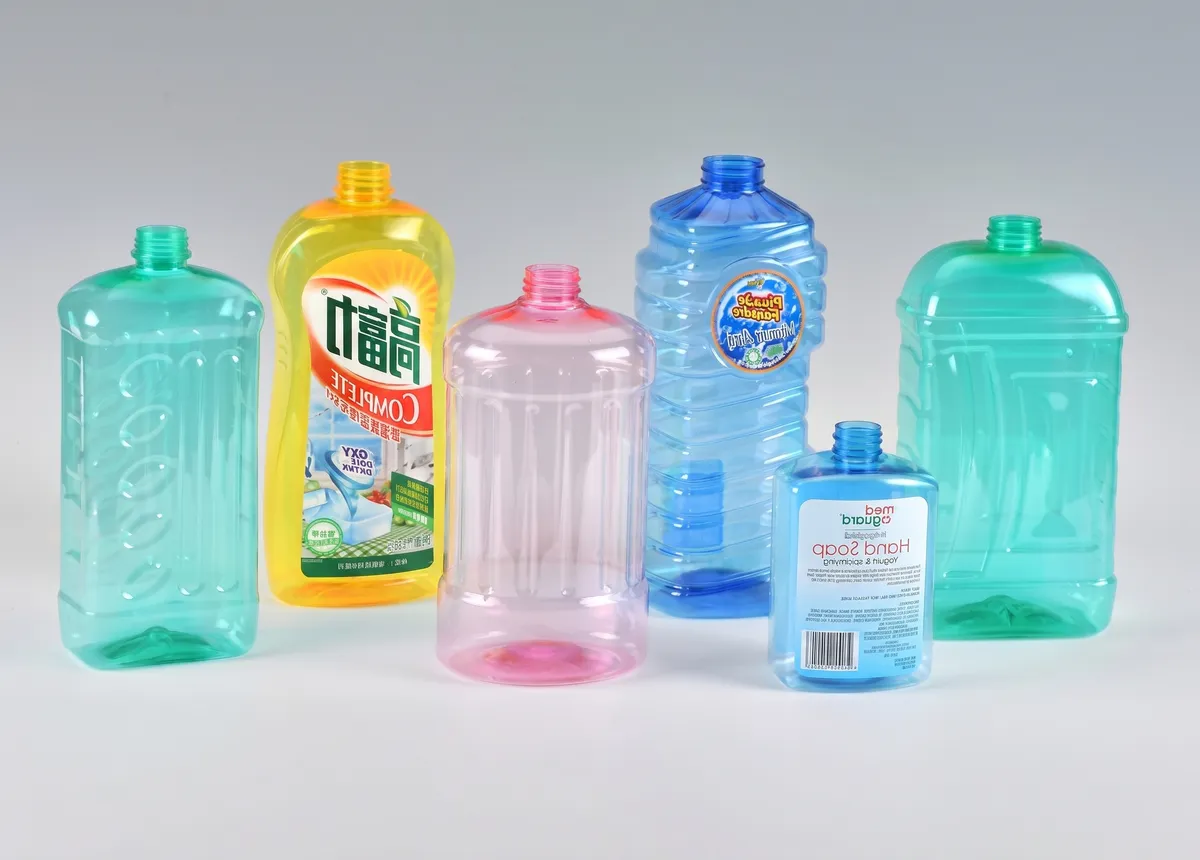
Les produits de soins personnels tels que les shampoings et les après-shampoings nécessitent des flacons aux formes attrayantes, aux épaules robustes et dotés de fermetures fiables. La Y250-V4 permet de produire des flacons de shampoing en PETG ergonomiques et design, avec une finition de surface haut de gamme. Les configurations de cavités plus larges permettent des productions journalières à haut volume, répondant aux exigences des grandes marques de soins personnels à des coûts unitaires compétitifs.
Flacon de soin oculaire
Le conditionnement des flacons de produits ophtalmiques exige une précision extrême au niveau du col et des conditions de production stériles et exemptes d'huile. La Y250-V4, dans sa configuration entièrement servo-motorisée, répond à ces exigences rigoureuses, garantissant des tolérances serrées sur les diamètres de col de 16 à 28 mm, typiques des emballages ophtalmiques. Le procédé d'étirage biaxial assure également une épaisseur de paroi constante dans le corps de petit diamètre, un facteur essentiel pour un dosage précis.
Bouteille de liquide vaisselle
Les flacons de liquide vaisselle doivent présenter une grande rigidité structurelle, une bonne résistance chimique et une présentation attrayante en rayon. La Y250-V4 produit ces flacons avec une uniformité de paroi élevée et une excellente rigidité, idéale pour les emballages empilables destinés à la vente au détail. Sa capacité à traiter des configurations de 4 à 8 cavités par cycle permet une production efficace des formats moyens de 200 ml à 750 ml, qui dominent cette catégorie de produits sur les marchés mondiaux.
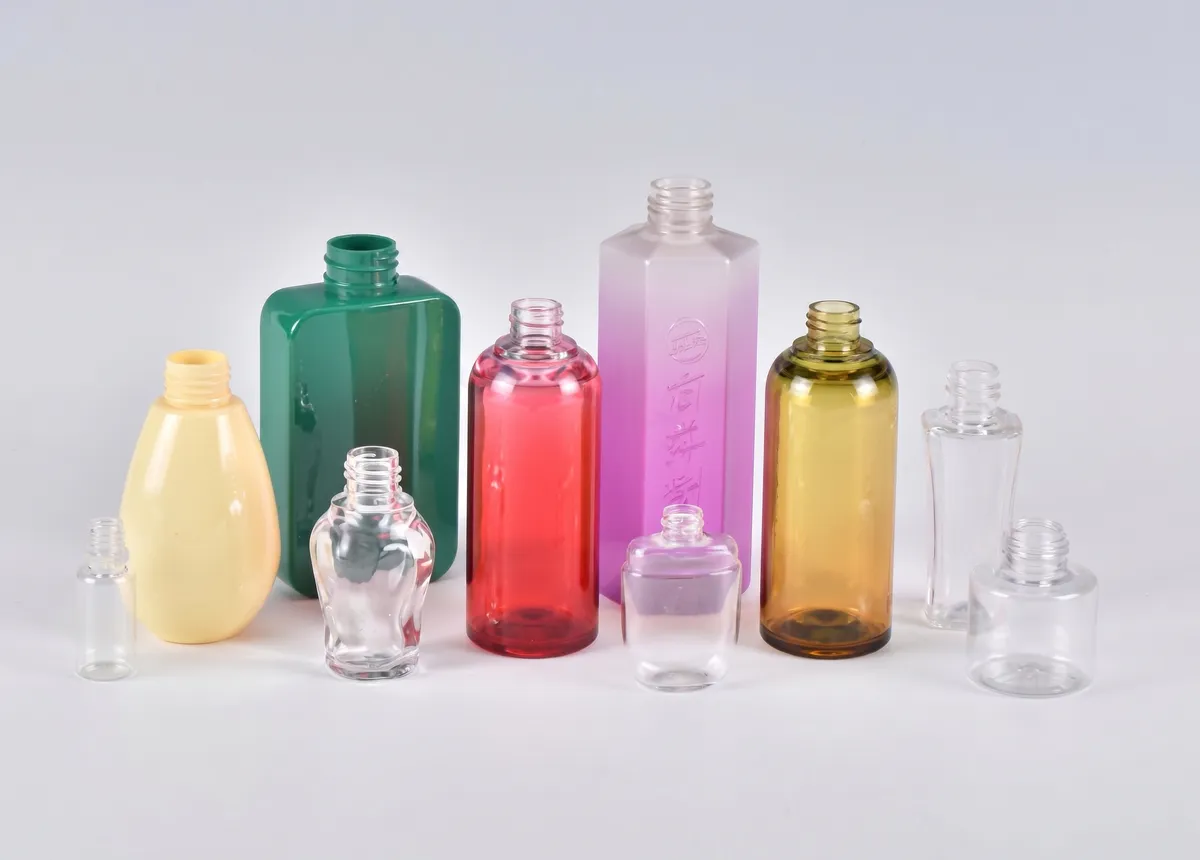 | 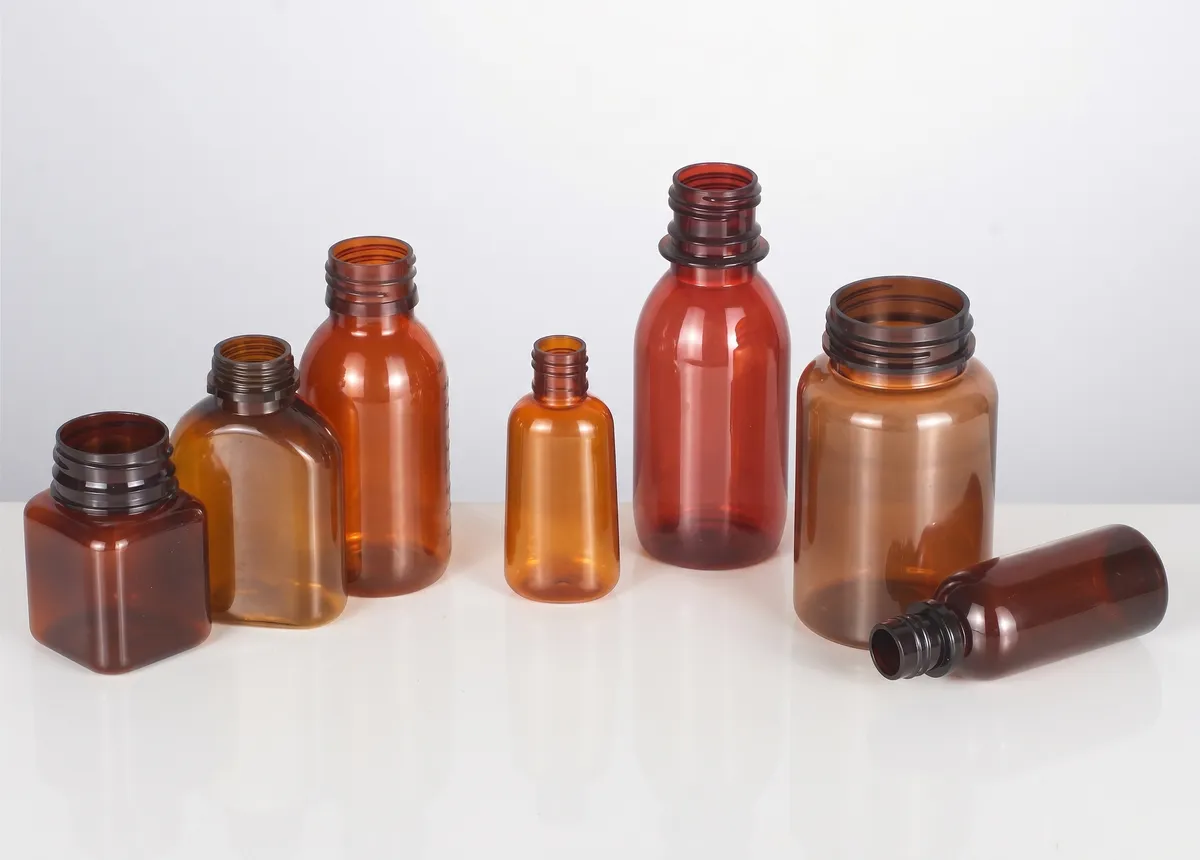 |
| Flacon cosmétique | Flacon pharmaceutique |
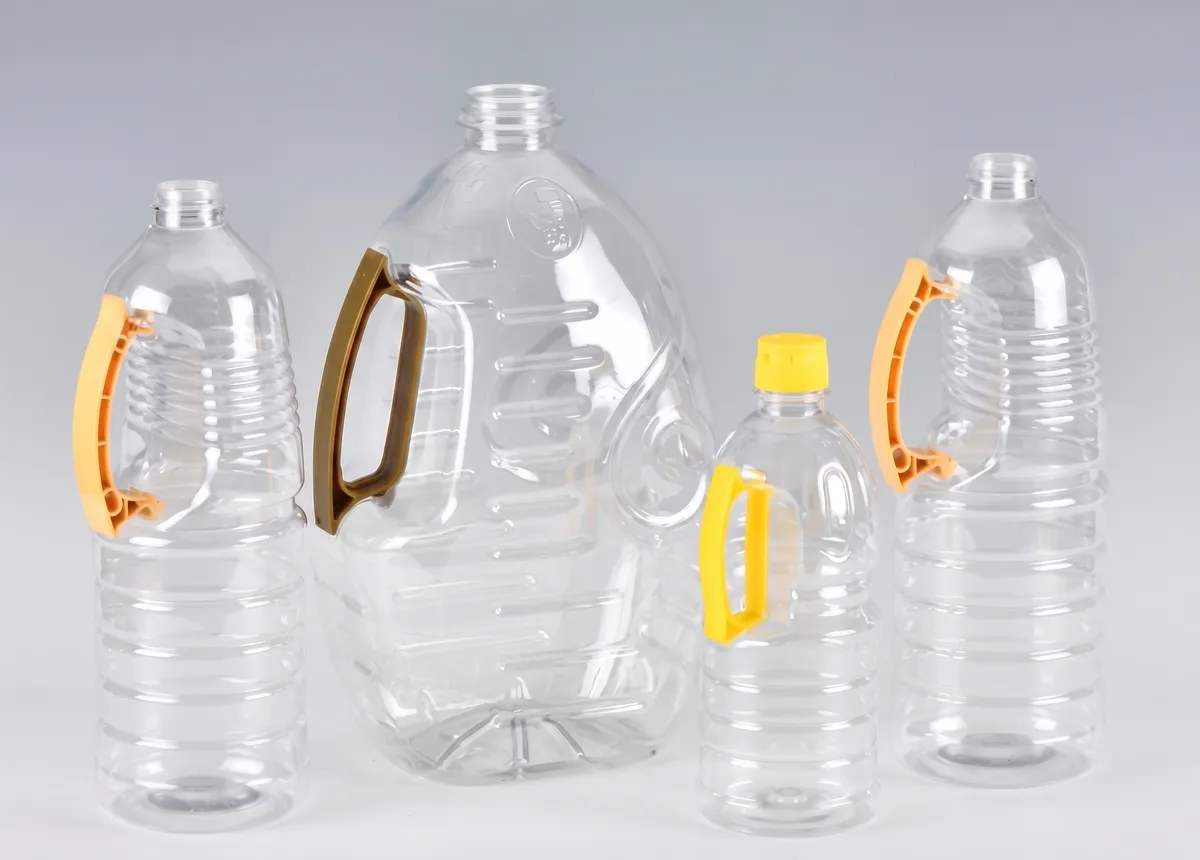 | 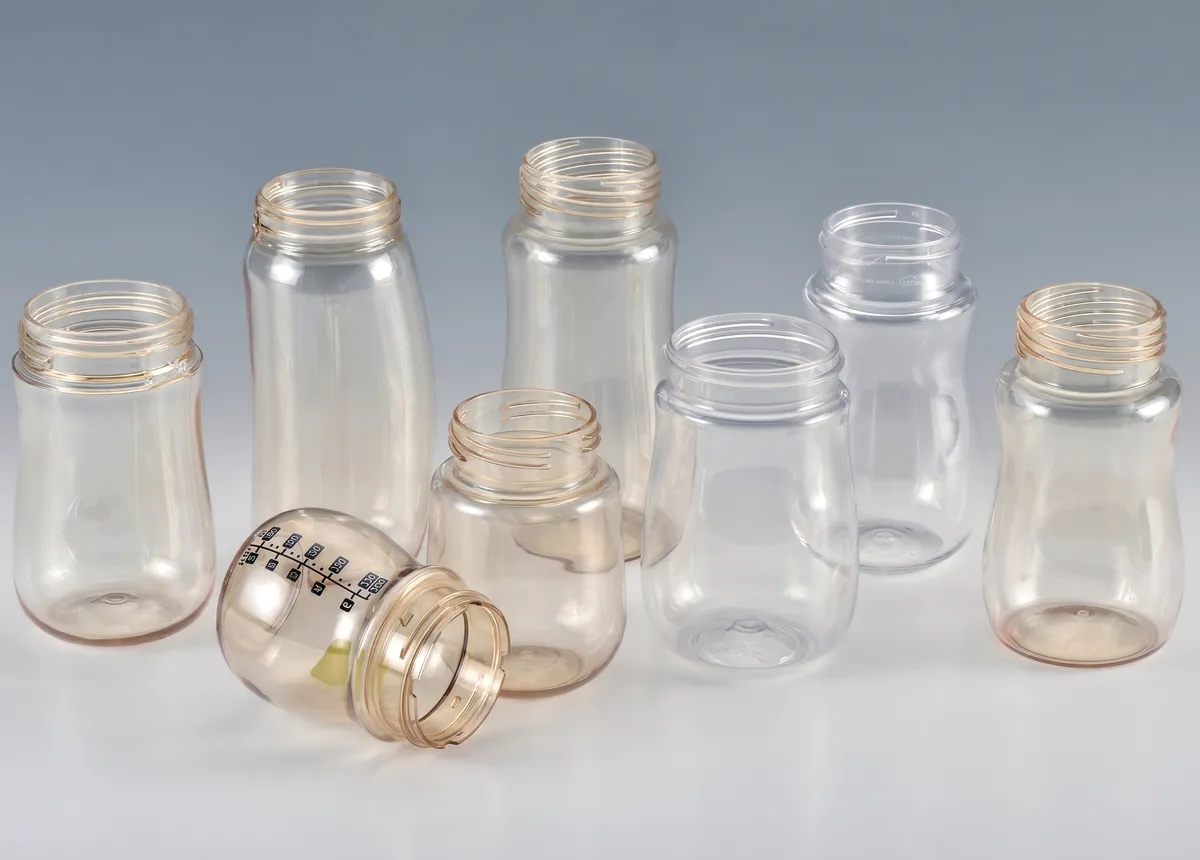 |
| Bouteille d'huile de cuisson | biberon |
Équipement clé pour machine de moulage par injection-soufflage
1. Unité de serrage
Le système de fermeture par injection exerce une force de 300 kN, maintenant le moule parfaitement fermé durant la phase d'injection haute pression. Le système de fermeture par soufflage fournit une force de 200 kN (d'un seul côté), assurant une étanchéité parfaite aux gaz lors du processus de soufflage-étirage. L'option de fermeture du moule par double servomoteur avec compensation de haute pression garantit une répétabilité optimale et une longue durée de vie du moule, même après des millions de cycles.
2. Unité d'injection
L'unité d'injection, commandée par un seul vérin, accepte des vis de 50, 55 ou 60 mm de diamètre, permettant des volumes d'injection théoriques respectifs de 340, 420 ou 480 cm³. Le moteur de fusion peut être entraîné hydrauliquement ou par un servomoteur pour une efficacité énergétique optimale. La vis est chauffée par un anneau chauffant nano-infrarouge lointain de 10 kW, assurant une plastification rapide et homogène du matériau avec une consommation d'énergie minimale.
3. Système de moulage
Le système de moule Y250-V4 est fabriqué avec une précision extrême, éliminant ainsi les lignes de joint visibles sur le contenant fini et représentant une amélioration de qualité significative par rapport aux machines japonaises standard. Compatible avec le format ASB-70DPH et les dimensions de moules AOKI, il constitue une solution de mise à niveau directe pour les lignes de production existantes. Disponible avec 2 à 14 cavités, ce moule est conçu pour une longue durée de vie et un changement de format aisé.
4. Système de goupille de soufflage et de noyau
La course du noyau de soufflage de 300 mm et celle du moule de soufflage de 75 + 75 mm sont conçues pour s'adapter à toutes les hauteurs de bouteilles, de 100 mm à 220 mm, compatibles avec la Y250-V4. La valve haute pression Parker (marque américaine Parker) régule le débit d'air entre 2,0 et 3,5 MPa pour une pression de gonflage constante et reproductible. Ainsi, chaque bouteille atteint la forme finale, l'épaisseur de paroi et le profil dimensionnel spécifiés par la conception du moule.
5. Système de refroidissement
Le système de refroidissement intégré fonctionne à une pression d'eau de 0,4 à 0,6 MPa pour le circuit de refroidissement du moule et de 0,3 à 0,4 MPa pour le circuit de refroidissement de l'huile de la machine. La température de l'eau du refroidisseur d'huile est maintenue entre 20 et 25 °C afin de protéger les composants hydrauliques et de garantir une viscosité stable. Le réservoir d'huile de 600 litres offre une capacité thermique suffisante pour un fonctionnement continu à haute vitesse sans dérive de performance liée à la température.
6. Système d'éjection
Le système d'évacuation dispose d'une course de 190 mm, offrant un dégagement suffisant pour retirer en toute sécurité les bouteilles finies à partir de 14 cavités. Le système de vérin pneumatique Airtak assure une actionnement fiable et à cycle élevé pour le mécanisme d'éjection, tandis que le servomoteur Yaskawa du Japon entraîne le plateau tournant entre les stations avec le positionnement angulaire précis requis pour un fonctionnement séquentiel à 4 stations à pleine vitesse de production.
Machine ISBM ou machine EBM : laquelle vous convient le mieux ?
Aperçu du processus
ISBM (Injection Stretch Blow Molding) Le moulage par injection-soufflage est un procédé qui consiste à injecter du plastique pour obtenir une préforme, laquelle est ensuite étirée dans un moule de soufflage pour former le contenant final. Cette méthode est largement utilisée pour la production de bouteilles PET de haute qualité, notamment pour les boissons, les cosmétiques et les produits pharmaceutiques. La Y250-V4 est un exemple de machine de moulage par injection-soufflage PET haute performance qui exploite pleinement les avantages de ce procédé.
EBM (Extrusion-Soufflage) Le procédé EBM consiste à extruder un tube de plastique fondu (paraison), qui est ensuite placé dans un moule et gonflé pour obtenir la forme souhaitée. L'EBM est largement utilisé pour la fabrication de contenants avec poignées, de formes complexes et de grandes dimensions, comme les bouteilles de détergent et les pièces automobiles. Bien que les machines EBM offrent une grande flexibilité de conception, elles ne possèdent pas la même clarté, la même précision dimensionnelle et la même efficacité énergétique que les machines ISBM modernes.
Comparaison des coûts : ISBM vs EBM
Investissement initial
ISBM : Le procédé ISBM exige des machines de moulage par injection et par soufflage de haute précision, ce qui se traduit généralement par un investissement initial plus important. Les moules sont complexes et coûteux en raison de la nécessité de préformes et de composants pour le moulage par soufflage. Toutefois, la cadence de production unitaire plus élevée et le coût énergétique unitaire plus faible permettent d'amortir rapidement cet investissement grâce à la production en série.
Investissement initial
EBM : Les machines EBM sont généralement moins chères à l'achat. La conception des moules est plus simple, notamment pour les formes basiques, ce qui rend l'EBM plus accessible aux jeunes entreprises et aux petites structures qui n'ont pas besoin de la clarté optique ni des tolérances serrées des contenants produits par ISBM.
Coûts d'exploitation
ISBM : Les machines ISBM, comme la Y250-V4, sont économes en énergie, notamment pour la production en grande série de bouteilles légères. Trois systèmes de pompes servo et un chauffage par nano-infrarouge lointain réduisent considérablement la consommation d'énergie. Bien que la présence d'opérateurs qualifiés soit requise, le système de contrôle PLC entièrement automatisé diminue sensiblement la charge de travail quotidienne.
Coûts d'exploitation
EBM : Les procédés EBM peuvent être plus énergivores, notamment pour les contenants à parois épaisses ou de grande taille. Les déchets de matériaux sont plus importants en raison des bavures et des ébarbages, ce qui augmente la consommation de matières premières et les coûts d'élimination. Pour les contenants à parois fines et haute transparence, l'EBM est généralement moins compétitif que l'ISBM en termes de coût unitaire.
Comparaison des performances : ISBM vs EBM
Qualité et constance des produits (ISBM)
ISBM fabrique des contenants d'une clarté optique, d'une résistance structurelle et d'une précision dimensionnelle exceptionnelles. Idéaux pour les applications exigeant des tolérances serrées et des normes esthétiques élevées, comme les bouteilles de boissons, les contenants cosmétiques et les emballages pharmaceutiques, où la confiance du consommateur est directement liée à l'apparence du contenant.
Qualité et constance des produits (EBM)
L'EBM offre une grande flexibilité de conception, ce qui la rend idéale pour les contenants avec poignées ou de formes originales. Cependant, l'épaisseur des parois peut varier et la finition de surface est généralement moins raffinée que celle de l'ISBM. Elle convient parfaitement aux contenants opaques ou colorés pour lesquels la transparence n'est pas un critère essentiel.
Capacités de conception de conteneurs (ISBM)
ISBM excelle dans la production de contenants légers, uniformes et d'une transparence cristalline. Ce procédé est idéal pour les formes pouvant être réalisées à partir d'une préforme, notamment les formes rondes, ovales et la plupart des formes de bouteilles standard. L'outillage de préformes et les cavités de moules sur mesure permettent de configurer les machines de moulage par injection-soufflage de manière personnalisée afin de répondre aux exigences spécifiques du marché.
Capacités de conception de conteneurs (EBM)
L'EBM excelle dans la production de contenants avec poignées, de géométries complexes et de grands volumes. Elle offre une plus grande liberté de conception pour des applications spécifiques telles que les réservoirs de fluides automobiles, les conteneurs de produits chimiques industriels et les flacons de produits ménagers avec poignées intégrées, ce qui la rend complémentaire plutôt que concurrente de l'ISBM dans la plupart des gammes de produits.
Tableau comparatif
| Facteur | Machine ISBM | Machine EBM |
|---|---|---|
| Coût initial de la machine | Modéré à élevé | Inférieur |
| Coût du moule | Haute qualité (moules doubles précis) | Moules inférieurs (moules plus simples) |
| Déchets matériels | Faible | Plus élevé (flash, finition) |
| Consommation d'énergie (par unité) | Inférieur | Plus haut |
| Clarté et finition | Excellent | Bien |
| Résistance structurelle | Haut | Modéré |
| Contrôle de l'épaisseur de la paroi | Excellent | Variable |
| Flexibilité de conception | Formes standard | Haut (poignées, complexe) |
| Compétences requises de l'opérateur | Haut | Modéré |
Matières premières compatibles
PET (polyéthylène téréphtalate)
Le PET est le matériau le plus utilisé sur la plateforme Y250-V4. Il offre une excellente transparence, une grande légèreté et des propriétés barrières exceptionnelles pour les boissons gazeuses, l'eau et les jus de fruits. Entièrement recyclable et conforme aux réglementations internationales relatives au contact alimentaire, le PET est le matériau de prédilection pour la production en grande série d'emballages de boissons et d'aliments.
PETG (PET modifié au glycol)
Le PETG offre une résistance aux chocs et aux produits chimiques supérieure au PET standard, tout en conservant une excellente transparence. Il est particulièrement apprécié pour les emballages cosmétiques, les flacons de produits d'hygiène et les contenants pharmaceutiques, où l'esthétique et la durabilité sont essentielles. De plus, le PETG se transforme à des températures plus basses, ce qui permet de réduire les temps de cycle sur cette machine.
PP (Polypropylène)
Le polypropylène (PP) est apprécié pour sa haute résistance chimique, son excellente résistance à la fatigue et son aptitude au remplissage à chaud. La machine Y250-V4 permet de traiter le PP destiné aux biberons, aux contenants médicaux et aux emballages alimentaires. Les contenants en PP peuvent être stérilisés par autoclave, ce qui rend ce matériau idéal pour les applications nécessitant des nettoyages répétés à haute température.
PC (Polycarbonate)
Le polycarbonate offre une résistance aux chocs et une clarté optique exceptionnelles, combinées à sa capacité à supporter des températures élevées. Il est largement utilisé pour les bouteilles d'eau réutilisables, les conteneurs de laboratoire et les applications industrielles. La température de fusion élevée du PC exige un contrôle précis de la température d'injection, assuré avec fiabilité par le système de gestion de température intégré Y250-V4.
PCTG (PCT avec glycol)
Le PCTG allie la robustesse du PC à la transparence du PETG, ce qui en fait un matériau idéal pour les emballages cosmétiques haut de gamme, les applications en contact avec les aliments et les boîtiers de dispositifs médicaux. Il offre une excellente résistance à la fissuration et est sans BPA, un critère de plus en plus important pour les produits de santé grand public et les emballages de qualité supérieure.
Tritan
Le Tritan est un copolyester sans BPA, reconnu pour son exceptionnelle transparence, sa robustesse et sa compatibilité avec le lave-vaisselle. C'est le matériau de choix pour les gourdes réutilisables, les sacs de sport et les gourdes pour enfants, où sécurité, durabilité et esthétique sont primordiales. La machine Y250-V4 permet de travailler le Tritan avec une grande régularité, quelle que soit la configuration du moule (multi-empreintes).
PE (Polyéthylène)
Les matériaux en polyéthylène, notamment le PEHD et le PEBD, sont utilisés pour la fabrication de contenants exigeant une excellente résistance chimique, une grande flexibilité et un faible coût de production. Le PE est couramment employé pour les flacons pharmaceutiques, les contenants de produits d'entretien et les emballages industriels. Transformé sur cette machine de moulage par injection-soufflage, le PE permet de produire des contenants d'épaisseur constante et assurant une fermeture fiable.
PLA (Acide polylactique)
Le PLA est un polymère biosourcé et compostable de plus en plus prisé par les marques en quête de certifications de développement durable. Transformable sur la machine Y250-V4, il permet de produire des bouteilles transparentes et rigides, idéales pour les boissons, les compléments alimentaires et les produits d'hygiène. Les emballages en PLA séduisent fortement les consommateurs soucieux de l'environnement sur les marchés européens et nord-américains, offrant ainsi aux marques un avantage concurrentiel indéniable.
 |  |
 |  |
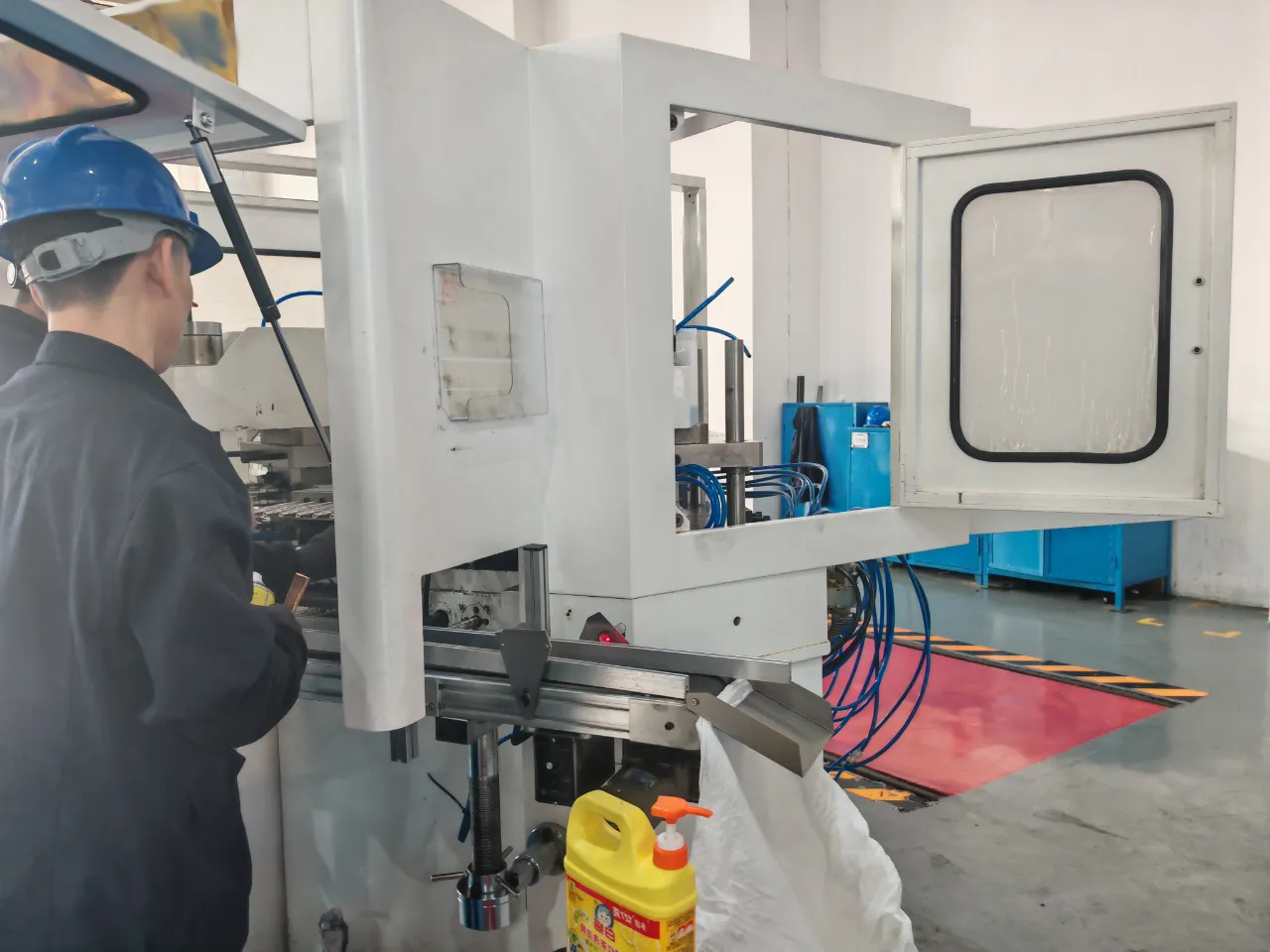
Conseils d'entretien pour la machine ISBM Y250-V4
Nettoyage régulier
Après chaque production, nettoyez soigneusement les moules d'injection, les moules de soufflage et toutes les pièces mécaniques afin d'éliminer les résidus de plastique, la poussière et les dépôts d'huile. Portez une attention particulière au système d'alimentation, aux surfaces des cavités et aux orifices des broches de soufflage. Des moules propres garantissent une finition de surface nettement supérieure sur les contenants finis et préviennent l'accumulation progressive de résidus pouvant entraîner des variations dimensionnelles au fil du temps.
Entretien de la lubrification
Appliquez les huiles et graisses lubrifiantes appropriées sur tous les rails de guidage, vis-mères, paliers et points de pivot du plateau tournant, conformément au calendrier d'entretien. Les vis-mères NSK (Japon) nécessitent une lubrification régulière pour garantir leur précision et prévenir l'usure prématurée. Un graissage insuffisant est l'une des principales causes d'augmentation du frottement, de dérive dimensionnelle et de réduction de la durée de vie des composants sur les machines ISBM à cycle élevé.
Vérification du système entièrement électrique
Inspectez régulièrement tous les servovariateurs, les connexions des moteurs, les câbles de retour d'information des codeurs et le câblage des signaux de l'automate programmable afin de vérifier leur bon fonctionnement. Comparez les paramètres des servovariateurs aux valeurs de référence enregistrées lors de l'installation. Toute réponse instable des servovariateurs, toute vibration anormale ou tout code d'erreur sur les servovariateurs Inovance/WEICHI doit faire l'objet d'une investigation et d'une résolution rapides afin d'éviter tout dommage à la machine et tout problème de qualité du produit.
Maintenance du système électrique
Inspectez régulièrement l'intérieur de toutes les armoires électriques et boîtes de jonction afin de détecter tout signe de surchauffe, de connexion desserrée ou d'infiltration d'humidité pouvant provoquer des courts-circuits. Vérifiez l'intégrité de toutes les liaisons de terre, le calibre des fusibles et l'état des contacts des contacteurs. Contrôlez la résistance des circuits de l'anneau chauffant nano-infrarouge lointain afin de déceler toute dégradation précoce des câbles avant qu'elle n'affecte les performances de chauffage.
Entretien des moisissures
Inspectez régulièrement les moules d'injection et de soufflage afin de détecter tout signe d'usure de surface, de corrosion par piqûres ou de dommages au niveau des joints de séparation. Toute usure visible sur les surfaces des cavités doit être traitée immédiatement, car même une légère dégradation de surface se traduit par des défauts de finition visibles sur les bouteilles produites. Remplacez les inserts de bague de col usés et les bouchons d'évent des moules de soufflage selon le calendrier prévu afin de garantir la précision dimensionnelle et une bonne évacuation des gaz pendant le cycle de soufflage.
Réglage des paramètres de la machine
Après tout changement de matériau, de moule ou arrêt prolongé de la machine, vérifiez et optimisez tous les paramètres, notamment la pression d'injection, la vitesse de la vis, les températures des zones de chauffe, la pression d'air de soufflage, la force de serrage et le temps de refroidissement. Les variations saisonnières de température ambiante peuvent affecter le comportement du fluide et nécessiter un léger réétalonnage des paramètres. Consignez tous les réglages dans le carnet de bord de la machine pour assurer la traçabilité et l'amélioration continue du processus.
Comment choisir la machine ISBM adaptée à votre application
1. Définissez votre volume de production
Estimez votre production journalière ou mensuelle requise en unités. Pour des volumes de production plus importants, une configuration à plus grand nombre de cavités (jusqu'à 14) est justifiée sur la Y250-V4, tandis que pour des productions plus modestes, une configuration à 2 ou 4 cavités sera plus efficace. La plateforme 4 stations Y250-V4 est parfaitement adaptée aux opérations de production de moyennes et grandes séries, et sa configuration de cavités peut être mise à niveau au fur et à mesure de la croissance de votre activité.
2. Identifiez votre gamme de tailles de bouteilles
Assurez-vous que les dimensions de vos bouteilles correspondent aux spécifications de la machine. La Y250-V4 accepte des bouteilles de 30 à 200 mm de diamètre, de 100 à 220 mm de hauteur et de 30 à 2 500 ml de volume. Si votre gamme de produits comprend des bouteilles de dimensions différentes, notre équipe d'ingénieurs vous conseillera sur le modèle le plus adapté parmi la gamme complète de machines CMN ISBM, notamment la Y150-V4 (petites bouteilles) ou la Y650-V4 (grands contenants).
3. Choisissez la configuration de disque appropriée
Choisissez entre la Y250-V4 Standard (pompe servo hydraulique), la Y250-V4 Servo (serrage et injection servo pour une haute précision et une faible consommation d'énergie) ou la Y250-V4-EV 100 % électrique (sans huile, conforme aux BPF). Les applications pharmaceutiques et de puériculture nécessitent presque toujours la version 100 % électrique. Les applications cosmétiques et de boissons offrent d'excellents résultats avec les configurations standard ou servo, à moindre coût.
4. Évaluer la compatibilité des matériaux
Veuillez vérifier que le matériau d'emballage de votre choix (PET, PETG, PP, PC, Tritan, PLA, etc.) est compatible avec la configuration machine envisagée. Chaque matériau requiert une géométrie de vis, un profil de température du fourreau et des conditions de traitement spécifiques. CMN vous propose des conseils de configuration adaptés à chaque matériau lors de la consultation technique avant-vente, afin que votre machine soit opérationnelle dès le premier jour.
5. Tenir compte de la compatibilité des moules
Si vous utilisez actuellement une machine ASB ou AOKI japonaise, vérifiez la compatibilité de vos moules avec le Y250-V4. Ce dernier est compatible avec les moules ASB-70DPH, ce qui en fait une solution de remplacement directe et économique pour les machines ASB ISBM. Si vos moules actuels ne sont pas compatibles, CMN peut en fabriquer de nouveaux ou vous recommander des modifications permettant une transition avec un investissement minimal en outillage.
6. Plan de support après-vente
Collaborez avec un fabricant de machines ISBM capable d'assurer l'installation sur site, la formation des opérateurs, le diagnostic à distance et la disponibilité locale des pièces détachées. L'équipe de service CMN prend en charge l'installation, la mise en service et la formation technique complète sur votre site. Notre réseau mondial de pièces détachées garantit la disponibilité rapide de composants critiques tels que les vannes Parker, les vis-mères NSK et les vérins Airtak, assurant ainsi la continuité de votre production.
Pourquoi choisir la machine de moulage par injection-soufflage de CMN ?
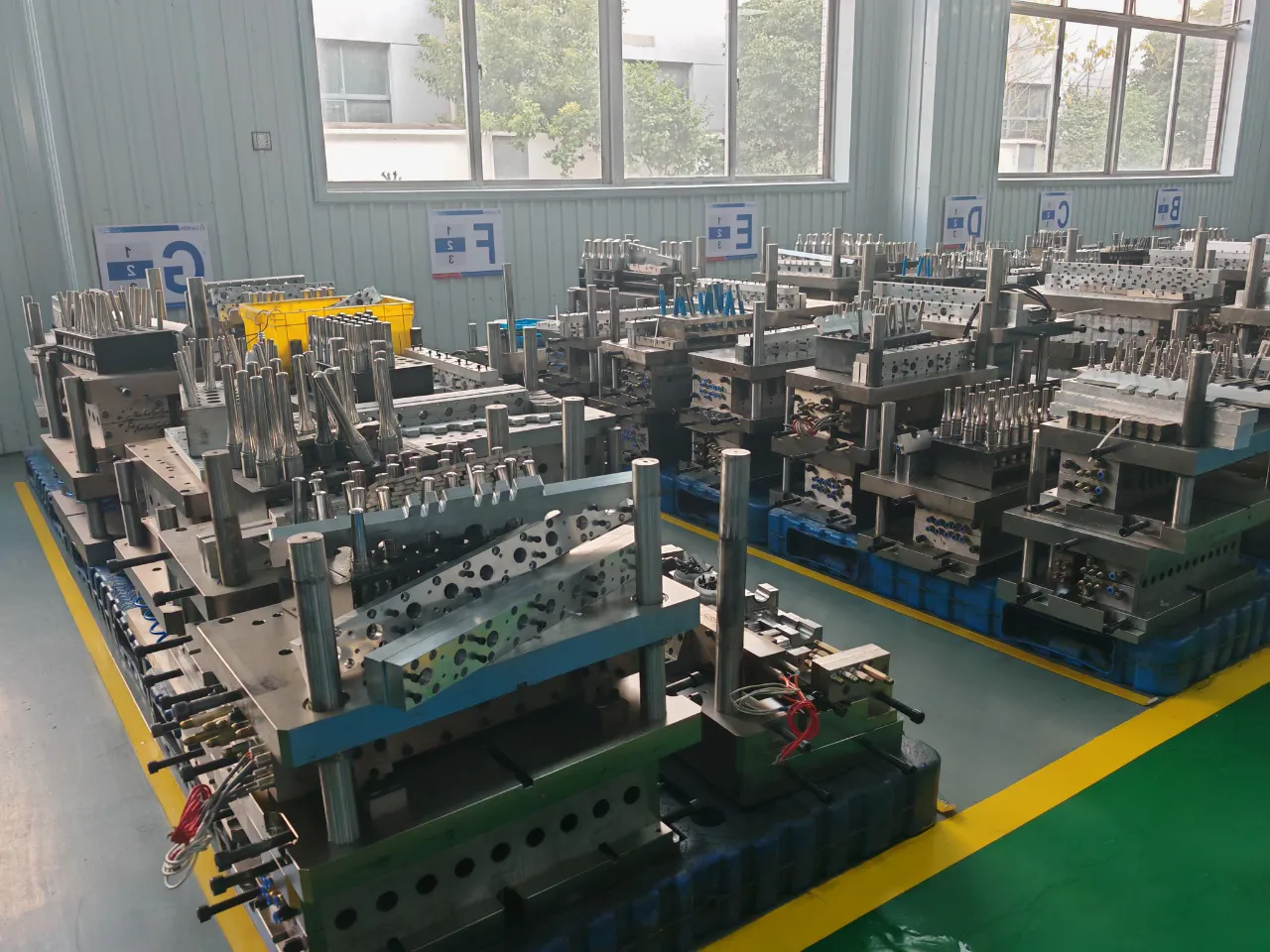
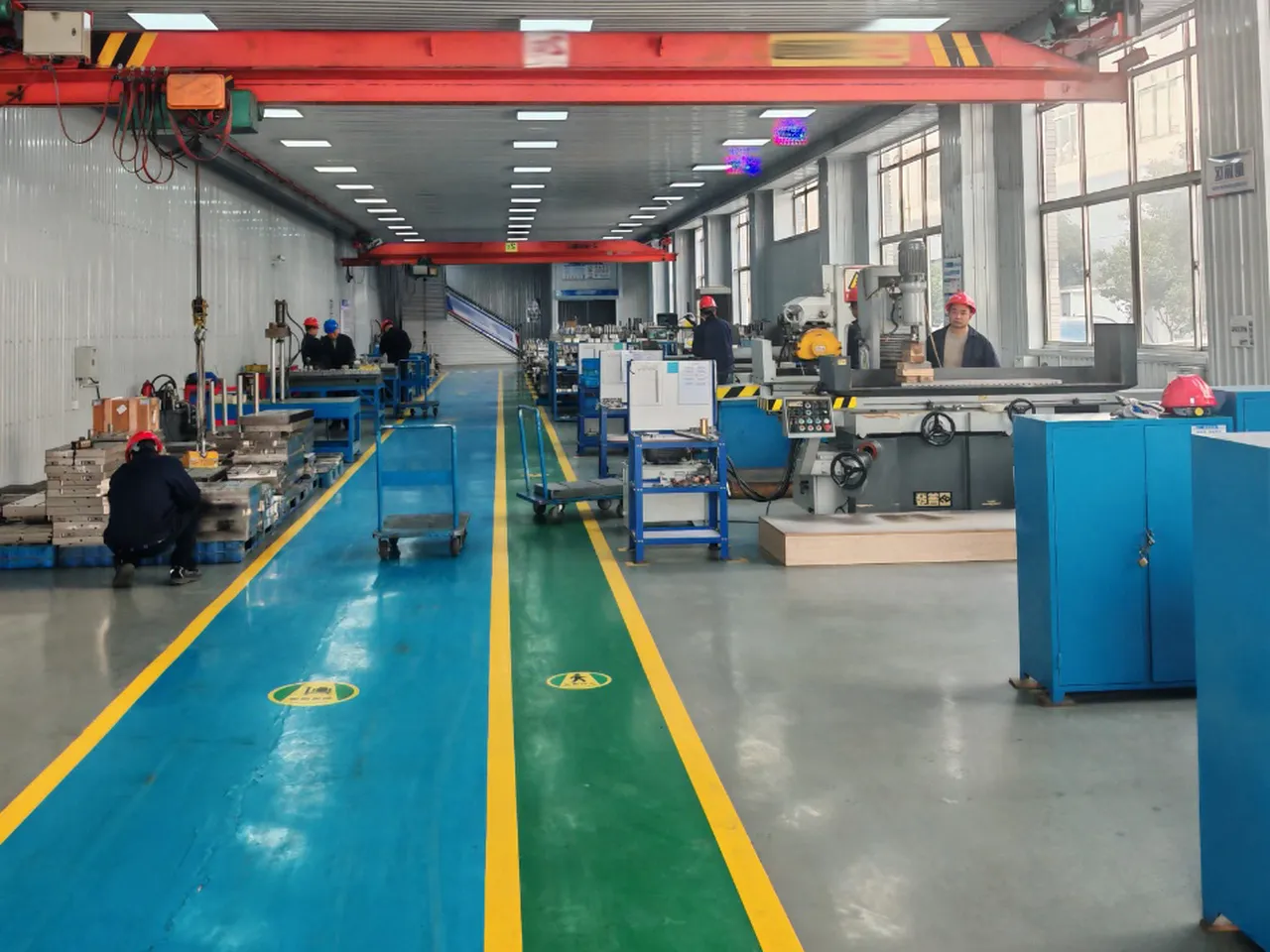
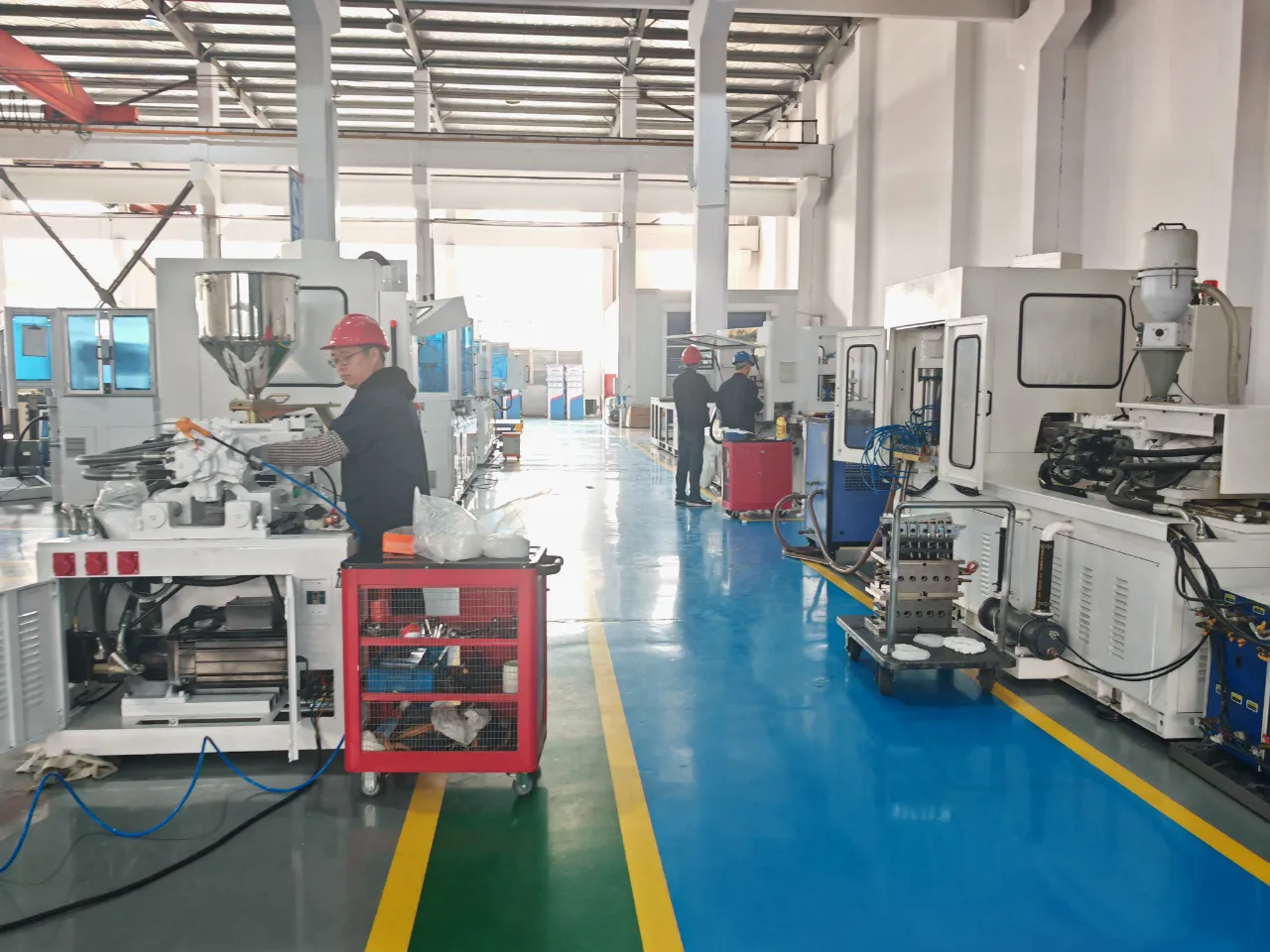
CMN Transmission est un fabricant professionnel de machines ISBM, spécialisé dans le développement, la production et l'exportation de machines de moulage par injection-soufflage en une étape et de machines de moulage par injection-étirage-soufflage pour le marché mondial. Fondée en 2003, CMN Transmission se consacre depuis plus de vingt ans exclusivement à la recherche, au développement et à la fabrication de ces machines. Cette expertise pointue permet à notre équipe d'ingénieurs de maîtriser chaque étape du processus ISBM, de la conception des préformes à l'optimisation des moules, jusqu'à la qualité du produit final. Nous ne sommes pas une entreprise de mécanique générale qui fabrique également des machines ISBM ; c'est notre unique activité, et cela se reflète dans la qualité de chacune de nos machines.
Notre entreprise réunit une équipe expérimentée d'ingénieurs et de techniciens possédant une expertise pointue en machines d'injection-soufflage et en conception de moules. Forte d'une solide expérience théorique et pratique dans les secteurs pharmaceutique, cosmétique, des boissons, agroalimentaire et de l'emballage industriel, notre équipe assure un accompagnement technique personnalisé et réactif à chaque étape : évaluation avant-vente, spécifications techniques sur mesure, mise en service sur site, formation des opérateurs et assistance technique après-vente à long terme.
Les machines CMN sont utilisées dans le monde entier pour la fabrication d'emballages pharmaceutiques, alimentaires, de produits de santé, cosmétiques et d'emballages plastiques industriels. Nous produisons des contenants de 1 ml à 1 000 ml en PEHD, PEBD, PET, PETG, PP, PS, PPSU, PC, Tritan, ABS, PLA, EVA, PCTG et autres matériaux homologués. Grâce à cette large gamme de matériaux et d'applications, une seule machine CMN peut alimenter plusieurs lignes de production au sein de votre usine, optimisant ainsi votre investissement.
CMN Transmission a mis en place une chaîne d'approvisionnement complète pour la production de machines ISBM, couvrant la fabrication des machines, la conception et la production des moules, l'outillage, les pièces de rechange et un support technique complet. Notre philosophie de développement, fondée sur l'autonomie, l'intégrité, le pragmatisme, l'innovation et la responsabilité, guide chacun de nos projets. Nous proposons une solution clé en main intégrée permettant à nos clients de bénéficier d'un interlocuteur unique et de confiance, de l'étude de faisabilité initiale jusqu'au support de production post-installation, qui se poursuit pendant plusieurs années.
 |  |
 | |
FAQ
Q : Quelle est la différence entre une machine ISBM en une étape et une machine de moulage par injection-soufflage en deux étapes ?
A: Une machine de moulage par injection-soufflage en une seule étape, comme la Y250-V4, réalise l'injection, le conditionnement des préformes et le moulage par étirage-soufflage en un seul cycle continu, sans manipulation intermédiaire ni réchauffage. Un système en deux étapes injecte les préformes dans une première machine, les refroidit complètement, les stocke, puis les réchauffe dans une machine de réchauffage par étirage-soufflage distincte avant le soufflage. Le procédé en une seule étape offre une homogénéité de produit supérieure, une consommation d'énergie réduite (environ 40% de moins qu'un système en deux étapes) et un circuit de production totalement exempt de contamination, ce qui en fait le choix privilégié pour les emballages pharmaceutiques, alimentaires et cosmétiques haut de gamme.
Q : Le Y250-V4 est-il un véritable remplaçant pour les machines de moulage par injection-soufflage ASB ?
R : Oui. La Y250-V4 est compatible avec les moules ASB-70DPH, ce qui en fait un remplacement parfaitement compatible pour les machines ASB ISBM. Dans la plupart des cas, les installations peuvent transférer les moules compatibles existants sur la Y250-V4 sans modification. La Y250-V4 offre également des améliorations notables par rapport aux machines japonaises d'origine : qualité de la ligne de joint (nos moules ne produisent aucune ligne de joint visible), nombre d'empreintes (jusqu'à 6 par cycle contre 4 pour les équivalents japonais) et efficacité énergétique (consommation électrique inférieure de 15 à 25%).
Q : La machine de moulage par injection-soufflage Y250-V4 peut-elle produire des flacons de qualité pharmaceutique ?
R : Oui. En version entièrement servo (YS250-V4) ou entièrement électrique (Y250-V4-EV), la machine fonctionne sans système hydraulique, garantissant un environnement de production totalement exempt d'huile et de pollution, conforme aux normes BPF. Le mécanisme de coupe du fond, entraîné par un servomoteur, remplace les composants pneumatiques, améliorant ainsi la propreté et la vitesse de cycle. Les dimensions de finition du col sont réalisées avec une grande précision, assurant une fermeture fiable, sécurisée pour les enfants et inviolable. Contactez notre équipe technique pour obtenir la documentation BPF spécifique et des recommandations de configuration adaptées à votre environnement réglementaire.
Q : Quelles sont les tailles et les volumes de bouteilles que la machine Y250-V4 ISBM peut produire ?
A : La Y250-V4 prend en charge les bouteilles d'un diamètre de 30 mm (configuration 14 cavités) à 200 mm (configuration 2 cavités), d'une hauteur de 100 mm à 220 mm et d'un volume maximal de 30 ml à 2 500 ml. Le diamètre du col varie de 16 mm à 130 mm selon le nombre de cavités. La course du moule de soufflage est de 75 + 75 mm et celle du noyau de soufflage est de 300 mm, ce qui permet de traiter toutes les hauteurs de bouteilles compatibles. Pour les dimensions de bouteilles spécifiques ne figurant pas dans les plages indiquées, notre équipe d'ingénieurs peut évaluer la faisabilité et vous conseiller sur le modèle de machine le plus adapté.
Q : Comment la consommation énergétique du Y250-V4 se compare-t-elle à celle des machines ISBM japonaises et européennes ?
A : La Y250-V4 consomme de 151 à 251 TJB de moins d'énergie que les machines de moulage par injection-soufflage japonaises, européennes et américaines comparables. Ce résultat est obtenu grâce à trois systèmes de servopompes qui ne consomment que la puissance nécessaire (contrairement aux systèmes hydrauliques à vitesse fixe fonctionnant en continu à pleine puissance), des anneaux chauffants nano-infrarouges à économie d'énergie sur la vis et le fourreau, et un processus en une seule étape qui élimine l'énergie de réchauffage consommée par les machines en deux étapes. Pour une machine fonctionnant 20 heures par jour, cette économie d'énergie représente un avantage significatif en termes de coûts d'exploitation annuels.
Q : Quels matériaux la machine de moulage par injection-soufflage monobloc Y250-V4 peut-elle traiter ?
A: La Y250-V4 peut traiter le PET, le PETG, le PP, le PE (PEHD et PEBD), le PC, le PCT, le PCTG, le Tritan, le PLA, l'ABS, le PS et d'autres thermoplastiques homologués. Les machines standard sont optimisées pour le PET et le PETG. Pour d'autres matériaux, notamment le PP, le PC, le Tritan et le PLA, des vis de conception spécifique, des profils de température du fourreau et des configurations de moules particulières peuvent être nécessaires. Notre équipe technique déterminera la configuration adaptée à votre matériau cible lors de la consultation préalable à la vente. Des vis personnalisées sont disponibles pour optimiser le traitement de votre nuance de matériau.
Q : Quel est le délai de livraison habituel entre la commande et la livraison du Y250-V4 ?
A: Le délai de livraison standard pour la Y250-V4 est d'environ 60 à 90 jours à compter de la confirmation de commande et de la réception de l'acompte, selon la configuration, les exigences en matière de moule et le planning de production. Les machines avec des moules sur mesure ou des configurations de matériaux non standard peuvent nécessiter un délai supplémentaire. Les clients sont tenus informés des étapes de production tout au long du processus. Les tests d'acceptation en usine (FAT) peuvent être organisés dans nos locaux avant l'expédition. Nous fournissons la documentation d'exportation complète et pouvons vous accompagner dans les démarches de dédouanement pour les expéditions internationales.
Q : CMN propose-t-il l'installation sur site et la formation des opérateurs pour la machine de moulage par injection-soufflage ?
R : Oui. CMN propose des services complets d'installation et de mise en service sur site. Des ingénieurs expérimentés se déplacent dans vos locaux pour la configuration de la machine. La formation des opérateurs couvre le démarrage, le paramétrage, les procédures de changement de moule, le contrôle qualité des produits, la maintenance courante et le dépannage. Une assistance technique à distance par visioconférence est également disponible pour une intervention rapide sur les problèmes mineurs après la mise en service. Notre équipe du service après-vente reste disponible pendant toute la durée de vie de la machine pour la fourniture de pièces détachées, les conseils techniques et l'optimisation des processus.
Q : Quelle est la différence entre le modèle standard Y250-V4, le modèle servo YS250-V4 et le modèle entièrement électrique Y250-V4-EV ?
A : Le modèle standard Y250-V4 utilise un système hydraulique à servopompe pour le serrage et l'injection, offrant un bon compromis entre coût et performance pour la plupart des applications. Le modèle servo YS250-V4 utilise un système de serrage et d'injection par vis à servocommande en plus du système hydraulique à servopompe, garantissant une précision accrue, une consommation d'énergie réduite et une meilleure stabilité à long terme pour les applications aux exigences dimensionnelles strictes. Le modèle entièrement électrique Y250-V4-EV élimine tout système hydraulique, utilisant exclusivement des entraînements électriques, ce qui le rend idéal pour les applications pharmaceutiques BPF, les applications en contact avec les aliments et les applications cosmétiques de précision où tout risque de contamination par l'huile est inacceptable.
Q : CMN peut-elle fournir une machine de moulage par injection-soufflage personnalisée pour des formes de bouteilles spéciales ou des exigences de production non standard ?
R : Oui. CMN propose des solutions de moulage par injection-soufflage sur mesure pour les clients ayant des bouteilles aux géométries non standard, des exigences particulières en matière de matériaux, un nombre de cavités inhabituel ou des besoins d'intégration de ligne de production uniques. Notre équipe d'ingénieurs peut évaluer vos besoins spécifiques et vous proposer une configuration machine, une conception de moule et un ensemble de paramètres de processus adaptés à votre produit. Cela inclut des machines pour les bouteilles artisanales et de formes spéciales, les pots à large ouverture, les contenants multicouches et les bouteilles nécessitant une intégration de poignée personnalisée. Contactez notre équipe d'ingénierie commerciale avec vos plans de bouteilles et vos objectifs de production pour obtenir une proposition personnalisée.
Avis clients
Kim Jae-won, Emballage cosmétique, Corée du Sud
« Nous avons installé la machine ISBM Y250-V4 il y a environ dix mois sur notre ligne de production de flacons cosmétiques en Corée du Sud. La qualité du produit nous a vraiment impressionnés. Nous utilisions une machine ASB japonaise depuis des années et le problème de la ligne de joint était un véritable casse-tête, surtout pour nos clients de marques de soins de la peau haut de gamme qui exigent des joints invisibles. La machine CMN ne présente aucune ligne de joint visible. L'installation a duré environ huit jours avec l'ingénieur CMN sur place, et nous faisons maintenant tourner six cavités à plein régime. Nous n'avons absolument rien à redire concernant sa fiabilité. »
Werner Hoffmann, Conditionnement pharmaceutique, Allemagne
« Je dirige une unité de conditionnement pharmaceutique de taille moyenne en Allemagne et nous sommes passés d'une machine AOKI à la Y250-V4 il y a deux ans. Les économies d'énergie ont été considérables : environ 201 TP3T sur notre facture d'électricité pour un même volume de production. L'option entièrement servo que nous avons choisie nous permet de travailler dans un environnement sans huile, conformément aux exigences de notre certification BPF. J'ai été particulièrement impressionné par la réactivité de CMN lorsque nous avons eu besoin d'une vanne Parker de remplacement ; la pièce est arrivée en quatre jours. Ce niveau de fiabilité après-vente est essentiel pour une chaîne de production qui fonctionne 16 heures par jour. »
Rodrigo Almeida, Emballage de boissons, Brésil
« Commander chez CMN au Brésil était un peu stressant au départ, car je n'avais jamais travaillé avec un nouveau fournisseur de machines ISBM. Mais tout s'est déroulé sans accroc. La documentation était complète, l'expédition a été gérée correctement et, une fois la machine arrivée et dédouanée, le technicien de CMN est intervenu dans la semaine. Nous produisons maintenant des bouteilles d'eau en PET avec 4 cavités par cycle et la production est très régulière. L'interface PLC est facile à comprendre, même pour les opérateurs novices. Je suis très satisfait de cet achat. »
Elif Arslan, fabricante de flacons cosmétiques, Turquie
« Nous avions besoin d'une machine pour produire des flacons cosmétiques en PETG destinés à l'exportation vers l'Europe et les États-Unis. La Y250-V4, équipée d'un moule à 6 cavités, fonctionne depuis environ 14 mois dans notre usine en Turquie. Les flacons sont d'une clarté exceptionnelle, sans défaut et présentent un diamètre de col parfaitement régulier. Nos clients européens contrôlent des échantillons à chaque livraison et, depuis notre passage à cette machine, nous n'avons enregistré aucun rejet de lot pour des raisons de qualité. Le délai de livraison, de la commande à la livraison, était de 65 jours, ce qui convenait parfaitement à notre planning. Globalement, c'est une entreprise très professionnelle avec laquelle collaborer. »
Priyanka Mehta, Emballage pharmaceutique, Inde
L'équipe commerciale de CMN a fait preuve d'une grande patience en répondant à toutes mes questions avant que je ne passe commande. Je suis un petit fabricant indien de flacons ophtalmiques pour des entreprises pharmaceutiques locales et je craignais que la Y250-V4 ne soit trop imposante pour mes besoins. L'équipe m'a présenté les différents modèles et nous avons finalement opté pour une Y250-V4 capable de produire des moules ophtalmiques à 9 cavités avec un diamètre de col de 28 mm. La qualité de production est excellente et la machine s'est montrée très stable. Nous l'utilisons depuis 8 mois sans interruption majeure. La maintenance est assurée à distance par visioconférence, ce qui est très efficace.
Fatima Al-Rashid, fabricante de produits pour bébés, Arabie saoudite
« J'utilisais une ancienne machine japonaise pour la production de biberons en PP depuis environ six ans. Au moment de la remplacer, j'ai étudié plusieurs fabricants de machines de moulage par injection-soufflage et CMN m'a présenté l'offre technique la plus détaillée, accompagnée d'explications claires sur les performances de leur machine avec le PP. Nous utilisons la Y250-V4 avec un moule PP à 4 cavités pour biberons depuis près d'un an. La régularité dimensionnelle est remarquable et notre taux de rebut au niveau du col a diminué de plus de 60 % par rapport à l'ancienne machine. Nous sommes pleinement satisfaits du support technique fourni. »
Carlos Vega, Conditionnement à façon, Mexique
« Nous sommes une entreprise de conditionnement à façon au Mexique et nous produisons des bouteilles pour plusieurs marques de boissons, de soins personnels et d'alimentation. Disposer d'une machine capable de traiter le PET, le PETG et le PP sur une même plateforme, avec un changement de moule simple, est extrêmement précieux pour notre modèle économique. La Y250-V4 a géré ces trois matériaux sans problème au cours des 16 derniers mois. Nous avons pu effectuer un changement complet de moule, passant d'une bouteille d'eau en PET à une bouteille de shampoing en PETG, en seulement 90 minutes environ avec une équipe expérimentée. Une machine globalement très polyvalente. »
Nguyen Thi Lan, Produits ménagers, Vietnam
« Nous nous approvisionnons régulièrement en machines d'emballage et la performance logistique est toujours un point crucial lors de nos importations. Je dois dire que CMN s'est montré très fiable à cet égard. La machine a été emballée et expédiée dans les délais prévus, la documentation d'exportation était claire et complète, et lors du dédouanement au Vietnam, la machine était en parfait état. L'installation a été réalisée à distance avec un accompagnement pas à pas que notre technicien local a suivi sans difficulté. Nous produisons des flacons de liquide vaisselle à raison de 5 cavités par cycle et notre production journalière atteint systématiquement nos objectifs. »
Tomasz Kowalczyk, emballage alimentaire, Pologne
Notre entreprise en Pologne recherchait une solution économique pour remplacer notre machine ASB-70DPH vieillissante. Nous avons découvert CMN grâce à un contact du secteur et la compatibilité annoncée de la Y250-V4 s'est avérée exacte (norme 100%). Nous avons transféré trois de nos moules ASB existants sur la nouvelle machine et ils ont fonctionné sans modification. La qualité de production des moules transférés était nettement supérieure à celle obtenue avec l'ancienne ASB, notamment en termes de précision dimensionnelle du col. Ce seul résultat justifiait l'investissement. Le rapport qualité-prix de la Y250-V4 est excellent comparé au coût des machines OEM européennes offrant les mêmes performances.
Informations complémentaires
| Édité par | Yjx |
|---|
Produits similaires
-
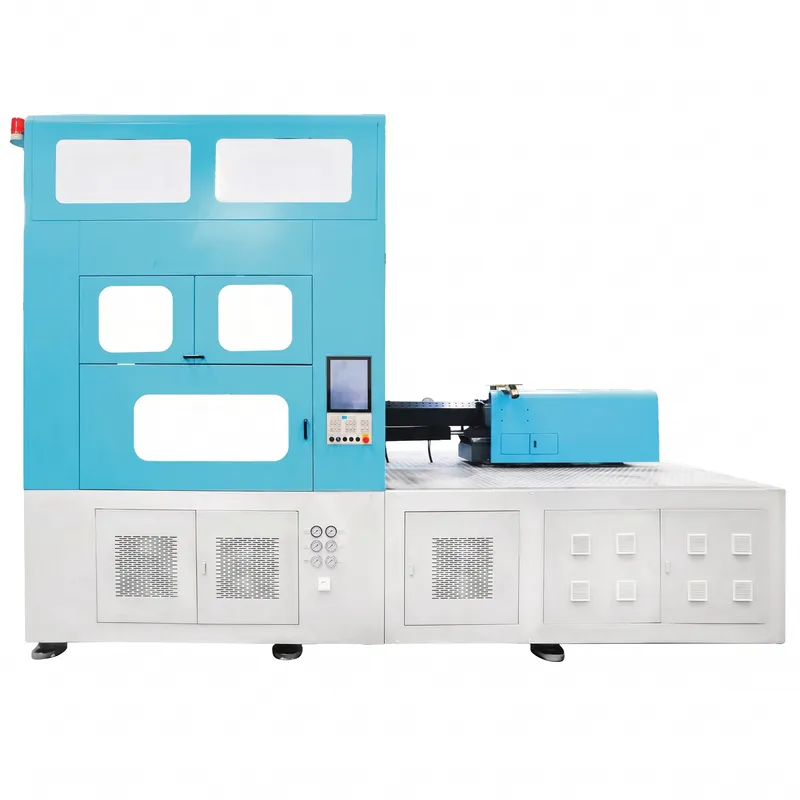
Machine de moulage par injection-soufflage en une étape Y280-V6 (6 stations)
-
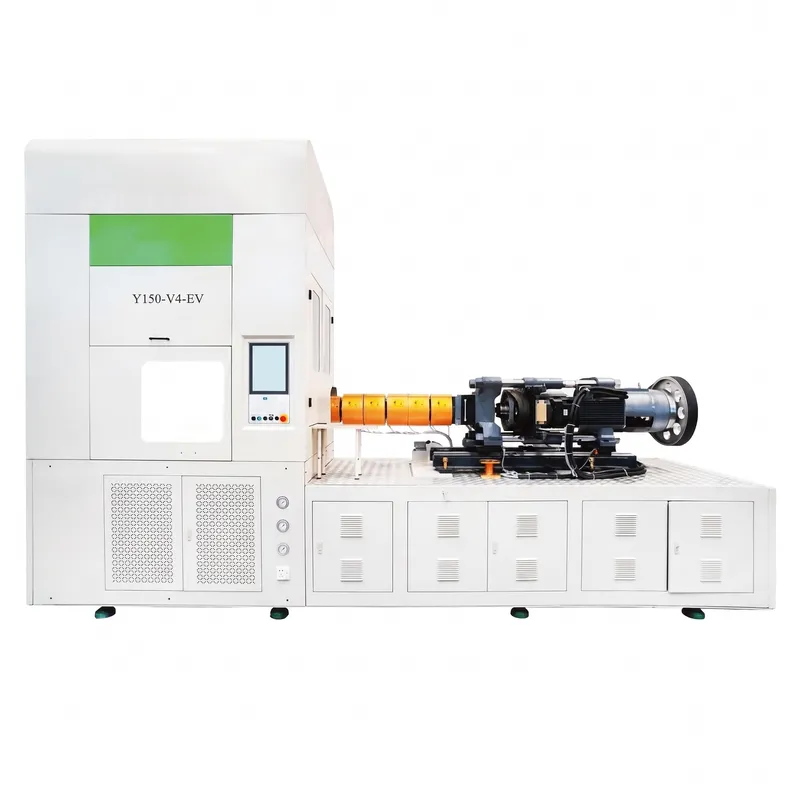
Machine de moulage par injection-soufflage en une étape Y150-V4-EV (4 stations)
-
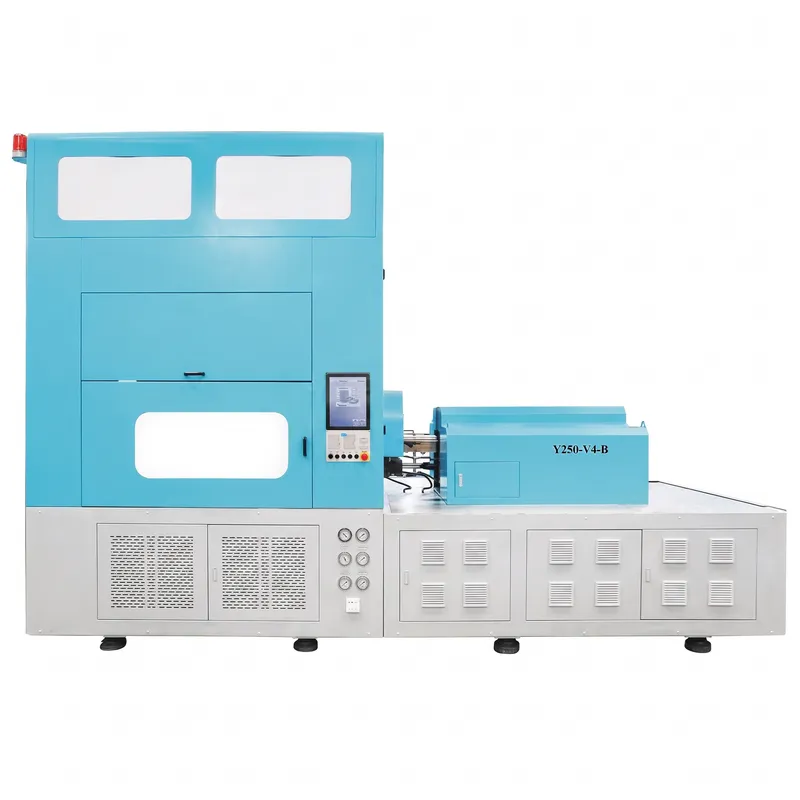
Machine de moulage par injection-soufflage en une étape Y250-V4-B (4 stations)
-
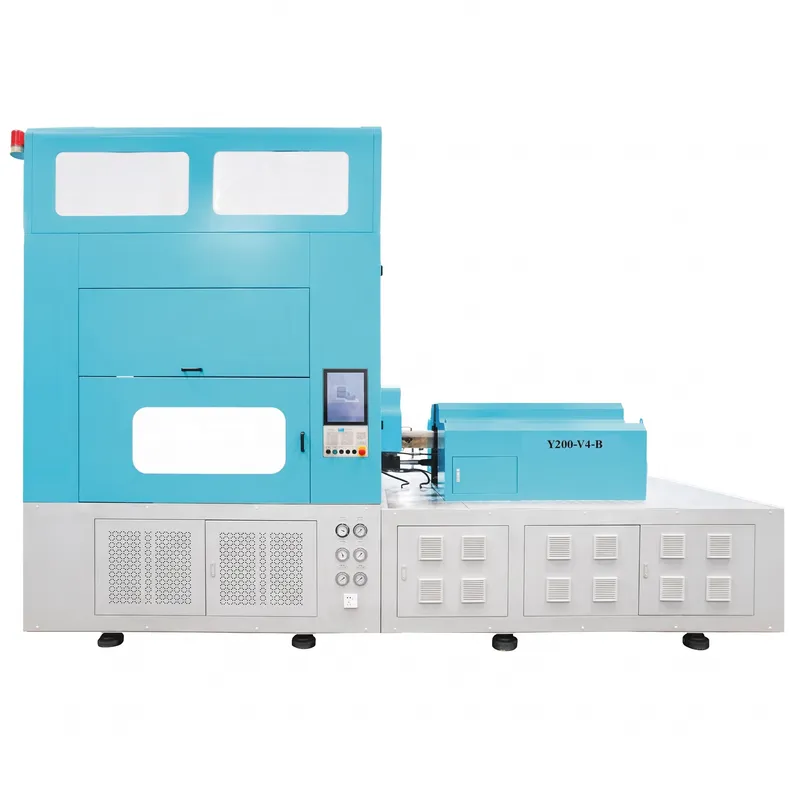
Machine de moulage par injection-soufflage en une étape Y200-V4-B (4 stations)
-
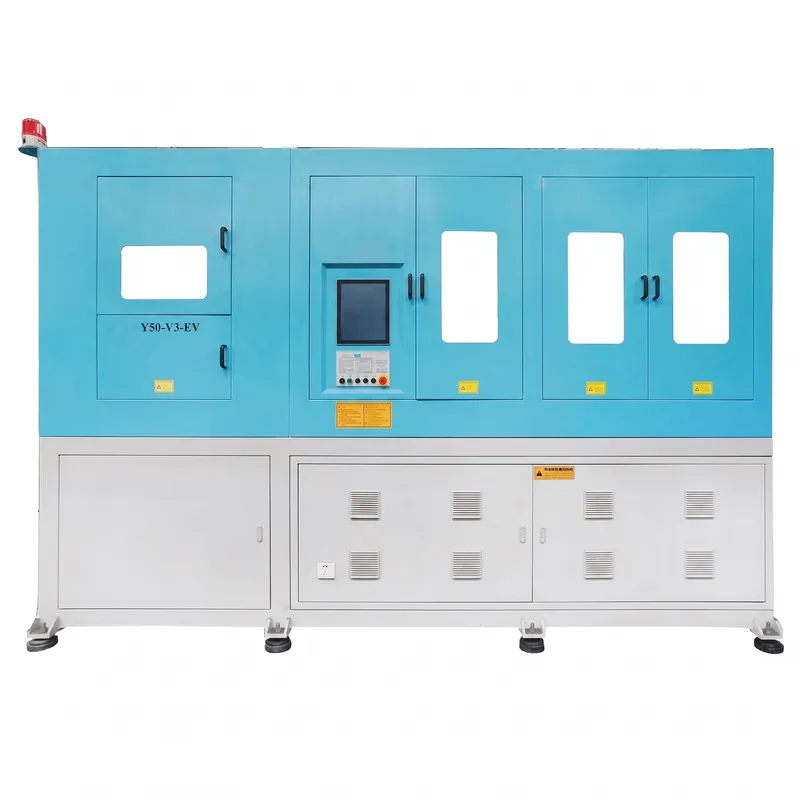
Machine de moulage par injection-soufflage en une étape Y50-V3-EV (3 stations)