
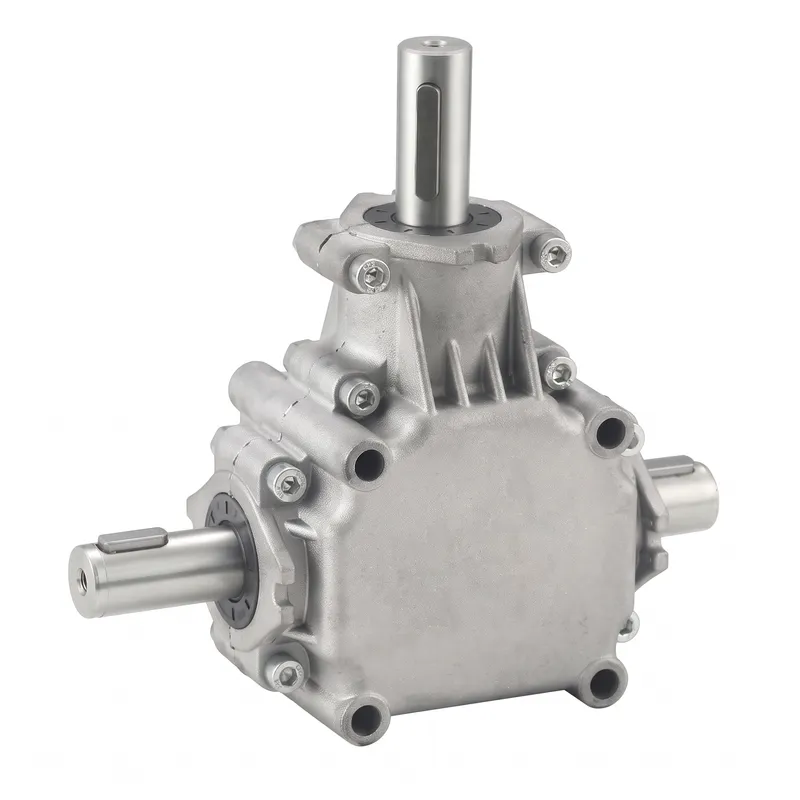
CMN-RV010 Fertilizer Spreader Gearbox Ratio 1:1 Aluminum Right Angle 13/15HP 540RPM PTO
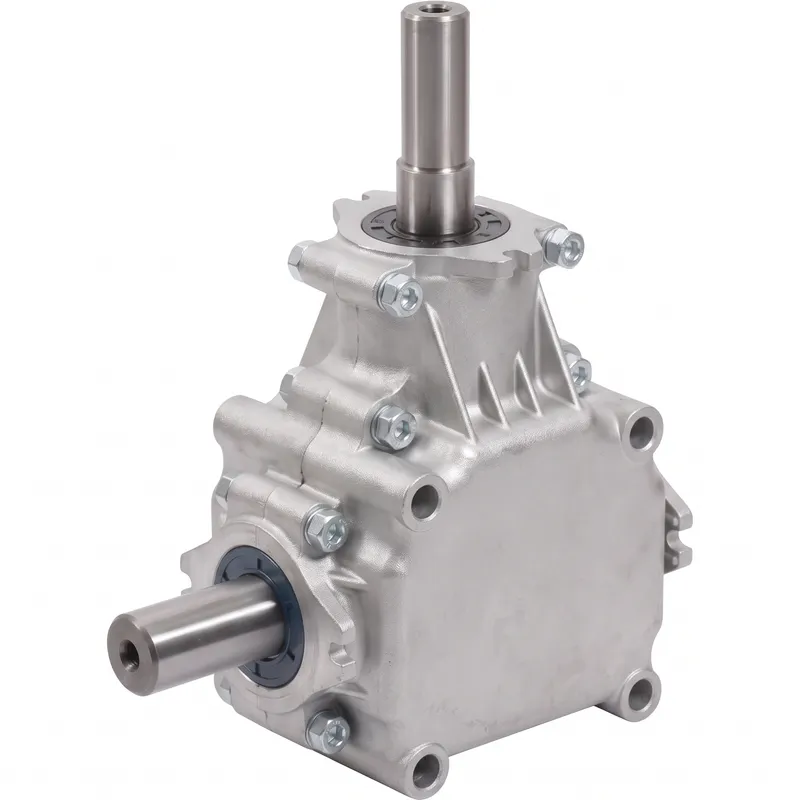
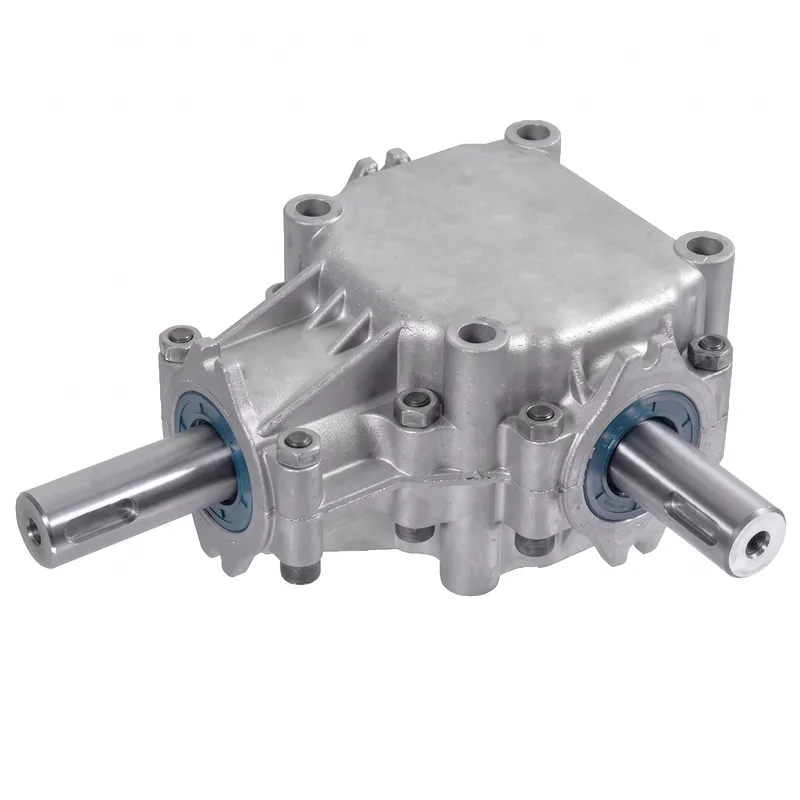
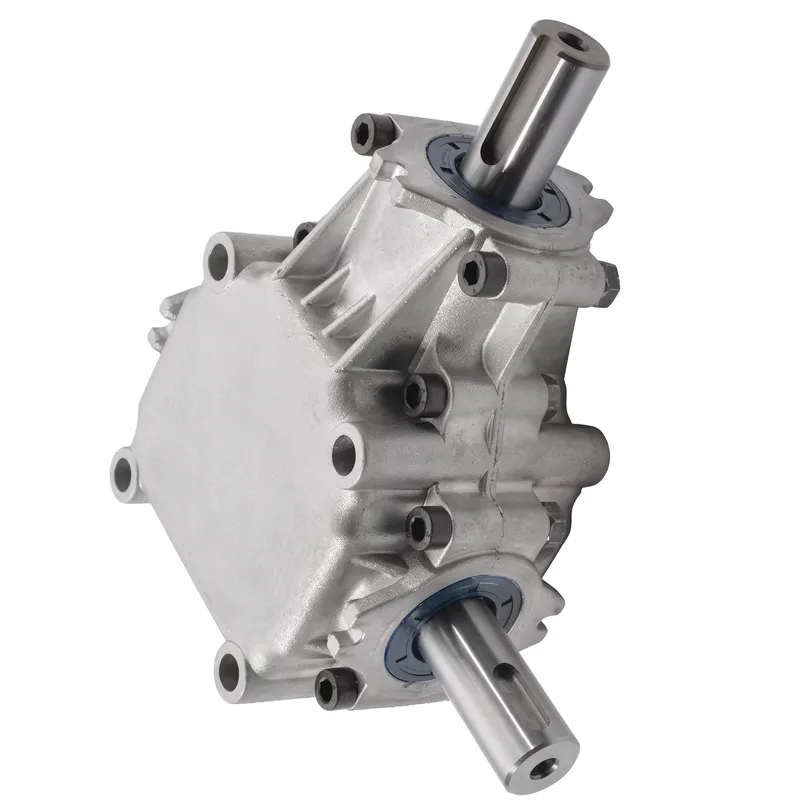
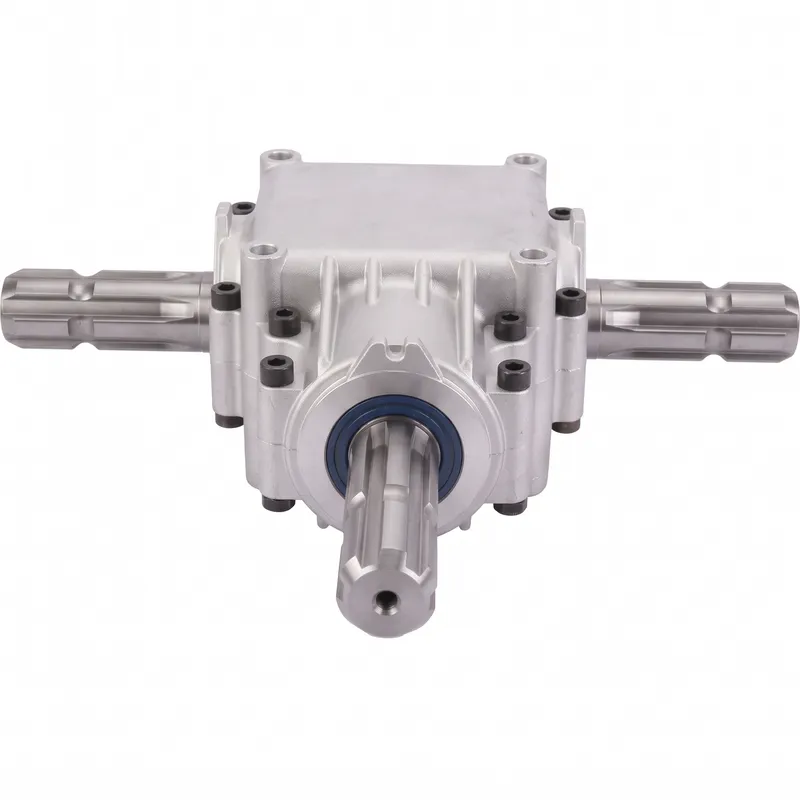
The CMN-RV010 fertilizer spreader gearbox is a compact aluminum right-angle agricultural gearbox developed for PTO-driven fertilizer spreading equipment. It transfers rotational power from a tractor driveline into the spreader drive system so spinner discs, distribution elements, or machine-specific agitator components can rotate at the speed required by the implement design. The supplied technical data lists a rated input speed of 540 rpm, a 1-3/8 Z6 input description, four available ratio and gearset combinations, and a net weight of 4 kg. For the 1:1 configuration, the table pairs the ratio with 16/16 teeth, module 4.5, and 15 HP. Other listed options are 1:1.35 at 13 HP, 1:1.9 at 15 HP, and 3.3:1 at 3 HP.
The CMN-RV010 fertilizer spreader gearbox is a compact aluminum right-angle agricultural gearbox developed for PTO-driven fertilizer spreading equipment. It transfers rotational power from a tractor driveline into the spreader drive system so spinner discs, distribution elements, or machine-specific agitator components can rotate at the speed required by the implement design. The supplied technical data lists a rated input speed of 540 rpm, a 1-3/8 Z6 input description, four available ratio and gearset combinations, and a net weight of 4 kg. For the 1:1 configuration, the table pairs the ratio with 16/16 teeth, module 4.5, and 15 HP. Other listed options are 1:1.35 at 13 HP, 1:1.9 at 15 HP, and 3.3:1 at 3 HP.
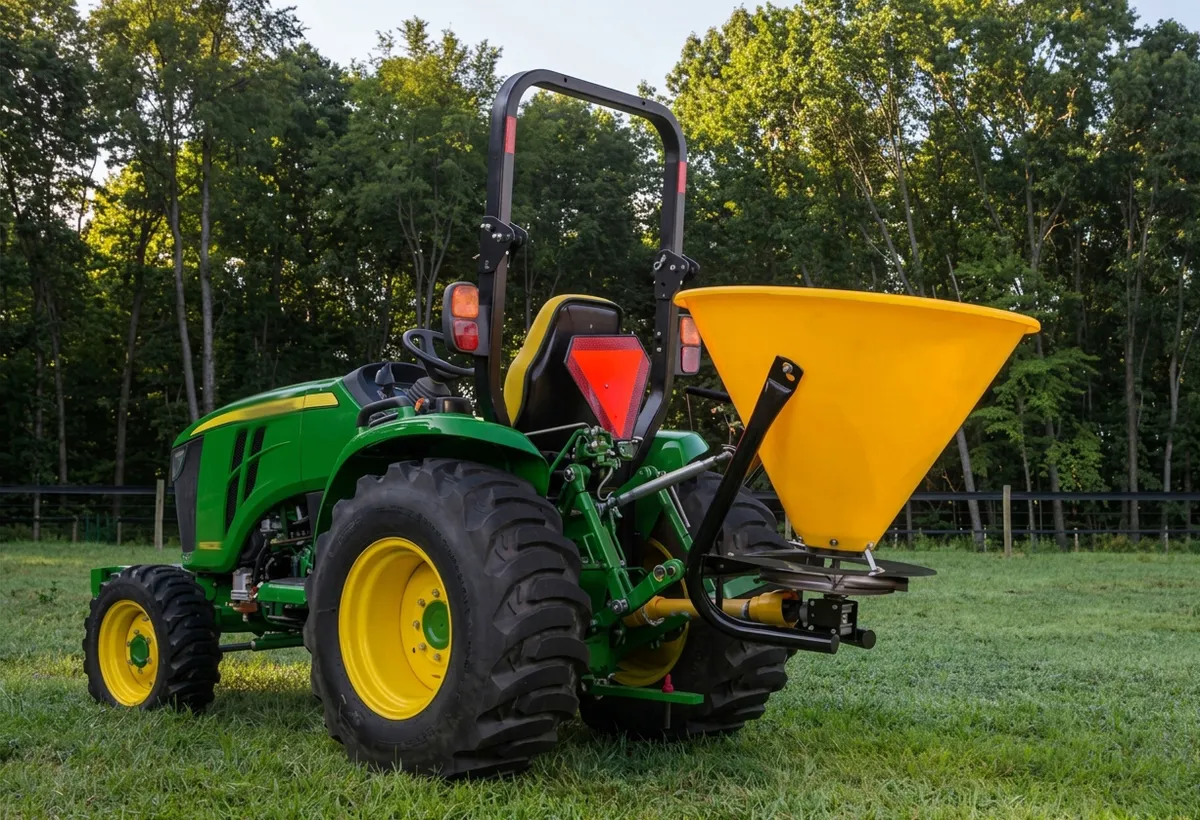
As a gearbox for fertilizer spreader assemblies, the CMN-RV010 is suited to equipment where a lightweight housing, right-angle shaft arrangement, standard tractor PTO interface, and compact mounting envelope are important. Typical machines include single-disc and twin-disc spreaders, crop nutrient applicators, pasture spreaders, orchard and vineyard fertilizer equipment, turf spreaders, and machines used for lime or compatible granular soil amendments. The product can also be described as a fertilizer distributor gearbox or fertiliser spreader gearbox in markets that use different terminology. Final fitment should always be confirmed by checking shaft form, rotation direction, ratio convention, mounting dimensions, power demand, PTO speed, and the original spreader drawing before installation.
Technical Parameters
| Item | CMN-RV010 Gearbox |
| Ratio | 1:1 / 1:1.35 / 1:1.9 / 3.3:1 |
| Teeth | 16/16 / 17/23 / 10/19 / 10/33 |
| Module | 4.5/3.5/4.5/2.5 |
| Power(HP) | 15/13/15/3 |
| Rated Input | 540 rpm |
| Input/Output Description | 1 3/8 Z6 /Optic axis |
| Weight(N.W) | 4Kg |
We have completed a third-party supplier audit and company verification supported by SGS / TÜV Rheinland. This verification helps buyers review company identity, business operations, supplier profile and general manufacturing capability. Product-specific inspection reports, material documents or compliance records can be provided according to order requirements.
Minimum Order Quantity (MOQ): Flexibly set based on the product type and order amount.
Samples: New customers may request 1–5 samples under appropriate circumstances.
Mixed Orders: Combining different models is supported; the total order amount must reach approximately $1,500.
Small Orders: Orders starting from 1–2 pieces are supported, but the unit price will be relatively higher.
Lead Time: 10–25 working days for standard parts; 20–45 working days for customized components; 45–120 working days for project-based equipment.
Trade Terms: EXW, FOB, CIF, and DAP are generally supported; FCA, CFR, CPT, CIP, and DDP terms can be specifically negotiated.
Key Features of the CMN-RV010 Fertilizer Spreader Gearbox
1. PTO Interface and Spline Compatibility
The CMN-RV010 is specified with a 1-3/8 Z6 input description and a rated input speed of 540 rpm, matching the common six-spline tractor PTO format used on many agricultural implements. Correct PTO matching is essential for a fertilizer spreader gearbox because an incorrect spline, driveline length, or working angle can cause vibration, side loading, rapid seal wear, or coupling damage. Before installation, confirm that the PTO shaft locks fully on the input, telescopes freely through the hitch range, and does not bottom out at maximum compression.
2. Ratio Configurations and Output Options
The model family is listed with 1:1, 1:1.35, 1:1.9, and 3.3:1 ratio options. This gives fertilizer spreader suppliers and machine builders a way to match the gearbox to different spinner-disc or agitator speed requirements without changing the entire spreader architecture. Ratio selection must be tied to the matching teeth, module, and power figures in the data table. When sourcing a replacement, do not assume that two housings with the same external shape have the same fertilizer spreader gearbox ratio.
3. Lightweight Aluminum Housing
The product is shown in the aluminum box series and is listed at only 4 kg net weight. Aluminum is useful on spreader frames where reducing suspended mass helps installation and handling, and it also offers practical corrosion resistance compared with unprotected ferrous housings. Fertilizer dust remains chemically aggressive, however, so the housing should still be rinsed and dried after use, especially around seal lips, fasteners, plugs, shaft interfaces, and places where damp fertilizer can accumulate.
4. Right-Angle Bevel Power Path
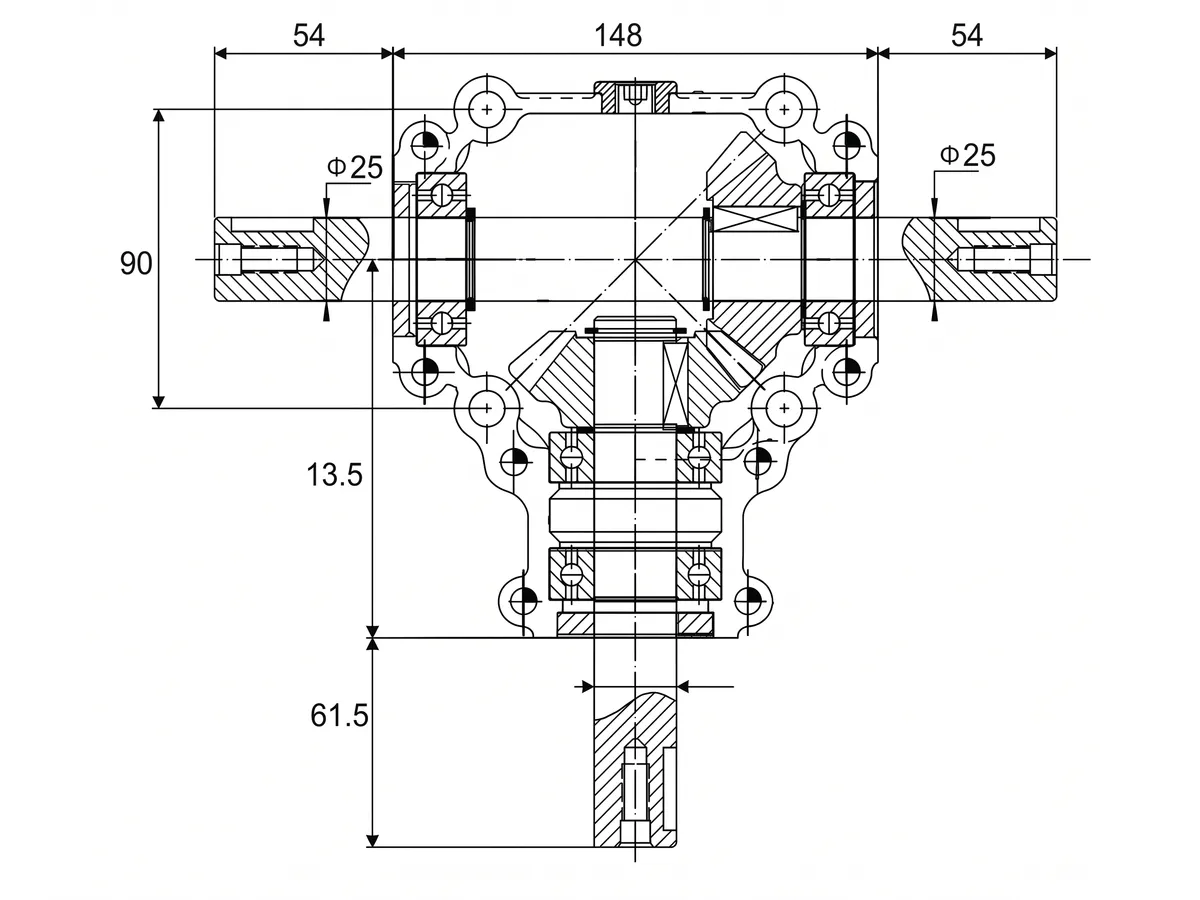
The sectional drawing shows intersecting bevel gears that redirect the power path through a right angle. This geometry is well suited to fertilizer spreading equipment where the tractor PTO driveline and the spinner or distribution shaft are arranged on different axes. A compact right-angle agricultural gearbox lets the equipment designer place the drive centrally and keep the power path mechanically simple. Correct bearing support, shaft alignment, and gear mesh are critical because bevel gears are sensitive to axial and radial positioning.
5. Agitator and Disc Drive Integration
The supplied drawing shows two horizontal side shafts and a vertical shaft arrangement around the bevel gear set. This layout can support spreader architectures that need power distributed to machine-specific spinner, agitator, or secondary drive elements. The exact function of each shaft depends on the fertilizer spreader design, so a buyer should confirm the required input and output orientation before ordering. This is especially important when replacing fertilizer spreader gearbox parts on twin-disc machines or machines with an integrated agitator.
6. Wide Agricultural Application Range
A compact 540 rpm gearbox for fertilizer spreader machinery can be used across field crop farms, pasture operations, orchard and vineyard equipment, turf maintenance, horticulture, and compatible soil-amendment applications. The CMN-RV010 family is particularly useful where the required power is within the listed configuration limits and where the drawing matches the implement mounting geometry. Buyers comparing fertilizer spreader gearboxes should evaluate not only price, but also ratio, shaft interface, replacement dimensions, sealing, lubricant support, and access to technical confirmation.
Working Principle
The operating principle begins at the tractor PTO. With the tractor set to the implement's required PTO mode, rotational power travels through the guarded PTO drive shaft and enters the CMN-RV010 input shaft. The supplied data specifies a rated input of 540 rpm and describes the input as 1-3/8 Z6. Inside the housing, the input shaft drives a bevel gear set. The bevel gears change the direction of rotation through the right-angle arrangement shown in the sectional drawing and transmit the load to the selected output shaft path. In the 1:1 configuration, the nominal gear relationship is direct. The other listed gearsets use different tooth counts to create the required speed relationship for the spreader mechanism.
A fertilizer spreader gearbox does not simply reduce speed in every configuration. It changes speed and torque according to the selected ratio and the way the manufacturer defines that ratio. This is important for replacement work because ratio notation is not always written in the same input-to-output convention across all suppliers. Before calculating spinner RPM from a 1:1.35, 1:1.9, or 3.3:1 label, confirm which shaft is treated as the input and how CMN defines the ratio for that exact assembly. For the common 1:1 version, a 540 rpm input gives an approximately corresponding no-load output relationship, while real operating speed is affected by normal drivetrain losses and load.
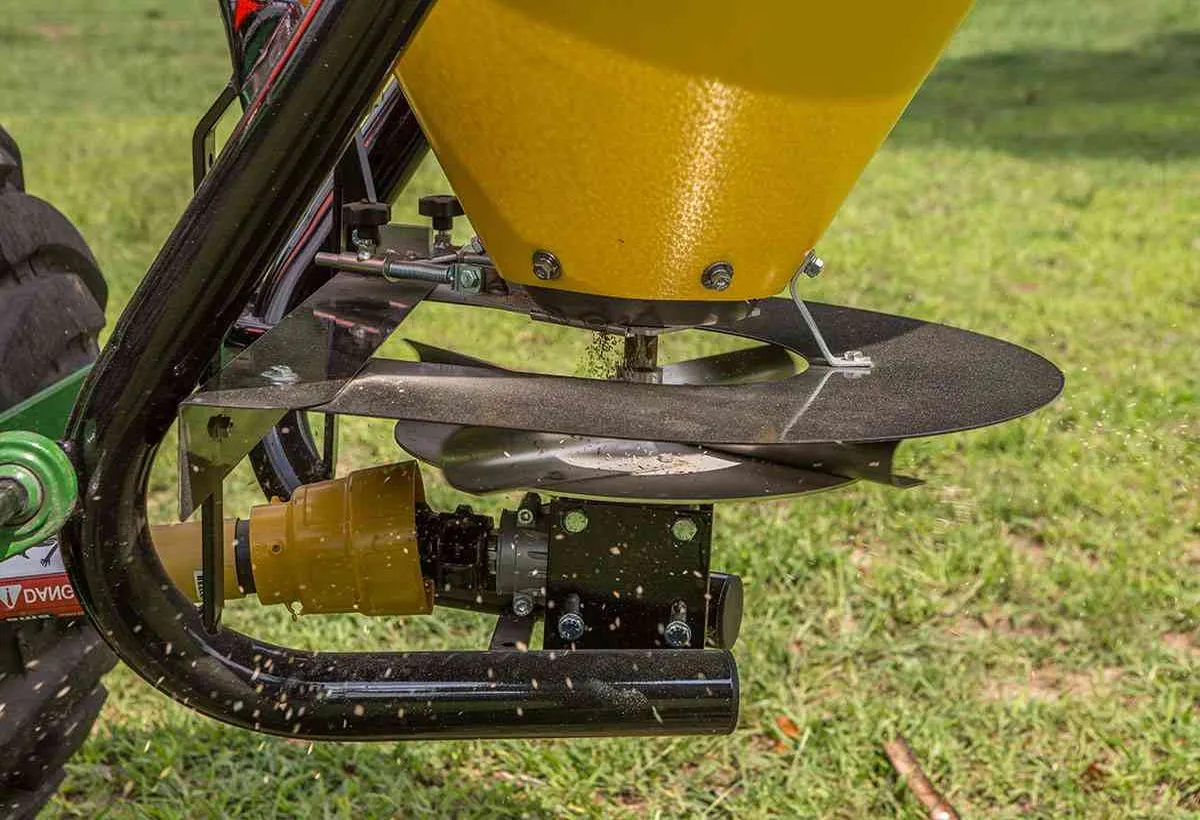
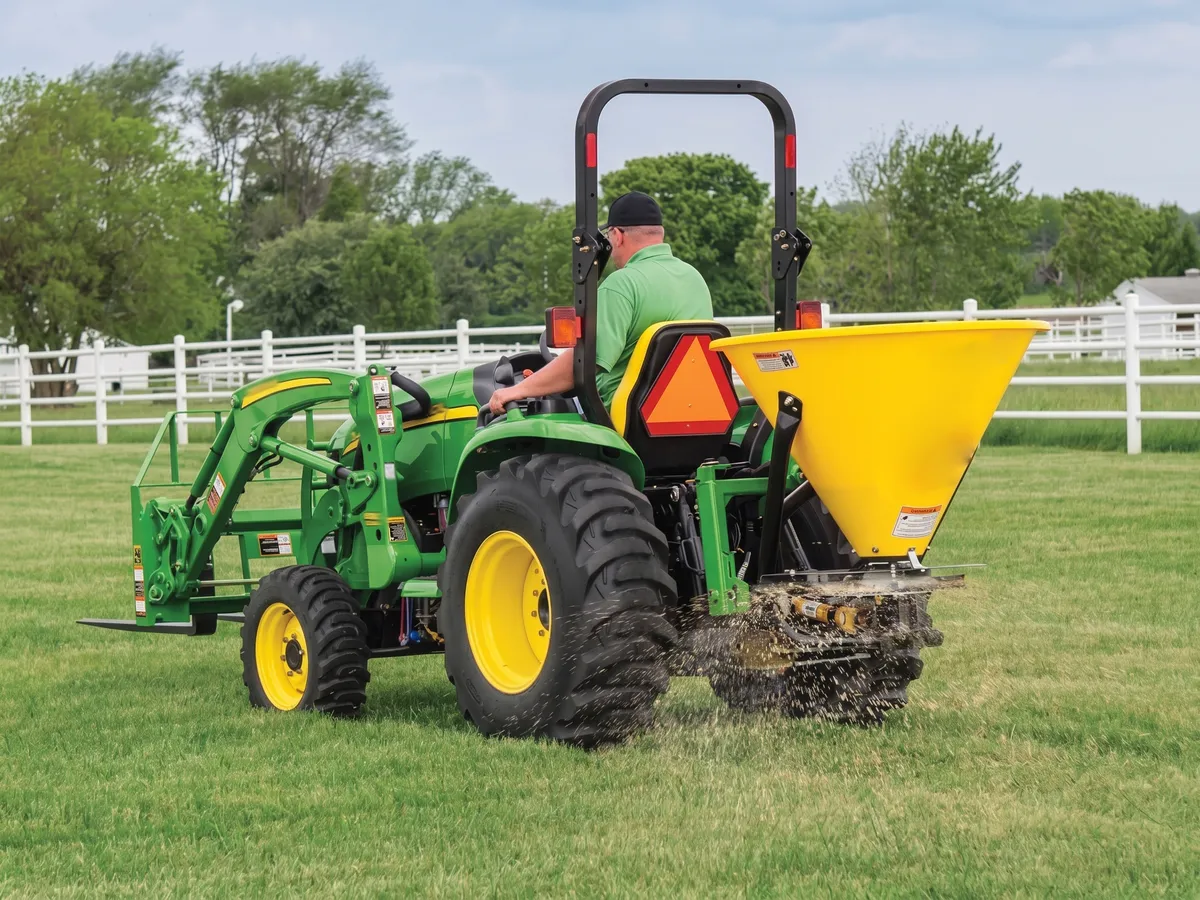
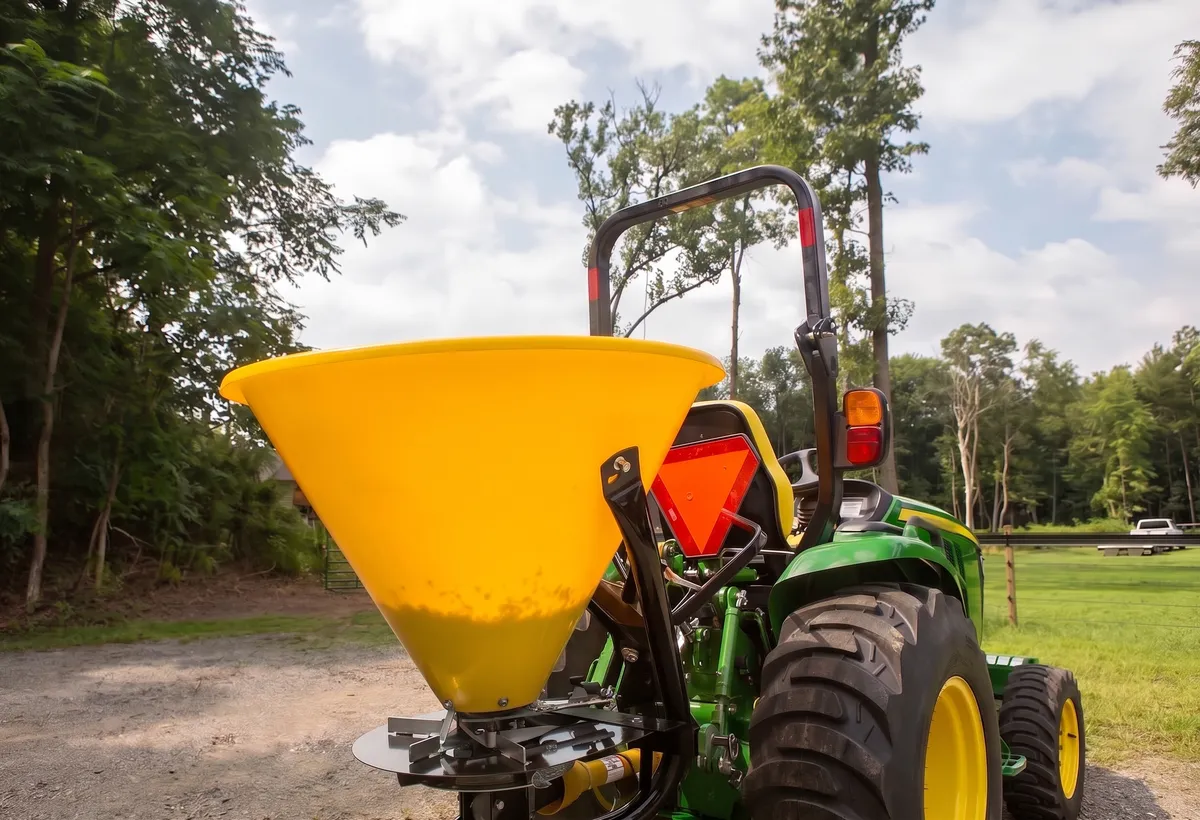
Once the output shaft rotates, the fertilizer spreader's own mechanism converts that motion into material distribution. On a disc spreader, the gearbox can drive the spinner system that accelerates granules outward. On other equipment, the driven element may be an auger, agitator, metering mechanism, or secondary shaft depending on the implement design. The gearbox therefore provides the mechanical bridge between tractor PTO power and the spreader's distribution hardware. Uniform field application depends on the complete system: correct gearbox ratio, stable PTO speed, correct vane or disc setup, calibrated material gate, fertilizer flow characteristics, and consistent forward travel speed.
Durability depends on keeping the bevel gears and bearings correctly aligned and lubricated. The aluminum housing supports the internal shafts while seals keep lubricant inside and limit entry of fertilizer dust, moisture, and field contamination. Because fertilizer can become highly corrosive when damp, regular cleaning around shaft exits and housing joints is especially important. The supplied CMN-RV010 data does not state lubricant viscosity or fill quantity, so do not copy oil specifications from an unrelated agricultural gearbox. Use the current CMN service specification or the spreader manufacturer's manual when setting the fertilizer spreader gearbox oil level.
Overload protection should be treated as a driveline-system function. Slip clutches, shear bolts, shear pins, or torque limiters are commonly installed in the PTO shaft or implement driveline so a sudden jam or abnormal load can be interrupted before damaging the gearbox. The supplied CMN-RV010 technical information does not state that a clutch or torque limiter is built into the gearbox itself. If the spreader uses an agitator that can jam on compacted fertilizer, confirm the required protective device and torque setting with the machine manufacturer. Correct guarding, shutdown procedure, and lockout before service are equally important for safe operation.
Application Areas
Grain Farming
In grain production, a fertilizer spreader gearbox helps transfer PTO power to equipment applying granular nutrients across wheat, corn, barley, rice, sorghum, and other broad-acre crops. The gearbox does not determine the agronomic rate by itself, but stable output speed supports consistent spinner behavior when the spreader is properly calibrated. A 540 rpm compatible agricultural gearbox is useful where tractors and mounted or trailed spreaders are standardized around the conventional six-spline PTO interface.
Vegetable Production
Vegetable farms often work with tighter field widths, repeated nutrient applications, and different fertilizer formulations through the season. A compact gearbox for fertilizer spreader equipment allows the implement to maintain the required disc or metering speed while the operator adjusts gate opening, travel speed, and spread width for the crop. Before using the CMN-RV010, verify that the selected ratio and listed power rating are appropriate for the actual hopper size, agitator load, and material being distributed.
Fruit Farming
Fruit farms may use fertilizer spreading equipment between tree rows or around orchard blocks where control of spread pattern is more important than maximum throw distance. A right-angle fertilizer distributor gearbox can fit centrally into compact spreader frames and transmit PTO power to the distribution mechanism without a complex chain of external shafts. Matching the ratio to the disc design helps the machine maintain a repeatable pattern, while regular washdown reduces the corrosive residue that can collect around gearbox seals and fasteners.
Pasture Management
Pasture and grazing operations use fertilizer and soil amendments to maintain forage density and nutrient availability. A fertilizer spreader gearbox for sale to this market must tolerate dust, vibration, repeated seasonal starts, and long transport periods between paddocks. The CMN-RV010's 540 rpm input specification makes it relevant to common tractor-driven spreaders, provided the mounting and output geometry match. Calibration should be checked whenever material density, granule size, or spreading width changes.
Lawn and Turf Management
Large turf areas such as sports grounds, parks, municipal lawns, and golf-course maintenance zones may use tractor or utility-vehicle spreaders for granular fertilizer. A compact fertiliser spreader gearbox supports the drive system where precise and repeatable spinner speed is needed. Turf applications can involve lower application rates than broad-acre farming, so the spreader's metering system, gate opening, and travel speed must be calibrated carefully instead of relying on gearbox speed alone to control nutrient application.
Horticulture and Nurseries
Nurseries, greenhouse support areas, and horticultural farms may use smaller PTO-driven spreaders for container yards, field-grown ornamentals, and soil-conditioning work. The CMN-RV010 fertilizer spreader gearbox can be considered where its dimensions, shaft layout, power rating, and ratio match the equipment. In these environments, fertilizer dust can be fine and persistent, so cleaning around the input and output seals and checking for early corrosion are important maintenance steps after spreading cycles.
Landscaping and Estate Maintenance
Commercial landscaping contractors and estate managers often operate several attachments from one tractor. Standardizing around a 540 rpm PTO driveline can simplify attachment changes and service planning. When the spreader requires the CMN-RV010 geometry, the gearbox provides the right-angle mechanical path between tractor power and the spread mechanism. Buyers should compare shaft diameter, spline form, mounting pattern, ratio, and output orientation before treating any visually similar fertilizer gearbox as a direct replacement.
Soil Amendments
Fertilizer spreader gearboxes are often used on machines that can distribute compatible granular soil amendments such as lime products or other free-flowing conditioning materials. The gearbox supplies mechanical power, while the hopper, gate, agitator, disc, and vanes determine whether a specific material can be handled safely and uniformly. Dense or abrasive material may increase drive load, so the selected CMN-RV010 ratio and HP rating should be checked against the spreader manufacturer rather than assuming the same setting used for ordinary fertilizer.
Orchards and Vineyards
Orchards and vineyards require controlled application around rows, headlands, trunks, and sensitive root zones. Spreader machines in these settings may use shields, directed discs, or narrow-pattern accessories. A compact agricultural gearbox for fertilizer spreader equipment can provide the required right-angle power transfer while leaving room for those distribution components. Ratio selection should be made together with the spinner or agitator design, and the operator should perform a catch-pan or field calibration to confirm actual material distribution before full-scale application.
CMN-RV010 Fertilizer Spreader Gearbox Components
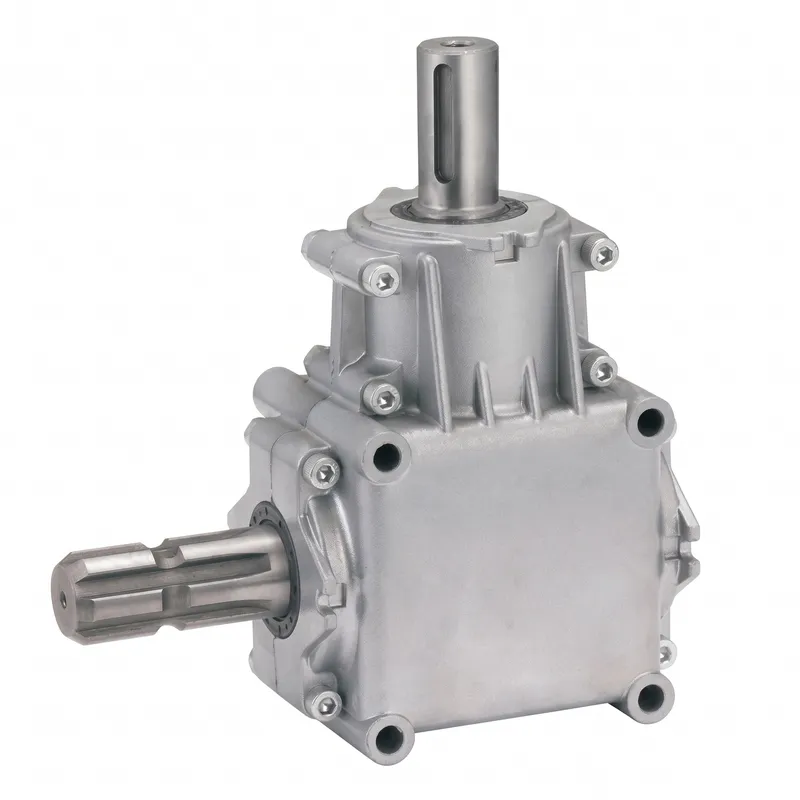
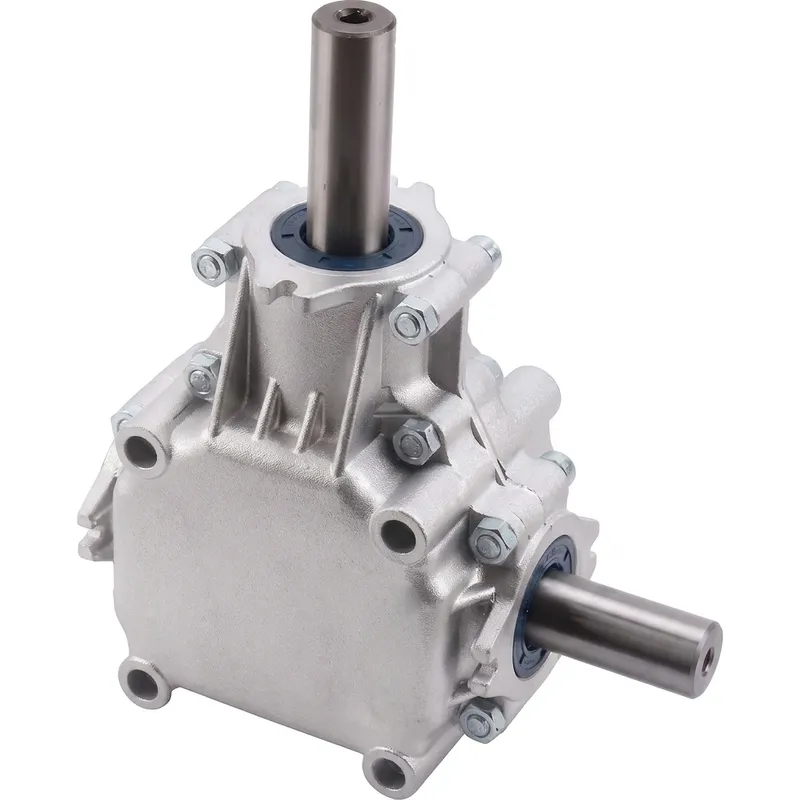
Gearbox Housing: The housing is the structural body that supports the shafts, bearing locations, and bevel gear mesh while maintaining the right-angle geometry under load. The supplied catalogue places the RV010 in an aluminum box series, which helps keep the assembly weight at 4 kg. Housing condition should be checked for impact damage, distorted mounting areas, thread damage, and corrosion deposits before the gearbox is installed or rebuilt.
Input Shaft: The input shaft receives power from the tractor PTO through the driveline. The supplied data describes the connection as 1-3/8 Z6 and rates the gearbox input at 540 rpm. The spline must engage fully with the PTO shaft yoke, and the coupling should lock positively. Worn splines, excessive yoke play, incorrect PTO shaft length, or a severe working angle can introduce vibration and accelerate bearing and seal wear.
Bevel Gears: The internal bevel gears redirect rotation through the right-angle transmission path. The CMN-RV010 family uses different tooth combinations for the four listed ratios: 16/16, 17/23, 10/19, and 10/33. Bevel gear accuracy depends on correct shaft position and bearing support, so abnormal end play, damaged bearings, or incorrect assembly can change contact pattern and produce noise, heat, pitting, or premature tooth damage.
Output Shafts: The sectional drawing shows multiple shaft exits, including horizontal side shafts identified with Ø25 callouts and a vertical shaft arrangement. The exact role of each output depends on the spreader layout. These shafts transmit the gearset's rotation to discs, hubs, agitators, or other driven components. When replacing fertilizer spreader gearbox parts, match diameter, keying or connection details, shaft length, direction, and coupling geometry to the existing implement drawing.
Bearings: Bearings locate the shafts and carry the radial and axial forces generated by bevel gear mesh and external driveline loading. Their alignment is critical because bevel gears develop thrust as they transmit torque. The supplied documents do not list bearing part numbers, so replacements should be identified from current CMN parts information or from markings on a correctly disassembled unit. Do not substitute a bearing solely on outside diameter without matching load class and internal geometry.
Oil Seals and Gaskets: Seals keep lubricant inside the housing and reduce entry of fertilizer dust, moisture, and grit. This is especially important because fertilizer residue can become corrosive when combined with humidity. A small leak should not be ignored, since loss of lubricant can quickly damage gears and bearings. Before installing new seals, inspect shaft surfaces for grooves or corrosion that could damage the replacement seal lip and cause the leak to return.
Lubrication System: Gear oil forms the film that separates tooth surfaces and bearing rolling elements under load. Correct lubricant level is therefore central to fertilizer spreader gearbox life. The supplied CMN-RV010 information does not provide an oil grade, capacity, or confirmed level-plug position. For that reason, the fertilizer spreader gearbox oil level must be set using current CMN service data or the spreader OEM instruction, not a value copied from another gearbox model.
Fasteners, Plugs, and Mounting Interfaces: Housing bolts, mounting fasteners, drain or fill plugs, and shaft retaining elements complete the functional assembly. Their condition affects sealing and alignment even though they are less visible than the gears. Fertilizer deposits should be cleaned from these areas before service. If a mounting face is distorted or fasteners are loose, the gearbox can shift under load, leading to coupling misalignment, vibration, and accelerated wear in the PTO driveline.
Installation Steps
1. Confirm the Exact Gearbox Configuration
Read the existing spreader plate, parts manual, old gearbox markings, and mounting drawing before removing the original unit. Confirm that the replacement CMN-RV010 fertilizer spreader gearbox has the required ratio, teeth configuration, power rating, shaft orientation, and 540 rpm input specification. If the old gearbox is visually similar but the ratio is different, the spinner speed and distribution pattern can change significantly.
2. Lock Out the Tractor and Unload the Driveline
Park on level ground, lower or securely support the spreader, stop the engine, remove the key, and wait for all rotating parts to stop. Disconnect the PTO shaft only after the driveline is fully stationary. Clean loose fertilizer from the work area so corrosive material does not enter the new gearbox or contaminate coupling surfaces while the fertilizer spreader gearbox parts are being handled.
3. Inspect Mounting Surfaces and Driven Components
Before bolting in the new agricultural gearbox, inspect brackets, mounting faces, disc hubs, agitator shafts, couplings, keys, and guards. Bent brackets or worn couplings can side-load the gearbox and shorten bearing life. Compare the supplied dimension drawing with the machine. Check the 148 mm housing span and shaft callouts where relevant, and request a production drawing if your installation depends on exact tolerances.
4. Install and Align the Gearbox
Place the gearbox into the spreader frame without forcing shafts into misaligned couplings. Start all mounting fasteners by hand, align the shaft centerlines, and tighten fasteners evenly to the torque specified by the implement manufacturer. A right-angle gearbox must sit square to the driven components. If the housing is pulled into position by bolts, the resulting strain can distort alignment and produce noise, seal wear, or gear contact problems.
5. Connect the PTO Driveline Correctly
Verify that the PTO yoke matches the 1-3/8 Z6 input description and locks securely. Check telescoping overlap, minimum compressed length, and working angle through the full three-point hitch or drawbar movement. A PTO shaft that is too long can bottom out and push axial force into the fertilizer gearbox. A shaft that is too short can separate under movement. Reinstall all driveline guards and safety chains before operation.
6. Set Lubrication to the Confirmed Specification
Before startup, verify that the gearbox contains the correct lubricant at the correct level. Do not assume that a newly supplied unit is filled for service unless the shipping documentation says so. The provided CMN-RV010 data does not specify oil type or capacity, so use the current CMN instruction or spreader OEM manual. An incorrect fertilizer spreader gearbox oil level can cause overheating, foaming, leakage, or rapid gear and bearing damage.
7. Perform a Low-Speed Functional Check
With all guards fitted and bystanders clear, start the tractor at low engine speed and engage the PTO smoothly. Observe the fertilizer spreader gearbox from a safe distance for abnormal vibration, oil leakage, irregular noise, or movement at the mounts. Do not approach rotating equipment. If operation is stable, increase to the specified 540 rpm PTO condition and check that the spreader discs or agitator rotate in the correct direction.
8. Calibrate the Spreader Under Real Material Load
A mechanically correct installation still requires application calibration. Load a known quantity of fertilizer, set the gate and vane positions, operate at the intended PTO speed and travel speed, and measure the actual distribution pattern using the spreader manufacturer's calibration method. If the pattern differs from previous performance, recheck the fertilizer spreader gearbox ratio, disc speed, disc direction, PTO speed, material condition, and distribution hardware before field application.
Fertilizer Spreader Gearbox and PTO Drive Shaft
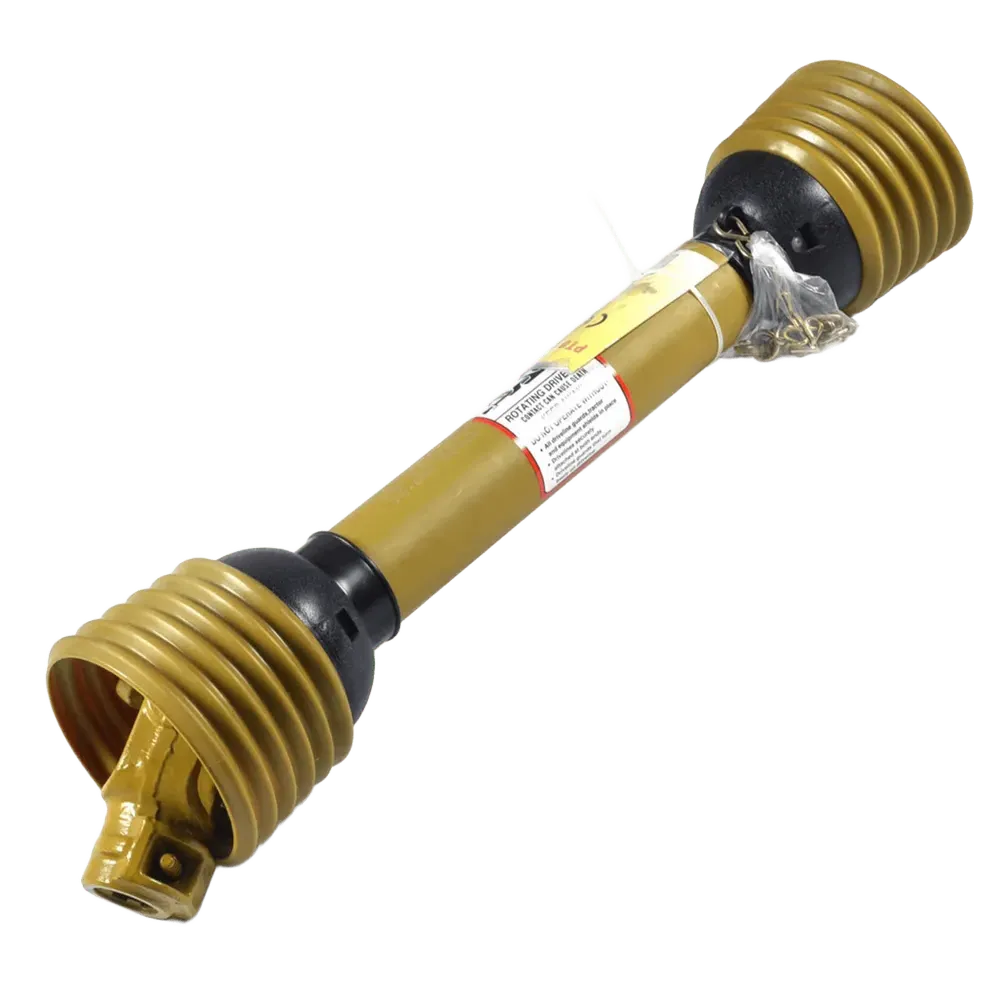
The PTO drive shaft and the fertilizer spreader gearbox form two consecutive stages in the mechanical power path. The PTO shaft carries rotation from the tractor's PTO stub to the implement. The gearbox receives that rotation, changes its direction through the bevel gear set, and applies the selected ratio before power reaches the spinner disc, agitator, auger, or other spreader mechanism. The PTO shaft is therefore the flexible connection between tractor and implement, while the gearbox is the fixed transmission unit mounted on the spreader frame. One cannot perform the other's job, and correct performance requires both components to be matched as a system.
On the CMN-RV010, the supplied table specifies a rated input of 540 rpm and an input description of 1-3/8 Z6. This corresponds to the common six-spline PTO interface used on many tractors and agricultural implements. A compatible PTO shaft must have the correct yoke or coupling for the gearbox input and enough telescoping range to accommodate hitch movement. It must also be the correct operating length. If the shaft is too long, it can bottom out when the tractor and spreader move closer together, pushing damaging axial force into the gearbox and tractor PTO. If it is too short, it can lose safe spline overlap or separate when the hitch extends.
The PTO shaft also handles articulation. Universal joints allow the driveline to operate while the tractor and spreader are not perfectly aligned. However, excessive joint angle increases speed fluctuation, vibration, and bearing load. This can make a good fertilizer gearbox appear faulty when the real problem is driveline geometry. During installation, the shaft should be checked through the full range of implement movement, and the operator should avoid sharp turns or raised-hitch positions that exceed the PTO manufacturer's operating-angle limits. All rotating guards must remain fitted, free to rotate independently of the shaft, and secured with the appropriate retaining chains.
Overload protection is often located in the PTO driveline. A shear bolt can break at a designed threshold, a slip clutch can momentarily release torque, and a torque limiter can interrupt or reduce transmitted load when the spreader mechanism jams. These devices are particularly useful when fertilizer compacts around an agitator or when foreign material obstructs a driven component. The supplied CMN-RV010 documents do not identify an internal overload device, so buyers should not assume the gearbox itself provides this protection. The spreader manufacturer should specify the correct driveline protection method and torque setting.
The gearbox and PTO shaft also share maintenance consequences. A worn universal joint, bent PTO tube, seized telescoping section, or incorrect shaft length can create vibration that damages fertilizer spreader gearbox seals and bearings. Conversely, a seized gearbox can overload the PTO shaft and protective device. Seasonal service should therefore inspect both systems together. Clean fertilizer residue, verify guard condition, grease PTO universal joints and telescoping surfaces according to the shaft supplier's schedule, check gearbox mounts and shaft play, inspect for oil leakage, and confirm the fertilizer spreader gearbox oil level using the correct CMN or spreader specification.
 |  |
Common Troubleshooting
Gearbox Runs Hot
First verify the lubricant level and confirm that oil type and quantity match current CMN or spreader service information. Too little oil can starve gears and bearings, while too much oil can cause churning, foaming, pressure, and leakage. Also inspect the PTO shaft for excessive working angle, the outputs for binding, and the driven disc or agitator for obstruction. Persistent heat after correct lubrication and free rotation can indicate bearing damage, incorrect gear mesh, or overload.
Oil Leakage Around a Shaft
Clean the housing first so the true leak path is visible. Inspect the seal area for fertilizer deposits, damaged seal lips, loose plugs, blocked venting where applicable, and grooves or corrosion on the shaft surface. Replacing only the seal may not solve a leak if the shaft is worn. Check the fertilizer spreader gearbox oil level after any leakage. If the level has fallen, do not continue operation until the source is repaired and the correct lubricant quantity is restored.
Abnormal Noise or Vibration
A growl, whine, knock, or repeating vibration can come from the gearbox, PTO shaft, coupling, spinner disc, or mounting frame. Inspect the PTO universal joints, yoke fit, shaft straightness, gearbox fasteners, disc balance, and shaft play before assuming the bevel gears are damaged. Verify that the replacement fertilizer spreader gearbox ratio matches the original. A mismatched ratio can move the spreader into a speed range that produces vibration in other components even if the gearbox itself is mechanically sound.
Uneven Fertilizer Distribution
Check agronomic calibration before disassembling the gearbox. Uneven spreading is commonly caused by gate setting, worn or damaged vanes, material moisture, incorrect disc speed, blocked flow, wrong travel speed, or a disc rotating in the wrong direction. Confirm that the tractor is delivering the intended PTO speed and that the CMN-RV010 ratio is correct for the machine. If one driven shaft slips or binds, inspect couplings, keys, output shafts, and fertilizer spreader gearbox parts for wear.
Output Shaft Has Excessive Play
Radial or axial movement beyond normal design clearance can indicate bearing wear, loose retention, shaft damage, or internal wear. Do not continue heavy operation if the output shaft visibly moves or the seal starts leaking, because bevel gear alignment depends on accurate shaft location. Disconnect and lock out the driveline, then inspect the gearbox according to the service procedure. Replacement bearings and seals should be matched to the correct part specification rather than selected only by approximate dimensions.
Gearbox Does Not Drive the Spreader
If the PTO turns but the spreader does not, stop the tractor and inspect the driveline safely. Check the PTO yoke lock, shear bolt or clutch if fitted, keys, couplings, and driven hubs. A failed protective shear bolt can disconnect power without internal gearbox damage. If the input turns but the outputs do not, internal gear or shaft damage is possible. Do not continue engaging the PTO repeatedly, because loose fragments can cause additional damage inside the fertilizer gearbox.
Corrosion After Seasonal Storage
Damp fertilizer left on an agricultural gearbox can attack fasteners, shaft surfaces, seals, and adjoining steel components even when the main housing is aluminum. Wash the spreader after the season, dry it thoroughly, repair damaged protective finishes on surrounding parts, and store the implement under cover when possible. Before the next season, rotate the gearbox by hand with the machine locked out, inspect for leakage or roughness, and verify lubricant level before reconnecting the PTO driveline.
Why Choose CMN Transmission's Fertilizer Spreader Gearboxes?
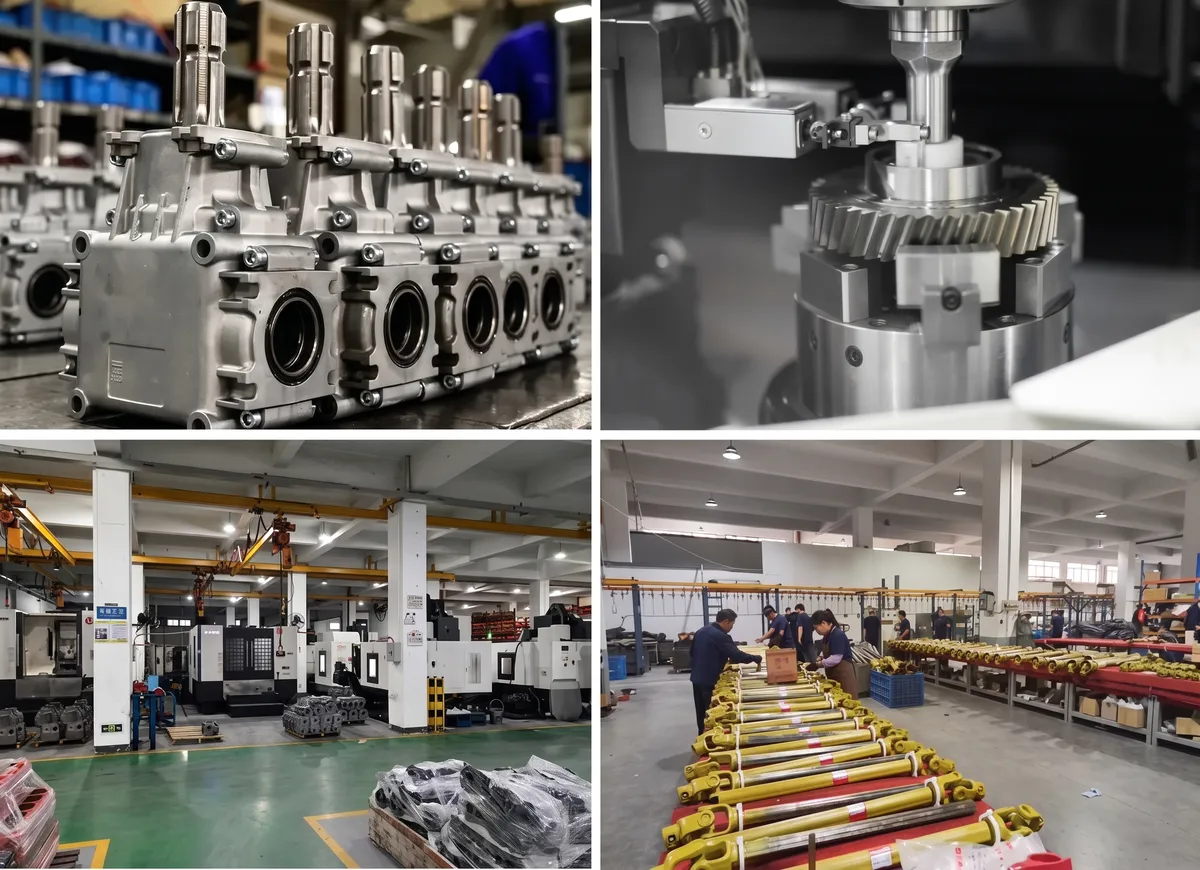
Korea CMN Transmission Co., Ltd. was established in 2000 and is located in Sandan-o, Danwon-gu, Ansan-si, Gyeonggi-do, Korea. Our company has more than 100 factory employees who support research and development, manufacturing, sales, and service for agricultural power-transmission products. Over more than two decades, CMN Transmission has developed a broad agricultural gearbox program and exports to more than 60 destinations. For buyers evaluating fertilizer spreader gearbox manufacturers, this matters because replacement and OEM projects often require more than a catalog number. Ratio verification, shaft matching, drawing review, PTO selection, and after-sales parts support can all affect whether the gearbox works correctly in the final machine.
The CMN portfolio covers rotary cutter gearboxes, rotary tiller gearboxes, feed mixer gearboxes, rotary mower gearboxes, fertilizer spreader gearboxes, flail mower gearboxes, post hole digger gearboxes, round baler gearboxes, square baler gearboxes, disc mower gearboxes, center pivot irrigation gearboxes, hydraulic drive gearboxes, silage machine gearboxes, orchard sprayer gearboxes, rotary rake gearboxes, combine harvester gearboxes, grain storage and transportation gearboxes, corn header gearboxes, cutting bar gearboxes, poultry feeding gearboxes, and custom agricultural gearbox programs covering nearly one thousand specifications. Related drivetrain products include PTO shafts, U-joints, yokes, tubes, torque limiters, covers, adapters, couplings, bearings, blades, chains, and sprockets. This wider driveline capability can be useful when a spreader project needs both the fertilizer gearbox and the connecting PTO components reviewed together.
CMN Transmission's annual production exceeds 500,000 gearbox units and is manufactured under ISO 9001 quality management, with CE-related product compliance for applicable markets. Its listed export markets include the United States, Canada, Mexico, Brazil, Argentina, France, Germany, Italy, Spain, the United Kingdom, Russia, China, India, Thailand, Vietnam, Turkey, Australia, and New Zealand. The practical advantage for distributors and equipment manufacturers is the ability to discuss standard models and custom requirements with a supplier already experienced in international agricultural machinery programs. Buyers can provide drawings, samples, shaft details, required fertilizer spreader gearbox ratio, and machine duty information for technical review.
- Application-Focused Support
Technical review can cover ratio, shaft geometry, PTO interface, mounting, and machine duty rather than treating the gearbox as a generic commodity. - Wide Agricultural Gearbox Range
A broad product family gives OEMs and distributors access to spreader, mower, tiller, baler, irrigation, and other agricultural transmission solutions. - PTO and Driveline Sourcing
Related PTO shafts, yokes, U-joints, torque limiters, and couplings can be considered with the gearbox so interface problems are addressed earlier. - Custom Production Capability
Custom agricultural gearbox and driveline production can be discussed from drawings, specifications, and samples when a standard model does not match the machine. - Global Export Experience
Experience shipping to major agricultural markets supports documentation, packaging, technical communication, and repeat-order programs for international buyers. - Specification Transparency
For the CMN-RV010, buyers can review ratio, teeth, module, HP, rated input, input description, weight, and the dimension drawing before confirming an order.
Frequently Asked Questions
Q: What is the rated input speed of the CMN-RV010 fertilizer spreader gearbox?
A: The supplied technical table lists a rated input of 540 rpm. That makes the model suitable for spreader systems designed around a 540 RPM tractor PTO driveline, provided the spline, ratio, shaft layout, and power requirement also match. Do not run the gearbox from a different PTO speed unless the implement manufacturer has confirmed that the entire spreader drive system is designed for it.
Q: What fertilizer spreader gearbox ratios are available for CMN-RV010?
A: The supplied data lists four fertilizer spreader gearbox ratio options: 1:1, 1:1.35, 1:1.9, and 3.3:1. These ratios correspond in order to different teeth counts, modules, and listed power values. When ordering a replacement, provide the exact ratio from the original gearbox or machine manual. A housing that looks identical can still produce the wrong spinner speed if the internal gearset is different.
Q: What are the listed power ratings for the CMN-RV010 configurations?
A: The table lists 15, 13, 15, and 3 HP in the same sequence as the ratios 1:1, 1:1.35, 1:1.9, and 3.3:1. This means the rated power is configuration-specific rather than one value for every gearset. If your spreader has an unusually heavy agitator, dense material load, or non-standard drive, confirm the real torque demand before selecting the agricultural gearbox.
Q: Does the CMN-RV010 use a standard PTO spline?
A: The input/output description in the supplied specification 1 3/8 Z6 / Optic axis. The 1-3/8 Z6 description is consistent with a common six-spline agricultural PTO interface. Before ordering a PTO shaft or replacement yoke, measure and confirm the actual shaft because safe fit depends on spline profile, engagement length, locking method, driveline length, and the implement operating angle.
Q: What is the correct fertilizer spreader gearbox oil level for CMN-RV010?
A: The supplied product data does not state lubricant grade, oil capacity, or exact level-plug procedure. For that reason, the correct fertilizer spreader gearbox oil level should be taken from current CMN service information or the fertilizer spreader manufacturer's maintenance manual. Avoid filling by guesswork or copying the oil quantity from another gearbox, because overfilling and underfilling can both cause heat and leakage problems.
Q: Can CMN-RV010 be used as a direct replacement on any fertilizer spreader?
A: No replacement should be selected by appearance alone. Confirm the gearbox ratio, 540 rpm input requirement, 1-3/8 Z6 connection, output shaft geometry, mounting dimensions, rotation direction, power rating, and the spreader's driveline layout. The drawing shows a 148 mm center housing span and 54 mm side projections with Ø25 side shaft callouts. A direct replacement requires the machine-specific interfaces to match.
Q: Is the CMN-RV010 housing aluminum?
A: Yes. The supplied catalogue page identifies this product family as an aluminum box series, and the product title also specifies an aluminum right-angle gearbox. Aluminum helps keep the listed net weight to 4 kg and offers useful corrosion resistance. It is not maintenance-free, however. Fertilizer residue should still be removed because damp granules can attack seals, fasteners, shaft surfaces, and adjoining steel components.
Q: Can this fertilizer gearbox drive both spinner discs and an agitator?
A: The sectional drawing shows a multi-shaft right-angle arrangement, which can support different spreader drive architectures. However, the supplied data does not assign a specific function to each shaft for every machine. Whether one shaft drives a spinner, twin discs, or an agitator depends on the spreader design. Provide your machine drawing or photos so the shaft function and required direction can be confirmed before ordering.
Q: How do I know whether I need a 1:1 or 1:1.9 fertilizer spreader gearbox?
A: Start with the original equipment specification or the old gearbox marking. If those are unavailable, measure the required spinner or driven-shaft speed and confirm how the manufacturer defines the ratio direction. The CMN-RV010 table lists several gearsets in one family, but the same external housing does not mean they are interchangeable. Changing ratio can change distribution width, material pattern, torque demand, and calibration.
Q: Why is my fertilizer spreader gearbox leaking after PTO shaft replacement?
A: A new PTO shaft can create problems if it is too long, too short, misaligned, or operated at excessive universal-joint angle. If it bottoms out, axial force can be pushed into the gearbox and damage bearings or seals. Inspect the PTO shaft length through the full hitch range, check universal joints and yoke fit, and then inspect the gearbox seal and shaft surface. Correct the driveline cause before installing another seal.
Q: What information should I send fertilizer spreader gearbox manufacturers for a quotation?
A: For the fastest compatibility check, send the spreader make and model, clear photos of the existing gearbox and label, required fertilizer spreader gearbox ratio, tractor PTO speed, input spline, output shaft dimensions, mounting dimensions, rotation direction, estimated power demand, and annual order quantity. For an OEM project, send a controlled drawing or sample. These details help fertilizer spreader gearbox manufacturers separate similar housings that contain different gearsets.
Q: Can I buy the CMN-RV010 fertilizer spreader gearbox for sale as a custom configuration?
A: CMN Transmission supports custom production based on customer drawings and specifications for agricultural gearboxes, PTO shafts, and related machinery components. For a custom CMN-RV010 or related fertilizer gearbox, provide the required ratio, shaft interface, mounting geometry, material or sealing requirements, expected torque or power, duty cycle, and target quantity. Engineering confirmation is recommended before any non-standard configuration is released for production.
Customer Reviews
Michael Davis, Equipment Distributor, United States
"We evaluated the RV010 format for a compact 540 RPM spreader line because the aluminum housing keeps the unit easy to handle during assembly. The 1:1 configuration was the closest match to our existing disc-speed requirement, and the 1-3/8 Z6 PTO interface made integration straightforward. What mattered most to us was getting the drawing and ratio details checked before ordering. Once we matched the shaft geometry and mounting position, installation was routine. For future orders we would again confirm the exact ratio and oil specification before the machines go into dealer inventory."
Robert Chen, Farm Machinery, Canada
"Our main concern with fertilizer spreader gearboxes is usually not the housing; it is whether the replacement actually matches the old ratio and output arrangement. The CMN-RV010 specification gives several gearsets in the same family, so we used the teeth and ratio information to avoid mixing them up. The 4 kg weight was convenient on the bench and the unit fit the compact spreader layout we were repairing. After commissioning, we checked for heat, leakage, and vibration at 540 RPM. The gearbox ran smoothly during the initial service test."
Lucas Costa, Agricultural Equipment, Brazil
"For our market, a common problem is sourcing a replacement that arrives with the correct PTO spline but the wrong internal ratio. On this model we liked having the 1:1, 1:1.35, 1:1.9, and 3.3:1 options documented separately. We asked our customer for the old gearbox plate and spreader photos before confirming the order. That extra step prevented a compatibility mistake. The aluminum body also helps with freight weight. We would still recommend keeping fertilizer residue washed off the unit because our humid climate is hard on seals, fasteners, and surrounding steel parts."
Thomas Müller, Implement Engineering, Germany
"We were interested in the RV010 as a compact right-angle agricultural gearbox rather than simply as a catalog replacement. The sectional drawing was useful because it showed the bevel gear arrangement, 148 mm central span, 54 mm side shaft projections, and Ø25 shaft callouts. Our engineers could compare those references with the machine model before moving ahead. We also appreciated that the power values are tied to the ratio sequence instead of one universal rating. For an OEM project, we would request the current controlled drawing and tolerance information before final release."
Giovanni Russo, Fertilizer Spreader Dealer, Italy
"The practical advantage for us is that the gearbox family covers several ratios without forcing us to redesign the whole machine around a completely different housing. We mainly handle small and medium PTO spreaders, so the 540 RPM input and compact weight are relevant. During installation we check the PTO shaft length carefully because many failures blamed on the gearbox actually come from a driveline that bottoms out or runs at too much angle. With the correct setup, the unit gave the stable mechanical feel we expect from a new fertilizer spreader gearbox."
Laurent Lefebvre, Agricultural Service, France
"We used the RV010 specification while rebuilding a spreader that had been stored with fertilizer residue still on it. The old unit had corrosion around the seal areas and the PTO yoke was worn. Replacing only the gearbox would not have solved the root cause, so we serviced the driveline at the same time. The new unit's compact aluminum construction was easy to install. We ran it first at low engine speed, then at the full 540 RPM PTO setting, and checked temperature and leakage before returning the machine to field calibration."
Vikram Patel, Spreader Manufacturer, India
"For a production machine, the most valuable part of the specification is the ratio, gear teeth, module, input description, and weight being available together. We selected the configuration only after checking our spinner requirement and the load from the agitator. We also reviewed PTO protection because compacted fertilizer can create a sudden jam. The gearbox is only one part of the system, so our engineering team treats the PTO shaft, clutch, mounting bracket, disc hub, and fertilizer gearbox as one driveline. That approach has reduced field-service issues for us."
William Jones, Farm Equipment, Australia
"Our customers work long distances and often service equipment themselves, so we pay close attention to parts identification and installation instructions. The RV010 is light enough to handle easily, but we still advise customers to support the spreader and disconnect the tractor before any work. We also make a point of telling them not to guess the oil quantity. The supplied basic table does not list oil grade or capacity, so we confirm that information separately. Clear ratio identification is also important because a wrong spinner speed can completely change the spread pattern."
Antonio Fernandez, Orchard Equipment, Spain
"We looked at this style of fertilizer distributor gearbox for narrow orchard spreaders where the drive has to fit into a compact central frame. The right-angle layout and multiple shaft arrangement made sense for our equipment concept. What we liked most was being able to compare the drawing before committing to the order. In orchard work, the spread pattern can be sensitive to disc speed and shields, so we would never select the gearbox by appearance alone. We confirm PTO speed, ratio, shaft orientation, and mounting first, then calibrate the machine with actual material."
Additional information
| Edited by | Yjx |
|---|
Related products
-
L-25A Fertilizer Spreader Gearbox Ratio 1.9:1 Replacement for Comer L-25A Gearbox
-
CMN-01-674 Fertilizer Spreader Gearbox Ratio 1.46:1 Aluminum Right Angle 23HP 540RPM PTO
-
L-25A Fertilizer Spreader Gearbox Ratio 1:1.35 Replacement for Comer L-25A Gearbox
-
L-25A Fertilizer Spreader Gearbox Ratio 2.78:1 Replacement for Comer L-25A Gearbox
-
T-281A Fertilizer Spreader Gearbox Ratio 2.16:1 Replacement for Comer T-281A Gearbox