
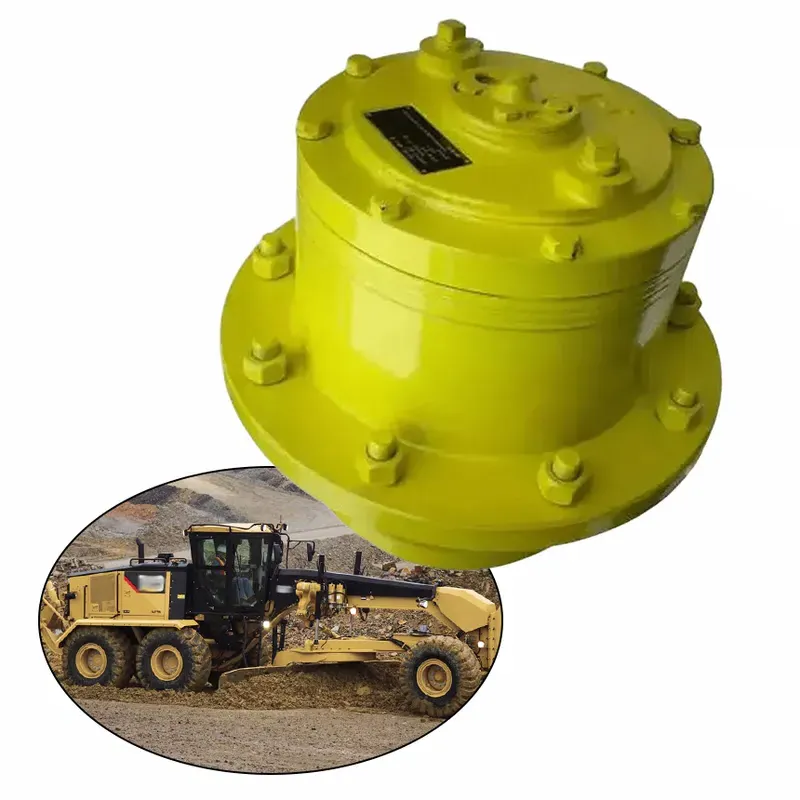
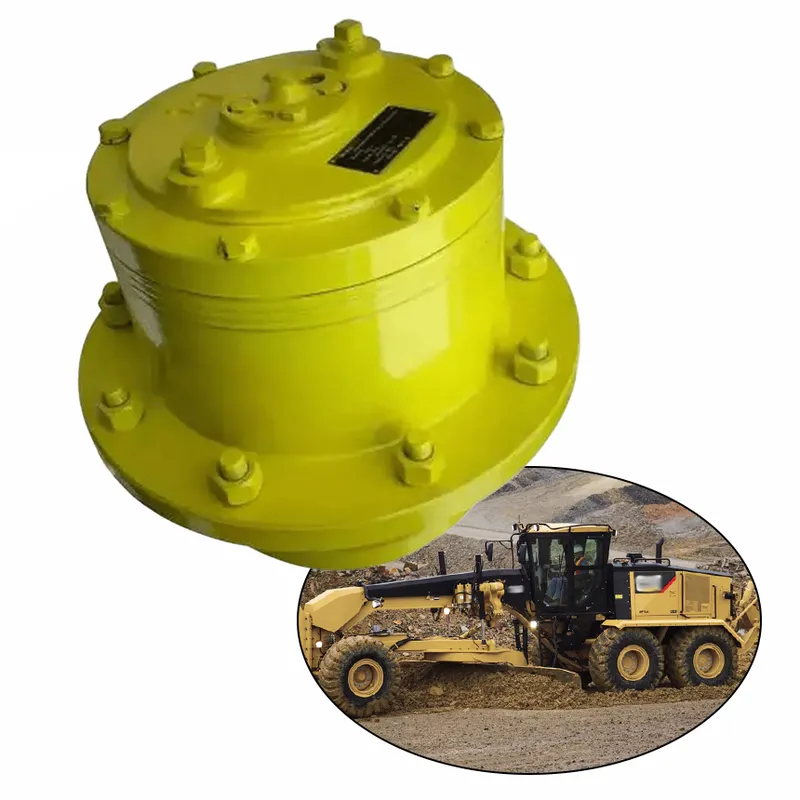
Tração planetária para motoniveladoras de mineração
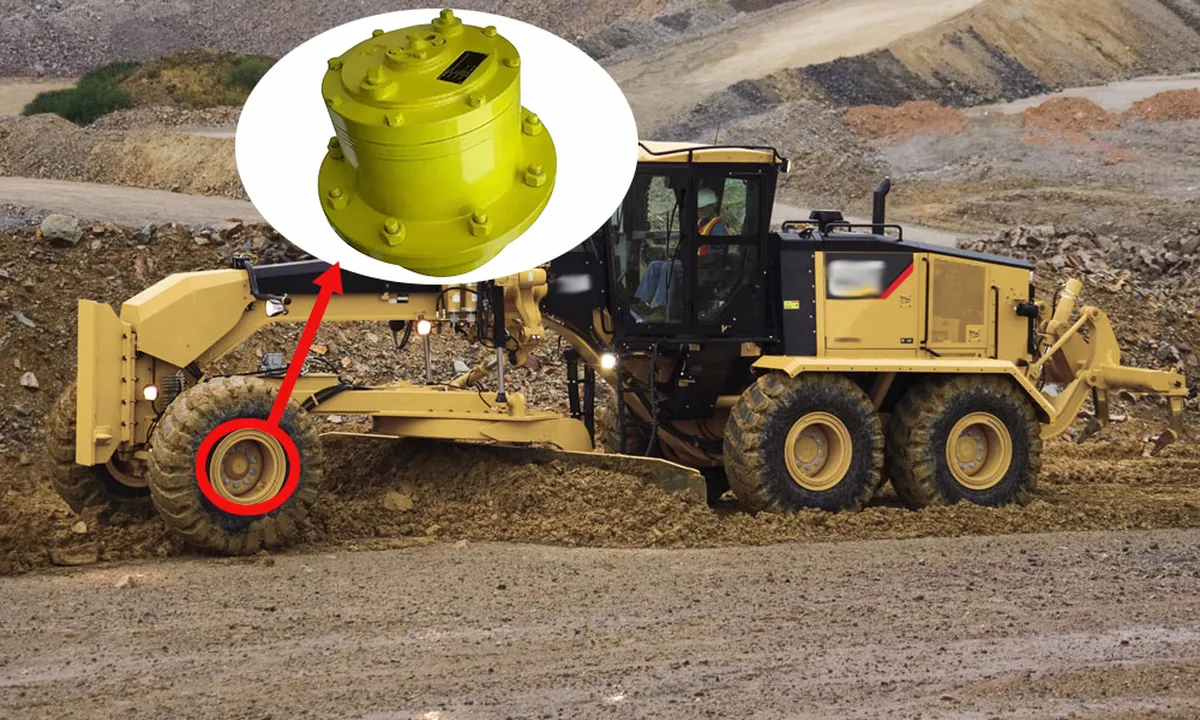
The planetary wheel drive for mining motor graders is a specialized gearbox system that employs planetary gear mechanisms to transmit power efficiently from the engine to the wheels. In mining applications, it enhances the grader’s performance by providing superior traction and stability on challenging terrains such as loose gravel, mud, or steep inclines, which are common in open-pit operations. By delivering torque directly to each wheel, it minimizes slippage, improves maneuverability, and supports heavy-duty tasks like road leveling and material spreading.
The planetary wheel drive for mining motor graders is a specialized gearbox system that employs planetary gear mechanisms to transmit power efficiently from the engine to the wheels. This compact transmission unit consists of a central sun gear, surrounding planet gears mounted on a carrier, and an outer ring gear, enabling high torque multiplication while maintaining a reduced speed output. In mining applications, it enhances the grader's performance by providing superior traction and stability on challenging terrains such as loose gravel, mud, or steep inclines, which are common in open-pit operations. By delivering torque directly to each wheel, it minimizes slippage, improves maneuverability, and supports heavy-duty tasks like road leveling and material spreading.
Planetary Wheel Drive Gearbox Dimensions
Definições Técnicas
| Símbolos | Unidades de medida | Descrição |
| eu | - | Taxa de redução |
| T2máx | [Nm] | Torque máximo de saída |
| T2p | [Nm] | Torque de saída de pico |
| T2maxint | [Nm] | Torque intermitente máximo |
| T2cont | [Nm] | Torque de saída contínuo |
| Pcont | [kW] | Potência máxima contínua |
| Pinta | [kW] | Potência máxima intermitente |
| n1máx | [rpm] | Velocidade máxima de entrada |
| n2máx | [rpm] | Velocidade máxima de saída |
GR 80
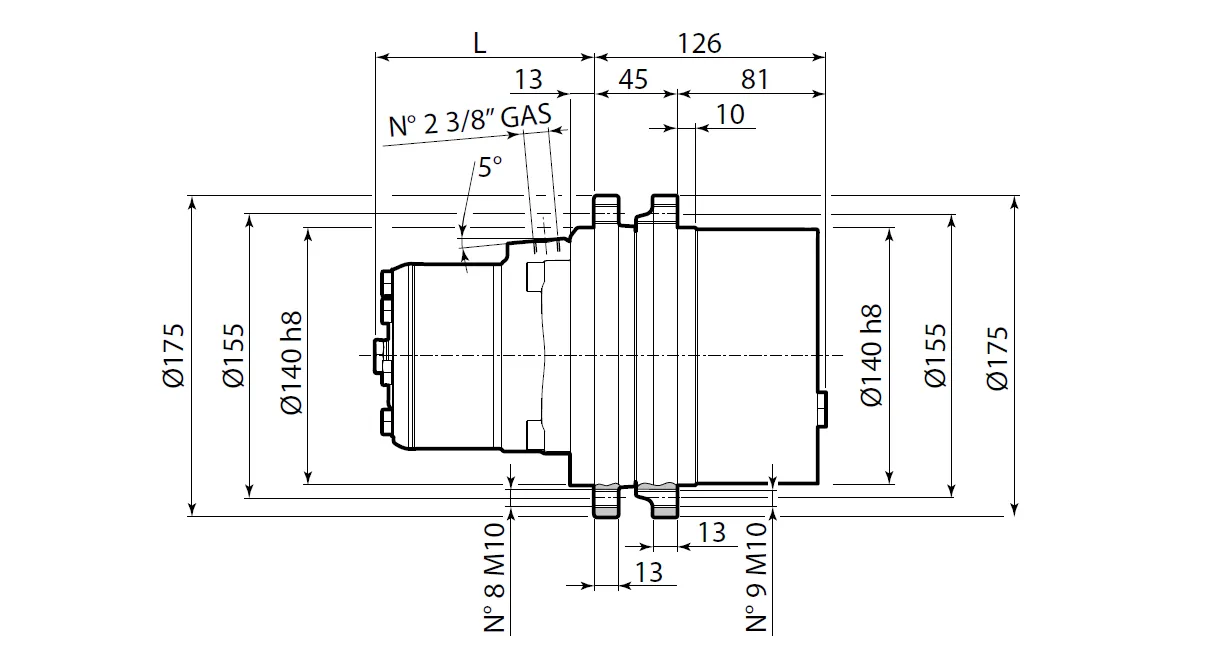
| Tipo | Exibição do motor. [cc] | Exibição total. [cc] | eu | Torque | Velocidade n2máx | Poder | |||||||
| T2cont | T2maxint | T2p | Pcont [kW] | Pinta [kW] | |||||||||
| [Nm] | Δp [barra] | [Nm] | Δp [barra] | [Nm] | Δp [barra] | [rpm] | portata fluxo [l/minuto] | ||||||
| GR80-MR50 | 51,6 | 269,9 | 5,23 | 470 | 145 | 570 | 175 | 630 | 205 | 115 | 30 | 5,5 | 7 |
| GR80-MR80 | 80,3 | 420,0 | 800 | 145 | 960 | 175 | 1060 | 205 | 68 | 30 | 5,5 | 7 | |
| GR80-MR100 | 99,8 | 522,0 | 800 | 115 | 1000 | 145 | 1310 | 205 | 55 | 30 | 5,5 | 7 | |
| GR80-MR125 | 125,7 | 657,4 | 800 | 95 | 1000 | 120 | 1500 | 190 | 45 | 30 | 5,5 | 7 | |
| GR80-MR160 | 159,6 | 834,7 | 800 | 75 | 1000 | 95 | 1500 | 145 | 33 | 30 | 5 | 7 | |
| GR80-MR200 | 199,8 | 1045,0 | 800 | 60 | 1000 | 75 | 1500 | 115 | 26 | 30 | 5 | 7 | |
| GR80-MR250 | 249,3 | 1303,8 | 800 | 50 | 1000 | 60 | 1500 | 95 | 21 | 30 | 4,5 | 6 | |
GR 200
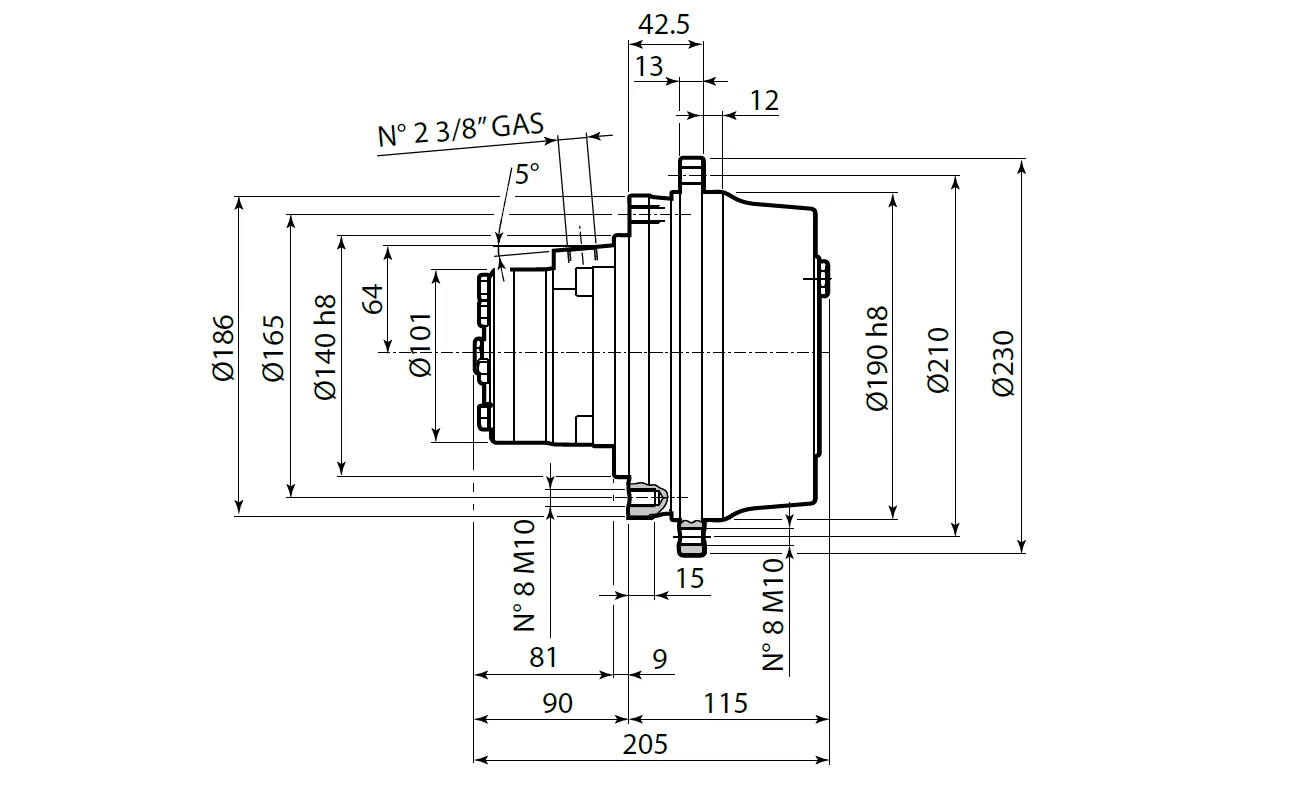
| Tipo | Exibição do motor. [cc] | Exibição total. [cc] | eu | Torque | Velocidade n2máximo | Poder | |||||||
| T2continuação | T2maxint | T2p | Pcont [kW] | Pinta [kW] | |||||||||
| [Nm] | Δp [barra] | [Nm] | Δp [barra] | [Nm] | Δp [barra] | [rpm] | portata fluxo [l/minuto] | ||||||
| GR200-MR50 | 51,6 | 319,9 | 6,20 | 560 | 145 | 670 | 175 | 740 | 205 | 98 | 30 | 5,5 | 7 |
| GR200-MR80 | 80,3 | 497,9 | 950 | 145 | 1150 | 175 | 1250 | 205 | 58 | 30 | 5,5 | 7 | |
| GR200-MR100 | 99,8 | 618,8 | 1180 | 145 | 1420 | 175 | 1560 | 205 | 46 | 30 | 5,5 | 7 | |
| GR200-MR125 | 125,7 | 779,3 | 1450 | 145 | 1750 | 175 | 1920 | 205 | 38 | 30 | 5,5 | 7 | |
| GR200-MR160 | 159,6 | 989,5 | 1600 | 125 | 2100 | 165 | 2450 | 205 | 29 | 30 | 5 | 7 | |
| GR200-MR200 | 199,8 | 1238,8 | 1600 | 100 | 2150 | 135 | 2500 | 165 | 23 | 30 | 5 | 7 | |
| GR200-MR250 | 249,3 | 1545,7 | 1600 | 80 | 2150 | 105 | 2500 | 135 | 18 | 30 | 4,5 | 6 | |
| GR200-MR315 | 315,7 | 1957,3 | 1600 | 65 | 2150 | 85 | 2500 | 110 | 15 | 30 | 4 | 5 | |
| GR200-MR375 | 372,6 | 2310,1 | 1600 | 55 | 2150 | 70 | 2500 | 90 | 12 | 30 | 3,5 | 4,5 | |
EH 210
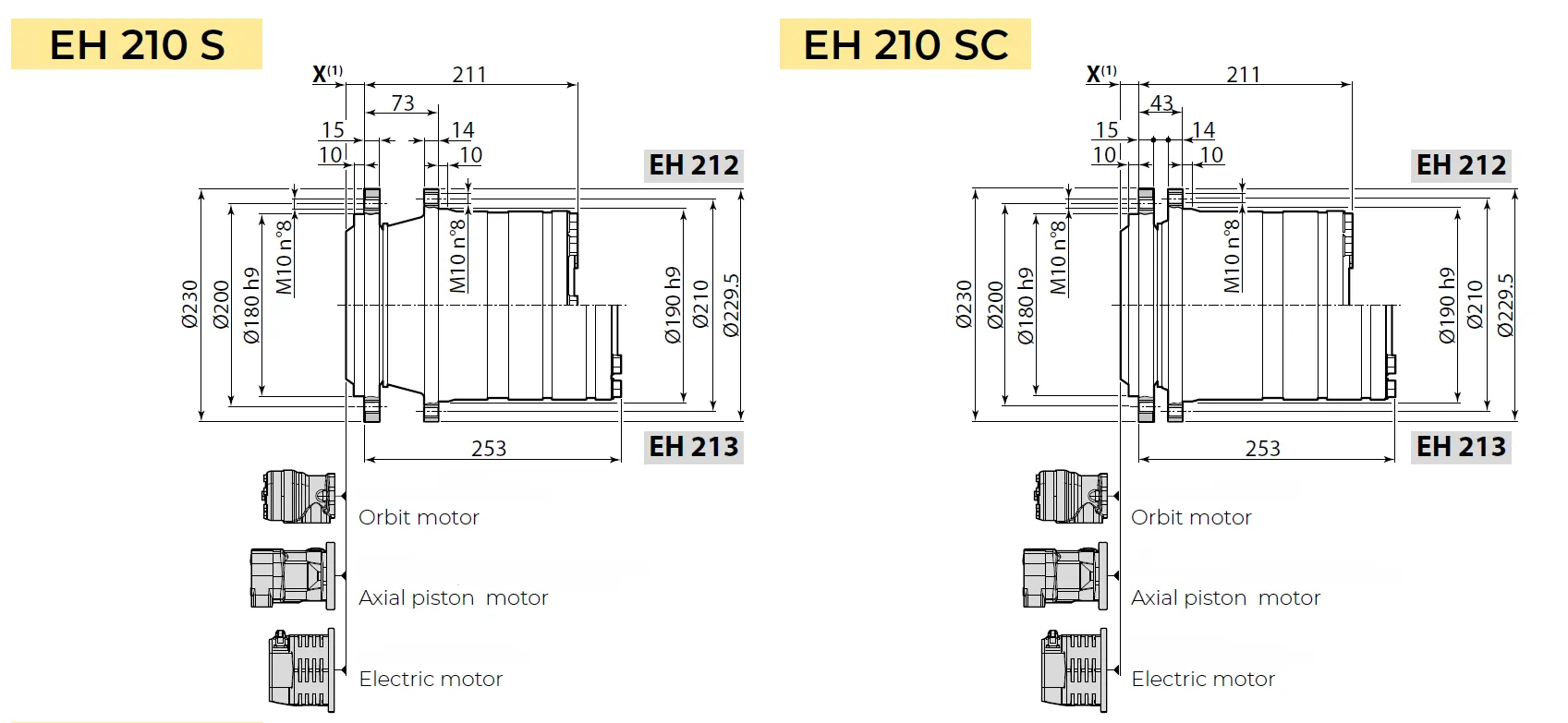
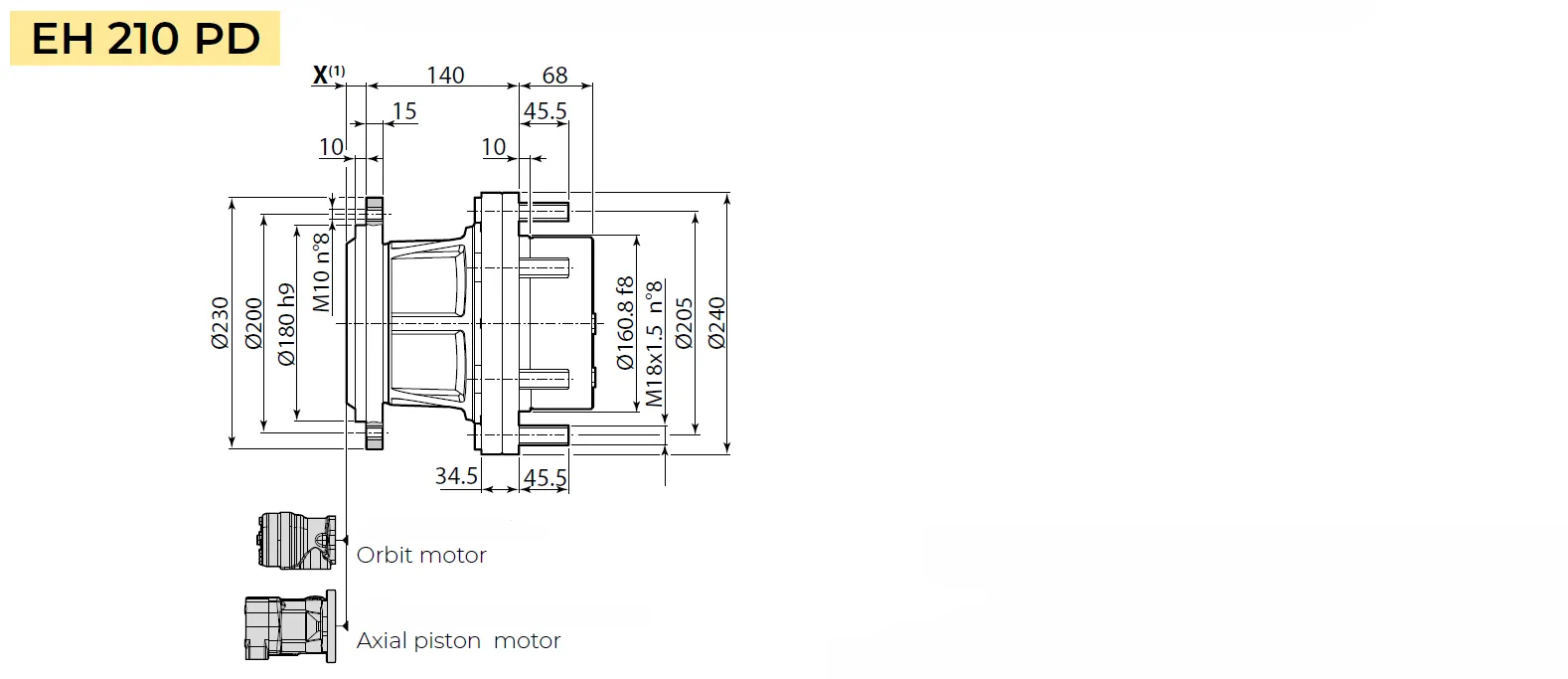
| Tipo | Peso | Quantidade de óleo | i (da÷a / De÷para) | T2máx [Nm] | n1máx [rpm] | ||||
| EH 212 | EH 213 | EH 212 | EH 213 | EH 212 | EH 213 | ||||
| EH 210 S | 35 | 40 | 0.8 | 1 | 11 ÷ 29 | 41 ÷ 129 | 3950 | 3500 | |
| EH 210 SC | |||||||||
| EH 210 PD | - | - | |||||||
EH 240
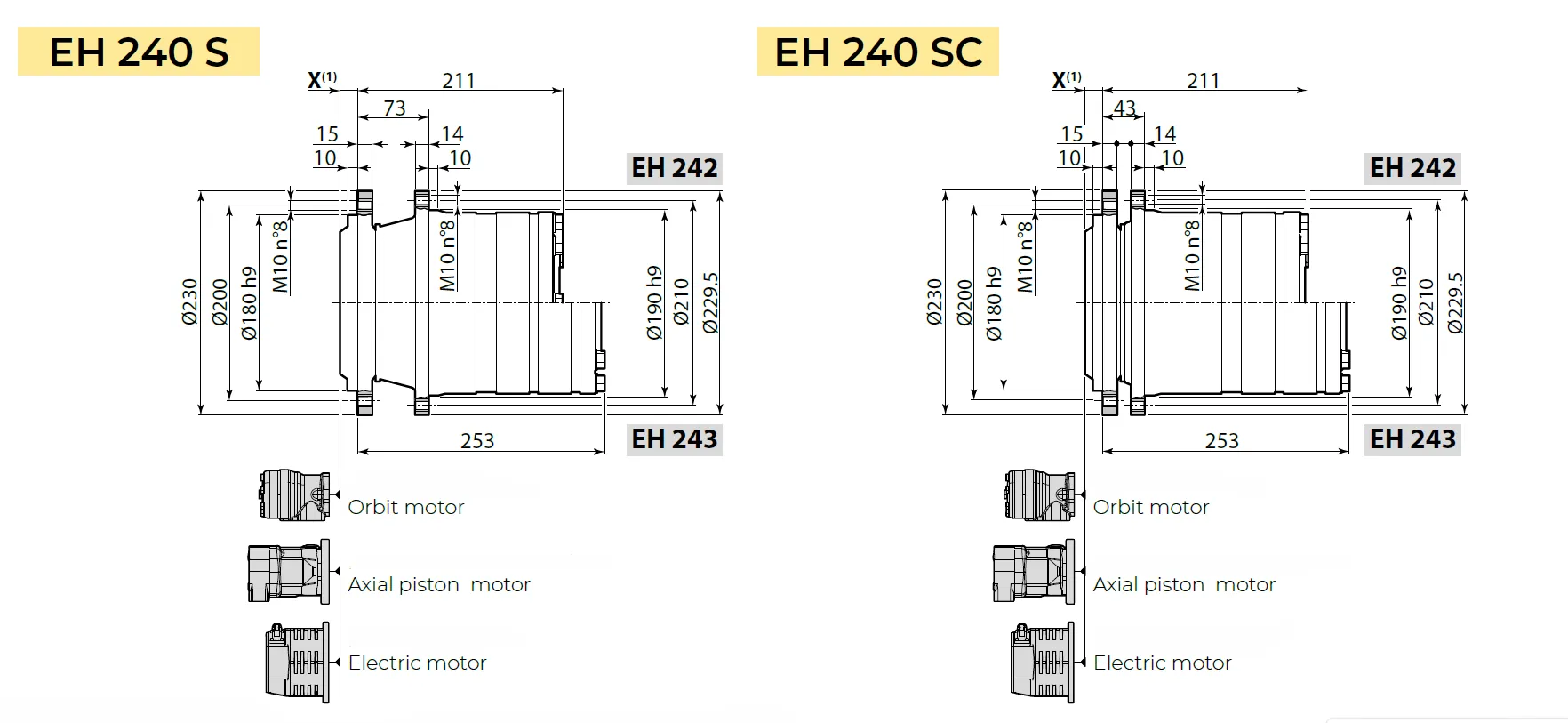
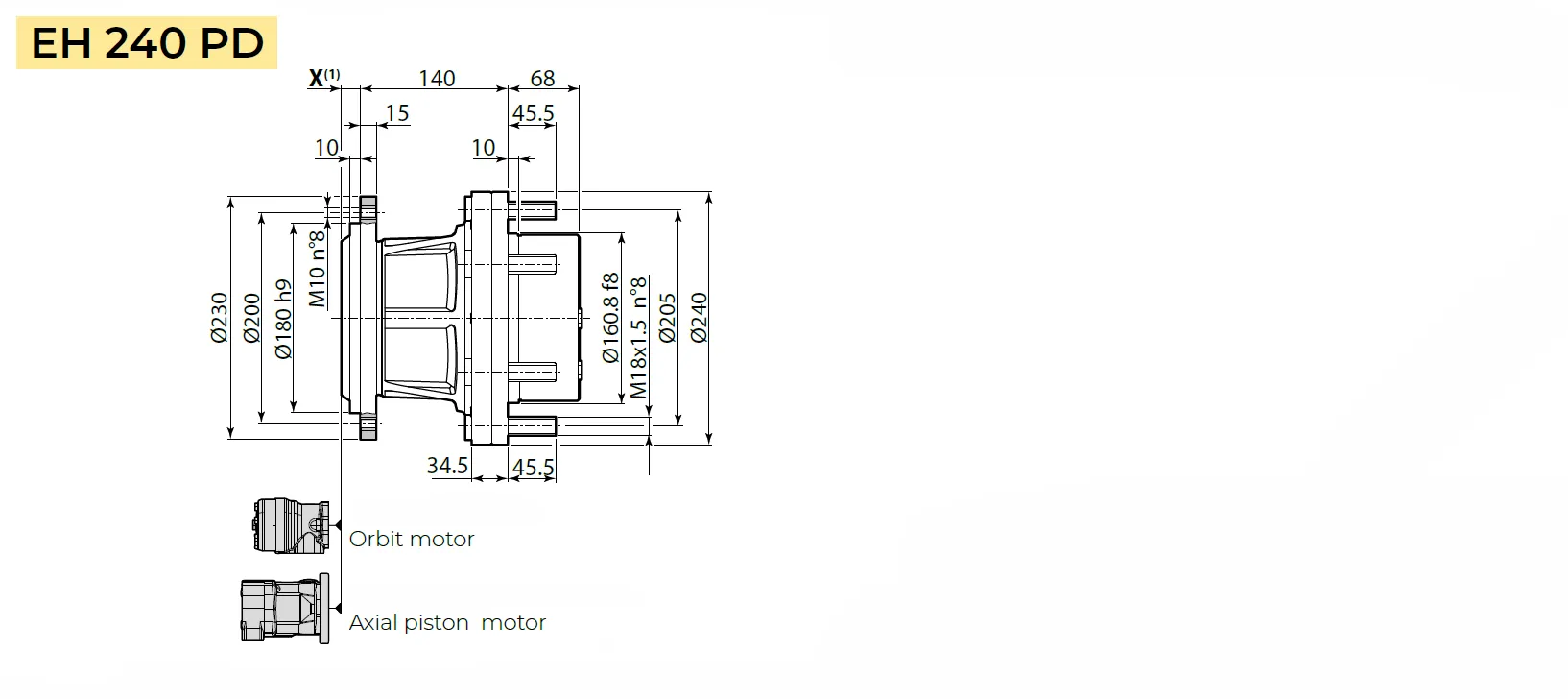
| Tipo | Peso | Quantidade de óleo | i (da÷a / De÷para) | T2máx [Nm] | n1máx [rpm] | ||||
| EH 242 | EH 243 | EH 242 | EH 243 | EH 242 | EH 243 | ||||
| EH 240 S | 35 | 40 | 0.8 | 1 | 12 ÷ 31 | 45 ÷ 135 | 5600 | 3500 | |
| EH 240 SC | |||||||||
| EH 240 PD | - | - | |||||||
EH 350
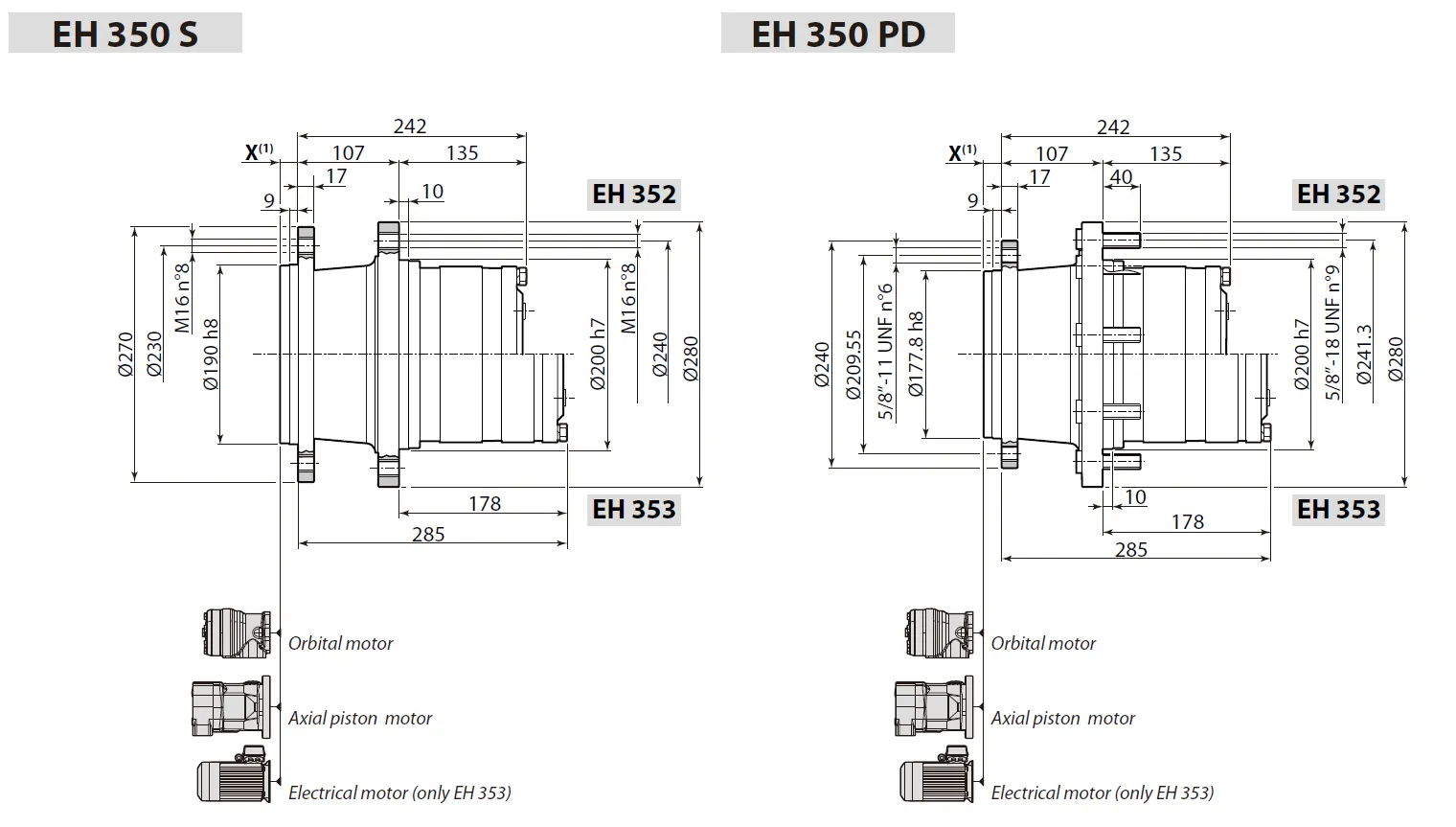
| Tipo | Peso | Quantidade de óleo | i (da÷a / De÷para) | T2máx [Nm] | n1máx [rpm] | ||||
| EH 352 | EH 353 | EH 352 | EH 353 | EH 352 | EH 353 | ||||
| EH 350 S | 55 | 60 | 1 | 1.2 | 15 ÷ 31 | 52 ÷ 135 | 7200 | 3500 | |
| EH 350 PD | |||||||||
EH 610
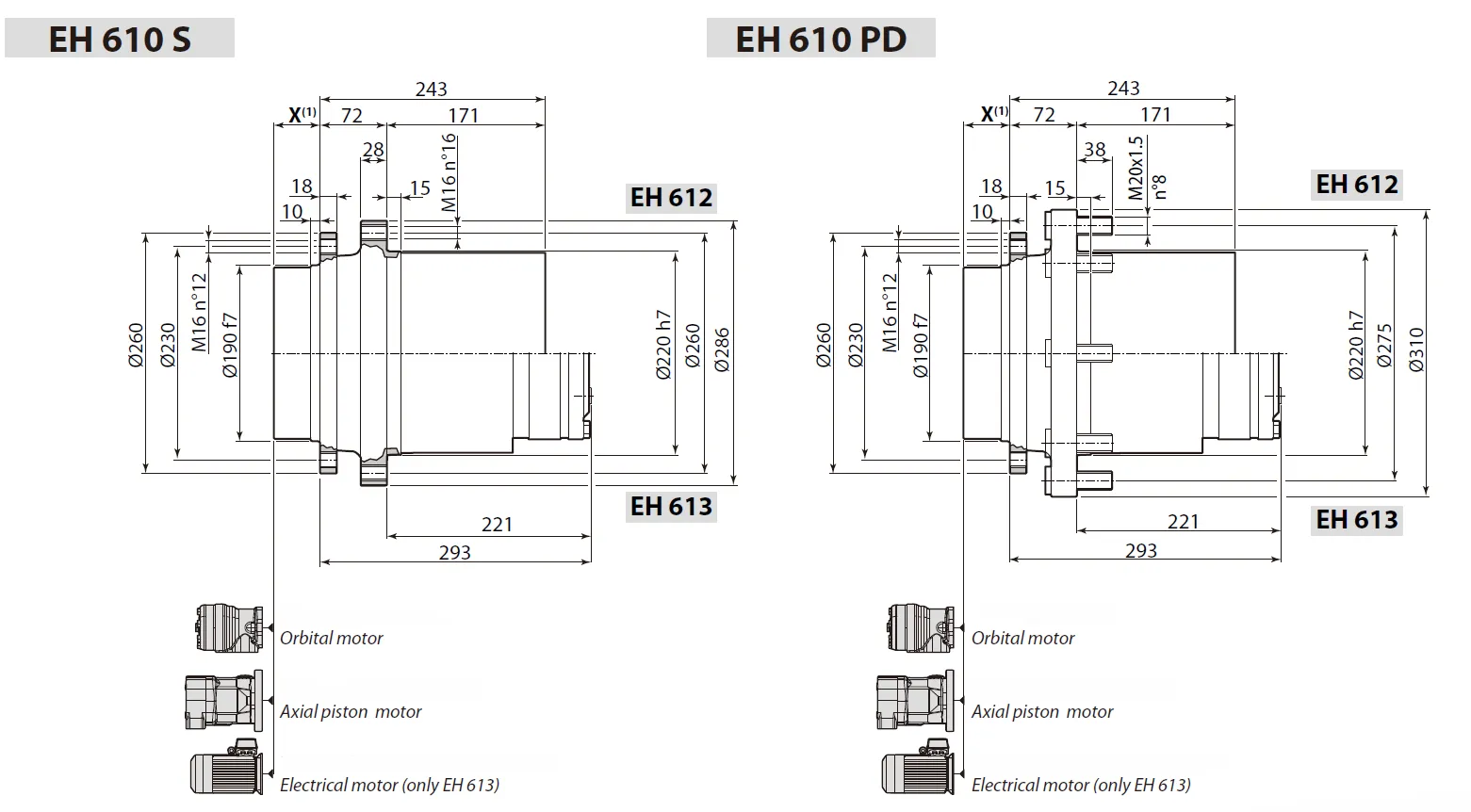
| Tipo | Peso | Quantidade de óleo | i (da÷a / De÷para) | T2máx [Nm] | n1máx [rpm] | ||||
| EH 612 | EH 613 | EH 612 | EH 613 | EH 612 | EH 613 | ||||
| EH 610 S | 60 | 70 | 1.2 | 1.5 | 12 ÷ 31 | 47 ÷ 138 | 13500 | 3500 | |
| EH 610 PD | |||||||||
EH 910
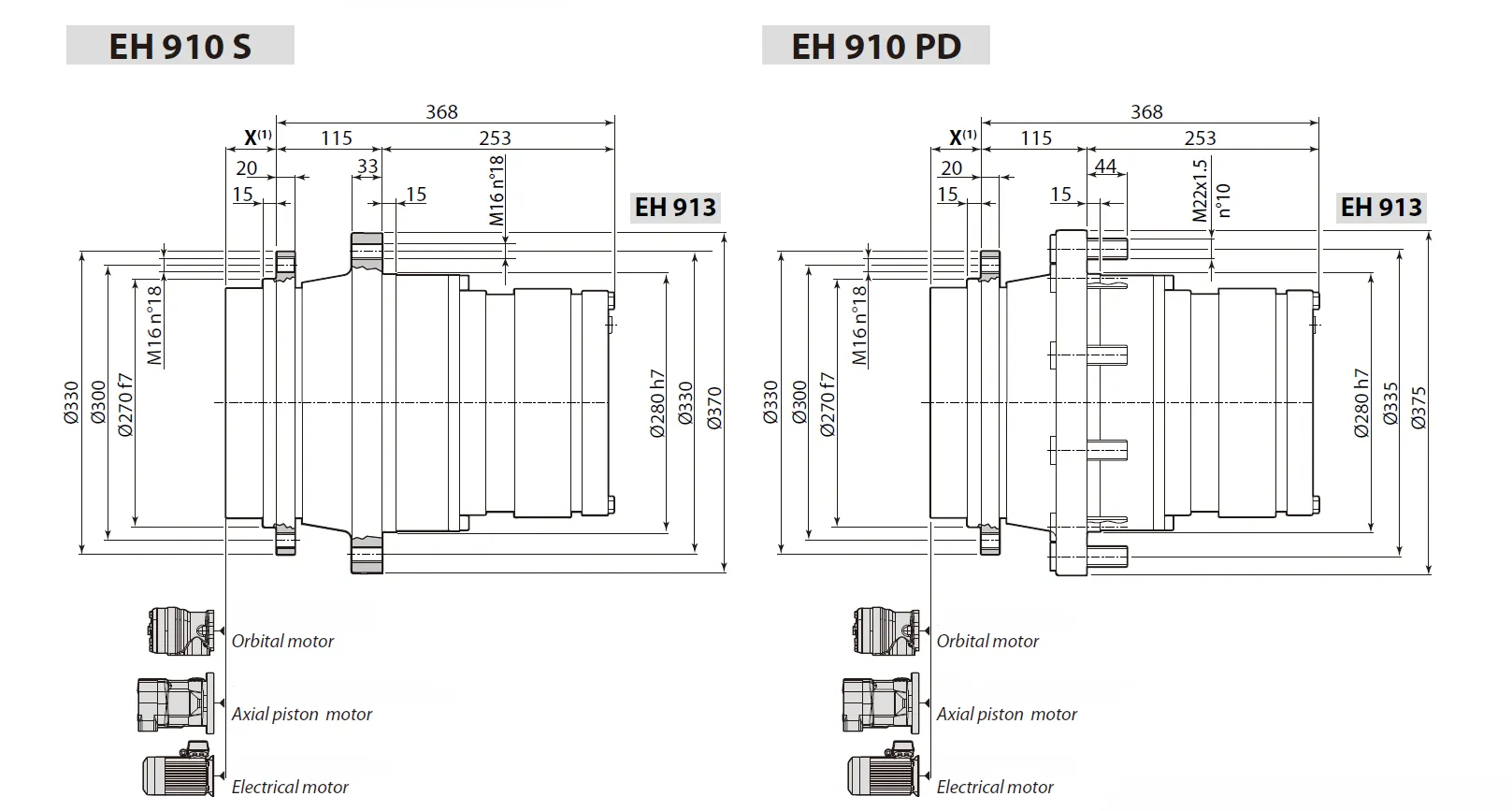
| Tipo | Peso | Quantidade de óleo | i (da÷a / De÷para) | T2máx | n1máx | |
| EH 913 | EH 913 | EH 913 | [Nm] | [rpm] | ||
| EH 910 S | 130 | 1 | 47 ÷ 131 | 24200 | 3500 | |
| EH 910 PD | ||||||
Versão S

| Tamanho | Dimensões | ||||||||||
| D1 | D2 | D3 | D4 | D5 | D6 | D7 | D8 | L1 | L2 | L3 | |
| EH 210 S | 230 | 200 | 180 h9 | 190 h9 | 210 | 229.5 | M10 n°8 | M10 n°8 | 253 | 73 | 180 |
| EH 240 S | 230 | 200 | 180 h9 | 190 h9 | 210 | 229.5 | M10 n°8 | M10 n°8 | 253 | 73 | 180 |
| EH 350 S | 270 | 230 | 190 h8 | 200 h7 | 240 | 280 | M16 n°8 | M16 n°8 | 242 | 107 | 178 |
| EH 610 S | 260 | 230 | 190 f7 | 220 h7 | 260 | 286 | M16 n°12 | M16 n°16 | 243 | 72 | 171 |
| EH 910 S | 330 | 300 | 270 f7 | 280 h7 | 350 | 370 | M16 n°18 | M16 n°18 | 368 | 115 | 253 |
Versão PD
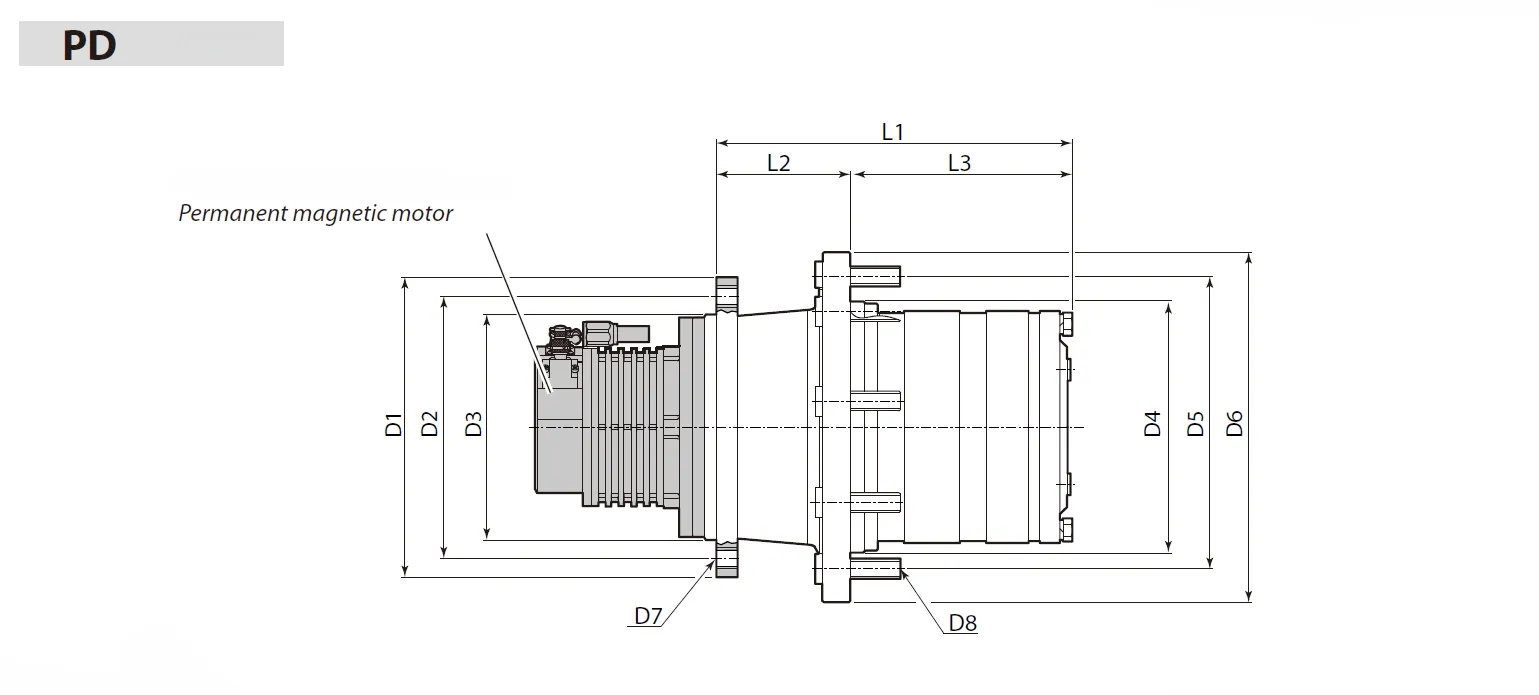
| Tamanho | Dimensões | ||||||||||
| D1 | D2 | D3 | D4 | D5 | D6 | D7 | D8 | L1 | L2 | L3 | |
| EH 210 PD | 230 | 200 | 180 h9 | 160,8 f8 | 205 | 240 | M10 (8x) | M18x1,5 (6x) | 210 | 140 | 70 |
| EH 240 PD | 230 | 200 | 180 h9 | 160,8 f8 | 205 | 240 | M10 (8x) | M18x1,5 (6x) | 210 | 140 | 70 |
| EH 350 PD | 240 | 209.55 | 177,8 h8 | 200 h7 | 241.3 | 280 | 5/8"-11 UNC (6x) | 5/8"-19 UNF (9x) | 285 | 107 | 178 |
| EH 610 PD | 260 | 230 | 190 f7 | 220 h7 | 275 | 310 | M16 (12x) | M20x1,5 (8x) | 293 | 72 | 221 |
| EH 910 PD | 330 | 300 | 270 f7 | 280 h7 | 335 | 375 | M16 (18x) | M22x1,5 (10x) | 368 | 115 | 253 |
Mining Motor Grader Wheel Drive Planetary Gearbox Features
1. Compact and space-saving configuration
This design integrates the planetary wheel drive gearbox seamlessly into the wheel or axle assembly, allowing for efficient use of space within the grader's drivetrain while maintaining high power density, which is crucial for maneuverability in confined mining sites and reduces overall vehicle weight for improved fuel efficiency.
2. High torque output with amplification
The epicyclic gear system multiplies torque significantly while reducing output speed, enabling the grader to handle heavy loads and steep inclines typical in mining operations, ensuring reliable propulsion for tasks such as earth leveling and material handling under extreme conditions.
3. Even load distribution across gears
By employing multiple planet gears that share mechanical stress evenly, this feature minimizes wear on individual components, extends the wheel drive planetary gearbox's lifespan, and enhances durability in harsh terrains, preventing premature failures during prolonged mining activities.
4. Integrated oil cooling and heat dissipation
Large-diameter clutch packs combined with oil-cooled systems effectively manage thermal buildup during continuous operation, promoting superior load distribution and preventing overheating, which is essential for maintaining performance in high-temperature mining environments.
5. Negative multi-disk parking brake
This built-in braking mechanism provides reliable holding power for the vehicle on slopes, enhancing safety in mining applications, and includes hydraulic release options for flexibility, ensuring stable parking without additional external components.
6. Versatile gear ratios for adaptability
Offering a wide range of ratios, such as from 4.3 to 153, this feature allows precise matching of speed and torque to varying operational demands, supporting smooth shifting and optimal efficiency in diverse mining tasks like road maintenance and overburden removal.
Planetary Wheel Drive Gearbox Application Industry
1. Mining Industry
In the mining sector, planetary wheel drive gearboxes are integral to heavy machinery such as motor graders, excavators, and conveyor systems, providing robust torque transmission for operations in rugged terrains, enabling efficient material handling, mineral extraction, and transport while withstanding extreme loads and vibrations typical of open-pit and underground mining activities.
2. Indústria da Construção
Within construction applications, these planetary wheel drives power equipment like wheel loaders, bulldozers, and mobile cranes, offering compact design and high power density to facilitate precise control during site preparation, earthmoving, and structural assembly, ensuring reliability under continuous heavy-duty cycles and variable site conditions.
3. Indústria Agrícola
Wheel drive planetary gearboxes are employed in agricultural machinery including tractors, harvesters, and fertilizer spreaders, delivering smooth torque distribution for enhanced traction on uneven fields, supporting tasks such as plowing, seeding, and crop collection with improved fuel efficiency and reduced mechanical wear.
4. Indústria Florestal
In forestry operations, these planetary gear reducers drive equipment such as log loaders, debarkers, and forage harvesters, providing high torque for navigating dense woodlands and handling timber processing, which enhances operational stability, minimizes downtime, and supports sustainable harvesting practices in challenging forested environments.
5. Port Industry
For port applications, planetary wheel drive gearboxes are utilized in cargo handling systems like cranes, stackers, and automated guided vehicles, enabling precise maneuvering of heavy containers and bulk materials, ensuring efficient loading/unloading processes with superior durability against corrosive marine conditions and high-impact loads.
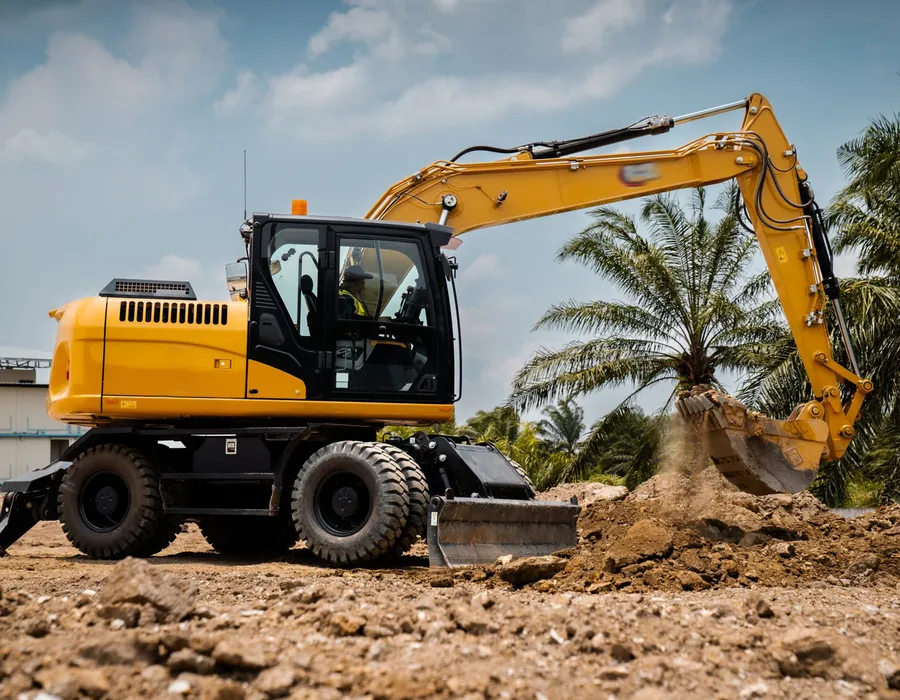 | 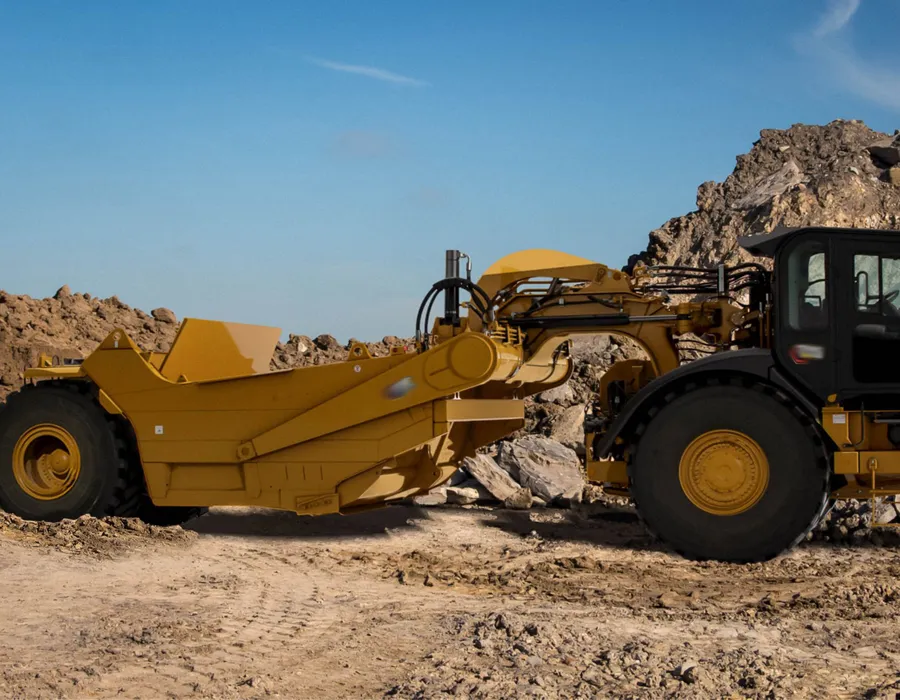 |
| Tração planetária para escavadeiras de rodas | Tração planetária para tratores-raspadores de rodas |
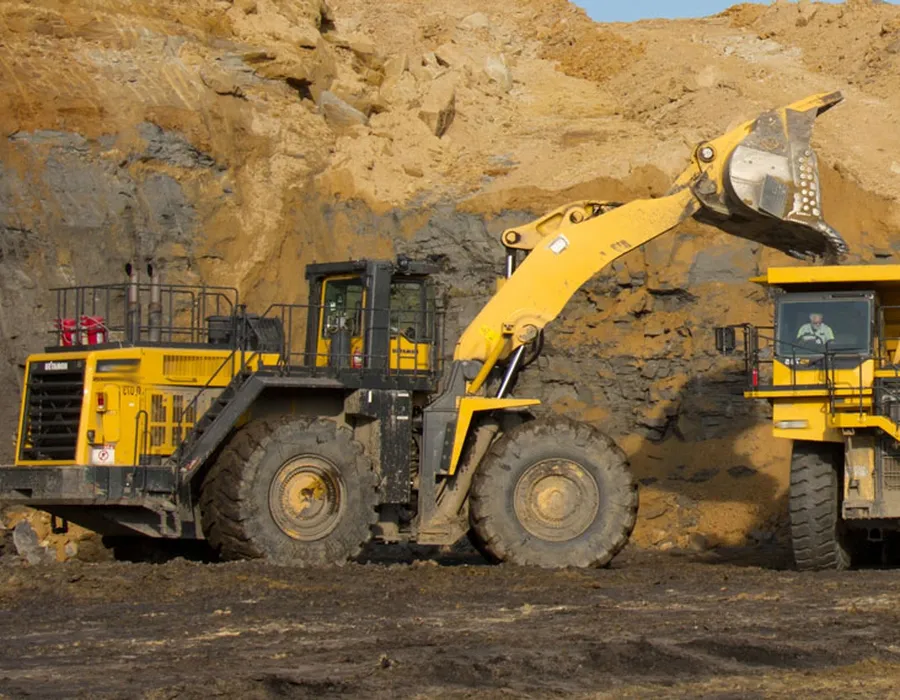 | 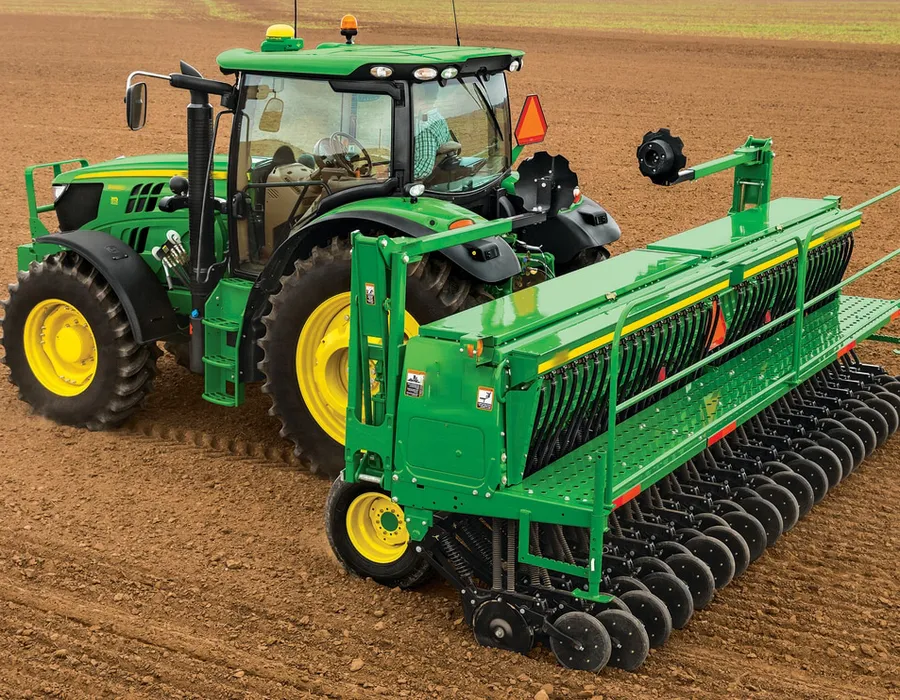 |
| Tração planetária para carregadeiras de rodas de mineração | Acionamento por roda planetária para semeadoras de trigo |
Processo de fabricação da caixa de engrenagens planetárias de tração nas rodas
1. Preparação da matéria-prima
This initial phase involves procuring high-quality metals such as alloy steel, cast iron, or stainless steel, followed by rigorous quality inspections to detect defects, removal of surface impurities through cleaning processes, and preliminary cutting to shape the materials into blanks approximating the final component dimensions, ensuring foundational integrity for subsequent forming.
2. Forging or Casting Formation
Critical components like the planetary carrier, sun gear, and inner ring gear are formed using forging techniques where metals are heated to high temperatures and hammered or pressed into preliminary shapes, or alternatively, casting for complex large parts by pouring molten metal into molds, enhancing structural strength and density for heavy-duty mining use.
3. Usinagem de desbaste
Post-formation, the blanks undergo rough machining on CNC tools including turning, milling, and drilling to eliminate excess material, establishing basic contours, structural features like cylindrical surfaces, planes, keyways, and threaded holes essential for the gearbox's assembly and functionality in motor graders.
4. Primeiro tratamento térmico
Rough-machined parts receive normalization, annealing, or tempering based on material properties to refine internal microstructures, balance hardness with toughness, relieve stresses from prior steps, and prepare components for finer machining, thereby improving overall resilience in demanding mining environments.
5. Processamento de Precisão
Heat-treated components are subjected to advanced techniques such as grinding, honing, gear hobbing, shaving, or slotting to achieve exact tooth profiles, accuracy, and surface finishes on gears and carriers, ensuring seamless meshing and operational efficiency in wheel drive systems for motor graders.
6. Segundo tratamento térmico
For enhanced durability, gears and high-stress areas undergo carburizing, quenching, nitriding, or surface hardening to boost wear resistance, hardness, and fatigue strength, preventing premature failure during prolonged exposure to vibrations and heavy loads typical in mining operations.
7. Usinagem e Inspeção de Precisão Secundária
Final grinding, polishing, and ultra-precision operations refine gear accuracy and surface quality to minimize noise and wear, followed by comprehensive checks including dimensional measurements, hardness tests, and non-destructive methods like ultrasonic or magnetic particle inspections to confirm defect-free parts.
8. Montagem e Teste
Cleaned components are lubricated with specialized greases or oils and assembled per design specifications to ensure proper gear engagement and sealing, culminating in rigorous tests such as no-load runs, load simulations, vibration analysis, and performance evaluations to validate reliability under mining motor grader conditions.
Informação adicional
| Editado por | Yjx |
|---|
Produtos relacionados
-
Caixa de engrenagens de transmissão de esteira planetária para carregadeiras
-
Caixa de engrenagens de tração planetária para manipuladores telescópicos
-
Caixa de engrenagens de transmissão de esteira planetária para caminhões basculantes
-
Caixa de engrenagens planetárias para acionamento por esteiras de colhedoras-processadoras
-
Caixa de engrenagens planetária para acionamento de rodas em caminhões articulados