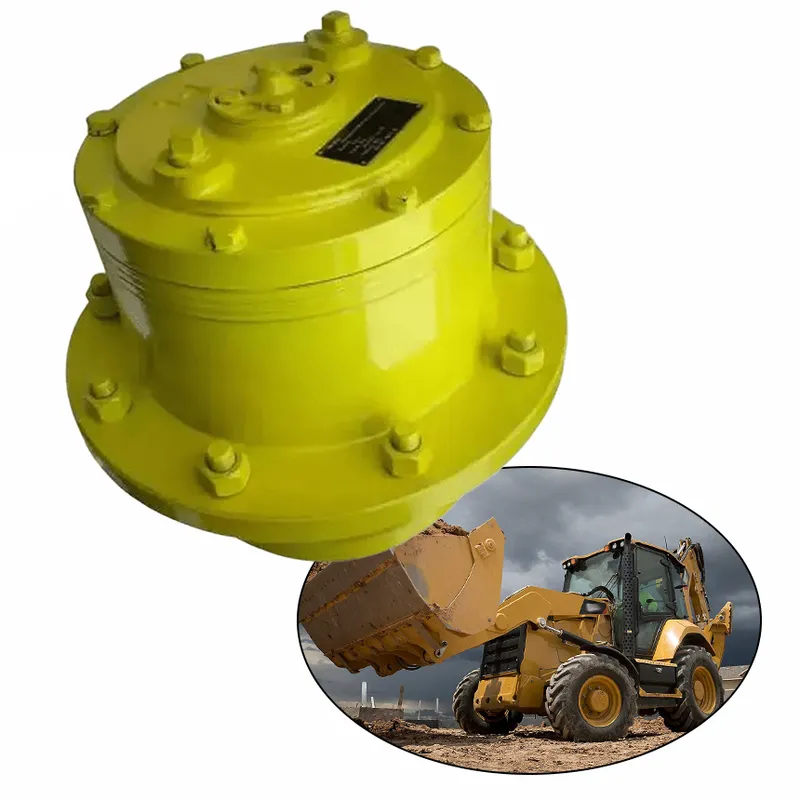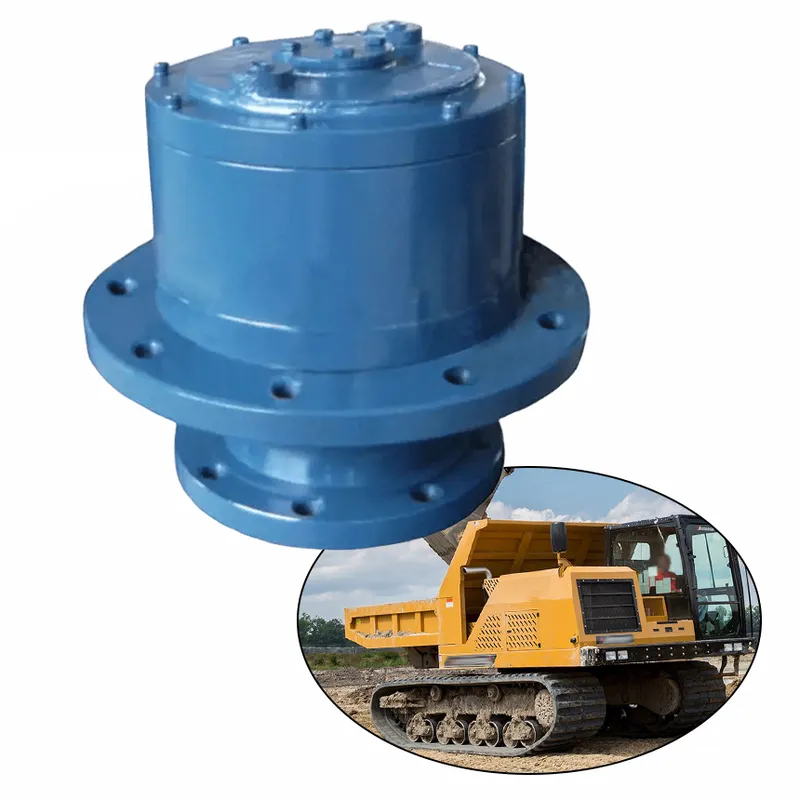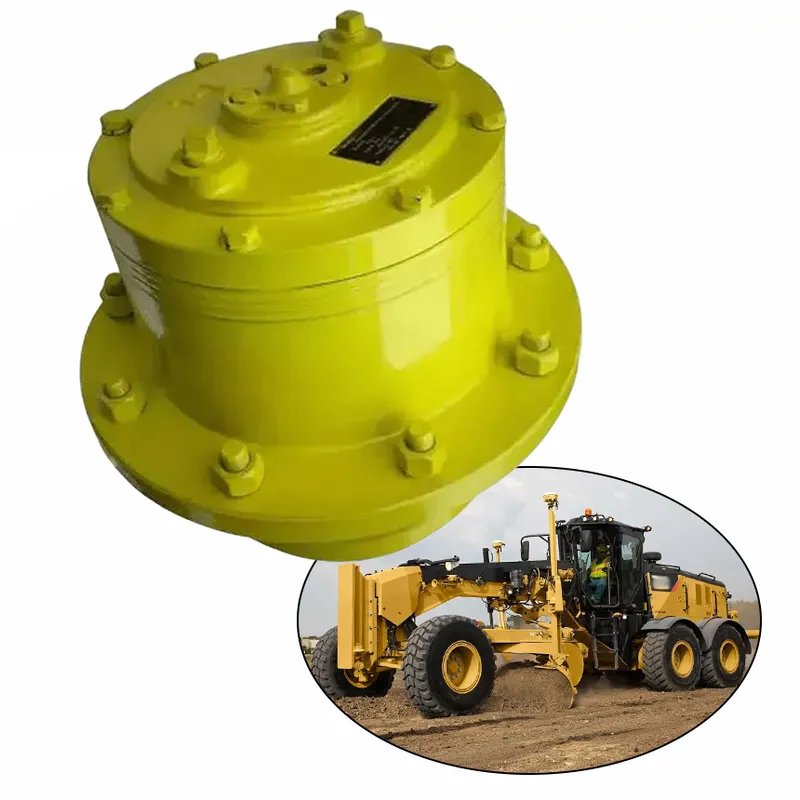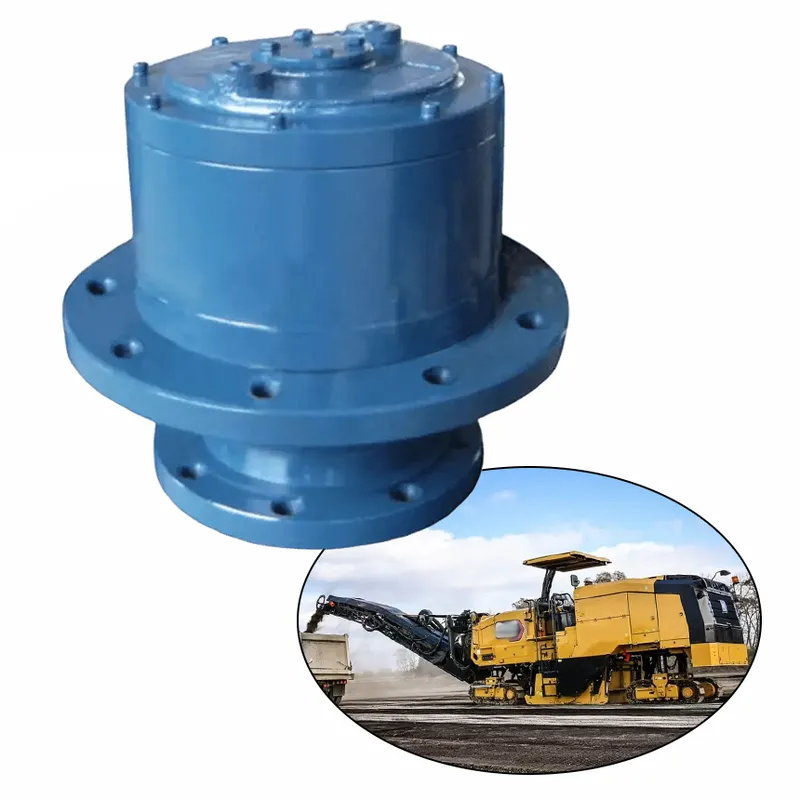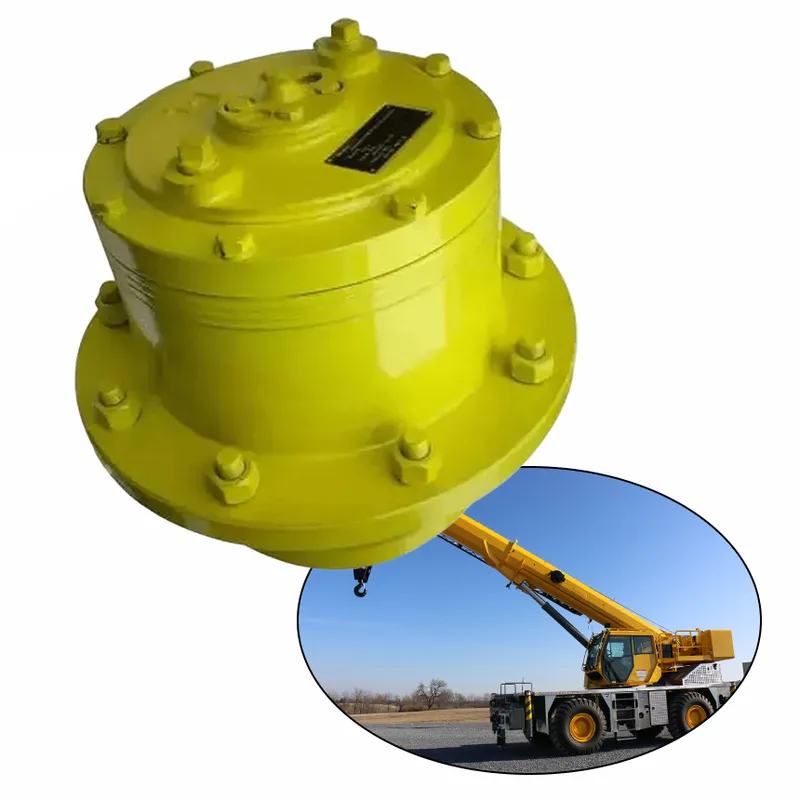
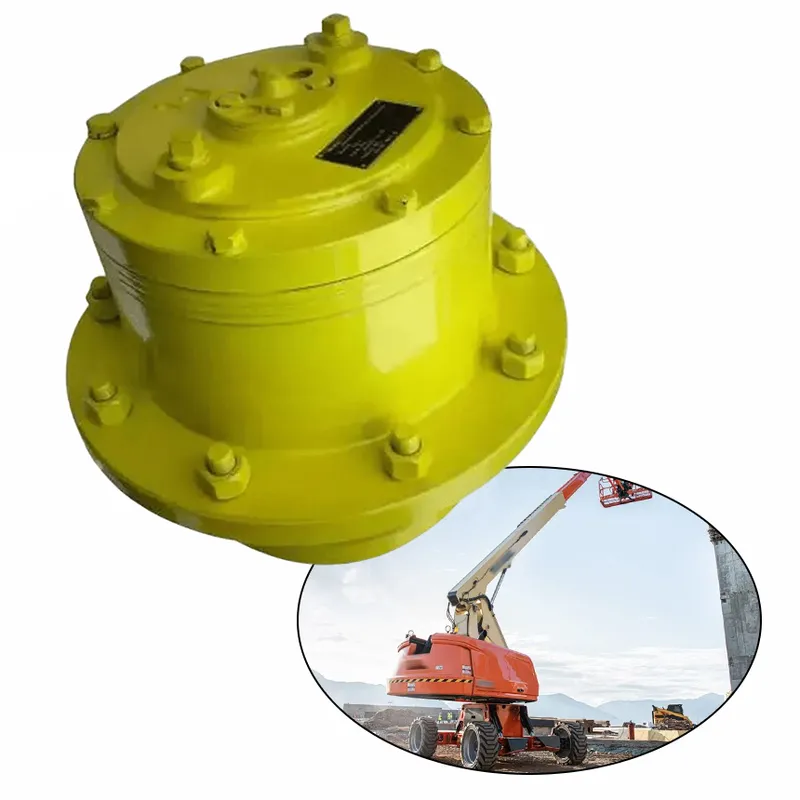
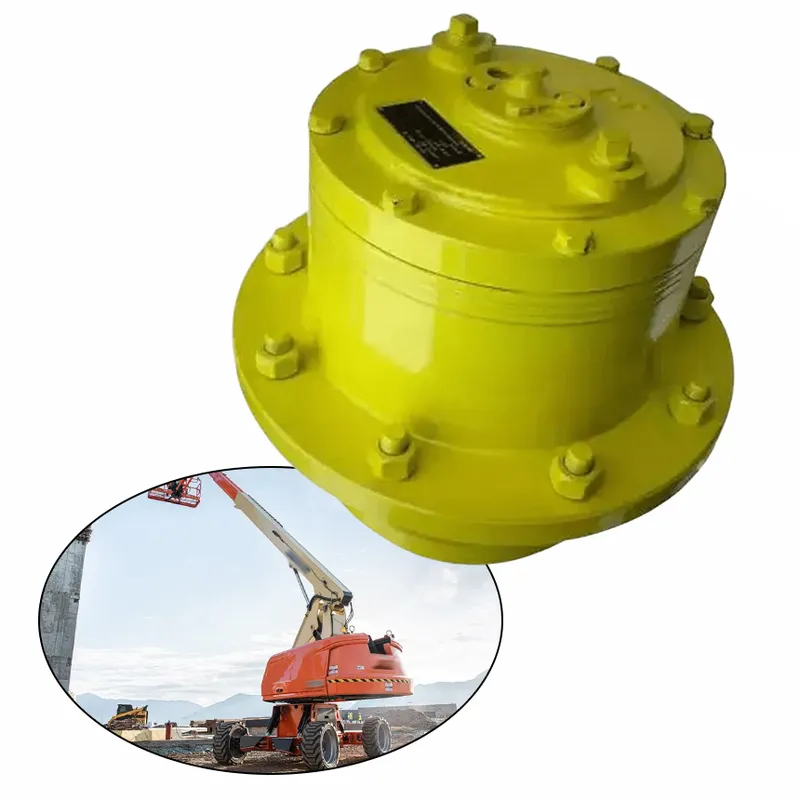
Planetary Wheel Drive Gearbox for Telescopic Boom Lifts
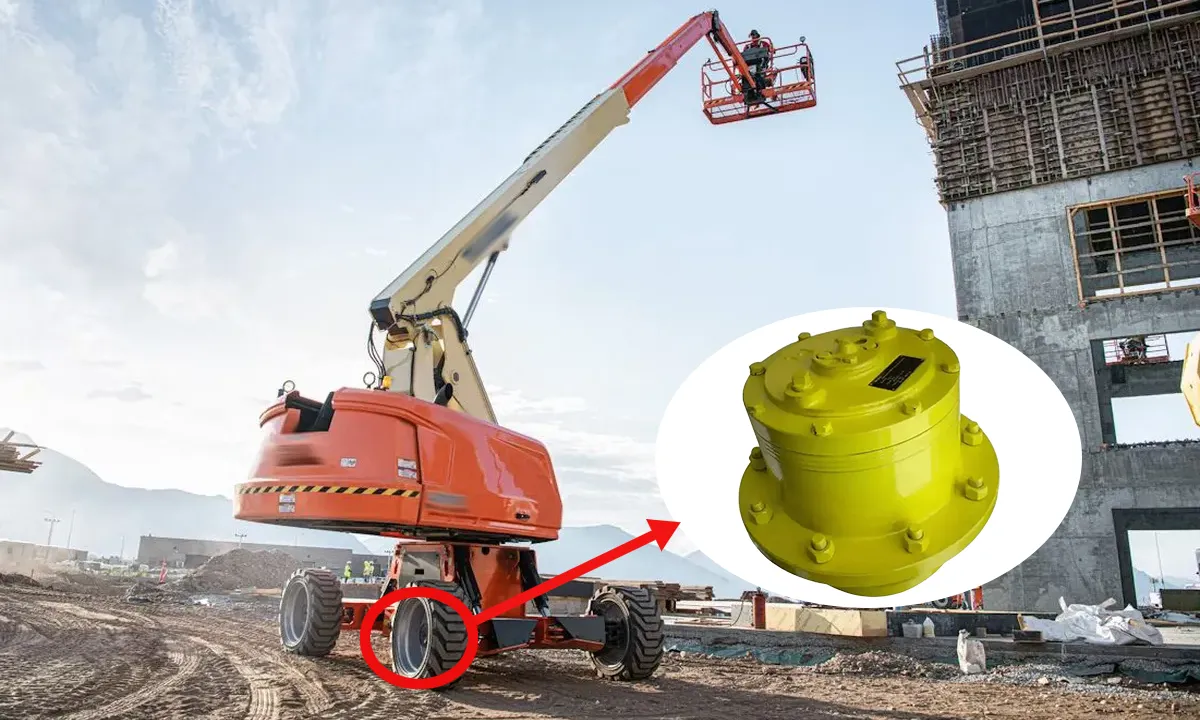
The planetary wheel drive gearbox for telescopic boom lifts is a compact, high-performance epicyclic gear system. In telescopic boom lifts, these planetary gearboxes are primarily integrated into wheel or track drive systems to facilitate stable propulsion across uneven terrains, slopes, and confined spaces, as well as into slewing drives for precise rotational control of the boom platform, enabling accurate positioning during high-altitude tasks such as maintenance, construction, or inspection.
The planetary wheel drive gearbox for telescopic boom lifts is a compact, high-performance epicyclic gear system comprising a central sun gear, multiple planet gears, and an outer ring gear, designed to deliver substantial torque multiplication and speed reduction while maintaining efficiency and durability in demanding applications. In telescopic boom lifts, these planetary gearboxes are primarily integrated into wheel or track drive systems to facilitate stable propulsion across uneven terrains, slopes, and confined spaces, as well as into slewing drives for precise rotational control of the boom platform, enabling accurate positioning during high-altitude tasks such as maintenance, construction, or inspection.
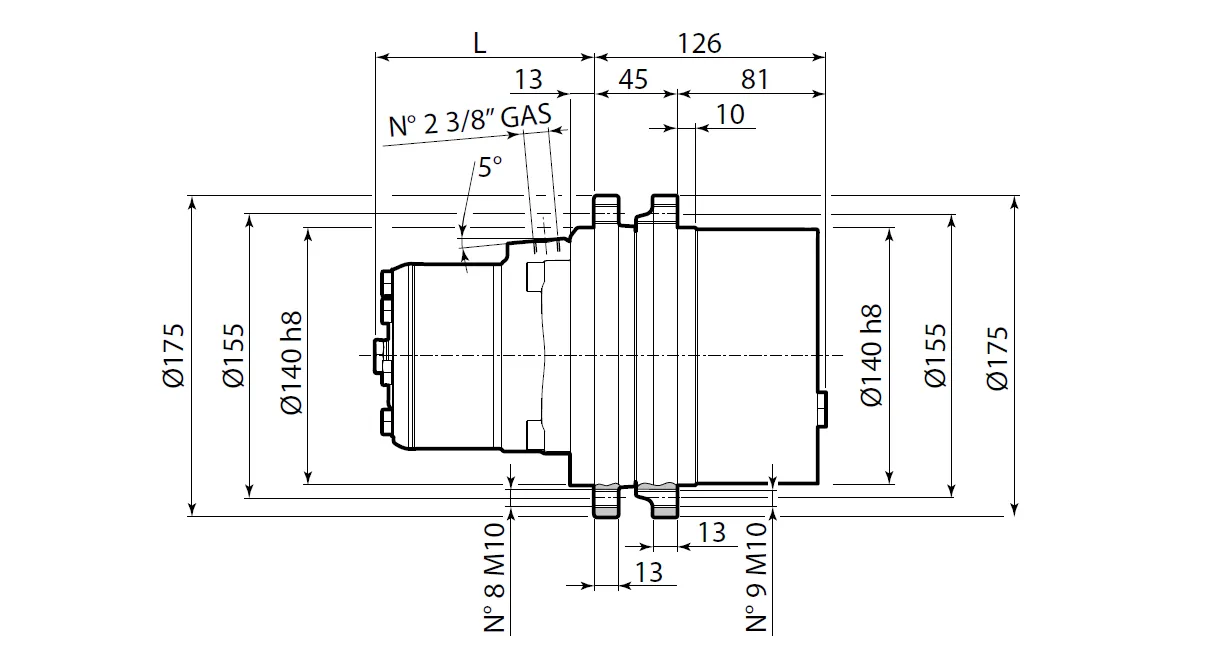
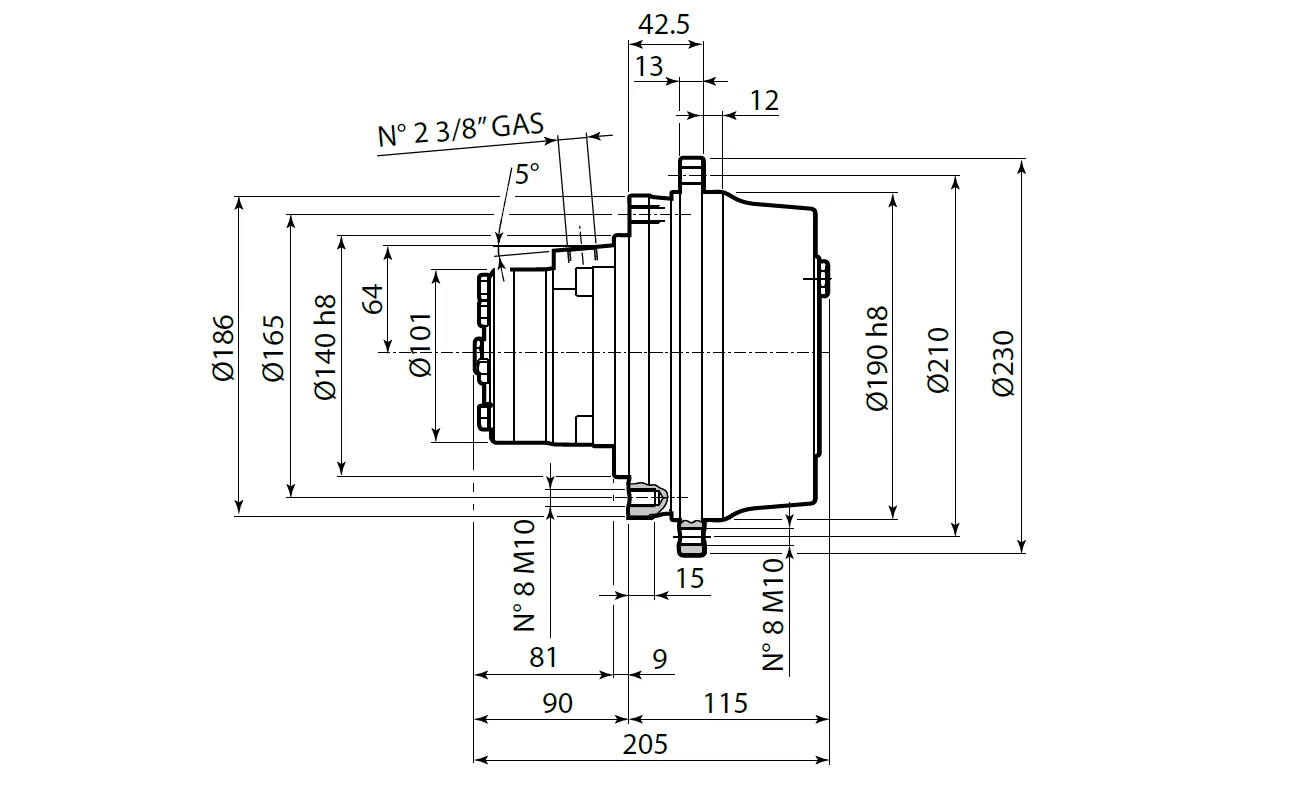
Planetary Wheel Drive Dimensions
Technical Definitions
| Symbols | Units of measurement | Description |
| i | - | Reduction ratio |
| T2max | [Nm] | Maximum output torque |
| T2p | [Nm] | Peak output torque |
| T2maxint | [Nm] | Maximum intermittent torque |
| T2cont | [Nm] | Continuous output torque |
| Pcont | [kW] | Maximum continuous power |
| Pint | [kW] | Maximum intermittent power |
| n1max | [rpm] | Maximum input speed |
| n2max | [rpm] | Maximum output speed |
GR 80
| Type | Motor disp. [cc] | Total disp. [cc] | i | Torque | Speed n2max | Power | |||||||
| T2cont | T2maxint | T2p | Pcont [kW] | Pint [kW] | |||||||||
| [Nm] | Δp [bar] | [Nm] | Δp [bar] | [Nm] | Δp [bar] | [rpm] | portata flow [l/min] | ||||||
| GR80-MR50 | 51,6 | 269,9 | 5,23 | 470 | 145 | 570 | 175 | 630 | 205 | 115 | 30 | 5,5 | 7 |
| GR80-MR80 | 80,3 | 420,0 | 800 | 145 | 960 | 175 | 1060 | 205 | 68 | 30 | 5,5 | 7 | |
| GR80-MR100 | 99,8 | 522,0 | 800 | 115 | 1000 | 145 | 1310 | 205 | 55 | 30 | 5,5 | 7 | |
| GR80-MR125 | 125,7 | 657,4 | 800 | 95 | 1000 | 120 | 1500 | 190 | 45 | 30 | 5,5 | 7 | |
| GR80-MR160 | 159,6 | 834,7 | 800 | 75 | 1000 | 95 | 1500 | 145 | 33 | 30 | 5 | 7 | |
| GR80-MR200 | 199,8 | 1045,0 | 800 | 60 | 1000 | 75 | 1500 | 115 | 26 | 30 | 5 | 7 | |
| GR80-MR250 | 249,3 | 1303,8 | 800 | 50 | 1000 | 60 | 1500 | 95 | 21 | 30 | 4,5 | 6 | |
GR 200
| Type | Motor disp. [cc] | Total disp. [cc] | i | Torque | Speed n2max | Power | |||||||
| T2cont | T2maxint | T2p | Pcont [kW] | Pint [kW] | |||||||||
| [Nm] | Δp [bar] | [Nm] | Δp [bar] | [Nm] | Δp [bar] | [rpm] | portata flow [l/min] | ||||||
| GR200-MR50 | 51,6 | 319,9 | 6,20 | 560 | 145 | 670 | 175 | 740 | 205 | 98 | 30 | 5,5 | 7 |
| GR200-MR80 | 80,3 | 497,9 | 950 | 145 | 1150 | 175 | 1250 | 205 | 58 | 30 | 5,5 | 7 | |
| GR200-MR100 | 99,8 | 618,8 | 1180 | 145 | 1420 | 175 | 1560 | 205 | 46 | 30 | 5,5 | 7 | |
| GR200-MR125 | 125,7 | 779,3 | 1450 | 145 | 1750 | 175 | 1920 | 205 | 38 | 30 | 5,5 | 7 | |
| GR200-MR160 | 159,6 | 989,5 | 1600 | 125 | 2100 | 165 | 2450 | 205 | 29 | 30 | 5 | 7 | |
| GR200-MR200 | 199,8 | 1238,8 | 1600 | 100 | 2150 | 135 | 2500 | 165 | 23 | 30 | 5 | 7 | |
| GR200-MR250 | 249,3 | 1545,7 | 1600 | 80 | 2150 | 105 | 2500 | 135 | 18 | 30 | 4,5 | 6 | |
| GR200-MR315 | 315,7 | 1957,3 | 1600 | 65 | 2150 | 85 | 2500 | 110 | 15 | 30 | 4 | 5 | |
| GR200-MR375 | 372,6 | 2310,1 | 1600 | 55 | 2150 | 70 | 2500 | 90 | 12 | 30 | 3,5 | 4,5 | |
EH 210
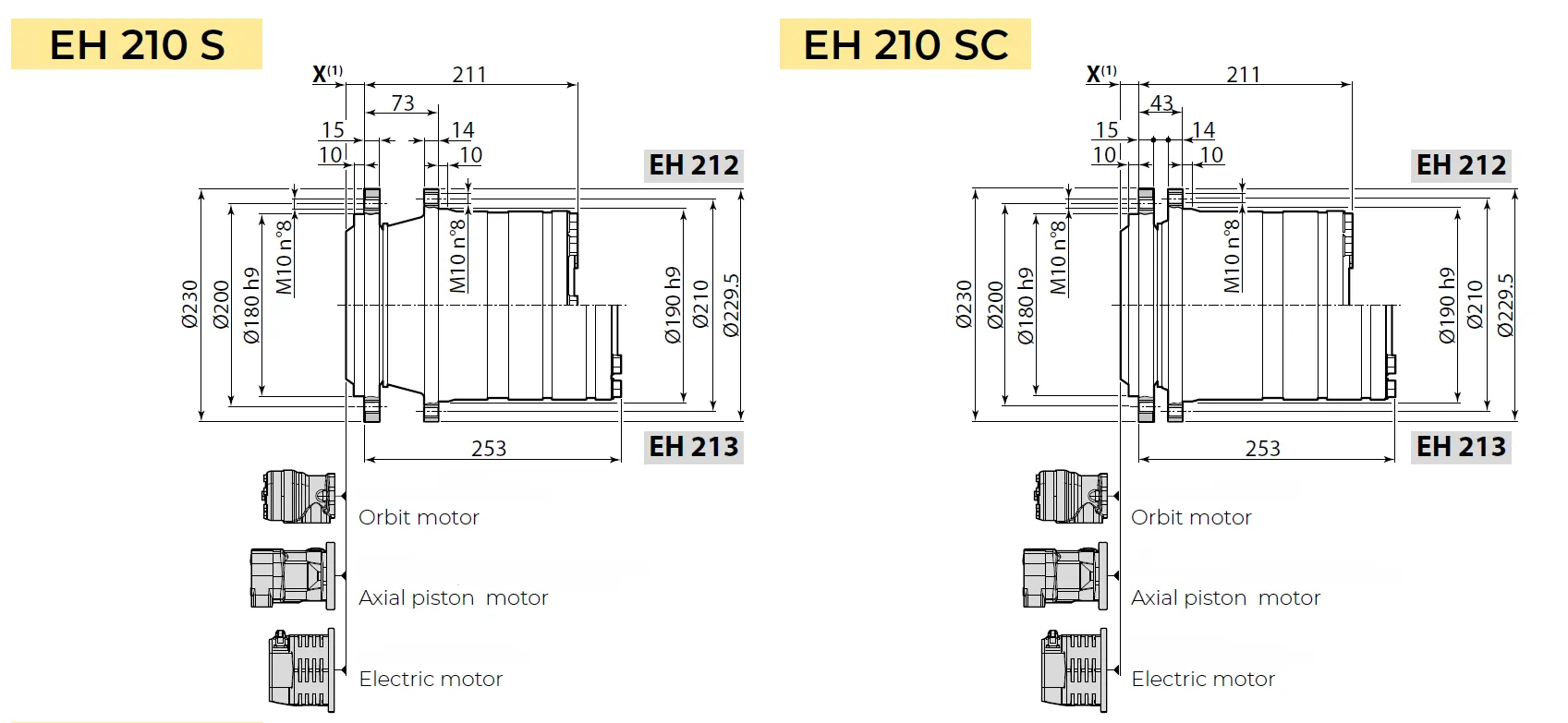
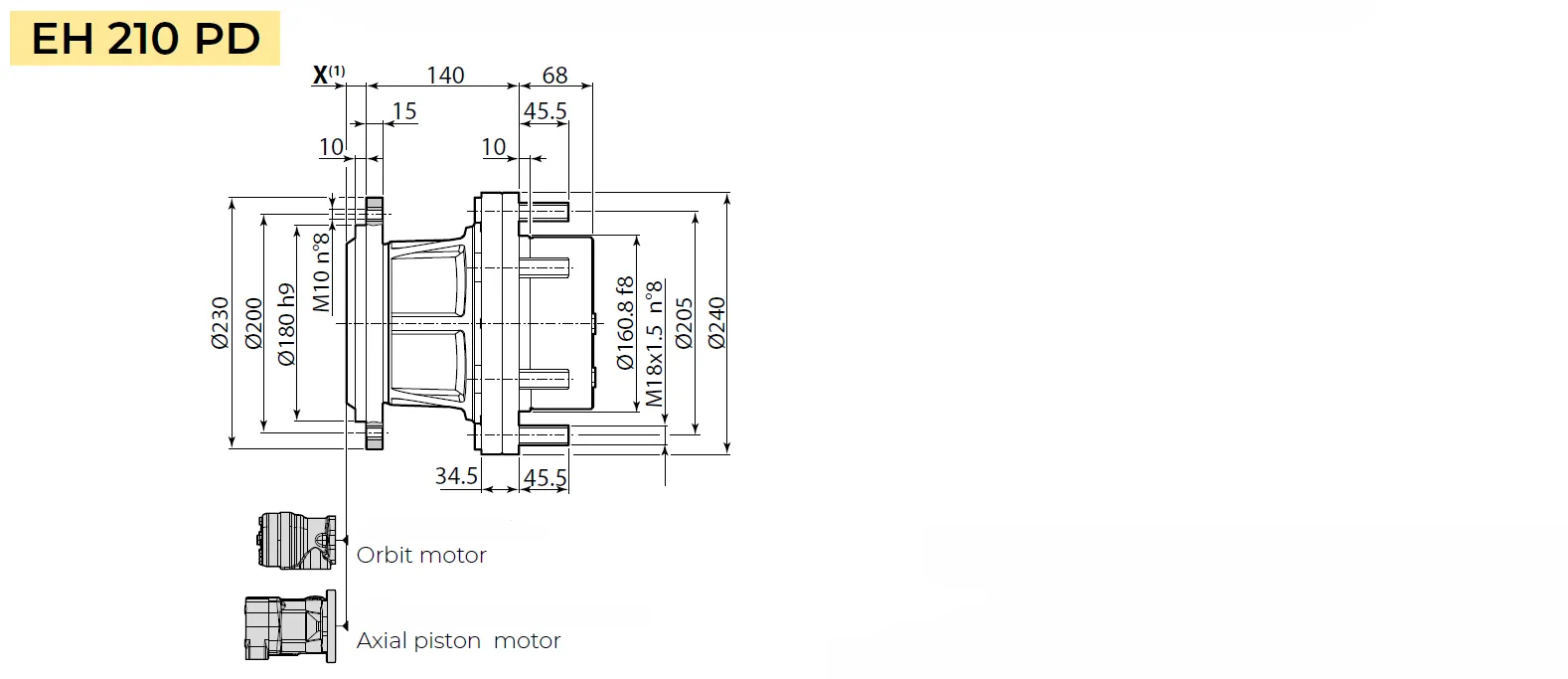
| Type | Weight | Oil quantity | i (da÷a / From÷to) | T2max [Nm] | n1max [rpm] | ||||
| EH 212 | EH 213 | EH 212 | EH 213 | EH 212 | EH 213 | ||||
| EH 210 S | 35 | 40 | 0.8 | 1 | 11 ÷ 29 | 41 ÷ 129 | 3950 | 3500 | |
| EH 210 SC | |||||||||
| EH 210 PD | - | - | |||||||
EH 240
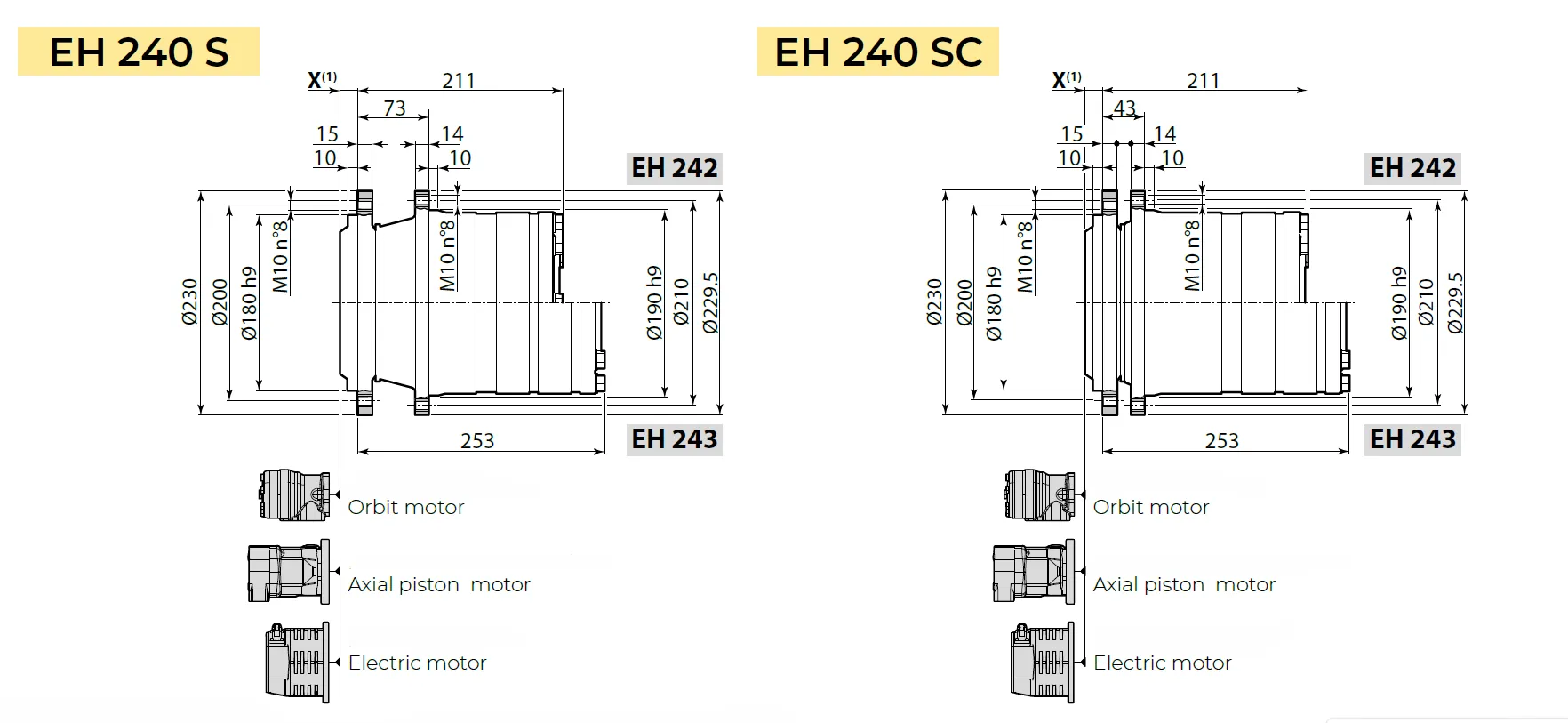
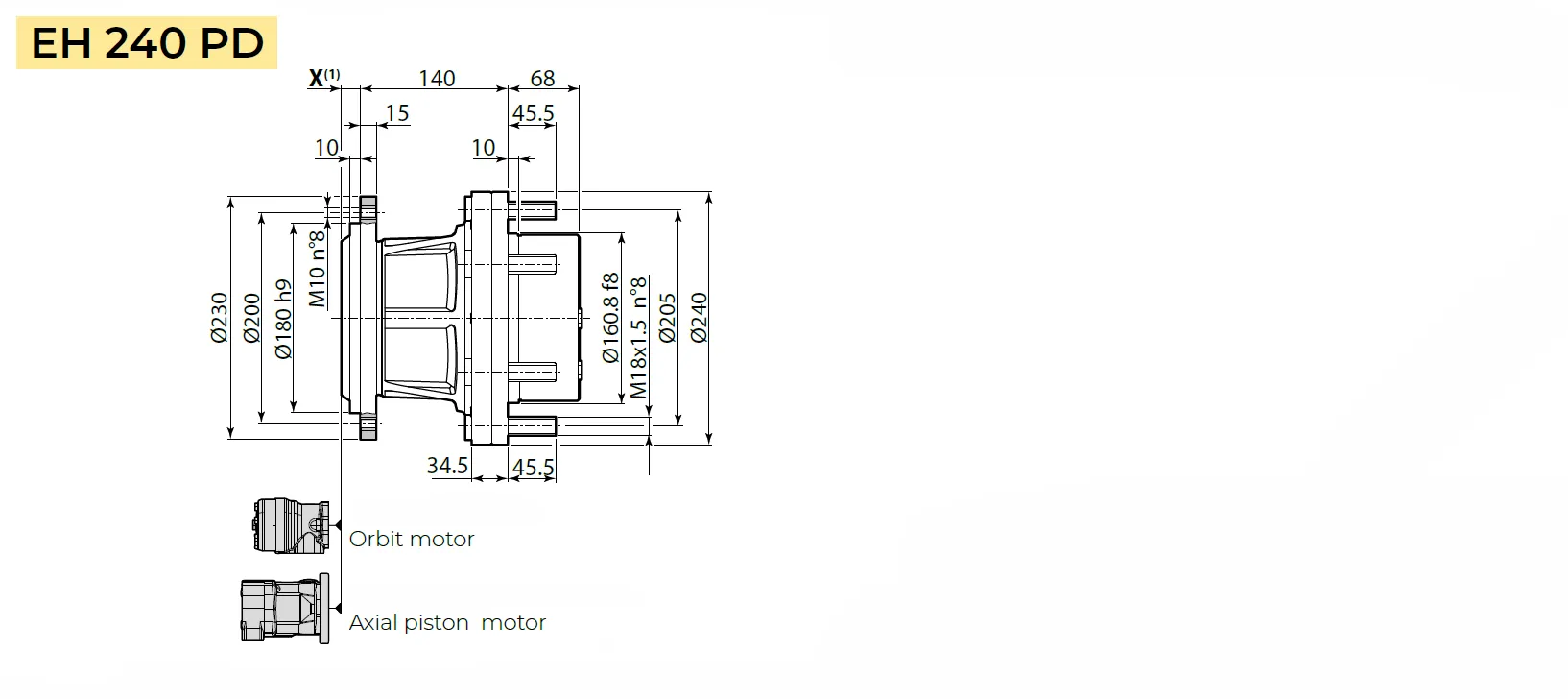
| Type | Weight | Oil quantity | i (da÷a / From÷to) | T2max [Nm] | n1max [rpm] | ||||
| EH 242 | EH 243 | EH 242 | EH 243 | EH 242 | EH 243 | ||||
| EH 240 S | 35 | 40 | 0.8 | 1 | 12 ÷ 31 | 45 ÷ 135 | 5600 | 3500 | |
| EH 240 SC | |||||||||
| EH 240 PD | - | - | |||||||
EH 350
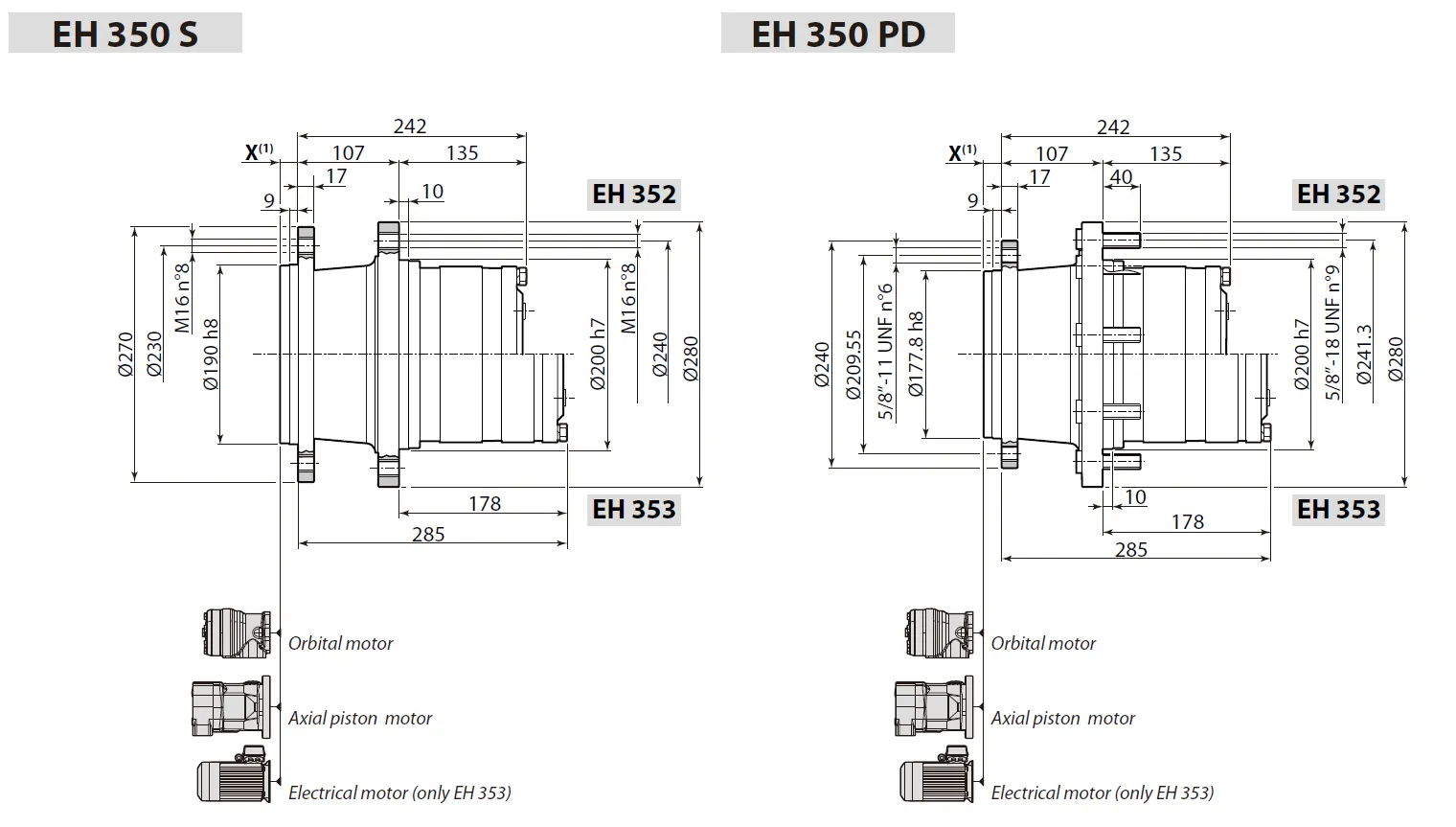
| Type | Weight | Oil quantity | i (da÷a / From÷to) | T2max [Nm] | n1max [rpm] | ||||
| EH 352 | EH 353 | EH 352 | EH 353 | EH 352 | EH 353 | ||||
| EH 350 S | 55 | 60 | 1 | 1.2 | 15 ÷ 31 | 52 ÷ 135 | 7200 | 3500 | |
| EH 350 PD | |||||||||
EH 610
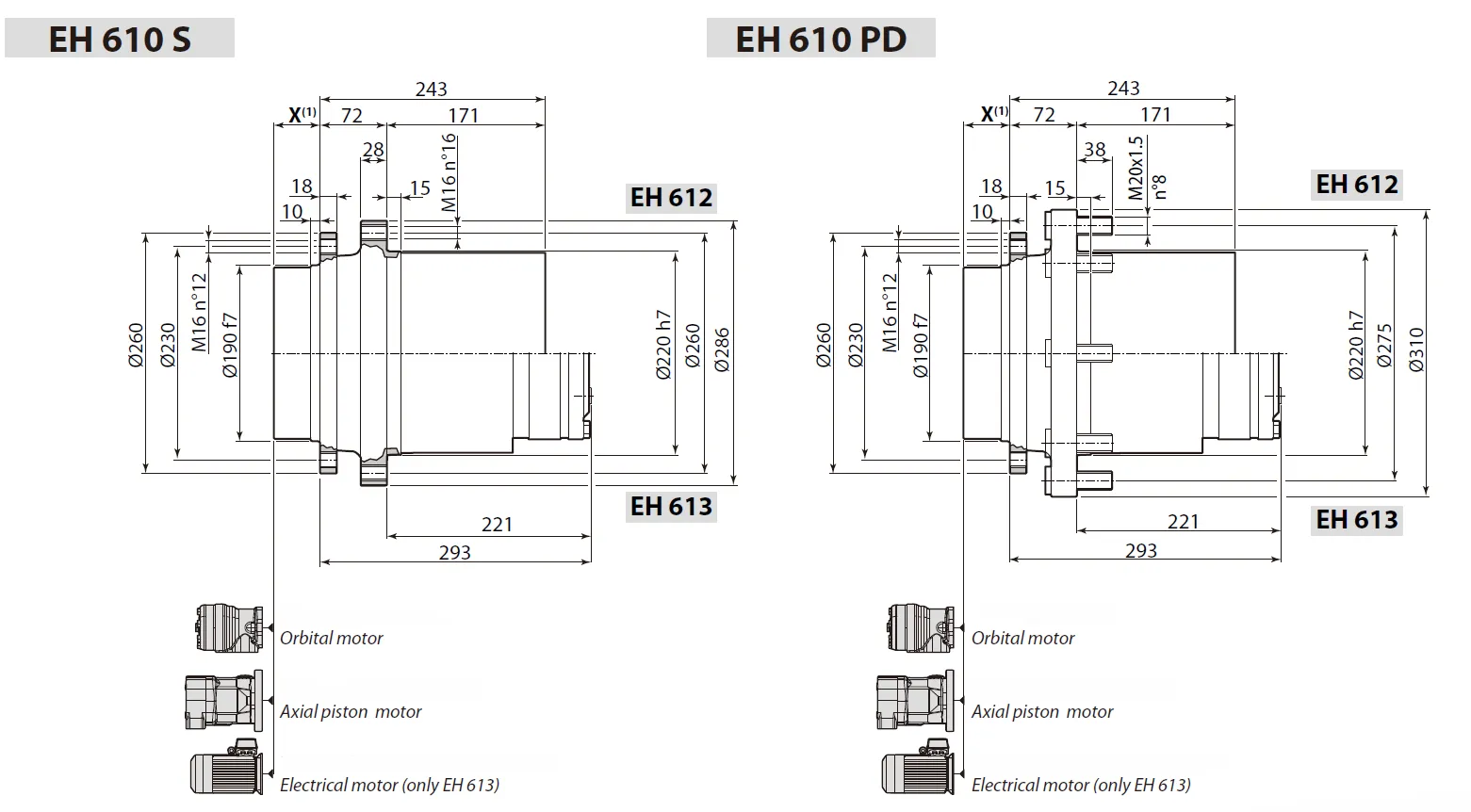
| Type | Weight | Oil quantity | i (da÷a / From÷to) | T2max [Nm] | n1max [rpm] | ||||
| EH 612 | EH 613 | EH 612 | EH 613 | EH 612 | EH 613 | ||||
| EH 610 S | 60 | 70 | 1.2 | 1.5 | 12 ÷ 31 | 47 ÷ 138 | 13500 | 3500 | |
| EH 610 PD | |||||||||
EH 910
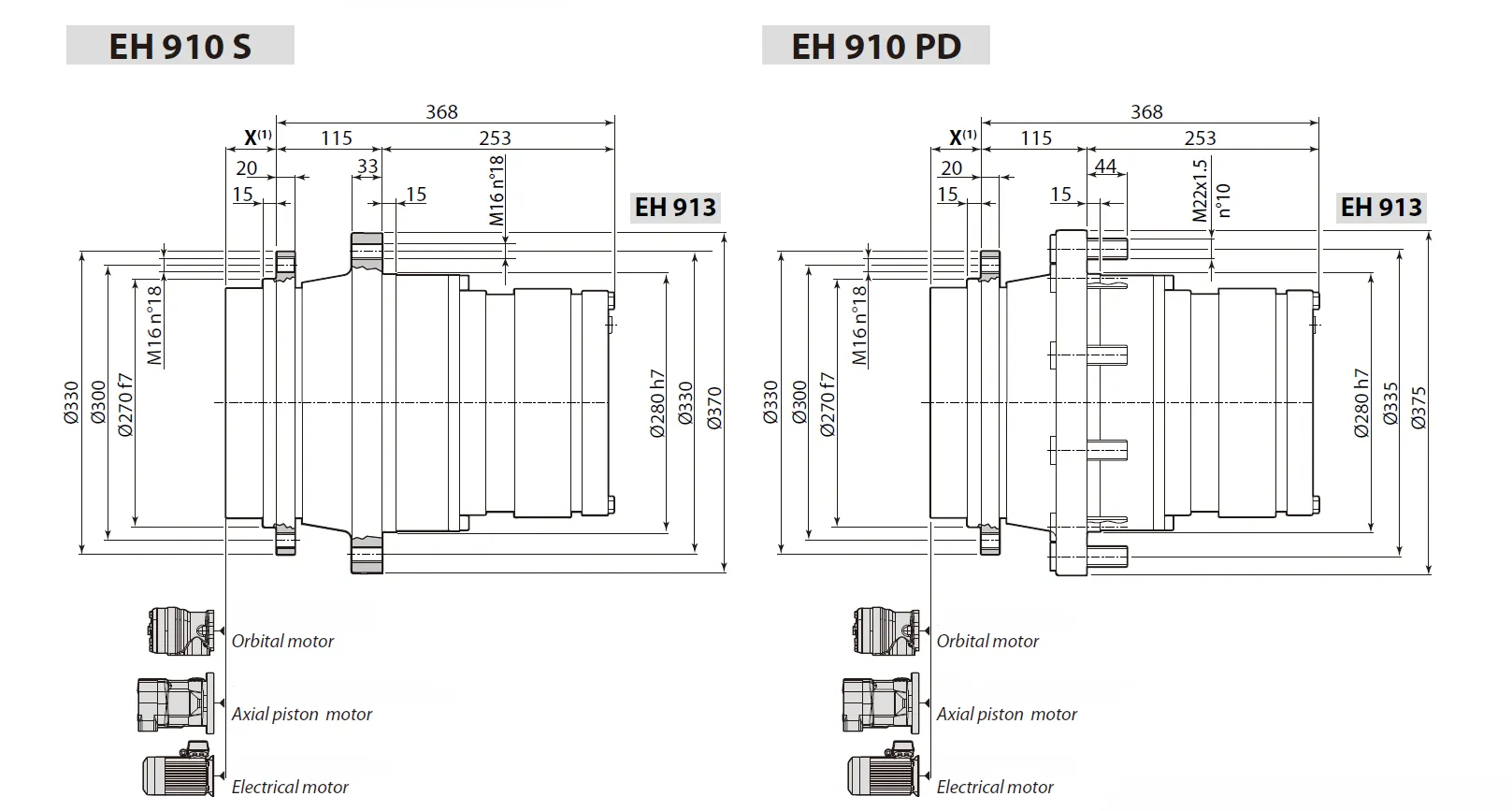
| Type | Weight | Oil quantity | i (da÷a / From÷to) | T2max | n1max | |
| EH 913 | EH 913 | EH 913 | [Nm] | [rpm] | ||
| EH 910 S | 130 | 1 | 47 ÷ 131 | 24200 | 3500 | |
| EH 910 PD | ||||||
S Version

| Size | Dimensions | ||||||||||
| D1 | D2 | D3 | D4 | D5 | D6 | D7 | D8 | L1 | L2 | L3 | |
| EH 210 S | 230 | 200 | 180 h9 | 190 h9 | 210 | 229.5 | M10 n°8 | M10 n°8 | 253 | 73 | 180 |
| EH 240 S | 230 | 200 | 180 h9 | 190 h9 | 210 | 229.5 | M10 n°8 | M10 n°8 | 253 | 73 | 180 |
| EH 350 S | 270 | 230 | 190 h8 | 200 h7 | 240 | 280 | M16 n°8 | M16 n°8 | 242 | 107 | 178 |
| EH 610 S | 260 | 230 | 190 f7 | 220 h7 | 260 | 286 | M16 n°12 | M16 n°16 | 243 | 72 | 171 |
| EH 910 S | 330 | 300 | 270 f7 | 280 h7 | 350 | 370 | M16 n°18 | M16 n°18 | 368 | 115 | 253 |
PD Version
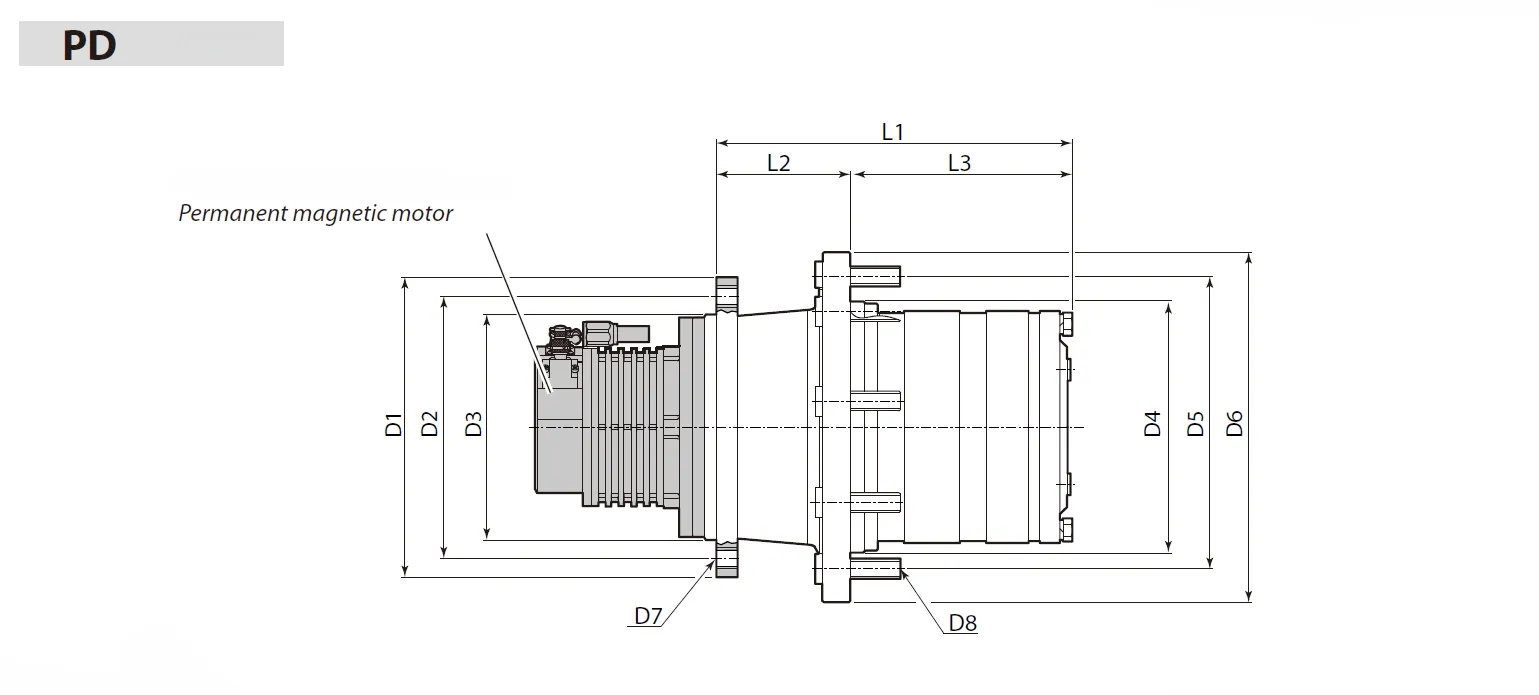
| Size | Dimensions | ||||||||||
| D1 | D2 | D3 | D4 | D5 | D6 | D7 | D8 | L1 | L2 | L3 | |
| EH 210 PD | 230 | 200 | 180 h9 | 160.8 f8 | 205 | 240 | M10 (8x) | M18x1.5 (6x) | 210 | 140 | 70 |
| EH 240 PD | 230 | 200 | 180 h9 | 160.8 f8 | 205 | 240 | M10 (8x) | M18x1.5 (6x) | 210 | 140 | 70 |
| EH 350 PD | 240 | 209.55 | 177.8 h8 | 200 h7 | 241.3 | 280 | 5/8"-11 UNC (6x) | 5/8"-19 UNF (9x) | 285 | 107 | 178 |
| EH 610 PD | 260 | 230 | 190 f7 | 220 h7 | 275 | 310 | M16 (12x) | M20x1.5 (8x) | 293 | 72 | 221 |
| EH 910 PD | 330 | 300 | 270 f7 | 280 h7 | 335 | 375 | M16 (18x) | M22x1.5 (10x) | 368 | 115 | 253 |
Telescopic Boom Lift Planetary Wheel Drive Gearbox Features
1. High Torque Multiplication and Output Capability
Planetary wheel drive gearboxes excel in delivering substantial torque multiplication through their epicyclic gear configuration, which is essential for powering heavy-duty telescopic boom lifts during lifting and propulsion tasks on challenging surfaces. This feature ensures reliable performance under high loads, enhancing operational efficiency in construction and maintenance applications.
2. Wide Range of Reduction Ratios
These planetary gearboxes offer versatile gearing arrangements with reduction ratios, allowing customization for diverse speed and torque requirements in telescopic boom lifts. Such flexibility supports various industrial uses, from precise low-speed maneuvers to high-speed travel, optimizing machine adaptability across different work environments.
3. Enhanced Stability and Traction on Uneven Terrains
Designed for integration with four-wheel drive systems, wheel drive planetary gearboxes provide stable traction and load handling, particularly on rough or sloped grounds, by incorporating oscillating axles and planetary reduction gears. This contributes to safer operations and improved machine balance during extension and rotation of the boom.
4. Compact and Durable Construction for Heavy Applications
Featuring high-strength gears and hubs, these planetary gear reducers are built compactly to withstand the rigorous demands of telescopic boom lifts, including exposure to extreme conditions and heavy payloads. Their robust design minimizes wear, extends service life, and supports seamless integration into wheel or track drives without compromising overall equipment footprint.
5. Efficient Speed Reduction and Rotary Force Generation
By utilizing a planetary gear system, the planetary wheel drive effectively reduces wheel motor speed while amplifying rotary force, which is crucial for controlled movement in aerial work platforms. This efficiency leads to lower energy consumption, reduced operational costs, and smoother performance in hydrostatic drive setups commonly found in boom lifts.
Applications of Planetary Wheel Drives
1. Construction Equipment
Wheel drive planetary gearboxes are extensively utilized in construction machinery such as excavators, loaders, and telescopic boom lifts to provide high torque and precise speed reduction for propulsion on uneven terrains. Their compact design ensures efficient power transmission, enhancing machine stability and load-handling capabilities during heavy-duty operations like digging, lifting, and material transport in demanding job sites.
2. Agricultural Machinery
In agricultural applications, these planetary gearboxes drive wheels in tractors, harvesters, and sprayers, delivering robust torque multiplication to navigate soft soils and slopes while maintaining operational efficiency. This facilitates reliable performance in crop management tasks, reducing downtime and improving productivity across large farmlands under varying environmental conditions.
3. Automated Guided Vehicles (AGVs)
Planetary wheel drive gearboxes are integral to AGVs in warehouses and manufacturing facilities, enabling smooth, high-precision wheel hub propulsion for automated material transport. They support compact integration with electric motors, ensuring low-noise operation and extended service life in logistics environments requiring continuous, reliable mobility.
4. Heavy Trucks and Buses
These planetary gear reducers are employed in the wheel hubs of heavy trucks and buses to achieve significant torque amplification and speed control, optimizing fuel efficiency and handling on highways and urban routes. Their durable construction withstands high loads, contributing to safer and more economical transportation in commercial fleets.
5. Mining and Earthmoving Equipment
In mining operations, wheel drive gearboxes power wheeled vehicles like dump trucks and drills, providing exceptional torque for hauling heavy payloads over rugged landscapes. This application enhances equipment reliability, minimizes maintenance needs, and supports continuous extraction processes in harsh, abrasive environments.
6. Material Handling Systems
Utilized in forklifts, conveyors, and cranes, these planetary wheel drives facilitate controlled wheel drives for precise maneuvering and lifting in industrial settings. They offer high efficiency and compactness, improving workflow in warehouses and production lines by ensuring stable, energy-efficient movement of goods.
 | 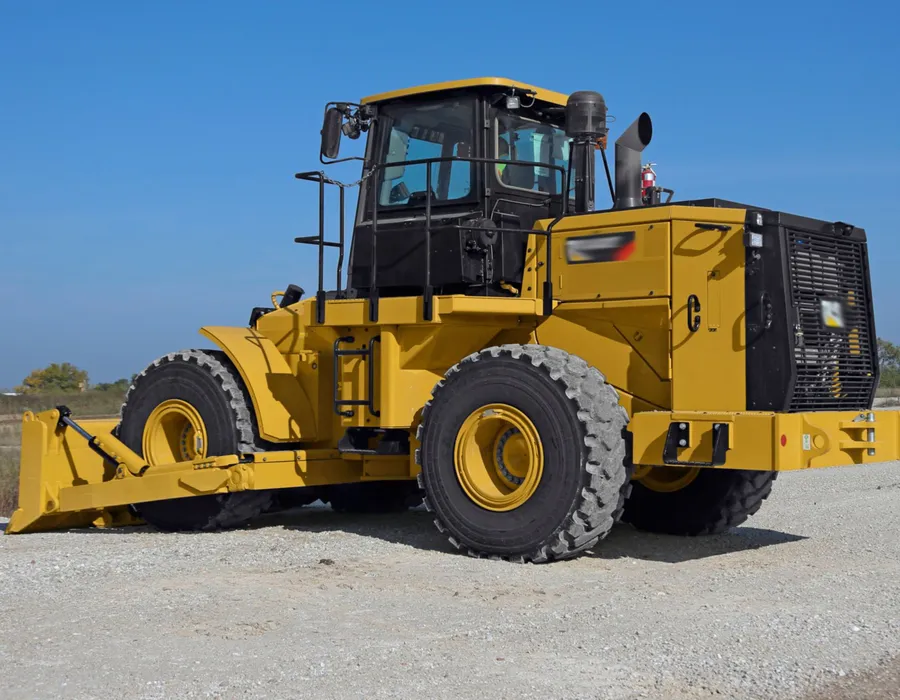 |
| Planetary Wheel Drive for Boom Sprayers | Planetary Wheel Drive for Wheel Dozers |
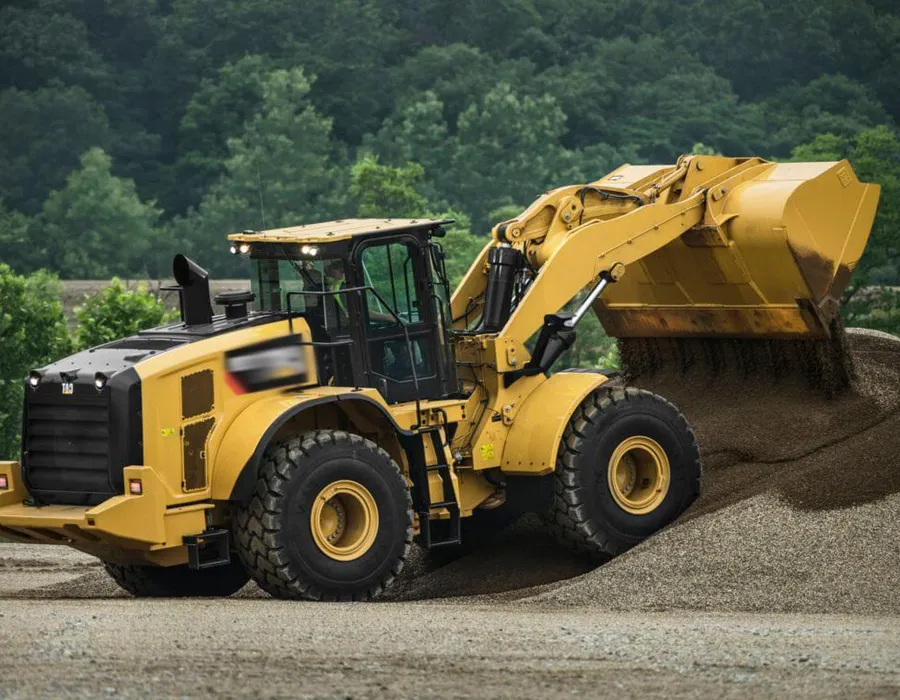 | 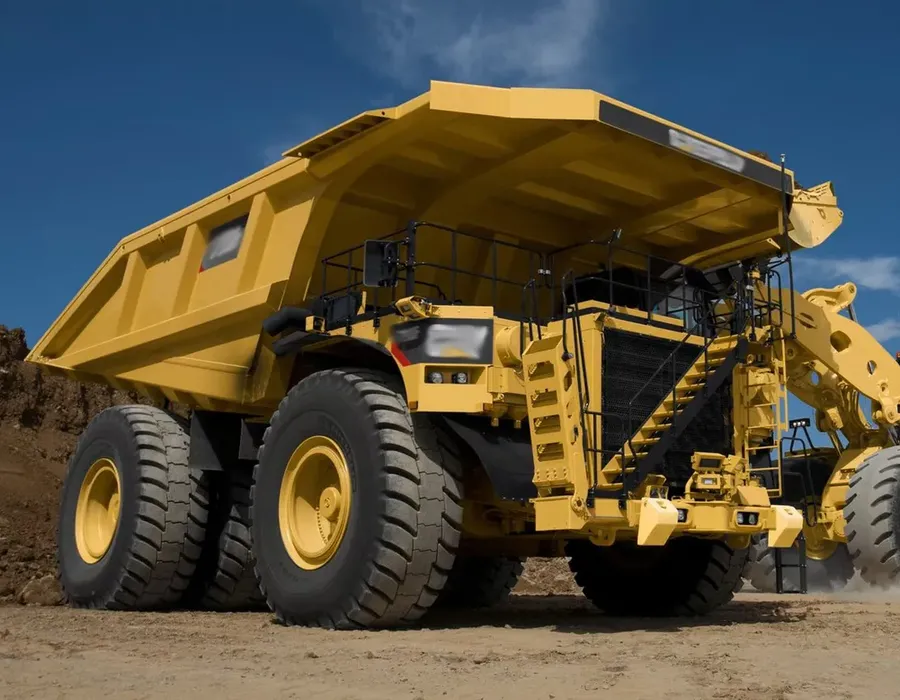 |
| Planetary Wheel Drive for Wheel Loaders | Planetary Wheel Drive for Mining Dump Trucks |
Wheel Drive Planetary Gearbox Manufacturing Process
1. Raw Material Preparation
The manufacturing process begins with procuring high-quality metals such as cast iron, alloy steel, or stainless steel, followed by rigorous quality inspections to eliminate impurities and preliminary cutting to form blanks approximating the required shapes and dimensions for components like planetary carriers and gears.
2. Forging and Casting Forming
Essential components, including planetary carriers, sun gears, and inner gear rings, are shaped through forging by heating metals at high temperatures and applying hammering or pressing forces, while casting is employed for larger or intricate structures to achieve precise preliminary forms.
3. Rough Machining Operations
Utilizing CNC machine tools, the forged or cast blanks undergo turning, milling, and drilling to remove excess material, establishing basic contours, structural features, and elements such as inner and outer cylindrical surfaces, planes, keyways, and threaded holes for gearbox assembly.
4. Initial Heat Treatment
Post-rough machining, parts receive normalization, annealing, or tempering treatments tailored to material properties, enhancing internal metal structures, adjusting hardness and toughness, and preparing components for subsequent precision machining to ensure durability and performance.
5. Precision Machining Techniques
Heat-treated components are subjected to grinding, honing, and gear hobbing processes, where planetary gears are shaped via hobbing, shaving, or slotting, and carriers undergo precision grinding and leveling to meet exact tooth profiles, accuracy, and surface roughness standards.
6. Secondary Heat Treatment
To bolster wear resistance in high-stress areas like gears, carburization quenching, nitriding, or surface hardening is applied, preventing premature wear and fatigue failure during prolonged operation in demanding wheel drive applications.
7. Final Precision Machining and Quality Inspection
Further grinding, polishing, and ultra-precision methods refine gears and key parts for superior accuracy and surface quality, followed by comprehensive inspections including dimensional checks, hardness testing, and non-destructive methods like magnetic particle or ultrasonic testing to detect defects such as cracks or inclusions.
8. Assembly and Performance Testing
Cleaned components are lubricated with specialized oils or greases and assembled per design specifications to ensure proper gear meshing and seal installation, culminating in rigorous testing phases encompassing no-load runs, load simulations, noise, vibration, and overall performance evaluations to confirm long-term stability under operational conditions.
Additional information
| Edited by | Yjx |
|---|