
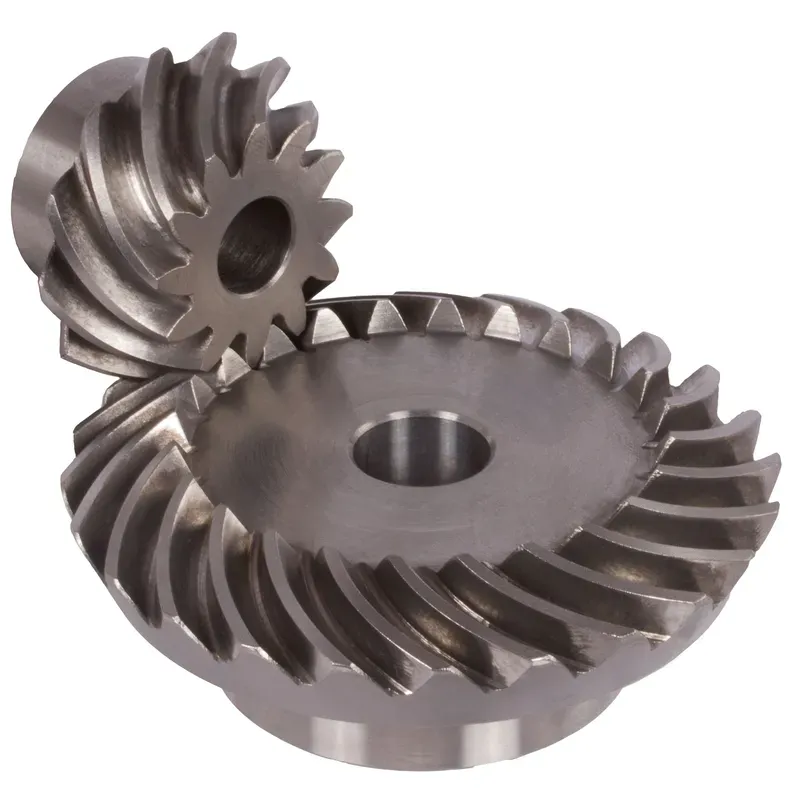
Ingranaggi conici a spirale in acciaio con rapporto 2:1 Sistema di denti a spirale
Steel spiral bevel gears with a 2:1 ratio are conical gears designed to transmit power between intersecting shafts, typically at a 90-degree angle, with a speed reduction where the driven gear rotates at half the speed of the driving gear. The spiral tooth system features curved, oblique teeth, often with a 35-degree helix angle, enabling smoother and quieter operation compared to straight bevel gears. Made from carbon or alloy steels like 42CrMo4 or 16MnCr5, these gears are heat-treated for enhanced durability and strength, ideal for high-load, high-speed applications such as automotive differentials or industrial machinery.
Steel spiral bevel gears with a 2:1 ratio are conical gears designed to transmit power between intersecting shafts, typically at a 90-degree angle, with a speed reduction where the driven gear rotates at half the speed of the driving gear. The spiral tooth system features curved, oblique teeth, often with a 35-degree helix angle, enabling smoother and quieter operation compared to straight bevel gears. Made from carbon or alloy steels like 42CrMo4 or 16MnCr5, these gears are heat-treated for enhanced durability and strength, ideal for high-load, high-speed applications such as automotive differentials or industrial machinery.
The 2:1 ratio is achieved by the driven gear having twice the number of teeth as the pinion, ensuring efficient torque transfer. Their design minimizes vibration, increases contact ratio, and requires robust bearings to handle axial thrust loads.
Ingranaggio conico a spirale in acciaio Rapporto 2:1
| 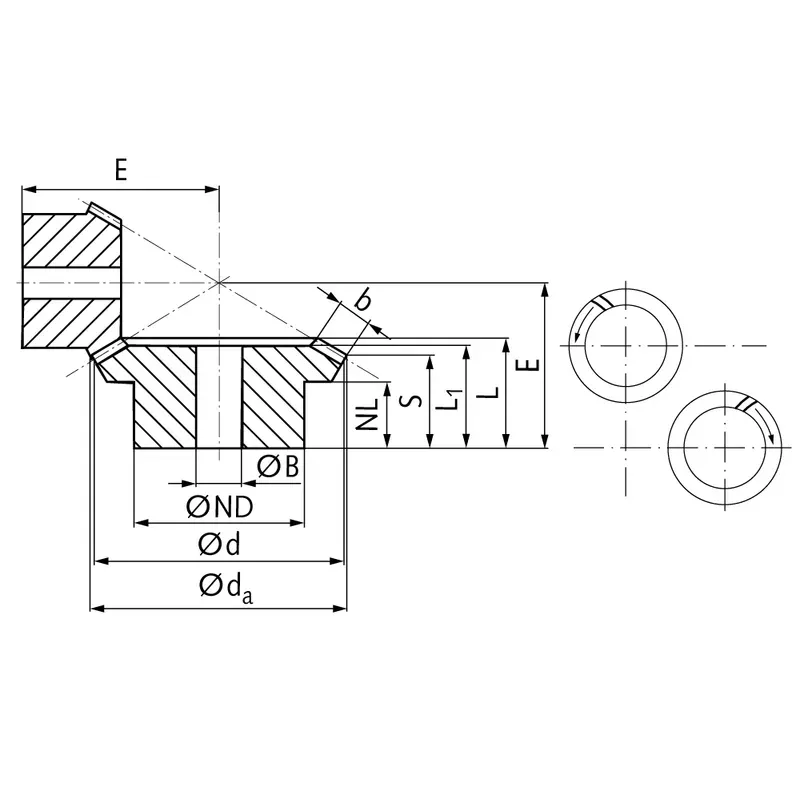 |
| Modulo | Numero di denti | dUN | d | ND | Paesi Bassi | L1 | L | S | b | BH7 | E | Coppia* | Peso |
| mm | mm | mm | mm | mm | mm | mm | mm | mm | mm | Ncm | g | ||
| 0,6 | 22 | 20,8 | 19,8 | 16 | 7,4 | 15 | 15,6 | 8,5 | 8 | 6 | 28 | 2,3 | 116 |
| 0,6 | 44 | 40,1 | 39,6 | 25 | 8 | 15 | 17,2 | 13,6 | 8 | 10 | 23 | 4,6 | 116 |
| 1 | 20 | 31,8 | 30 | 25 | 8 | 19 | 20,2 | 9,4 | 12 | 8 | 39 | 9,8 | 323 |
| 1 | 40 | 60,9 | 60 | 40 | 8 | 18 | 21,2 | 15,9 | 12 | 12 | 30 | 19,6 | 323 |
| 1,3 | 16 | 34,4 | 32 | 25 | 7 | 20 | 22,1 | 9,6 | 14 | 8 | 41 | 12,0 | 397 |
| 1,3 | 32 | 65,1 | 64 | 40 | 8 | 20 | 23,3 | 17,1 | 14 | 12 | 32 | 24,0 | 397 |
| 1,5 | 16 | 38,0 | 35,2 | 30 | 8,4 | 19 | 21,2 | 10,5 | 12 | 10 | 45 | 14,4 | 435 |
| 1,5 | 32 | 71,7 | 70,4 | 45 | 8 | 17 | 21,0 | 15,7 | 12 | 12 | 32 | 28,8 | 435 |
| 2,269 | 12 | 44,0 | 41,5 | 30 | 12 | 28,23 | 28,23 | 17,6 | 15 | 12 | 55 | 10,1 | 846 |
| 2,269 | 24 | 83,0 | 83 | 50 | 15 | 27 | 32,41 | 26,0 | 15 | 16 | 45 | 20,2 | 846 |
| 2,321 | 13 | 47,0 | 45 | 30 | 15 | 30 | 33,0 | 21,7 | 15 | 10 | 63,65 | 49 | 818 |
| 2,321 | 26 | 91,0 | 90 | 40 | 22 | 30 | 35,5 | 29,8 | 15 | 16 | 50 | 98 | 818 |
| 2,5 | 11 | 57,0 | 52,5 | 40 | 15 | 36,72 | 36,72 | 19,7 | 20 | 16 | 70 | 17,8 | 2000 |
| 2,5 | 22 | 106,0 | 105 | 70 | 20 | 39 | 44,65 | 35,8 | 20 | 20 | 60 | 35,6 | 2000 |
| 2,5 | 13 | 59,0 | 56 | 39 | 15 | 34 | 38,37 | 22,9 | 20 | 16 | 75,13 | 95 | 1400 |
| 2,5 | 26 | 113,0 | 112 | 54 | 21 | 30 | 37,72 | 29,0 | 20 | 25 | 55 | 190 | 1400 |
| 3 | 13 | 68,0 | 64 | 45 | 16 | 37 | 41,95 | 24,9 | 22 | 20 | 84,62 | 133 | 2000 |
| 3 | 26 | 128,0 | 128 | 54 | 20 | 32 | 39,9 | 30,6 | 22 | 25 | 60 | 266 | 2000 |
| 3 | 14 | 76,0 | 72,5 | 55 | 25 | 51,46 | 51,46 | 32,0 | 25 | 20 | 100 | 644 | 4800 |
| 3 | 28 | 146,0 | 145 | 90 | 25 | 50 | 57,1 | 46,2 | 25 | 30 | 80 | 128 | 4800 |
| 3,5 | 13 | 77,0 | 72 | 54 | 12 | 34 | 39,8 | 21,1 | 24 | 20 | 88,38 | 197 | 2800 |
| 3,5 | 26 | 146,0 | 144 | 64 | 25 | 38 | 47,1 | 36,5 | 24 | 30 | 70 | 394 | 2800 |
Diversi tipi di ingranaggi conici
Ingranaggi conici dritti
Gli ingranaggi conici a denti dritti sono il tipo più semplice di ingranaggi conici, con denti dritti paralleli alla generatrice del cono primitivo. Sono utilizzati in applicazioni in cui sono presenti velocità elevate e carichi medio-bassi. Tuttavia, gli ingranaggi conici a denti dritti possono generare più rumore rispetto ad altri tipi di ingranaggi conici a causa dell'innesto improvviso dei denti.
Ingranaggi conici a spirale
Gli ingranaggi conici a spirale presentano denti curvi e obliqui rispetto alla generatrice del cono primitivo. L'angolo di inclinazione dei denti garantisce un innesto graduale e fluido, con conseguente funzionamento più silenzioso e maggiore capacità di carico rispetto agli ingranaggi conici dritti. Gli ingranaggi conici a spirale sono comunemente utilizzati nei differenziali automobilistici e in applicazioni industriali che richiedono velocità elevate e carichi pesanti.
Ingranaggi conici ipoidi
Gli ingranaggi conici ipoidi sono simili agli ingranaggi conici a spirale, ma con una differenza notevole: i coni primitivi degli ingranaggi non si intersecano. Invece, gli assi degli ingranaggi sono sfalsati, consentendo diametri del pignone maggiori e un migliore contatto dei denti. Questa configurazione sfalsata offre diversi vantaggi, come una maggiore capacità di coppia, una minore rumorosità e design più compatti. Gli ingranaggi ipoidi sono frequentemente utilizzati negli assali posteriori delle automobili e nei cambi industriali.
Ingranaggi conici Zerol
Gli ingranaggi conici Zerol sono un caso speciale di ingranaggi conici a spirale, in cui l'angolo di spirale è zero. Ciò significa che i denti sono paralleli all'asse di rotazione, in modo simile agli ingranaggi conici dritti. Tuttavia, a differenza degli ingranaggi conici dritti, gli ingranaggi conici Zerol presentano un profilo dei denti curvo che consente un innesto fluido e graduale. Gli ingranaggi conici Zerol offrono un equilibrio tra i vantaggi degli ingranaggi conici dritti e di quelli a spirale, garantendo una migliore capacità di carico e un funzionamento più silenzioso rispetto agli ingranaggi conici dritti.
Ingranaggi obliqui
Miter gears are a specific type of bevel gear where the number of teeth on both gears is equal, and the shaft angle is 90°. This configuration results in a 1:1 gear ratio, making miter gears ideal for applications that require a change in the direction of rotation without altering the speed or torque. Miter gears can have straight, spiral, or Zerol teeth.
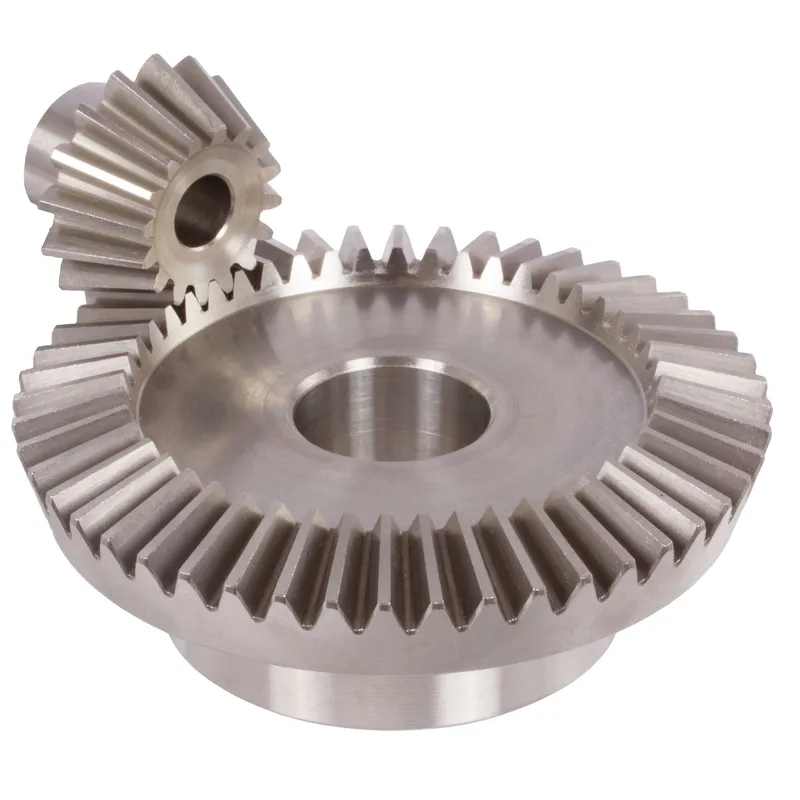 | 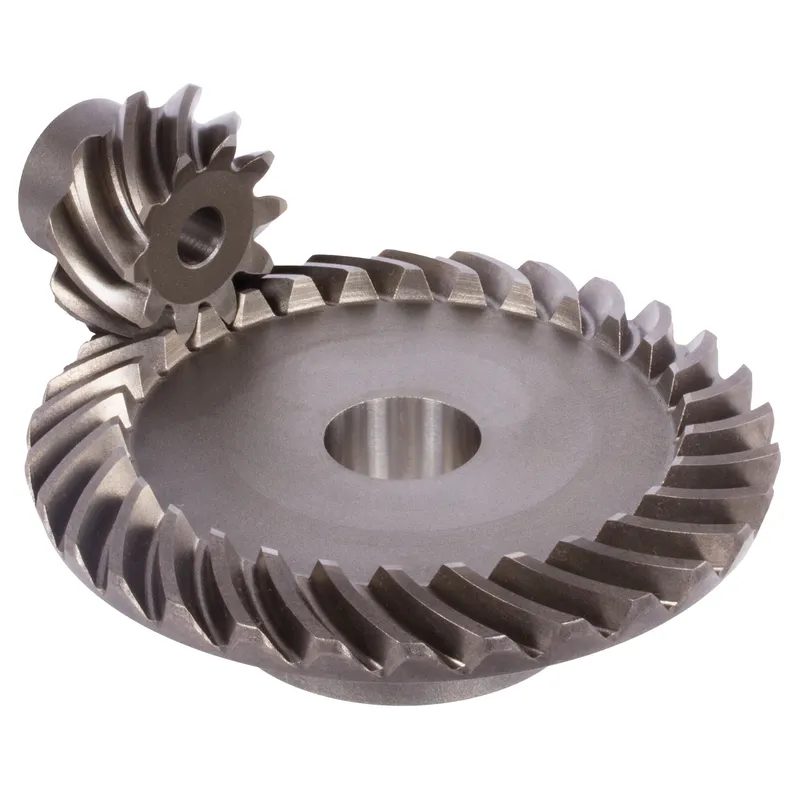 |
| Ingranaggi conici dritti | Ingranaggi conici a spirale |
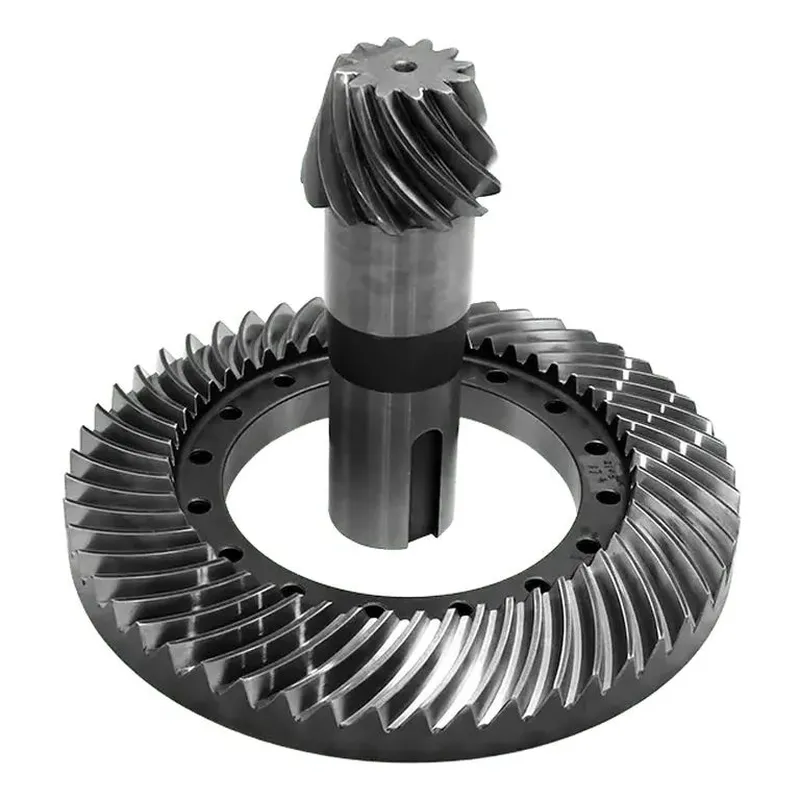 | 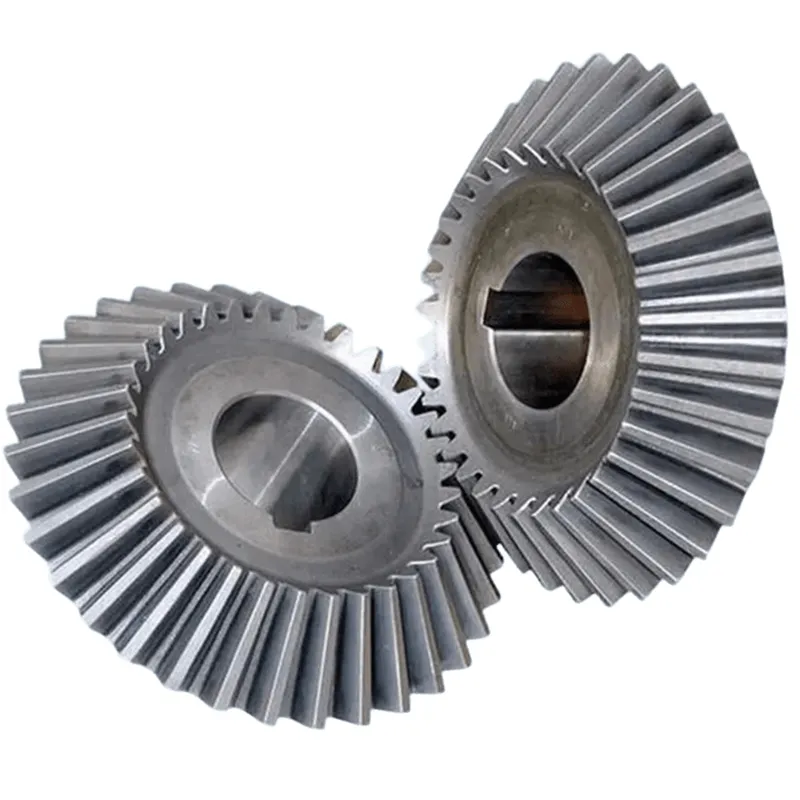 |
| Ingranaggi conici ipoidi | Ingranaggi conici Zerol |
Applicazioni degli ingranaggi conici a spirale
1. Differenziali automobilistici
Spiral bevel gears are widely used in automotive differentials to transmit torque from the driveshaft to the wheels while allowing the wheels to rotate at different speeds. Their smooth operation and quiet performance make them ideal for high-speed vehicles and heavy-duty trucks.
2. Industrial Machinery
In heavy-duty industrial machines such as conveyors, crushers, and mixers, spiral bevel gears ensure efficient power transmission between perpendicular shafts. Their ability to handle high torque loads with minimal vibration makes them suitable for applications requiring reliable and long-lasting operation under constant stress.
3. Aerospace Systems
Spiral bevel gears are integral to aerospace applications such as helicopter transmission systems and jet engines. They ensure precise and smooth power transfer in compact spaces while withstanding extreme conditions like high temperatures, heavy loads, and demanding operational environments, ensuring safety and reliability.
4. Marine Propulsion Systems
In marine applications, spiral bevel gears are used in propulsion systems to transfer power from engines to propellers. Their smooth engagement and high torque capacity allow for efficient power delivery, ensuring reliable performance in harsh environments, including prolonged exposure to saltwater and vibration.
5. Power Tools and Robotics
Spiral bevel gears are common in high-performance power tools and robotic systems where compact design and precision are essential. Their ability to transmit power smoothly in small spaces ensures accuracy and durability, especially in applications requiring continuous operation or varying load conditions.
6. Wind Turbines
Spiral bevel gears are used in wind turbine gearboxes to transfer rotational energy from the blades to the generator. Their smooth operation enhances energy efficiency, while their robust design ensures they can endure high torque loads and fluctuating wind conditions over extended periods.
 |  |
| Ingranaggi conici per l'industria automobilistica | Ingranaggio conico per robotica |
 | 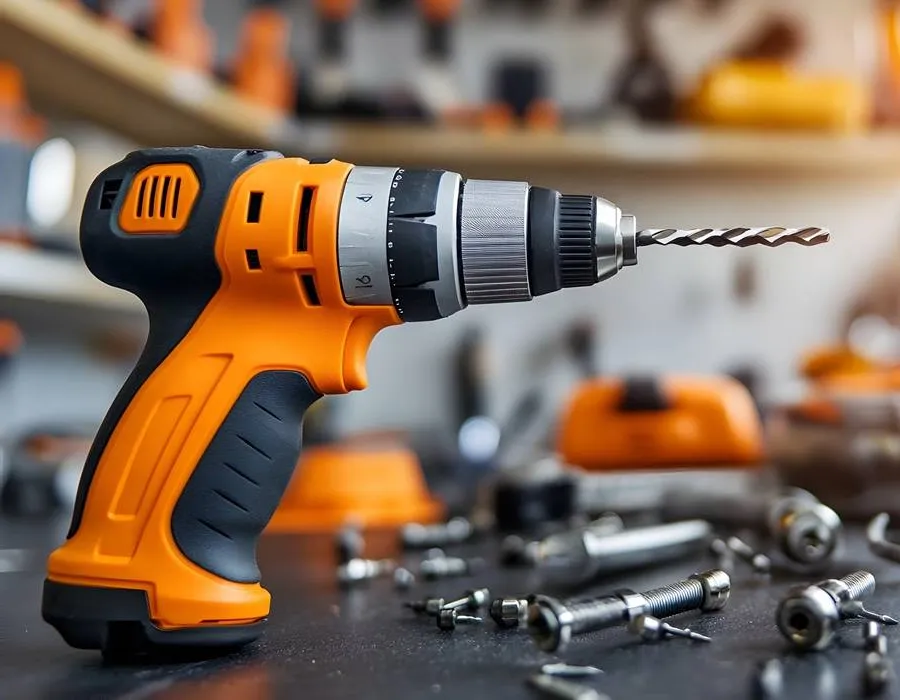 |
| Ingranaggi conici per l'industria marina | Ingranaggi conici per utensili elettrici |
Informazioni aggiuntive
| A cura di | Yjx |
|---|
Prodotti correlati
-
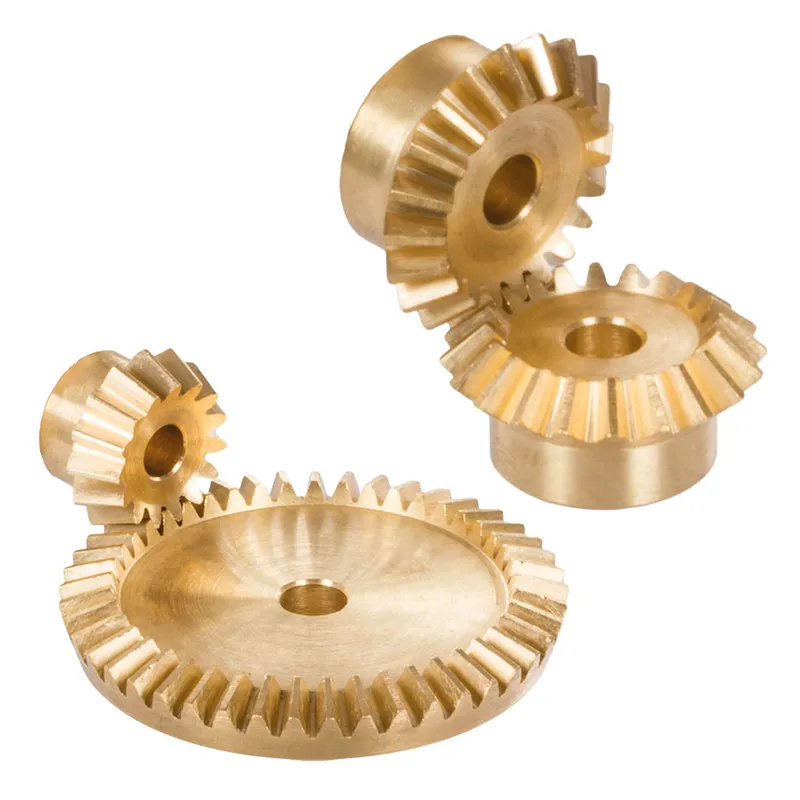
Brass Bevel Gears Ratio 1:1 – 4:1 Straight-Tooth System
-
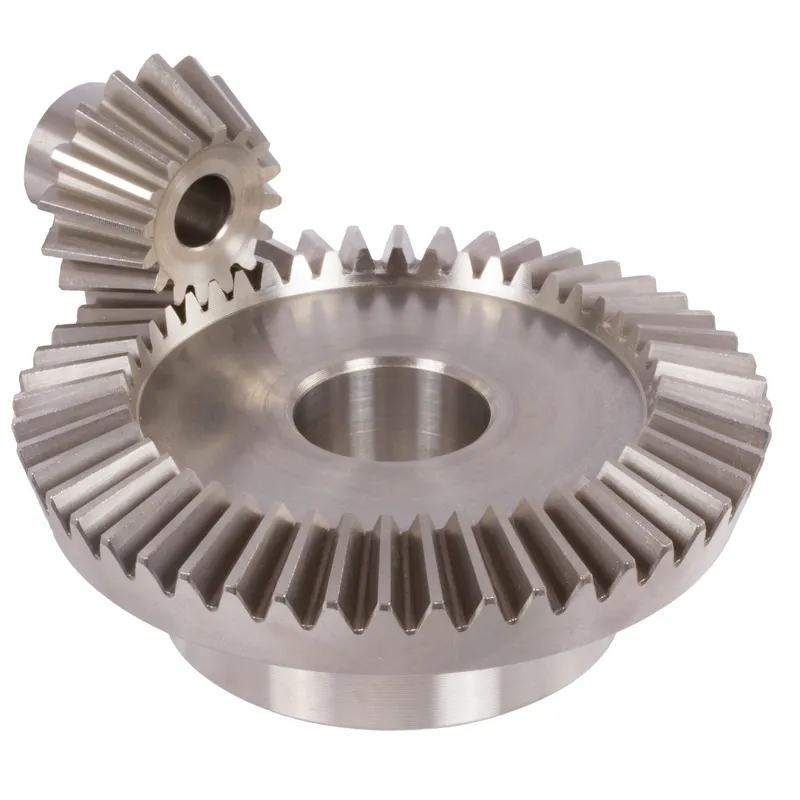
Stainless Steel Bevel Gears Ratio 1:1 Straight-Tooth System
-
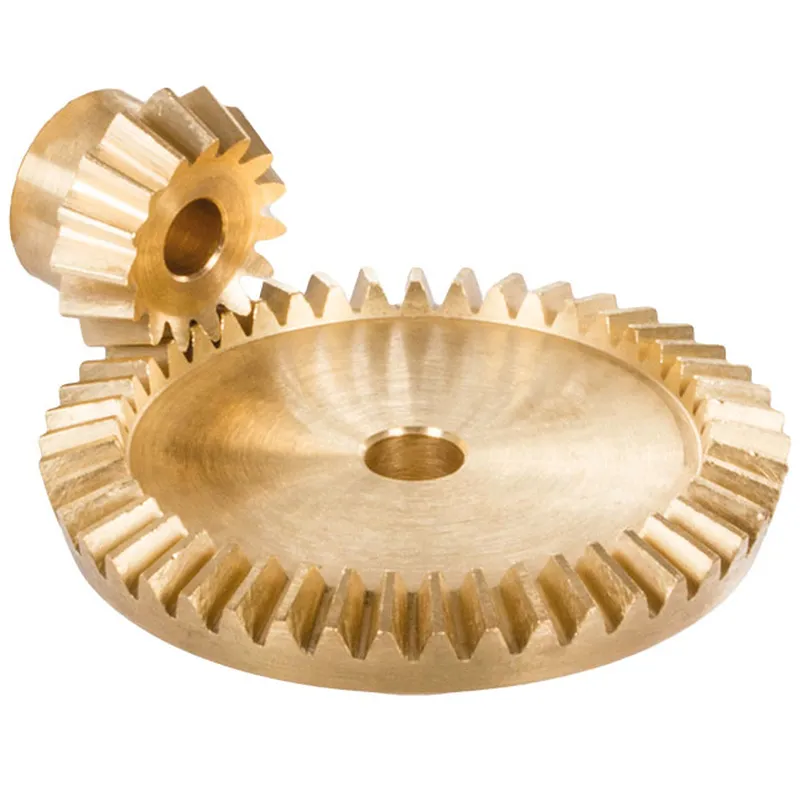
Ingranaggi conici in ottone con rapporto 2:1, sistema a denti dritti
-
Ingranaggi conici in acciaio inossidabile Rapporto 1:1 – 4:1 Sistema a denti dritti
-
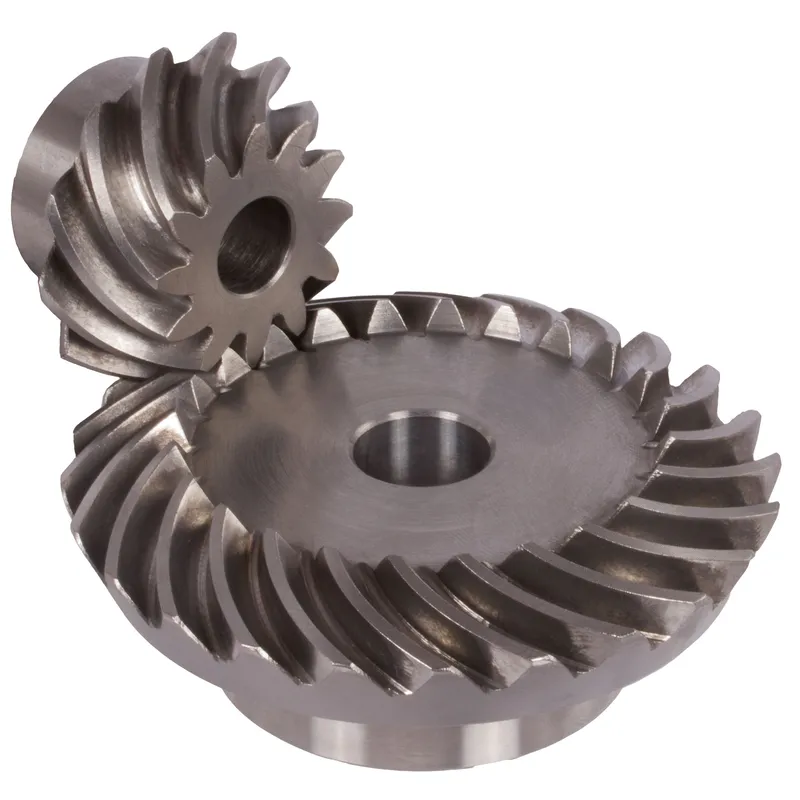
Ingranaggi conici a spirale in acciaio Rapporto 1:1 – 4:1 Sistema di denti a spirale